This site is supported by our readers. We may earn a commission, at no cost to you, if you purchase through links.
You grab the wrong tool mid-haircut and suddenly those clean lines turn into jagged disasters. It happens more than you’d think—even experienced barbers have reached for a clipper when they needed a trimmer, or vice versa.
The difference between hair clippers and trimmers isn’t just about size. Clippers pack powerful motors and wide blades built to cut through thick sections of hair fast. Trimmers use narrow blades and precision edges designed for tight spaces and detailed work.
Understanding which tool manages which job transforms your grooming results from acceptable to professional-grade sharp.
Table Of Contents
- Key Takeaways
- Hair Clippers: Purpose and Key Features
- Hair Trimmers: Design and Main Uses
- Blade Differences: Clippers Vs. Trimmers
- Performance and Power Comparison
- Accessories and Attachments Overview
- Maintenance and Longevity Tips
- Choosing The Right Tool for Your Needs
- Frequently Asked Questions (FAQs)
- Conclusion
Key Takeaways
- Clippers use powerful motors and wide blades to cut bulk hair fast, while trimmers rely on narrow blades and precision edges for detailed work in tight spaces
- Clipper blades range from 1.5–4.0 cm wide with cutting lengths of 3–25 mm, whereas trimmer blades measure 0.4–2.0 mm wide and cut as close as 0.5 mm to skin
- Motor strength differs significantly—clippers run at 6,000–10,000 RPM for thick hair removal, while trimmers operate at 5,000–7,000 RPM for controlled detailing
- You can’t effectively replace both tools with one device since hybrid models sacrifice the power needed for bulk cutting and the precision required for sharp edges
Hair Clippers: Purpose and Key Features
Hair clippers are built to cut large sections of hair quickly and efficiently. They’re your go-to tool for maintaining short haircuts and creating uniform lengths across the head.
Let’s break down how they work, what types are available, and when you’ll reach for them most.
How Hair Clippers Work
Your hair clipper’s power comes from a motor that drives a blade back and forth at high speed. One blade moves rapidly while the other stays fixed, creating the cutting action. The gap between these blades determines how short you’ll cut. Guide combs lift hair to set lengths, giving you control over your style.
Motor types affect blade efficiency and performance across different hair textures. Ensuring the accuracy of technical information is essential, much like addressing methodological flaws in scientific research.
Types of Hair Clippers (Corded Vs. Cordless)
You’ll find two main types: corded designs and cordless clippers. Corded models plug directly into outlets, delivering consistent power efficiency for extended sessions without interruption.
Cordless clipper options run on rechargeable batteries, giving you freedom to move anywhere. Battery life usually ranges from 60 to 180 minutes per charge.
Clipper motors in both styles drive the same cutting action, though cordless units may lose some torque as batteries drain.
Common Uses for Hair Clippers
Now that you’ve picked your power source, let’s explore what clippers actually do best. You’ll use a hair clipper to create uniform all-over cuts and maintain short haircuts with confidence.
These grooming tools excel at edge trimming around ears and necklines while blending different lengths for smooth fades.
Master these haircut techniques and cutting styles to handle any hair texture—clippers are your foundation for proper barber equipment safety.
Hair Trimmers: Design and Main Uses
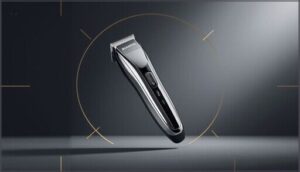
Hair trimmers are built for precision work where clippers can’t reach. They use narrower blades and smaller motors to handle detail cuts and tight spaces.
Let’s break down how they operate and where they deliver the best results.
How Hair Trimmers Work
You need precision engineering under the hood to achieve sharp, clean edges every time. A hair trimmer relies on blade oscillation powered by a small DC motor that converts electrical energy into rapid cutting action. The close-fitting blade assembly delivers accuracy for detailing work, while rechargeable batteries or direct power keep you mobile.
Trimmer safety features like protective guards minimize skin contact and maintain alignment throughout your grooming session.
Types of Hair Trimmers (Beard, Detail, Body)
When shopping for a hair trimmer, you’ll find three main categories, each designed for specific grooming needs. Beard trimmers handle full facial hair maintenance, featuring adjustable guards for even beard trimming and precision edging.
Detail trimmers excel at fine line work and detail cutting, equipped with narrow blades ideal for mustaches and sideburns.
Body grooming models are tailored for torso hair and body grooming, offering longer guards, water resistance, and skin-safe blade technology.
Areas Best Suited for Trimmers
You’ll get the best results with trimmers when precision cutting and detail work matter most. Use your beard trimmer for facial hair shaping, edge trimming along sideburns, and neckline cleanup.
Hair trimmers excel at body contour grooming in sensitive zones where hair cutting requires careful control. They’re perfect for mustache sculpting, goatee maintenance, and fixing stray hairs during hair trimming touch-ups.
Blade Differences: Clippers Vs. Trimmers
The blades are where clippers and trimmers really part ways. You’ll notice differences in size, shape, and how close they cut to the skin.
Let’s break down what sets them apart so you can pick the right tool for the job.
If you’re new to the product, this beginner’s guide to applying beard balm walks you through getting the texture and hold just right.
Blade Size and Shape Comparison
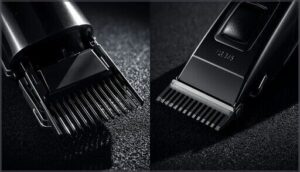
You’ll notice right away that clipper blades are built like workhorses—wider, longer, and curved to plow through bulk hair fast. Trimmers sport narrower, straight-edged blades designed for razor-sharp detail work. This isn’t just about size; it’s about control and purpose.
| Feature | Hair Clippers | Hair Trimmers |
|---|---|---|
| Blade Geometry | Wider, curved profile (1.5–4.0 cm) | Narrow, straight edge (0.4–2.0 mm) |
| Edge Sharpness | Beveled or rounded for skin safety | Fine, sharp for precision detailing |
| Cutting Angles | Offset/adjustable settings | Fixed blade geometry |
| Blade Materials | Stainless steel for durability | Ceramic-coated or self-sharpening |
| Safety Features | Rounded edges reduce irritation | Tight tolerances demand steady hands |
Clippers use clipper attachments and guard combs to deliver uniform cuts across large areas. Your trimmer thrives on close-contact work where blade materials and edge sharpness matter most. Master both tools, and you own every angle.
Cutting Lengths and Precision

Your clipper’s wider blade geometry handles longer hair lengths with ease—guards let you cruise from half-inch buzz cuts to full manes. Trimmers win on precision settings, delivering tight fades and clean edges down to stubble. Hair texture matters: coarse locks demand clipper power, while fine facial hair calls for trimmer finesse. Master both cutting techniques, and you’ll control every fade.
| Feature | Hair Clippers | Hair Trimmers |
|---|---|---|
| Typical Cutting Range | 3 mm–25 mm with guard combs | 0.5 mm–10 mm (closer to skin) |
| Precision Level | Uniform bulk removal | Fine detail and fade control |
| Best For Hair Texture | Thick, coarse, voluminous hair | Fine, short, facial hair |
| Blade Gap Settings | Adjustable (medium-long lengths) | Fixed or minimal adjustment |
| Detailing Capability | Limited edge work | Sharp lines, bevel cuts, staggered blades |
Switch tools based on the job—clipper attachments for volume, trimmers for that razor-sharp finish.
Adjustable Blades and Attachments
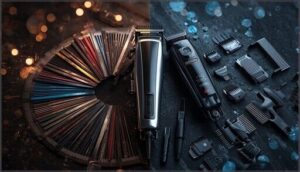
Blade adjustment separates control from chaos. Your clipper’s lever or knob shifts cutting length from 0 to 1.5 mm without swapping guards—trimmers often lock at fixed distances. Attachments expand your range: clippers pack 3–25 mm guide combs for bulk work, while trimmers carry 0.5–2 mm precision guards for tight edges. Interchangeable blades let you customize your trim buddy for any job.
| Tool Type | Adjustment Method |
|---|---|
| Hair Clippers | Lever-based, knob-style, or stepped presets |
| Trimmers | Fixed blade or micro-adjustments (0.1–0.2 mm) |
| Clipper Guards | Multiple combs (3 mm–25 mm range) |
| Trimmer Guards | Precision attachments (0.5 mm–2 mm) |
| Adjustable Guards | Replace multiple combs with continuous length control |
Performance and Power Comparison

Performance separates the tools that get the job done from the ones that waste your time. Clippers and trimmers don’t just differ in design—they pack different levels of power under the hood.
Here’s what you need to know about how each one performs when you put it to work.
Motor Strength and Efficiency
Your tool’s motor defines your freedom from pulling, tugging, and wasted time. Hair clippers pack motors ranging from 6,000 to 10,000 RPM in professional models, while trimmers run lighter at 5,000 to 7,000 RPM. Brushless motors in modern grooming devices slash heat buildup and extend battery life. Corded electric grooming devices maintain steady torque output, but cordless units may fade as voltage drops.
| Feature | Clippers | Trimmers |
|---|---|---|
| Motor Power | 6,000-10,000 RPM | 5,000-7,000 RPM |
| Torque Output | Higher, consistent | Lower, variable |
| Heat Management | Moderate buildup | Minimal heat |
| Battery Life | 60-120 minutes | 45-90 minutes |
| Efficiency Ratings | Professional-grade | Consumer-focused |
Speed and Cutting Capability
Motor power translates to real speed when you’re working through thick sections. Hair clippers tear through bulk at 3,000 to 6,000 strokes per minute, while trimmers prioritize control over raw cutting speed. Blade sharpness and hair density shape your cutting efficiency—dull edges slow you down fast. Corded grooming devices maintain consistent cutting capability, but battery-powered units may fade as charge drops.
| Tool Type | Cutting Speed | Best For |
|---|---|---|
| Clippers | 3,000-6,000 SPM | Bulk removal, fades |
| Trimmers | Lower, controlled | Detail work, edges |
| Corded Models | Constant power | Long sessions |
| Cordless Models | Variable output | Portability, quick cuts |
Noise and Vibration Levels
Your hands feel every motor hum during long sessions. Hair clippers run at 60–70 dB sound pressure levels, while trimmers sit quieter at 50–65 dB due to smaller motors. Brushless designs deliver smoother acoustic signatures with better vibration reduction. Cordless models often buzz less than corded versions. Ergonomic design with polymer dampers cuts hand fatigue. Noise measurement matters—pick lower-decibel grooming tools for comfort during extended personal grooming and hair care work.
| Feature | Clippers | Trimmers |
|---|---|---|
| Typical SPL Range | 60–70 dB | 50–65 dB |
| Vibration Profile | Higher, bulk cutting | Lower, precision work |
| Motor Type Impact | Brushless = smoother | Compact, controlled |
| Cordless Advantage | Quieter operation | Less sustained noise |
| Comfort Features | Dampening housings | Anti-vibration mounts |
Accessories and Attachments Overview
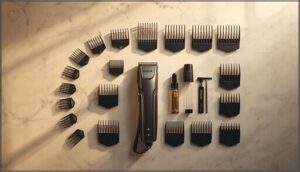
The right accessories turn a basic clipper or trimmer into a multi-purpose grooming toolkit. Clippers usually come loaded with guide combs for different lengths, while trimmers include specialized guards for precision work.
Most quality tools also pack maintenance essentials to keep your blades sharp and ready.
Guide Combs for Clippers
You control length with guide combs that snap onto your clippers. These clipper accessories range from 1 mm to 25 mm, letting you master hair cutting techniques from tight fades to longer styles.
Color-coded comb attachments make switching between clipper guard types fast. Keep your guards clean and dry—damaged teeth ruin precision cuts.
Different attachments release varied hair cutting and trimming possibilities.
Trimmer Attachments and Guards
Just like clippers, trimmers use guards to control precision. Detachable blades and trimmer combs let you execute sophisticated hair cutting techniques with surgical accuracy.
Your grooming tools deserve the right attachment types:
- Plastic shields for everyday detailing
- Stainless steel combs for durability
- Precision guards sized 1–8 mm
- Body-specific guards that minimize irritation
- Model-specific fits (check compatibility)
Guard sizes matter—clean them regularly or lose your edge.
Maintenance Tools Included
Your hair clipper and trimmers arrive with essential blade care supplies. Expect a cleaning brush, lubricating oil, and maybe a storage pouch.
These tool kits keep your grooming tools sharp and sanitary. Don’t skip the sanitizing tips in your manual—oil those blades after every session.
Smart storage solutions protect your investment. Treat maintenance like sharpening a knife: ignore it, and your attachments lose their edge fast.
Maintenance and Longevity Tips

Your clippers and trimmers won’t last if you don’t take care of them. A little regular maintenance keeps your blades sharp and your tools running smoothly for years.
Here’s what you need to do to protect your investment and maintain peak performance.
Cleaning and Oiling Blades
You’ll keep your blades sharp and ready by cleaning them after every use. Brush out trapped hair, then apply 1–2 drops of clipper oil to the teeth. Run your hair clipper or trimmer briefly to spread the lubricant evenly.
Use manufacturer-recommended oil types and avoid cooking oils.
For blade sanitizing, wipe with a lint-free cloth between grooming sessions to maintain peak performance.
Storage and Blade Replacement
Store your clippers and trimmers in a cool, dry spot away from moisture to prevent rust. Follow these steps for blade longevity:
- Keep blade guards on when not in use
- Replace blades every 12–18 months with regular grooming
- Verify blade compatibility with your model number before purchasing
- Store cleaning tools and oil nearby for quick maintenance access
Proper storage solutions extend your grooming tools’ lifespan considerably.
Preventing Wear and Damage
Your grooming tools won’t survive neglect—regular care separates pros from amateurs. Clean blades after every session to eliminate buildup causing friction and heat. Apply protective oil as manufacturers recommend for peak performance.
Here’s your damage control checklist:
| Action | Benefit |
|---|---|
| Post-use blade cleaning | Prevents oil/hair buildup wear |
| Protective oil application | Reduces corrosion and overheating |
| Dry environment storage | Stops rust formation |
Replace blades at recommended intervals to maintain cutting precision and reduce motor strain.
Choosing The Right Tool for Your Needs

You don’t need to guess which tool fits your routine. Your hair type, grooming style, and budget point you toward the right choice. Here’s how to match the tool to what you actually need.
Once you’ve narrowed down your needs, it helps to see real options side by side, like this roundup of curling irons for home use that balance safety features with everyday styling ease.
Selecting for Hair Type and Style
You can’t cut through thick, curly hair the same way you tackle fine strands—that’s where matching your tool to your hair texture matters. Hair clippers with adjustable blade settings handle textured hair and bulk removal, while trimmers deliver cut precision for detailed style options.
Assess your hair lengths and choose blade adjustment features that support your hair grooming techniques and men’s hair care routine with grooming tips that actually work.
Grooming Goals and Precision Needs
You need crisp lines on your beard, or just a quick buzz all over? Your grooming goals dictate the tool.
Hair clippers deliver speed and length control for full cuts, while a beard trimmer excels at facial detailing and precision cutting.
Match style accuracy to hair texture—fine adjustments matter when you’re chasing that sharp finish. Smart grooming device comparison keeps you on point.
Budget and Device Durability
Your cost analysis shouldn’t stop at the sticker price. Device longevity hinges on build quality—stainless steel blades outlast carbon steel, and metal housings beat plastic in durability tests. Budget options often fail faster, driving up maintenance costs through frequent blade replacements. Invest in mid-range personal grooming tools with solid warranties, and you’ll cut long-term spending on electric grooming gear while getting reliable performance from hair clippers or trimmers.
Don’t stop at sticker price—build quality and durability determine whether you save money or burn it on replacements
- Metal housings resist wear better than plastic in wet conditions
- Stainless steel blades stay sharp longer under regular use
- Lithium-ion batteries maintain capacity through hundreds of cycles
- Regular oiling and cleaning extend blade life considerably
Frequently Asked Questions (FAQs)
Can you use clippers on wet hair safely?
You shouldn’t risk it. Water becomes your enemy—corrosion, clogged blades, and electric shock all threaten safety.
Most hair clippers aren’t designed for wet conditions, so towel-dry first to protect yourself and your grooming tools.
Do trimmers work well for thick hair?
Trimmers can handle thick hair, but motor power and blade geometry matter. Heavy-duty models with wider blades cut dense growth better.
Pre-trim with hair clippers first, then use your trimmer for detailing.
How often should blades be professionally sharpened?
Most pros assess blade sharpness every two to six months, while high-volume shops accelerate sharpening intervals to every eight weeks.
Tracking cutting performance and edge geometry ensures your hair clippers and trimmers maintain professional standards.
Are expensive clippers worth the extra cost?
Premium clippers deliver stronger motors, sharper blades, and longer lifespans. User reviews confirm durability tests back the cost benefit.
Budget options work for occasional use, but professionals need that edge in grooming tool selection.
Can one device replace both tools effectively?
You can’t swap a jack-of-all-trades grooming tool for dedicated hair clippers and a trimmer.
Hybrid models sacrifice precision and power, leaving your cuts uneven and your edges rough around every corner.
Conclusion
Your tools are weapons—pick the wrong one and you’re fighting an uphill battle. Clippers bulldoze through bulk with raw power. Trimmers carve precision into tight corners where clippers can’t reach.
Understanding the difference between hair clippers and trimmers isn’t optional if you want control over your craft. Match the blade to the task. Respect the strengths of each tool. Master both and you won’t just cut hair—you’ll command every line you create.
- https://my.clevelandclinic.org/health/diseases/17722-ingrown-hair
- https://www.healthline.com/health/skin-disorders/sensitive-skin
- https://academichelpexpress.blog/2024/08/please-use-the-bulleted-points-and-the-rubric-below-to-guide-your-work-your-pa/
- https://www.sciencedirect.com/science/article/pii/S2949916X23000464