This site is supported by our readers. We may earn a commission, at no cost to you, if you purchase through links.

Most guys dump beard oil into their palms and slap it on like aftershave—then wonder why their beard still looks scraggly and feels like steel wool. The difference between a patchy, itchy mess and a beard that actually turns heads comes down to technique, not the bottle you bought.
You’re already investing time and money into grooming, but without the right application method, you’re wasting both. The skin beneath your beard needs as much attention as the hair itself, and how you distribute oil determines whether you get soft, healthy growth or just a greasy forehead.
Master the proper application sequence, nail the right amount for your beard length, and you’ll finally achieve the transformation you’ve been chasing.
Table Of Contents
Key Takeaways
- Apply beard oil right after your morning shower when pores are open for maximum absorption, working it into the skin beneath your beard first before distributing through the hair from roots to tips.
- Match your dosage to beard length—short beards need 2-3 drops, medium beards require 4-6 drops, and long beards demand 8-12 drops to avoid both dryness and greasy buildup.
- Never apply oil to a soaking wet or dirty beard since water blocks absorption by up to 30% and dirt traps oil on the surface instead of letting it penetrate where it’s needed.
- Use a wide-tooth comb or boar bristle brush after application to distribute oil evenly and prevent patchy coverage that leaves some areas dry while others get oversaturated.
Why Beard Oil is Essential
Beard oil isn’t just another grooming product you throw in your cart and forget about. It’s the foundation of a healthy, comfortable beard that actually looks good instead of feeling like a Brillo pad glued to your face.
Beard oil is the foundation of a healthy, comfortable beard that actually looks good instead of feeling like a Brillo pad glued to your face
Here’s what it does for you and why skipping it’s holding your beard back.
Hydration and Softening Benefits
Beard oil delivers deep hydration to your facial hair and the skin underneath, tackling dryness at its source. Natural carrier oils penetrate each hair shaft, boosting moisture retention and transforming coarse strands into softer, more manageable fibers.
This beard conditioning effect reduces roughness and frizz, while skin nourishment restores your natural moisture barrier—giving you a healthier, smoother beard that feels as good as it looks.
Preventing Beard Itch and Flaking
You’re done with dry, itchy facial hair. Daily beard hydration with quality beard oil prevents beard itch by maintaining your skin barrier and stopping transepidermal water loss.
When your beard absorbs oil properly, flake control becomes automatic—no more embarrassing beardruff on your shirt.
This targeted beard care approach works for any skin type, delivering real beard health without complicated routines.
Enhancing Beard Appearance and Health
Beyond itch relief, consistent beard oil application transforms your facial skin and hair follicle health. You’ll see up to 40% less frizz while boosting hair strength by 15% over eight weeks.
Beard shine improves without greasiness, and your beard texture becomes more uniform.
Regular beard care with quality essential oils fosters healthy growth cycles—giving you the commanding presence you deserve.
Choosing The Right Beard Oil

Not all beard oils are created equal. The wrong formula can leave your beard greasy, irritate your skin, or fail to deliver the results you’re after.
Here’s what you need to know to pick a product that actually works for your beard and face.
Key Natural Ingredients to Look For
Your beard oil should pack carrier oils like jojoba, argan, or sweet almond—they’re the heavy lifters that hydrate without gunking up your pores.
Look for plant derivatives rich in fatty acids and antioxidant properties, such as vitamin E or grapeseed oil.
Natural oils and essential extracts like chamomile or green tea calm irritation and protect your beard health from the roots up.
Selecting Oils for Your Skin Type
Your skin type shapes which beard oil works best. For sensitive skin or acne-prone faces, jojoba oil sits at a low comedogenic rating and won’t clog pores. Argan oil balances oily skin with linoleic acid that promotes beard hydration without heaviness. Dry skin thrives on sweet almond oil’s lightweight moisture.
Pick natural carriers that match your skin and hair health needs.
Avoiding Harsh Chemicals and Allergens
Reading labels protects your skin and hair health from hidden irritants. Many commercial beard oils contain fragrance allergens that trigger reactions in 2-4% of users, while paraben-free and sulfate-free formulas reduce risk.
Look for these markers of chemical-free products:
- Hypoallergenic formulas with disclosed natural ingredients
- Carrier oils like jojoba or argan instead of synthetic bases
- Fragrance-free labels confirming no added scents
- Patch-tested certification from independent labs
- Transparent lists showing every essential oil used
Essential oil risks include photosensitivity and irritation on sensitive faces.
When and How Often to Apply Beard Oil

Timing matters as much as technique regarding beard oil. Apply it at the wrong time or too often, and you’ll end up with a greasy mess instead of a well-groomed beard.
Here’s how to nail the schedule that works for your facial hair.
Optimal Times for Application
Timing transforms your beard care routine from ordinary to outstanding. Apply beard oil right after your morning shower when skin temperature and blood flow are elevated—your pores open wide, maximizing absorption of essential oils. This daily scheduling locks in moisture for all-day softness.
For deeper conditioning, add nightly care before bed to support beard growth and maintenance while you sleep.
Frequency Based on Beard Length
Your beard’s length dictates how often you need oil. Short beards under an inch thrive with daily application to keep skin hydrated and itch-free. Medium beards between one and three inches need oil every one to two days for ideal beard health maintenance. Long beards over three inches require three to four weekly sessions—enough to moisturize without overconditioning.
Match your beard care routine to your beard growth stage.
Adjusting Routine for Best Results
Consistency builds momentum—stick with daily beard oil application for several weeks to achieve real softness and shine. Climate adjustments matter more than you’d think:
- Humid weather demands lighter oils to prevent grease
- Longer beards need gradual dosing increases as they grow
- Beard tracking through photos or logs reveals what actually works
Rotate oils seasonally and monitor your skin’s response for smarter beard maintenance.
How Much Beard Oil to Use

Using the right amount of beard oil makes all the difference between a well-conditioned beard and a greasy mess. Too little won’t give you the hydration you need, while too much leaves you looking like you dunked your face in a deep fryer.
Here’s how to dial in the perfect amount for your beard.
Guidelines by Beard Length
Your beard length dictates how much oil you need—short stubble takes 2–3 drops, while medium beards require 4–6 drops to keep hair soft and manageable. Thick, dense facial hair? Go with 6–8 drops at the roots. Long beards demand 8–12 drops, split between two applications for thorough coverage. Match your oil amount to your growth stage for maximum beard oil benefits.
| Beard Length | Oil Amount | Application Tips |
|---|---|---|
| Short stubble | 2–3 drops | Focus on lower half |
| Medium length | 4–6 drops | Target roots and mid-lengths |
| Long/thick beards | 8–12 drops | Apply in two sections |
Tips for Measuring The Right Amount
Once you’ve nailed down beard length guidelines, precision matters. Use a dropper for consistent beard oil dosage—each drop equals roughly 0.05 milliliters, so 3–4 drops give you about 0.15–0.2 milliliters total.
Oil viscosity affects flow, so thicker formulas need gentle squeezes. Start conservative with measurement techniques, then adjust based on how your beard absorbs the product during application frequency shifts.
Adjusting for Thickness and Personal Needs
Your beard’s density changes everything. Thick beards trap oil between hairs, so massage longer to reach skin and prevent dry spots.
If you’ve got oily skin, stick with lighter carriers like jojoba to avoid clogged pores. Sensitive or dry skin? Go richer with argan or almond oil.
Always patch-test on your forearm first—allergen awareness saves you from redness and irritation down the line.
Step-by-Step Beard Oil Application
Getting the oil into your beard is only half the job—how you apply it makes all the difference. The right technique ensures every hair gets coated, your skin stays hydrated, and you don’t waste product.
Follow these steps to lock in maximum benefits every time.
Prepping Your Beard for Oil

Start with a clean slate. Wash your beard with a mild, sulfate-free shampoo to clear away dirt and excess oil that block absorption.
Rinse with warm water to open hair cuticles and boost hydration. Pat your beard dry with a towel—damp is fine, soaking wet isn’t.
This prep work sets the stage for maximum oil absorption and healthier facial hair.
Distributing Oil Evenly

Pour 2–4 drops into your palm—less for short beards, more for long ones. Rub your hands together to warm the oil, then massage it into the skin beneath your beard using upward strokes. This skin hydration step prevents itch and flaking.
For even distribution and root coverage:
- Section your beard into smaller zones for targeted beard oil application
- Use a dropper to control the exact amount and avoid over-application
- Warm the oil between palms before working through each area
Ensuring Coverage From Roots to Tips

Mastery comes from layering. Work the oil upward from your skin to hydrate follicles, then pull downward to saturate every strand. This dual motion delivers Root Hydration and Hair Saturation in one pass, preventing patchy dryness and promoting Beard Balance. Target both skin and hair for complete Follicle Care and maximum Oil Penetration during every Grooming session.
Check for uniform shine and softness—bare spots mean you’ve missed coverage. Consistent application fuels Beard Growth and keeps your Beard Care routine airtight.
| Growth Stage | Root Focus | Tip Coverage |
|---|---|---|
| 1–3 months | Massage skin thoroughly | Light pass to ends |
| 3–6 months | Deep circular motions | Pull oil through length |
| 6–12 months | Section and layer oil | Comb from base down |
| 12+ months | Apply in quarters | Distribute with Beard Comb |
| All lengths | Never skip the skin | Check for even sheen |
Using Combs or Brushes for Best Results
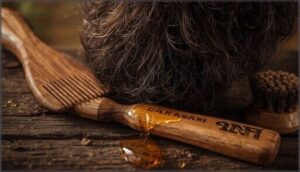
A wide-tooth comb handles knots without snapping coarse hair, while boar bristle brushes push oil deep into dense growth. Run your comb through damp beard before applying oil, then switch to a brush for final smoothing.
Match your tool to your texture—curly beards need soft bristles, straight ones respond to carbon fiber.
Clean tools weekly to prevent buildup and maintain sharp detangling power.
Common Mistakes to Avoid

Even the best beard oil won’t work if you’re applying it the wrong way. A few simple slip-ups can leave your beard greasy, patchy, or still itchy—no matter how premium your product is.
Here’s what to watch out for so you get the full benefit every time.
Overapplying or Underapplying Oil
Getting your oil balance right separates a champion beard from a greasy disaster. Too much leaves you shiny and transfers onto shirts; too little keeps your beard dry and flaky. Here’s how beard length guide experts dial in the perfect dose:
- Short beards (1 month): Start with 3–4 drops—anything more and you’re asking for grease.
- Medium growth (1–3 months): Use 4–6 drops; adjust application frequency if your beard still feels coarse.
- Long beards (3–12 months): Apply 6–10 drops, watching for oil absorption rates and skin irritation signs.
- Year+ growth: You’ll need 10+ drops, but add gradually to avoid weighing hair down.
- Adjustment test: If your beard clumps, feels sticky, or looks flat—you’ve overdone it; if it’s rough, itchy, or flaking—add more.
Monitor your beard health daily and tweak the amount based on thickness and climate. Proper beard care means finding your sweet spot through trial, not guessing.
Master these grooming basics and your beard care tips game becomes unstoppable.
Neglecting The Skin Beneath The Beard
Your beard looks great, but if you’re ignoring the skin underneath, you’re setting yourself up for beard dermatitis and facial irritation. Dead skin buildup blocks sebum control and clogs follicles, triggering itch and redness that beard oil alone can’t fix.
Massage oil directly into your skin during grooming—not just the hair—to maintain skin health, support follicle care, and keep your facial hair maintenance game solid.
Applying to a Wet or Dirty Beard
Water repels beard oil, cutting absorption by up to 30% on a soaking-wet beard. Dirt traps oil on the surface instead of letting it penetrate, creating a greasy mess that blocks beard hygiene.
Rinse and towel-dry first for proper oil absorption and wet beard care. Damp hair tips: blot excess moisture, then apply for best beard maintenance and facial hair maintenance results.
Maintaining a Healthy Beard Routine
Applying beard oil correctly is just the start—your real results come from building a solid routine around it. Consistency matters more than flawlessness, and a few simple habits will keep your beard looking sharp without extra effort.
Here’s how to lock in your gains and avoid the pitfalls that sabotage most guys.
Washing and Prepping Before Oil Application
Think of your beard oil as a high-performance fuel—it won’t work unless the engine’s clean. Start with a dedicated beard cleansing using warm water and a sulfate-free shampoo to strip away oils and debris.
Pat dry with a towel, then inspect the skin beneath for dryness or irritation. Proper drying techniques guarantee ideal oil absorption during your grooming routine, turning your shower into the launchpad for bulletproof beard care.
Preventing Product Buildup
You’ve cleaned your beard—now keep it that way. Use a light hand with your beard oil and stick to carrier oils like jojoba or argan for better oil balance.
Rotate products monthly to dodge buildup and comb through after application for even coverage.
Schedule clarifying washes twice a month to reset skin health and maintain peak beard care without the grease.
Incorporating Beard Oil Into Daily Grooming
Lock in your routine right after your morning shower—that’s when beard oil benefits hit hardest. Apply a few drops daily to trap moisture and crush beardruff before it starts.
Pair oil application techniques with a quick comb-through to spread grooming best practices evenly. This beard care routine becomes second nature fast, building the foundation for serious beard growth tips and long-term mens grooming products success.
Frequently Asked Questions (FAQs)
Can beard oil help with patchy beard growth?
Beard oil won’t create new hair follicles or fix genetic patchy beards, but it moisturizes skin beneath facial hair. This nourishes healthier hair follicles and reduces breakage, improving beard density appearance and overall beard health.
Regular use of beard oil can promote a scientific study approach to beard care.
Does beard oil expire or go rancid?
Yes, beard oil can expire or go rancid. Most oils last 12 to 24 months unopened, but once opened, expect 6 to 12 months of shelf life before oxidation kicks in and quality drops.
Can I use beard oil on stubble?
Absolutely. Apply one to two drops of beard oil to your stubble for skin hydration and facial hair softness.
This stubble maintenance step aids beard growth and prevents itch while promoting overall beard health.
Will beard oil clog my pores or cause acne?
Good news: quality beard oils won’t trigger breakouts. Most use non-comedogenic carriers like jojoba that balance skin oil.
Keep your beard clean, apply to damp skin, and choose paraben-free, sulfate-free formulas for acne prevention.
Can I mix different beard oils together?
You can mix beard oils, but test the blend on your skin first.
Stick with similar carrier oils like jojoba or argan to maintain pH balance and avoid irritation or clogged follicles.
Conclusion
Slapping beard oil on like cologne and hoping for the best? That’s the express route to grease stains and zero results. You’ve learned how to apply beard oil properly—now the only question is whether you’ll actually follow through.
Prime the skin, measure the dose, work it root to tip, and brush it through. Your beard won’t fix itself, but you’ve got the blueprint. Time to stop winging it and start looking the part.