This site is supported by our readers. We may earn a commission, at no cost to you, if you purchase through links. This content is for general informational and educational purposes only and is not a substitute for professional medical, dermatological, or nutritional advice.
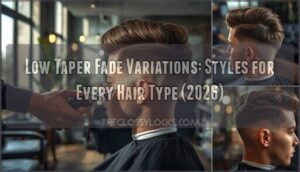
Most guys think fades are all or nothing—buzzed tight to the scalp or left long enough to lose the edge. That’s where the low taper fade breaks the mold. It sits right at ear level, blending length without shouting for attention.
You keep the weight on top, the fade stays close to your hairline, and the whole look holds together without constant upkeep. Whether you’re working with straight hair that shows every line or thick curls that need room to breathe, low taper fade variations give you control without locking you into one style.
The cut conforms to your texture, your face shape, and how much time you’re willing to spend in front of the mirror each morning.
Table Of Contents
Key Takeaways
- A low taper fade starts at ear level and gradually blends hair from longer on top to shorter on the sides, offering a versatile, low-maintenance cut that works with any hair texture or face shape.
- The fade adapts to your natural hair pattern—whether straight, wavy, curly, or coily—and pairs with everything from slicked-back styles to textured crops without locking you into one look.
- Classic variations like the timeless fade, side part, and comb over deliver polished simplicity, while modern styles like curly tops, textured crops, and pompadours push creative expression.
- Maintaining your fade requires trims every 2-4 weeks, sulfate-free products to preserve texture, and lightweight styling tools that protect your hairline without weighing down the blend.
What is a Low Taper Fade?
A low taper fade is one of those haircuts that feels classic but never goes out of style. It starts just above your ears and gradually blends your hair from longer on top to shorter on the sides and back.
The beauty of a taper fade haircut is how versatile it is—you can keep it sharp and clean or add texture on top for a more relaxed vibe.
Before you decide if it’s right for you, let’s break down what makes this fade different and who it works best for.
Key Features of Low Taper Fades
A low taper fade gives you clean lines and serious style flexibility. The magic happens around your ears, where the fade starts low and builds gradually upward.
Here’s what makes it work:
- Taper Placement: The fade begins at ear-level, keeping the shift tight to your hairline
- Edge Detailing: Sharp lineups frame your face while the fade stays soft below
- Hair Texture: Works with straight, wavy, curly, or coily hair—the taper shapes your natural pattern
- Style Versatility: Pairs with anything from slicked-back looks to textured crops
Proper maintenance and the right products are key for a sharp appearance, as detailed in this comprehensive low taper fade guide: https://ginasbarbersalon.com/low-taper-fade/.
How Low Taper Differs From Other Fades
Most fade variations start higher on your head, but this one sits right at ear level. That fade placement changes everything about the overall vibe—you get a subtle blend contrast instead of a graphic shave.
High fades spotlight your top styling with sharp edges, while a low taper fade keeps things understated and frames your whole head. It also means easier grow out between cuts.
To understand more about how fade placement differs between styles, knowing what to expect can help you make the best choice.
Who Suits a Low Taper Fade?
This cut works for just about anyone—oval faces, square faces, round faces, or heart-shaped faces all benefit from the balanced taper. Your hair texture guide matters too: straight hair, wavy hair, curly hair, or thick hair pairs well with this fade variation.
Lifestyle considerations play a role since you’ll need trims every 2–3 weeks. Personal style tips: It suits classic fade looks or modern mens hairstyles with ease.
Classic Low Taper Fade Variations
The classic low taper fade never goes out of style because it works with almost anything you throw at it. Whether you want something clean and simple or a bit more polished, these variations give you that timeless look without trying too hard.
Here are three classic options that’ll keep you looking sharp no matter where you’re headed.
Timeless Classic Low Taper Fade
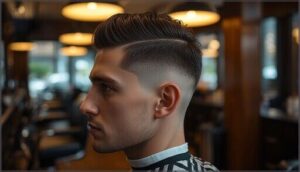
This is where rebellion meets refinement. The timeless classic fade starts near your ears and melts into longer hair on top, giving you that polished-but-effortless vibe that never goes out of style.
If you want to nail that seamless blend yourself, mastering the technique for shaving the sides of your head will help you maintain clean lines between visits to the barber.
Here’s what makes classic styles work:
- Clean fade techniques keep edges crisp without looking overdone
- Minimal styling tips mean you’re good with light pomade or wax
- Low maintenance fits any hair texture or face shape
- Diverse mens hairstyles shift from boardroom to bar
Low Taper With Side Part
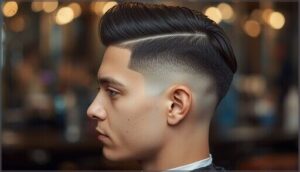
Sharp lines meet smooth transitions when you add a side part to your taper fade. This men’s haircut style gives you that old-school vibe with modern edge—perfect for square jaws and oval faces.
| Element | Technique | Result |
|---|---|---|
| Part Placement | Diagonal temple to crown | Balanced symmetry |
| Product Choice | Light pomade or clay | Controlled shine |
| Face Shape Analysis | Wide part for round faces | Length illusion |
| Taper Maintenance | Trims every 3-6 weeks | Crisp definition |
Your barber styles the part with clippers, creating contrast against the fade. Use parting techniques with blow drying for lift, then lock it with lightweight product. Hair texture tips: straight hair holds definition best, while wavy types add natural movement. Side part styling transforms a simple low fade into something commanding.
Low Taper Fade With Comb Over
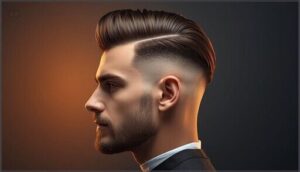
Command attention when you sweep hair across your scalp with this fade haircut. The comb over styles blend perfectly with a low taper, keeping sides trim while your crown stays full. Mens haircut styles don’t get more adaptable than this classic-modern fusion.
- Part your hair cleanly, then apply light pomade for flexible hold without stiffness
- Maintenance routines require trims every 2-4 weeks to preserve sharp fade techniques
- Hair texture tips: straight and wavy types comb easiest for daily styling
- Use heat protectant before blow-drying to protect fibers and improve barbering and grooming results
Modern Low Taper Fade Styles
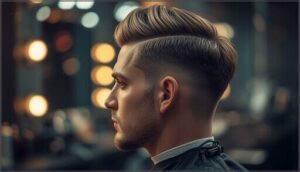
Modern low taper fades take the classic foundation and push it further with bold styling choices. These cuts work with your hair’s natural texture while giving you more edge and personality.
Here are five modern styles that blend precision with creative expression.
Low Taper Fade With Curly Top
Your curls don’t need to hide behind a heavy cut—this modern combo lets them own the spotlight. The low taper fade with curly top keeps 2 to 4 inches of natural texture on top while the sides gradually shorten just above your ears. You get volume where it counts and a clean frame that makes every coil pop without the bulk.
| Aspect | What You Need | Why It Works |
|---|---|---|
| Curl Enhancement | Light hold cream or curl-defining gel | Shapes coils without stiffness or crunch |
| Fade Techniques | Clipper guards blended smoothly from ear level | Prevents harsh lines that clash with curls |
| Styling Products | Sulfate-free shampoo and leave-in conditioner | Protects curl integrity and reduces frizz |
| Hair Texture | Works best with 2C to 4C curl patterns | Natural volume stays balanced on top |
| Maintenance | Trims every 3 to 6 weeks | Keeps fade sharp and curls defined |
This men’s haircut style works with your hair type instead of fighting it. Use a diffuser or finger-style to control frizz and define each curl’s shape. Curly hair tips like night conditioning keep texture bouncy between barber visits.
Textured Crop Low Taper Fade
You take control of every angle when you combine a textured fringe with a low taper fade. The crop sits 1.5 to 2 inches on top, cut with point shears to create uneven ends and natural movement.
Styling products like matte clay add separation without weight. This fade haircut suits any hair type—fine strands gain volume while thick hair sheds bulk.
Taper maintenance every three weeks keeps fade techniques crisp.
Low Taper Fade With Pompadour
You master classic rebellion when you stack a pompadour on top of a low taper fade. The fade techniques blend skin to 3-inch crown length, while pompadour styling sweeps volume back from your forehead.
Volume control starts with blow-drying against your natural hair texture, then locking shape with medium-hold styling products. This hairstyle works across every hair type—your taper fade stays sharp with monthly barber visits.
Brushed-Up Low Taper Fade
You lift your look with a brushed-up low taper fade that builds vertical power through upward motion. This fade construction sweeps top sections toward the sky while your taper fade sharpens near the ears, making it one of the boldest haircut trends in men’s grooming.
Styling products facilitate this transformation:
- Blow-dry against your hair texture for maximum lift
- Apply medium-hold pomade to lock the brush-up shape
- Finger-comb upward to maintain natural movement
Your face shape gains length with every upward stroke, though maintenance tips demand trims every three weeks to preserve that commanding fade haircut edge.
Ninja Low Taper Fade
The ninja low taper fade sharpens every edge into a weapon of style. This fade haircut delivers razor-precise lines along your temples and neckline, turning your low fade into a statement of control.
Ninja style demands impeccable fade techniques—your barber uses tight guard transitions to create smooth blends. Edge maintenance becomes your ritual, and styling products keep your hair texture locked in place with surgical precision.
Low Taper Fades for Different Hair Types
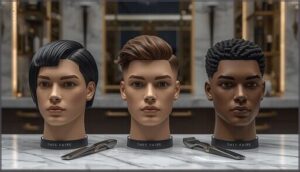
Your hair type changes everything in the context of a low taper fade. What works for straight hair won’t necessarily give you the same results if you’ve got thick curls or waves.
Let’s break down how this cut responds to different textures so you can get the look that actually works for you.
Low Taper Fade for Straight Hair
Straight hair shows off a low taper fade like nothing else. The natural flatness lets blade work shine through with clean, crisp lines that hold definition all week.
You’ll notice the gradient blends seamlessly from skin to length because there’s no curl to interrupt the flow. Keep your maintenance routine tight with regular trims and light styling products to lock in that sharp, polished edge.
Low Taper Fade for Thick Hair
Thick hair brings its own power to a low taper fade. The cut strips bulk from the sides while leaving 2–4 inches on top for real volume and control.
You’re looking at touch-ups every 3–6 weeks to keep that neckline sharp and prevent helmet head. Use matte clay or light pomade to shape the crown without flattening your density—let that texture work for you.
Low Taper Fade for Wavy Hair
Waves thrive when a low taper fade starts just above your ear—keeping 3–6 inches on top lets your natural texture roll and curve without fighting triangle shapes at the temples. The gradual blend prevents harsh lines that clash with your wave pattern.
- Use sulfate-free shampoo and a lightweight leave-in conditioner to lock in definition
- Schedule trims every 3–6 weeks so your fade stays crisp and waves stay balanced
- Apply styling cream while damp to control frizz and guide curl direction
Low Taper Fade for Afro-Textured Hair
Coils and curls release serious volume when you pair Afro texture with a low taper fade—the fade sits right at ear level while 4–8 inches on top lets your natural shrinkage and curl definition shine. Edge control keeps your hairline crisp without flaking.
| Afro Haircare Step | Product Type | Frequency |
|---|---|---|
| Moisture seal | Sulfate-free shampoo + light oil | Every 5–7 days |
| Fade maintenance | Barber trim | Every 2–4 weeks |
| Edge refresh | Edge control + satin pillowcase | Nightly |
You’ll preserve texture and protect your hairline when you treat hair type like the asset it is.
Low Taper Fade With Twists
Twists on top bring serious dimension when paired with a low taper fade—the fade starts at ear level while two-strand or finger twists create defined texture across the crown and temples.
This haircut variation delivers a standout mens hairstyle that highlights natural texture.
- Twist placement shapes your look: space them evenly across the top for balanced rhythm or cluster them at the crown for concentrated texture
- Hair texture dictates twist size: thick coils hold larger, bolder twists while fine strands need lightweight texturizing spray to create visible definition
- Fade maintenance keeps it sharp: trim every 2–4 weeks and use sulfate-free cleansing to preserve both your taper fade and twist integrity
Tips for Maintaining a Low Taper Fade
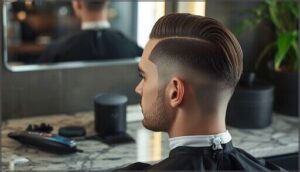
Getting a low taper fade is just the beginning—keeping it sharp takes the right routine. Your fade won’t maintain itself, but the work isn’t complicated if you know what to focus on.
Here’s what you need to do to keep your look clean and fresh between cuts.
Regular Trims and Barber Visits
Your low taper fade won’t stay sharp on its own—you’re the one who decides how fresh it looks. Most barbers recommend scheduling a trim every two to four weeks to keep the edges crisp and the blend smooth.
Regular haircut maintenance prevents blocky regrowth and keeps your fade looking intentional. Book your next appointment before you leave the chair.
Daily Haircare for Fade Longevity
Think of your fade haircut like a high-performance machine—it runs best with daily care. Hydration tips start with drinking eight glasses of water and using sulfate-free shampoo two to three times weekly.
Apply lightweight leave-in conditioner right after washing to lock moisture in. Skip heavy waxes that dull your fade’s contrast.
A consistent daily routine keeps your low taper fade sharp between barber visits.
Protecting The Hairline and Edges
Your hairline is the frame for your fade haircut—protect it like you’d a masterpiece. Edge care tips start with lightweight water-based moisturizers and avoiding tight styles that create tension. Gentle styling using wide-tooth combs prevents snagging along your taper fade.
Protect your hairline like a masterpiece—use lightweight moisturizers, avoid tension, and style gently with wide-tooth combs
Weekly scalp massage boosts blood flow for hairline repair. Edge protection works across every hair type when you prioritize hydration over heavy products.
Frequently Asked Questions (FAQs)
What types of low taper fades are there?
You’ve probably noticed tapered haircut styles everywhere lately.
Modern fade haircuts range from classic smooth transitions to textured crops, each designed to match different hair texture types and personal styling tips preferences.
What is the 3 2 1 buzzcut rule?
The 3 2 1 buzz cut uses three guard sizes: a #3 on top, #2 on the sides, and #1 around the edges. This clipper technique creates smooth fade transitions for a clean, low-maintenance taper.
What’s better than a low taper fade?
Nothing’s definitively better—it depends on your style. High fade cuts or mid taper looks offer more contrast, while undercut designs create sharper edges. Low taper fade remains unbeatable for versatility across men’s hairstyle trends.
How much does a low taper fade cost?
Your wallet won’t take a beating—most barbers charge between $25 and $40 for a solid low taper fade.
Though price factors like location and shop prestige can push costs toward $70 in major cities.
Can women wear low taper fade hairstyles?
Yes, women can rock low taper fade hairstyles. This feminine edge option works beautifully with short to medium lengths, creating low maintenance hair that flatters heart and oval face shapes while keeping female hair trends fresh.
What tools do barbers use for tapers?
Your barber relies on adjustable clippers with taper levers, guards from 0 to 3, T-blade trimmers for edges, foil shavers for skin-tight fades, and blending shears to perfect your low taper fade.
How long does a taper fade take?
Time is money, and your taper fade usually takes 20 to 45 minutes. Barber skill level, hair complexity, and fade timing factors like thickness all shift appointment scheduling for your fresh haircut.
Does a low taper work with beards?
A low taper fade pairs perfectly with beards when the neckline mirrors the fade height.
Regular trims keep the blend smooth, while beard oil softens hair for effortless facial hair styling and fade beard blending.
Conclusion
You control the fade. You control the length. You control how sharp or soft the blend hits your hairline.
Low taper fade variations don’t force you into a box—they adapt to straight hair that shows every cut, thick texture that needs breathing room, or curls that demand their own structure.
Pick the version that matches your routine, not someone else’s trend. Your barber sets the foundation, but you decide how far it goes.