This site is supported by our readers. We may earn a commission, at no cost to you, if you purchase through links. This content is for general informational and educational purposes only and is not a substitute for professional medical, dermatological, or nutritional advice.

Your barber starts the clippers at your temple, and that first pass changes everything. The temple taper fade doesn’t announce itself with drama—it frames your face with surgical precision, creating clean lines that make every other feature fall into place. This technique separates the amateurs from the artists, and it’s the difference between walking out looking sharp versus looking transformed.
You don’t need to commit to a full fade that demands weekly maintenance or settle for a basic cut that lacks definition. The temple taper gives you control over your aesthetic without the constant upkeep, whether you’re rocking a tight crop, flowing pompadour, or natural texture.
Getting it right means understanding the mechanics, communicating exactly what you want, and knowing how to maintain those crisp edges between appointments.
Table Of Contents
Key Takeaways
- A temple taper fade creates precision-focused definition at your temples without requiring the weekly maintenance of a full fade, making it ideal for men who want sharp lines with manageable upkeep every 2-4 weeks.
- Your face shape and hair texture directly determine fade height and blending technique—oval faces handle any taper height, square jawlines need higher fades to soften angles, while curly and afro-textured hair demands freehand blending instead of rigid clipper lines.
- Clear communication with your barber means specifying exact guard levels (like “low temple fade with zero guard baseline”), bringing high-resolution reference photos from multiple angles, and discussing hairline edge preference (sharp versus rounded).
- Home maintenance between cuts requires the right tools (adjustable clippers, detailing trimmers), proper products (sulfate-free shampoo, water-based pomade), and disciplined touch-up scheduling to keep temple edges crisp and prevent overgrowth.
What is a Temple Taper Fade?
A temple taper fade is a precision haircut that gradually shortens the hair around your temples and nape, creating a sharp, clean line that frames your face. This style gives you control over your look without committing to a full fade on the sides or back.
If you’re exploring variations, a taper fade haircut offers similar versatility with blending options that suit different hair types and personal styles.
Let’s break down what makes this cut distinct, where it came from, and how it stacks up against a traditional fade.
Key Features of The Temple Taper Fade
A temple taper fade creates a sharp shift at your temples, blending longer hair on top with a crisp edge below. The fade starts at temple level, tapering downward to skin or a very short length.
This precise technique emphasizes symmetry and offers remarkable style versatility—you can pair it with crops, pompadours, or slick backs across all hair textures.
For more inspiration and details, check out these popular.
History and Popularity
The temple taper fade broke into men’s hairstyles during the late 1990s, then exploded across global barbering culture in the 2000s. Celebrity influence and precision clipper evolution pushed this fade haircut into the spotlight.
Barbers refined temple techniques, while haircut trends on social media cemented its cultural symbolism as both professional polish and rebellious edge—a look you control entirely.
Temple taper fades became symbols of both professional polish and rebellious edge, refined by barbers and amplified by social media trends
Temple Fade Vs. Traditional Fade
While the temple fade sharpens only your temple hairline and creates bold contrast points, a traditional fade haircut blends gradually from sideburns down across your entire sides and back.
Visual impact differs: temple fades give you targeted definition and require expert barber skill for precise line work, while traditional fades offer universal style longevity with smoother transitions.
Understanding hair fades and fade haircut variations lets you choose based on client preference and maintenance commitment. Those interested in the technique’s history and versatility can learn more through this.
Who Should Get a Temple Taper Fade?

The temple taper fade works for most guys, but it really shines on certain face shapes and hair types. Your lifestyle matters too—this cut requires regular maintenance to stay sharp.
Here’s what you need to know before committing to a temple taper.
Best Face Shapes for Temple Taper
Your face shape determines how sharp your temple taper fade looks on you. Oval faces work with almost any taper height because of balanced proportions. Square jawlines need higher fades around temples to soften angles. Round faces benefit from vertical length with higher, longer tapers. Diamond shapes require narrow, precise temple work to highlight cheekbones without widening the forehead.
Ideal Hair Types and Textures
Your curl pattern and hair texture define how clean your temple taper fade holds its edge. Here’s what works:
Understanding the difference between taper and drop fades helps you choose which style complements your curl pattern best.
- Straight hair accepts sharp temple lines easily but may need frequent touch-ups as growth shows fast.
- Wavy hair blends naturally with medium-hold products, balancing texture and definition.
- Curly hair requires moisture-rich stylers to prevent frizz along faded temple edges.
- Afro-textured hair benefits from precise temple work that adds structure without removing natural volume.
- Coarse texture holds fades longer but needs hydration to prevent dryness at trimmed areas.
Hair porosity affects how products absorb. Low porosity repels lightweight gels, while high porosity drinks in creams quickly.
Lifestyle and Maintenance Considerations
Generally, your schedule dictates how well a temple taper fade fits your life. Hair growth rates vary, but most clients need professional touch-ups every 2 to 4 weeks to keep edges crisp.
Active lifestyles with swimming or gym sessions demand more frequent fade maintenance and scalp care. Product selection matters—lightweight gels and matte finishes prevent buildup while supporting your haircare routine.
Lifestyle adjustments like sleeping on clean pillowcases and daily scalp rinses preserve sharpness. Haircut maintenance aligns with your grooming advice needs and professional image goals.
Popular Temple Taper Fade Styles

The temple taper fade works with almost any style you throw at it. You can pair it with a neat crop, a bold pompadour, natural curls, or a sleek slick back.
Here’s how each variation changes the overall look and what you need to know to pull it off.
Temple Taper With Short Crop
Want maximum impact with minimum effort? Pairing a temple taper fade with a short crop delivers a compact, controlled profile that frames your face with precision. The fade line sits tight against your temples, highlighting sharp edges while the crown stays 1 to 3 inches long.
- Use light point cutting to add texture and prevent flatness
- Apply matte clay or light pomade for natural hold without weight
- Schedule touch-ups every 2 to 3 weeks to maintain crisp temple fade lines
Temple Taper With Pompadour
The pompadour temple fade combines the classic volume of a pompadour with the modern precision of a temple taper fade. The top length ranges from 2 to 5 inches, swept upward and back to create dramatic height. The temple fade starts at skin level or a 0 guard, blending smoothly into the crown. Medium-hold pomade lifts the hair, while edge maintenance with a trimmer keeps the temple fade lines sharp every 3 to 4 weeks.
| Element | Specification | Product/Tool |
|---|---|---|
| Pompadour height | 2 to 5 inches on top | Round brush, blow dryer |
| Temple fade depth | Skin to 0 guard base | Clipper, trimmer |
| Edge maintenance | Every 3 to 4 weeks | Detail trimmer |
Temple Taper on Curly and Afro Hair
Afro-textured hair demands a different approach—skip the rigid clipper lines and embrace freehand blending. Start with a 1.5 to 2.5 guard on curly hair, tapering gradually to avoid bulging at the temple.
Here’s how to nail the curly temple fade:
- Keep hair moisturized before cutting to see natural curl pattern
- Use freehand shading at temples for smooth transitions
- Blend upward in small sections to prevent harsh edges
- Follow the head’s natural contour for an organic hairline
- Schedule touch-ups every 2 to 4 weeks for consistent fade appearance
Temple Taper With Slick Back
The slick back pulls every eye forward—combine it with a temple fade for instant sophistication. Use strong-hold pomade on damp hair, blow-dry back while lifting at the crown, then comb smooth.
Oval and square face shapes wear this best, while straight to wavy hair textures hold the cleanest lines.
If you’re unsure which category you fall into, this guide to finding your best takuache haircut variation breaks it down by face shape and hair type.
Schedule trims every 2 to 3 weeks to preserve sharp temple edges and prevent buildup.
How to Ask Your Barber for a Temple Taper

Walking into the barbershop and asking for a temple taper shouldn’t feel like guessing. The clearer you communicate what you want, the better your barber can deliver the exact fade you’re after.
Here’s how to make sure you and your barber are on the same page from the start.
Using Clear Terminology
Specific language gives you control over the cut. Tell your barber the exact fade level, like ‘low temple fade with a zero guard baseline.’
Describe temple edges as sharp or rounded, and clarify gradation terms such as ‘smooth blend’ or ‘tight fade.’ Mention hairline treatments you prefer—natural or defined.
Clear barber communication ensures you master the temple taper fade technique every time.
Bringing Reference Photos
Words give power, but images seal the deal. Bring high-resolution photos with natural lighting and multiple angles—front, profile, and three-quarter views. Show clear temple edges and fade transitions, avoiding heavily edited shots.
Photo quality matters for temple taper fade precision. Include context shots of the hairline and crown so your barber sees exactly what you want. Sharp reference photos help you command the cut.
Customizing The Fade to Suit You
Once you’ve shown your barber the reference photos, dial in the details. Fade Depth Control determines how close the temple blend sits—guards zero to four let you pick skin-tight or subtle. Hair Texture Analysis shapes the blend tempo; curls need layered transitions, straight hair manages stepped fades. Face Shape Adaptation shifts the temple start point higher or lower to balance your bone structure. Personal Style Considerations lock in square, rounded, or curved hairline edges that match your vibe. Maintenance Scheduling sets your touch-up rhythm—one to three weeks keeps the temple taper fade sharp.
- Fade depth: Choose guard lengths that match your desired contrast
- Texture needs: Request layered blending for curls, smooth for straight hair
- Face balance: Adjust temple start height to complement your features
- Edge style: Specify square, rounded, or curved hairline shape
- Touch-up plan: Agree on a maintenance window with your barber
Step-by-Step Temple Taper Fade Guide
Cutting a temple taper fade takes focus, the right tools, and a steady hand. You’ll work in stages, starting with the setup and moving through blending, edging, and final details.
Here’s how to execute a clean temple fade from start to finish.
Tools and Preparation

Before you touch the clippers, get your tools dialed in. Sanitize blades with alcohol wipes to prevent cross-contamination. Check blade alignment and tension so your fade techniques stay sharp.
Use A5 clipper blades for most temple fade work, and keep a detailing trimmer ready for precise edge work.
Clipper maintenance isn’t optional—it’s what separates clean haircuts from sloppy ones.
Sectioning and Initial Cut

Start with a wide horizontal parting above the ears to mark your fade guide. This temple mapping keeps your sectioning techniques on point.
Next, place a vertical guide line parallel to the ear—this controls fade height. Use a higher guard for your initial cut tips, removing bulk before you taper. Cross-check both sides for symmetry.
Keep your temple taper fade sharp, not sloppy.
Blending The Temple Area

Blending the temple area demands precision and proper fade techniques. Use clipper-over-comb to soften transitions between guards, following temple angles that mirror your ear curve. Work upward in diagonal strokes for smooth hairline blending.
Switch between guards gradually—don’t jump sizes. Your barber techniques here separate clean temple taper fade work from amateur cuts. Maintain consistent blade angle throughout.
Sharpening Edges and Hairline

Edge control defines your temple taper fade’s crispness. Set clippers to a zero or 1 guard, then trace your hairline design with the grain. Use your edging blade or trimmer for sharp edging along the lineup—keep skin taut and move smoothly to avoid nicks.
Mark your shapeup symmetrically on both sides. Fade techniques demand precision here; a clean hairline definition separates professional work from sloppy cuts.
Finishing Touches
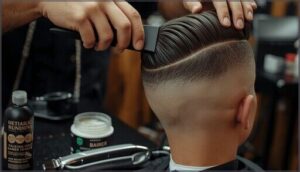
Complete your fade with a final pass over temple edges for symmetry. Clean skin with aloe-based balm to reduce redness by 40 percent—this skin prep matters.
Apply light-hold styling cream to maintain edge refinement without masking your lineup. Use a soft brush for fade maintenance, removing stray hairs.
Tool upgrades like ceramic blades keep your edgeup crisp through daily haircut maintenance sessions.
Maintaining and Styling Your Temple Taper

A sharp temple taper doesn’t maintain itself. You need the right products, a solid daily routine, and regular barber visits to keep that fade looking clean.
Here’s how to own your look and keep those lines razor-sharp between cuts.
Recommended Hair Products
You need the right hair products to lock in that sharp temple taper. Start with a sulfate-free shampoo around pH 5 to protect faded edges.
For styling, water-based pomade washes out clean and won’t clog your temple line. Medium-hold clay adds texture without grease. Hair oils like jojoba seal the cuticle.
Pick products based on fade maintenance needs, not hype.
Daily Styling Tips
Your morning routine shapes how long that temple taper stays sharp. Run damp fingers along your hairline to reset edges after sleep.
Use a lightweight leave-in conditioner to maintain moisture without weighing down the fade. Apply a small amount of styling product—matte paste for texture, light pomade for shine—and brush the temple area twice daily.
This daily hair styling keeps your fade crisp between cuts.
Scheduling Regular Touch-Ups
Daily hair styling keeps your look intact, but consistent touch ups lock in that sharp temple taper fade. Book appointments every 10 to 14 days to control hair regrowth and maintain clean lines. Growth rate dictates your schedule—faster growth means weekly visits, slower growth stretches to three weeks. Scheduling apps track your routine, and maintenance cost stays manageable with regular upkeep:
- Check your temple edges weekly in natural light
- Schedule the next touch up before leaving the barber chair
- Use booking reminders to stay ahead of overgrowth
- Budget $10 to $25 per visit for haircut maintenance and care
- Adjust intervals based on seasonal growth changes
Keeping The Fade Sharp at Home
Between shop visits, home trimming tools keep your temple fade crisp. Use sharp clippers with adjustable guards for haircut maintenance, working in small sections to preserve clean edges. At-home techniques like light, slow passes along the hairline prevent gouges.
Always sanitize equipment before each session—hygiene stops infections and extends blade life. A handheld mirror checks symmetry, so your hair grooming stays balanced.
Frequently Asked Questions (FAQs)
What is the 3 2 1 rule for haircuts?
The 3 2 1 rule uses clipper guard sizes in descending order: a number 3 guard on top, number 2 on sides, and number 1 around the neck and temples, creating clean stepped transitions.
What does 1, 2, 3, 4, 5 mean in haircuts?
Numbers 1 through 5 refer to clipper guard sizes that leave hair at specific lengths. A #1 leaves 1/8 inch, #2 leaves 1/4 inch, #3 leaves 3/8 inch, and so on—essential for fade haircuts and taper lengths.
Does temple taper fade work for receding hairlines?
Yes, a temple taper fade works well for receding hairlines. Low to mid fades soften temple recession, while textured tops add volume, creating balance. Regular trims maintain sharpness and boost overall density.
Can women wear a temple taper fade?
Like a sharp edge on a well-honed blade, the temple taper fade cuts across gender lines.
This unisex grooming choice works perfectly for women, blending genderless haircuts with womens fade cuts that emphasize temple definition and modern female hair trends.
How much does a temple taper fade cost?
A temple taper fade usually costs $20–$40 at most barber shops. Price factors include your barber’s experience, regional pricing, shop amenities, and maintenance frequency. High-end salons may charge $50–$
Whats the difference between temp fade and temple fade?
Both terms refer to the same haircut focused on fading the temple region. “Temp fade” is simply shorthand for “temple fade,” emphasizing sharp, high-contrast blending near your temples and ears.
Can you do temple taper fade at home?
With the right tools and patience, you can pull off a temple taper fade at home. Invest in quality clippers, detachable guards, and a steady hand. Practice clipper maintenance and follow DIY fade kits for safety precautions.
Conclusion
The difference between a decent haircut and one that completely redefines your look comes down to those temple lines. You’ve got the temple taper fade guide, the terminology, and the technique.
Now it’s about execution—communicating exactly what you want, finding a barber who understands precision, and maintaining those edges with discipline. Sharp temples don’t happen by accident.
They’re built through knowledge, maintained through consistency, and worn with confidence.