This site is supported by our readers. We may earn a commission, at no cost to you, if you purchase through links. This content is for general informational and educational purposes only and is not a substitute for professional medical, dermatological, or nutritional advice.

Your morning shower shouldn’t feel like standing under a garden sprinkler set to “mist.” Yet millions of people tolerate weak water flow every day, assuming it’s just how their shower works.
The truth is, multiple factors control what comes out of your shower head—from the water pressure pushing through your pipes to microscopic mineral deposits choking your nozzles. Water pressure, pipe diameter, flow restrictors, and even your shower head’s internal design all play distinct roles in determining whether you get a satisfying spray or a disappointing trickle.
Understanding these elements gives you the power to diagnose problems and restore the flow you deserve.
Table Of Contents
- Key Takeaways
- What Determines Shower Head Water Flow?
- How Does Water Pressure Affect Flow?
- Do Flow Restrictors Limit Shower Flow?
- Can Pipe Size and Material Impact Flow?
- How Shower Head Type Influences Water Flow
- Does Mineral Buildup Affect Water Flow?
- How to Measure Your Shower Head Flow Rate
- What Role Does Shower Head Material Play?
- Can Plumbing Issues Cause Low Flow?
- How to Improve and Optimize Shower Water Flow
- Frequently Asked Questions (FAQs)
- Conclusion
Key Takeaways
- Water pressure between 40-60 psi, pipe diameter and material, flow restrictors, and shower head design all work together to determine your actual flow rate—addressing weak flow means diagnosing which factor is the bottleneck.
- Mineral buildup from hard water physically clogs nozzles and reduces flow over time, but you can restore performance by soaking the shower head in white vinegar for 30-60 minutes and scrubbing deposits away.
- Flow restrictors cap your shower at 1.8-2.5 GPM regardless of incoming pressure to meet federal standards, so removing them boosts flow but may violate local codes or void warranties.
- Old galvanized pipes corrode internally and narrow over time, creating friction that drops pressure by up to 20 percent—upgrading to copper or PEX eliminates this resistance and restores consistent flow throughout your system.
What Determines Shower Head Water Flow?
Your shower head’s water flow isn’t controlled by a single factor. Three primary elements work together to determine how much water exits your shower head each minute.
If you’ve noticed persistent dripping even when the water’s off, understanding why your shower head drips after turning off can help you address pressure-related issues more effectively.
Understanding water pressure levels, pipe size and material, and shower head design gives you the foundation to diagnose flow problems and improve your shower experience.
Water Pressure Levels
Water pressure directly controls how much water exits your shower head each minute. Your home’s supply usually runs between 40 and 60 psi, creating the foundation for flow dynamics. Understanding these pressure levels helps you master flow rate optimization.
- 40 psi – Minimum for acceptable spray intensity
- 60 psi – Ideal range for most residential systems
- 80+ psi – High pressure that may stress plumbing components
Low water pressure cuts flow dramatically, reducing spray strength and shower satisfaction. For more details on, see this thorough guide.
Pipe Size and Material
Your plumbing system’s pipe diameter and material selection create friction loss that directly impacts water flow. Larger pipes reduce flow resistance through improved fluid dynamics in hydraulic systems.
Copper offers smooth interiors, while galvanized steel increases friction as pipe corrosion develops. Pipe scheduling determines wall thickness—thicker walls narrow the bore, raising velocity and friction.
Material selection affects long-term performance and flow consistency. The impact of pipe size and material also plays a significant role in maintaining ideal water pressure and efficient water distribution.
Shower Head Design
Beyond pipe selection, shower head design directly controls how water exits the fixture. The spray pattern and nozzle design shape coverage and feel—rain heads spread flow gently while jet nozzles concentrate it.
Flow dynamics differ between aerating technology that mixes air with water and standard designs. Head materials like brass or ABS plastic house internal channels calibrating the flow rate at your water pressure.
How Does Water Pressure Affect Flow?

Water pressure is the driving force behind your shower’s performance. Without adequate pressure, even the best shower head won’t deliver a satisfying flow.
Let’s break down how municipal supply, low pressure problems, and pressure-boosting solutions shape your daily shower experience.
Municipal Vs. Home Pressure
Understanding your water supply chain puts you in the driver’s seat. Municipal codes regulate delivery pressure to around 50 to 80 psi at your property line, but home plumbing often includes a pressure regulator that dials it down to safe levels—usually 40 to 60 psi.
This pressure regulation protects fixtures and appliances while optimizing flow dynamics throughout your system. Water pressure optimization starts with knowing the difference.
Effects of Low Pressure
When pressure drops below 40 psi, you’ll notice flow reduction immediately—weak spray, sluggish fill times, and frustrating showers.
Kids especially struggle with low pressure during bath time, so choosing durable shower heads designed for children helps maintain consistent performance even when water pressure fluctuates.
Low water pressure slashes your flow rate from a vigorous 2.5 GPM down to 1.5 GPM or less, even with a standard head. This pressure drop undermines water flow performance across your entire system, turning routine tasks into slow-motion ordeals that demand low water pressure solutions.
Boosting Water Pressure
You can install a booster pump system to raise incoming water pressure and deliver consistent flow throughout your home.
Most pump solutions include an automatic controller and pressure regulators to maintain 40 to 80 psi at fixtures. This setup offers reliable low water pressure solutions by coupling pressure increase with flow optimization—transforming weak showers into powerful, satisfying experiences.
Do Flow Restrictors Limit Shower Flow?
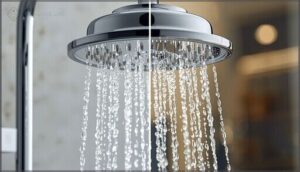
Flow restrictors control how much water exits your shower head each minute, often capping it at 2.5 GPM or less to meet federal standards.
While they save water and money, they can make your shower feel weak if your home pressure is already low. Understanding how restrictors work—and whether you should adjust them—gives you the power to customize your shower experience.
Purpose of Flow Restrictors
Flow restrictors act as gatekeepers in your shower head, capping GPM at a preset value—usually 1.8 to 2.5—regardless of incoming water pressure. This flow limitation drives water savings while helping you meet efficiency standards and local codes.
They guarantee consistent flow control across varying pressure conditions, protecting your plumbing from surges and keeping your utility bills in check through predictable low-flow performance.
Removing or Modifying Restrictors
You can remove the restrictor plate by disassembling your shower head and extracting the small insert that limits passage area. This restrictor removal boosts water flow rate beyond the factory low-flow setting, often raising your shower head GPM substantially.
Before attempting restrictor bypass or any shower head mods, check local codes—flow enhancement may void warranties, violate plumbing regulations, or require landlord approval in rental properties.
Can Pipe Size and Material Impact Flow?
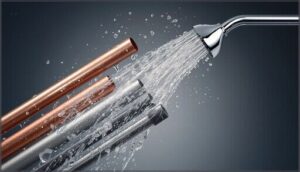
Your pipes do more than carry water—they shape how much actually reaches your shower head. The diameter and material determine resistance, which directly affects flow rate and pressure at the fixture.
Let’s break down how different pipe types influence your shower performance.
Common Pipe Materials
Your plumbing system’s pipe material directly shapes water delivery to your shower head. Here are three common options that influence flow performance:
- Copper Pipes and Brass fittings resist corrosion and maintain consistent flow for decades, making them the highest standard in residential installations.
- PEX Tubing flexes around obstacles and resists scale buildup better than older Galvanized Steel.
- Stainless Steel and HDPE Systems offer exceptional durability where pipe corrosion threatens water quality, though ABS Plastic remains a budget-friendly alternative.
Effects of Narrow or Old Pipes
Aging pipes become silent bottlenecks in your plumbing system. Narrow pipes boost flow resistance through friction, cutting your shower’s flow rate by up to 20 percent when galvanized lines corrode from within.
Old pipe materials like cast iron accumulate scale that blocks water pathways, while pressure drops multiply along each foot of constricted run—transforming what should be invigorating spray into a disappointing trickle.
How Shower Head Type Influences Water Flow
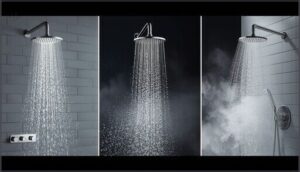
The shower head you choose shapes your water flow just as much as the pressure behind it.
Different designs handle water in distinct ways, from low-flow models to powerful drenching systems. Let’s examine how three major shower head categories control flow and affect your daily shower experience.
Low-Flow Vs. Standard Heads
Standard heads usually deliver 2.0 to 2.5 GPM, while low-flow models cap flow rate at 1.5 to 2.0 GPM.
This flow comparison shows how low-flow shower head designs cut water consumption without sacrificing coverage. Engineers use aeration and targeted nozzles to maintain strong pressure effects at reduced flow rates, delivering real water savings—up to 20 gallons per ten-minute shower.
Rainfall and Power Showers
Rainfall shower heads deliver a gentle cascade effect at moderate pressure, usually 40 to 60 psi, with a water flow rate around 2.0 to 2.5 GPM across wide spray patterns.
Rain shower designs prioritize coverage and relaxation, while power systems optimize intensity for those who want serious water pressure. Power showers flip the script—they use pressure boosting pumps to push flow beyond standard rates, creating forceful jets that transform your shower experience.
Multi-Function Spray Settings
Multi-function spray heads pack five to seven patterns—jet mode, shower, mist, and more—controlled by a selector dial that redirects water through internal channels. Here’s what you need to know:
- Jet mode maximizes flow for rinsing power
- Mist reduces consumption while covering wide areas
- Most modes maintain consistent shower head GPM regardless of spray pattern variety
Despite pressure adjustment across settings, overall flow rate stays within code limits.
Does Mineral Buildup Affect Water Flow?
Mineral buildup is one of the most common culprits behind reduced shower head flow. Hard water leaves calcium and lime deposits inside the nozzles, restricting water passage and weakening spray pressure over time.
Understanding how these deposits form and how to remove them will help you restore your shower’s performance.
Hard Water Deposits

Hard water deposits form when calcium and magnesium minerals precipitate out of heated water and cling to shower head orifices. Scale formation narrows passages over time, reducing flow rate and water pressure.
These mineral crystals also embed into fixtures, creating limescale that degrades spray patterns. Water softening systems prevent further buildup by removing hardness minerals before they reach your plumbing. Descaling methods and mineral removal restore peak performance.
Cleaning and Maintenance Tips
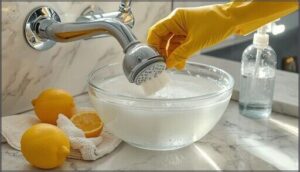
You can clear mineral deposits by soaking your shower head in white vinegar for 30 minutes, then scrubbing with a baking soda paste. Run hot water mixed with vinegar through the head for five minutes to improve flow.
After shower head cleaning and mineral removal, dry the fixture with a microfiber cloth. This simple pipe maintenance ensures water pressure stays strong and helps water conservation.
How to Measure Your Shower Head Flow Rate
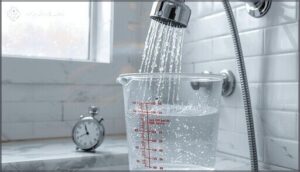
You can’t fix flow problems until you know exactly what you’re dealing with. Measuring your shower head’s flow rate gives you a baseline number to work from.
Here are two reliable methods you can use right now to get an accurate reading.
Using a Bucket and Timer
You can determine your shower’s flow rate with basic bucket and timer equipment. Place a one-gallon bucket directly under the shower head, then run the water at your typical setting for exactly 15 seconds.
Measure the collected water volume. Multiply by four to calculate gallons per minute, giving you accurate data on shower head GPM without requiring an expensive flow meter.
Flow Meter Methods
Professional flow meters deliver precision measurements that bucket tests can’t match.
Turbine flow meters use spinning rotors to track gallons per minute, while magnetic flow meters apply Faraday’s law to measure voltage in conductive water.
Ultrasonic meters emit sound pulses to calculate flow rate, and differential pressure devices use restriction points to determine shower head GPM with lab-grade accuracy.
What Role Does Shower Head Material Play?
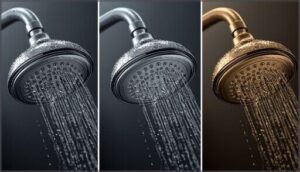
The material your shower head is made from directly impacts both how long it lasts and how consistently it delivers water.
Some materials resist corrosion and mineral buildup better than others, which keeps flow rates steady over time.
Let’s look at the three most common materials and what they offer.
Brass, Stainless Steel, ABS Plastic
You’ll find three materials dominate shower head construction, each bringing distinct advantages to water pressure and flow rate performance. Brass, stainless steel, and ABS plastic respond differently to chemical reactions and corrosion resistance challenges in your bathroom environment.
- Brass components handle high water pressure systems while resisting mineral buildup from hard water
- Stainless steel housings deliver exceptional corrosion resistance with minimal maintenance required over decades
- ABS plastic nozzles reduce manufacturing costs while maintaining adequate low-flow performance standards
- Material comparison testing shows metal options outperform plastics in durability under aggressive water conditions
Durability and Flow Consistency
You’ll notice that material resilience directly controls seal longevity and orifice wear across thousands of uses. A quality shower head GPM rating holds steady when internal seals withstand thermal cycling from cold to hot water without degrading.
Cycle testing reveals that brass and stainless steel maintain consistent flow rate under varying water pressure better than basic plastics, even with flow restrictors installed. Low-flow models need durable nozzles to preserve designed spray patterns.
Can Plumbing Issues Cause Low Flow?

Your shower head isn’t always the culprit when water flow drops off. Hidden plumbing problems can silently throttle your water supply, leaving you with weak pressure and frustration.
Let’s examine the two most common plumbing issues that cut flow before water even reaches your shower head.
Leaks and Blockages
Hidden leaks and blockages can sabotage your shower head’s flow rate before you even realize there’s a problem. Pipe corrosion creates pinholes that drop water pressure across your entire plumbing system, while mineral deposits narrow pipe bores and trap debris at bends.
Leak detection and blockage removal restore flow, but low-flow performance often signals the need for professional pressure adjustment and thorough shower head maintenance.
Shower Valve Malfunctions
Your shower valve itself can choke flow and cause wild temperature swings. A worn valve cartridge disrupts hot and cold mixing, while a faulty diverter jams water to the wrong outlet.
Thermostatic failure permits sudden bursts of scalding or cold water. Handle wear, corrosion issues, and sediment buildup inside the valve body reduce water pressure, cutting shower head GPM and sabotaging your flow rate.
How to Improve and Optimize Shower Water Flow

You don’t have to settle for weak shower flow when practical solutions exist. Improving water flow involves a combination of maintenance, upgrades, and adjustments to your plumbing system.
Here are the most effective steps you can take to boost performance and get the strong, consistent flow you’re after.
Cleaning and Replacing Shower Heads
Tackle mineral buildup by soaking your shower head in distilled white vinegar for 60 to 120 minutes, then scrub nozzle tips with a soft brush.
For shower head removal, use adjustable pliers with a cloth wrap to protect finishes. During shower head installation, apply fresh plumber tape clockwise on the shower arm threads and test for leaks at moderate flow rate to confirm ideal water pressure.
Upgrading Pipes or Fixtures
Replace old galvanized lines with PEX or copper to eliminate corrosion-driven flow loss. Upgrading your plumbing system with quarter-turn ball valves delivers sharper shutoff control than worn gate valves.
When performing fixture replacement, match fittings to local codes—crimp PEX rings for secure joints and use threaded adapters for future service access. Avoid sharp 90-degree bends to reduce turbulence and enhance flow optimization throughout your plumbing fixtures.
Checking and Adjusting Pressure Regulators
After upgrading pipes, turn your attention to the pressure regulator at your main water line. Use pressure gauges to verify outlet readings fall between 40 and 60 PSI—the sweet spot for flow optimization.
Make quarter-turn adjustment techniques with the regulator’s screw, tightening the lock nut after each change. If pressure drifts despite tuning, regulator replacement restores stable flow rate and improving water pressure across all fixtures.
Frequently Asked Questions (FAQs)
Are there legal GPM limits in my area?
Yes, you’ll find legal GPM limits set by federal standards, state codes, and local plumbing regulations.
Check your municipal building department or water utility rules for compliance checks and permit requirements on shower head flow rates.
How does temperature affect water flow rate?
Water temperature alters viscosity, directly changing flow rate. Warmer water flows more easily through pipes due to reduced internal friction, potentially increasing your shower head GPM by 15 to 20 percent compared to cold water.
Can shower arm length impact water pressure?
A longer shower arm adds flow path resistance through increased friction losses, creating a slight water pressure drop at the shower head while also changing the shower head angle and perceived force on your body.
Do handheld shower heads reduce flow rate?
Handheld shower heads don’t inherently reduce flow rate compared to fixed models.
Most handheld units meet the same 0 GPM or 8 GPM low-flow standards, using aerated spray and flow regulation to maintain water pressure while achieving water savings.
Will a water softener improve shower flow?
Can soft water really boost your shower performance? A water softener reduces mineral buildup that clogs nozzles, helping maintain consistent flow over time.
But it won’t fix low water pressure or increase your shower head’s base flow rate.
Conclusion
Think of your shower system as a mountain river flowing to the sea. When obstacles appear—mineral deposits, narrow pipes, weak pressure—the current slows to a trickle.
Now you know what affects shower head water flow and how each component shapes your daily experience. Armed with this knowledge, you can clear the path, upgrade the channels, and restore that powerful cascade. Your morning shower doesn’t have to settle for less.