This site is supported by our readers. We may earn a commission, at no cost to you, if you purchase through links. This content is for general informational and educational purposes only and is not a substitute for professional medical, dermatological, or nutritional advice.

Your shower head doesn’t need to look like a science experiment gone wrong. Those crusty white deposits that cling to every nozzle aren’t just unsightly—they’re actively choking your water flow and corroding the finish beneath. The culprit is hard water, packed with minerals that bond to metal and chrome the moment water evaporates. Left unchecked, these deposits turn a once-powerful spray into a sad trickle.
The good news? You don’t need expensive equipment or harsh chemicals to stop buildup before it starts. A few simple daily habits and the right weekly routine keep your shower head clean, clear, and functioning at full pressure for years.
Table Of Contents
- Key Takeaways
- What Causes Hard Water Stains on Shower Heads
- How Hard Water Stains Damage Shower Heads
- Daily Habits to Prevent Hard Water Stains
- Weekly and Monthly Maintenance Routines
- Water Softening and Filtration Solutions
- Protective Coatings and Preventive Treatments
- Cleaning Methods Safe for Shower Heads
- Top 5 Products to Prevent Hard Water Stains
- Common Mistakes to Avoid in Prevention
- Frequently Asked Questions (FAQs)
- How to prevent calcium buildup on shower head?
- How to stop hard water in shower head?
- Can rainwater harvesting reduce hard water issues?
- Do shower head materials affect stain resistance?
- Will higher water pressure increase mineral buildup?
- Are DIY water softeners effective for showers?
- Does water temperature influence stain formation rate?
- Conclusion
Key Takeaways
- Wipe your shower head dry with a microfiber cloth after every use to stop mineral deposits from forming before they harden into stubborn white buildup.
- Soak your shower head in a 1:3 vinegar-to-water solution for 15-60 minutes every 2-6 weeks to dissolve calcium and magnesium deposits before they clog nozzles and reduce water flow by up to 40 percent.
- Install an inline filter or whole-house water softener to trap minerals at the source and cut buildup by 80 percent, protecting your fixture’s finish and extending its lifespan for years.
- Skip abrasive scrubbers like steel wool that scratch protective coatings and create rough surfaces where minerals cling faster—use soft cloths and gentle cleaning solutions instead.
What Causes Hard Water Stains on Shower Heads
Hard water stains form when mineral-rich water evaporates on your shower head, leaving behind white, chalky deposits.
Over time, these deposits can clog the tiny holes and reduce your shower head’s water flow, making cleaning essential.
Understanding what’s in your water and how those minerals stick around helps you tackle the problem at its source.
Let’s break down the three main factors that turn your water into a stain machine.
Mineral Content and Water Hardness
Water hardness comes down to invisible minerals—mainly calcium and magnesium ions—dissolved in your supply. When levels exceed 120 mg/L as calcium carbonate, you’ve got hard water that drives scale formation on shower heads.
Testing reveals exactly how much ionic balance your water carries, which tells you how aggressive your mineral buildup will be and what descaling strategy you’ll need to prevent mineral deposits from clogging nozzles.
To better understand classifications and issues, review details about how hard water is measured.
Effects of Heat and Evaporation
Hot showers create the perfect storm for mineral deposition. Heat raises surface temperature and vapor pressure, accelerating evaporation rates that leave behind scale buildup. Your shower head experiences this cycle constantly:
- Heat transfer warms water molecules
- Evaporation rates spike in dry air
- Vapor pressure drives moisture away
- Minerals concentrate on metal surfaces
- Repeated cycles cement hard water stains
That’s why descaling becomes essential before mineral deposits choke water flow.
Types of Mineral Deposits (Calcium, Magnesium, Iron)
Three key minerals fuel the hard water stains you see: calcium carbonate forms that white, chalky scale you can scrape with moderate effort; magnesium creates a slippery, stubborn film that clings hard to surfaces; and iron oxidation leaves reddish-brown rust marks when groundwater minerals hit air.
Together, these mineral deposits create different layers of scale buildup requiring targeted cleaning approaches.
How Hard Water Stains Damage Shower Heads
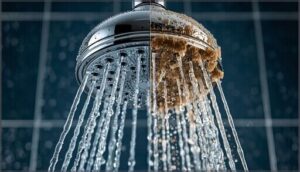
Hard water stains don’t just look bad—they actively harm your shower head over time. The mineral deposits create real problems that get worse if you ignore them.
Let’s look at the three main ways these stains damage your fixture and why catching them early matters.
Reduced Water Flow and Clogging
Hard water stains don’t just sit on the surface—they choke your shower heads from the inside out. Mineral buildup clogs nozzles and cuts flow by up to 40 percent in severely blocked heads.
Hard water stains choke your shower head from the inside, cutting flow by up to 40 percent in severely blocked heads
- Calcium carbonate forms crusty white rings around spray outlets, creating uneven patterns
- Biofilm growth traps minerals inside passages, accelerating clogging in warm conditions
- Hose kinking and connector restrictions compound flow loss at joints
- Regular descaling and a water softener prevent mineral deposits before clog prevention becomes urgent
Dulling and Corrosion of Finishes
Mineral buildup doesn’t just mark your shower heads—it permanently degrades the protective layers. Calcium and magnesium deposits create rough surfaces that dull chrome and nickel finishes, while iron-rich minerals leave rust-colored stains that resist wiping. Corrosion prevention starts with water softening to block mineral interactions before finish deterioration sets in.
Surface roughening accelerates material degradation as tiny mineral crystals abrade the finish during every use.
| Finish Type | Vulnerability Level | Primary Mineral Threat |
|---|---|---|
| Chrome Plating | Low | Calcium carbonate scale |
| Brushed Nickel | Medium | Magnesium film formation |
| Bronze/Brass | High | Iron-induced rust spots |
| PVD Coating | Low-Medium | Chloride corrosion |
| Stainless Steel | Medium | Sulfate deposits |
Long-Term Fixture Lifespan Impact
Ongoing exposure to hard water stains slowly undermines your shower heads’ structural integrity. Mineral damage accelerates wear on internal components, while corrosion effects weaken protective finishes far beyond cosmetic concerns. Water quality directly determines fixture durability—deposits create friction that stresses moving parts and seals.
- Scale buildup embeds in internal passages, reducing material life through accelerated wear
- Calcium deposits increase operating temperatures, stressing seals and shortening service intervals
- Mineral-laden water degrades rubber gaskets, causing leaks that lead to fixture failure
- Deposits on valve seats create pressure instability and necessitate earlier replacement
- Regular descaling and water softener installation extend lifespan by preventing cumulative damage
Fixture maintenance prevents the cascade of failures that mineral buildup triggers over time.
Regular cleaning with gentle, natural ingredients like shea butter-based solutions helps dissolve deposits without damaging fixture finishes.
Daily Habits to Prevent Hard Water Stains
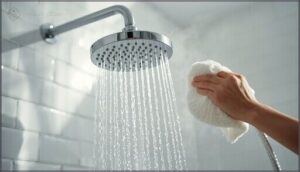
The best defense against hard water stains is stopping them before they form.
You don’t need expensive products or complicated routines to keep your shower head clean. A few simple daily habits will save you hours of scrubbing later.
Wiping Down Shower Heads After Use
You can stop most mineral buildup before it starts—simply wipe your shower head right after each use. Grab a damp microfiber cloth and gently rub the spray face and nozzle edges where minerals love to cling. This Daily Wipe Technique removes water droplets before they evaporate and harden into stubborn deposits.
| Shower Head Material | Best Cloth Type | Wiping Motion |
|---|---|---|
| Chrome | Microfiber | Circular, gentle pressure |
| Brushed Nickel | Soft cotton | Light, straight strokes |
| Plastic | Microfiber or terry | Pat and wipe motions |
| Brass/Bronze | Ultra-soft microfiber | Minimal pressure, quick pass |
| Stainless Steel | Lint-free microfiber | Follow grain direction |
The Microfiber Cloth Benefits are clear—these fabrics trap minerals without scratching delicate finishes. Focus your wiping around nozzle openings where calcium and magnesium concentrate fastest. For even better Mineral Deposit Prevention, keep a small spray bottle with a 50/50 water and white vinegar solution nearby. A quick spritz loosens any film before you wipe.
Finish by blotting the entire head dry with a clean towel. This final step prevents new water spots from forming and keeps your shower head cleaning routine practically easy. When you make this part of your shower maintenance habit, you’ll rarely need aggressive descalers or Gentle Cleaning Products later.
Regular post-shower care protects both the spray pattern and the finish, helping your fixture look newer longer while preventing hard water stains from taking hold. For more on the importance of for ideal shower head performance, refer to thorough care guides.
Using Squeegees or Towels
A quick squeegee pass after your shower takes seconds but saves hours of scrubbing later. Here’s how to make it work for Preventing Hard Water Stains on shower heads:
- Choose a flexible silicone blade sized to cover the head width for efficient mineral removal.
- Apply light, even pressure in downward strokes to dislodge deposits without scratching chrome finishes.
- Follow with a lint-free microfiber towel to pat the head completely dry and lift remaining droplets.
- Inspect your blade weekly for nicks that reduce contact and replace when the edge becomes uneven.
These Squeegee Techniques and Drying Methods work together—squeegees remove bulk water while towels capture what’s left. Store both tools near your shower for easy access. Integrate this into your Cleaning Routines right after each use, and you’ll rarely see mineral buildup on your fixture.
Quick Daily Spray Solutions
A thirty-second spritz after each shower beats hours of deep cleaning later. Daily spray formulas with mild surfactants lift mineral dust before it hardens into stubborn water spots.
Look for citric-acid or white vinegar based shower head cleaning solutions that dry to a protective film—they act as mineral repellents for up to twenty-four hours, preventing hard water stains without scrubbing.
Weekly and Monthly Maintenance Routines
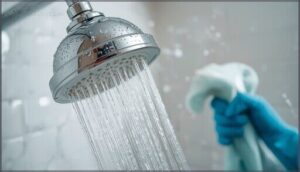
Daily habits keep your shower head clean, but they won’t stop every mineral deposit from forming. That’s why you need a simple weekly and monthly routine to catch buildup before it becomes a problem.
Here are three maintenance tasks that’ll keep your shower head flowing smoothly all year long.
Scheduled Vinegar Soaks
Regular vinegar soaks break down mineral buildup before it hardens into stubborn deposits. Mix one part white vinegar with three parts warm water, then let your shower head soak for 15 to 60 minutes depending on buildup severity.
- Schedule soaks every 2 to 6 weeks based on your water hardness
- Submerge the fixture completely in a container or sealed bag
- Rinse thoroughly with clean water after each soak
- Run hot water through the head for 30 seconds to clear debris
Gentle Scrubbing Techniques
After soaking loosens deposits, soft scrub methods finish the job without scratching your shower heads.
Use a damp microfiber cloth to wipe the surface in small circles, applying just enough pressure to lift soap film and mineral buildup.
Rinse thoroughly with warm water, then dry completely with a clean towel to prevent new spots from forming immediately.
Inspecting for Early Buildup
Visual inspection catches mineral buildup before it becomes a problem. Once a week, look closely at the spray holes under bright light for white specks or chalky lines—these signal scale detection time.
Check the base and arm joints where mineral testing shows deposits concentrate first.
Run your finger along seals and threads to feel for rough crust, a clear sign descaling is needed.
Water Softening and Filtration Solutions
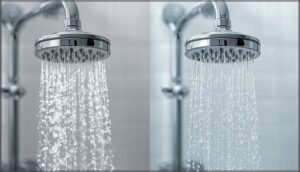
If you want to stop hard water stains before they start, you need to treat the water itself. Installing the right filtration or softening system can cut mineral deposits by 80 percent or more.
Here are three proven solutions that tackle hard water at the source.
Installing Whole House Water Softeners
For real relief from hard water, you’ll want a whole house water softener installation. Water testing methods confirm your hardness level first—this determines your softener system design and salt efficiency needs.
Installation costs range from $800 to $2,500, but these water treatment solutions cut mineral buildup by 80 percent.
Maintenance schedules require monthly salt checks and quarterly brine tank cleaning.
Using Inline Shower Head Filters
An inline filter screws between your shower arm and head in minutes—no plumber needed. These compact units use activated carbon and KDF media to trap minerals before they reach your fixture, cutting buildup by up to 80 percent.
Filter Components handle the heavy lifting:
- Housing fits standard 1/2 inch threads on most shower heads
- Activated carbon removes chlorine and improves water feel
- KDF 55 media targets metals through redox reactions
- Cartridge Replacement takes 6 to 12 months depending on usage
- Clear windows let you monitor media status at a glance
Easy Installation means you’re protecting your shower today, not next week.
Benefits of Electronic Descalers
Electronic descaling uses electromagnetic fields to alter mineral deposits before they crust your shower head, reducing scale buildup without salt or chemicals.
You’ll notice improved water flow as pipes stay clearer, and fixtures last longer with fewer clogs and seal failures.
The system mounts on your main supply line and runs maintenance-free—no cartridges to swap, no regeneration cycles, just steady scale reduction and lower upkeep costs year after year.
Protective Coatings and Preventive Treatments
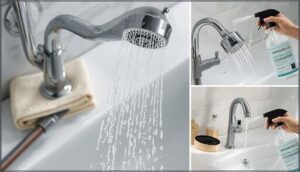
Protective coatings create a barrier between minerals and your shower head’s surface. These treatments make water bead up and roll off instead of sitting and evaporating into stubborn deposits.
Here’s how to choose and apply the right sealant for your fixtures.
Applying Fixture-Safe Sealants
Applying a fixture-safe sealant around your shower heads creates a protective barrier that keeps mineral deposits from sneaking behind the fixture and weakening the bond with the wall. Choose 100% silicone sealants over latex types—they resist mildew better in wet environments and won’t peel in high humidity.
Before application, clean the area thoroughly with isopropyl alcohol to remove soap scum and old residue. Lightly roughen glossy surfaces with a non-scratch pad to boost adhesion. Apply a continuous bead around the base, then smooth it with a damp finger within five minutes for a clean, watertight seal.
- Make certain surfaces are completely dry before applying to prevent weak spots and pinholes in the seal
- Work in temperatures between 40°F and 90°F for proper curing and long-lasting surface protection
- Avoid turning on water until the sealant fully cures per product instructions to maintain durability
How Often to Reapply for Best Results
Generally, you should refresh protective coatings on your shower heads every six to twelve months to maintain their barrier against hard water stains. If water hardness runs high in your area, tighten that schedule to every nine months to keep coating durability at its peak. Reapplication intervals also shift after deep descaling sessions—apply a fresh layer within two weeks to restore full protection.
Electronic descalers need yearly check-ups to confirm settings haven’t drifted, while inline filter replacement follows a three-month cycle under normal use. Mark your calendar now to stay ahead of mineral deposit removal needs.
Cleaning Methods Safe for Shower Heads
Cleaning your shower head the right way makes all the difference between preventing stains and accidentally damaging the finish.
You need methods that dissolve minerals without scratching surfaces or leaving harsh chemical residues behind. Here are three safe approaches that actually work.
Vinegar and Baking Soda Technique
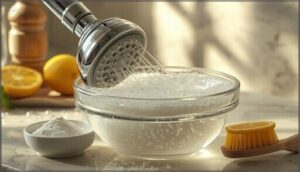
White vinegar and baking soda offer a reliable natural remedy for descaling shower heads without harsh chemicals. The acetic acid in vinegar dissolves calcium deposits, while baking soda provides gentle abrasive action for mineral removal.
This pH balancing combination addresses hard water stains effectively when you soak the detached head for 15 to 30 minutes, then scrub with a soft brush.
Avoiding Abrasive Materials
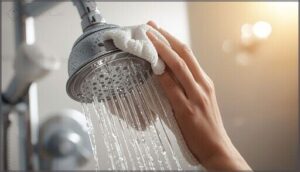
Your shower heads deserve protection from scratching, so skip steel wool and harsh scouring pads entirely. Choose soft cloth materials like microfiber towels or a nonabrasive sponge when removing mineral deposits. Abrasive brushes wear away protective finishes over time, making future descaling harder.
Gentle cleaning tips prioritize surface protection methods that preserve chrome and nickel coatings while still tackling stubborn buildup effectively with proper cleaning solutions.
Safe Use of Chemical Descalers
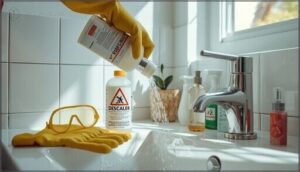
Descaler safety starts with reading the label before you unscrew the cap. Always wear gloves and eye protection when handling acidic solutions to avoid skin burns from chemical components.
Test descalers on a hidden spot first to prevent surface damage. Use them in well-ventilated spaces, and never mix with bleach—acidic reactions create toxic fumes that’ll clear a room fast.
Top 5 Products to Prevent Hard Water Stains
You don’t need expensive specialty cleaners to fight hard water stains on your shower head. Most effective products are affordable household items you probably already own or can grab at any grocery store.
Here are five proven products that remove mineral buildup and prevent future stains when used regularly.
1. Earthworm Mold And Mildew Treatment
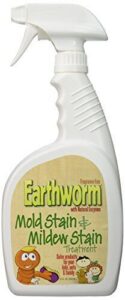
Enzyme-powered cleaners like Earthworm Mold And Mildew Treatment offer a gentler approach to stain prevention. This 22-ounce bottle uses natural bioenzymatic action to break down organic buildup before it hardens into stubborn deposits.
You’ll spray the affected area, wait 5 to 8 minutes, then lightly scrub if needed. The fragrance-free formula is safe around kids and pets, and enzymes keep working after application to prevent future growth.
At $24.99, it’s pricier than household alternatives but yields effective outcomes without harsh chemical residues.
| Best For | Households seeking a safer, eco-friendly mold treatment that works without heavy scrubbing or harsh fumes. |
|---|---|
| Brand | Earthworm |
| Item Form | Liquid |
| Size | 22 oz |
| Price | $24.99 |
| Eco-Friendly | Biodegradable |
| Primary Use | Mold removal |
| Additional Features |
|
- Fragrance-free bioenzymatic formula is safe around kids and pets
- Continues working after application to prevent future mold growth
- Effective on both porous and nonporous surfaces without harsh chemical residues
- At $24.99 for 22 oz, it’s more expensive than standard cleaning alternatives
- May require multiple applications for larger mold areas or stubborn stains
- Some users report decreased effectiveness compared to earlier formulations
2. Heinz White Vinegar
Heinz Distilled White Vinegar is the workhorse of hard water prevention. This 16-ounce bottle contains 5% acetic acid that dissolves calcium and magnesium deposits without damaging most finishes.
You’ll mix equal parts vinegar and water in a spray bottle for daily maintenance or use it full-strength for monthly soaks.
At $6.50, it’s budget-friendly and doubles as a kitchen ingredient. The all-natural formula leaves no chemical residue, making it safe for homes with kids and pets.
| Best For | Budget-conscious homeowners looking for a non-toxic, multipurpose solution that handles both hard water cleaning and everyday kitchen tasks. |
|---|---|
| Brand | Heinz |
| Item Form | Liquid |
| Size | 16 fl oz |
| Price | $6.50 |
| Eco-Friendly | All-natural |
| Primary Use | Multi-purpose cleaning |
| Additional Features |
|
- All-natural formula with 5% acidity effectively dissolves hard water deposits without harsh chemicals
- Versatile use for cleaning (microwaves, toilets, laundry) and cooking (marinades, pickling, sauces)
- Affordable at $6.50 for 16 ounces and safe around kids and pets
- Glass bottle may not be as convenient or durable as plastic alternatives for some users
- 16-ounce size is smaller than expected for those needing larger quantities
- Less powerful than specialized chemical cleaners for tough clogs or heavy buildup
3. Bioclean Hard Water Stain Remover
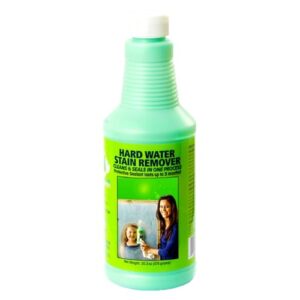
When stubborn mineral buildup won’t budge, Bio Clean Hard Water Stain Remover steps in with professional-grade power. This 20.3-ounce cream uses a biodegradable abrasive formula to physically scrub away years of calcium, limescale, and iron stains from chrome and glass surfaces.
You’ll apply it with gentle pressure using a soft cloth, then rinse thoroughly. At around $20, it removes the toughest deposits that vinegar can’t touch. Test on hidden areas first to protect delicate finishes from scratching.
| Best For | Homeowners dealing with severe hard water buildup on chrome and glass surfaces who don’t mind putting in some physical effort to restore their fixtures. |
|---|---|
| Brand | Bio-Clean Products |
| Item Form | Cream |
| Size | 20.3 oz |
| Price | Not specified |
| Eco-Friendly | Biodegradable |
| Primary Use | Hard water stain removal |
| Additional Features |
|
- Professional-strength formula tackles years of stubborn calcium, limescale, and iron stains that vinegar can’t remove
- Eco-friendly and biodegradable, so you’re not dumping harsh chemicals down the drain
- Works on multiple surfaces including shower doors, tiles, grout, and glass
- Requires scrubbing and elbow grease to get results—it’s not a spray-and-wipe solution
- Can irritate skin during use, so gloves are pretty much necessary
- May only lighten really stubborn stains rather than removing them completely
4. Arm And Hammer Pure Baking Soda
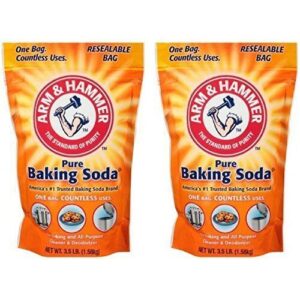
For lighter cleaning work that pairs perfectly with vinegar, Arm & Hammer Pure Baking Soda delivers gentle abrasive action without scratching. This 112-ounce stand-up bag offers pure sodium bicarbonate—no added scents or dyes.
You’ll mix it with water to form a paste, then scrub mineral deposits from chrome and stainless steel. It neutralizes acidic stains while physically lifting buildup.
At under $10 for seven pounds, you’ll have enough for hundreds of cleaning sessions. Store it sealed to prevent moisture clumping.
| Best For | Budget-conscious households looking for an affordable, multipurpose cleaner that works well on mineral deposits and pairs with vinegar for non-toxic cleaning. |
|---|---|
| Brand | Arm & Hammer |
| Item Form | Powder |
| Size | 112 oz |
| Price | Not specified |
| Eco-Friendly | Pure baking soda |
| Primary Use | Multi-purpose cleaning |
| Additional Features |
|
- Extremely affordable at under $10 for seven pounds, providing hundreds of cleaning sessions
- Pure sodium bicarbonate with no added scents or dyes, making it safe for multiple household uses beyond cleaning
- Gentle abrasive action that effectively removes mineral deposits and buildup without scratching surfaces like chrome and stainless steel
- Requires mixing with water to create a paste, adding an extra step compared to ready-to-use cleaners
- Can clump if exposed to moisture, requiring careful sealed storage between uses
- Some customers report receiving wrong products or experiencing shipping issues with online orders
5. Ziploc Gallon Freezer Bags
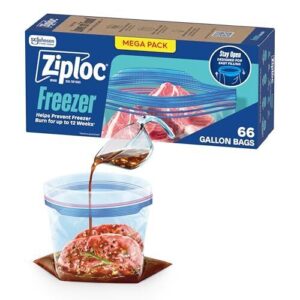
When you’re ready to soak your shower head in vinegar overnight, Ziploc Gallon Freezer Bags make the job simple. Their Stay Open design lets you fill without spilling, and the Grip ‘n Seal technology creates an airtight closure that won’t leak acid solution onto your tub.
At 10 inches wide, these bags fit most standard shower heads. You’ll secure them with a rubber band, let the vinegar work for eight hours, then toss the bag when you’re done.
| Best For | People who need a reliable, leakproof bag for overnight vinegar soaks on shower heads or other cleaning projects that require secure seals. |
|---|---|
| Brand | Ziploc |
| Item Form | Plastic Bags |
| Size | 66 count |
| Price | Not specified |
| Eco-Friendly | Recyclable plastic |
| Primary Use | Food storage |
| Additional Features |
|
- Stay Open design makes filling with vinegar easy without spills
- Grip ‘n Seal technology creates a strong, leakproof closure that won’t drip during overnight soaks
- Large gallon size fits most standard shower heads comfortably
- Some users report the seal doesn’t always work perfectly
- Higher priced compared to other freezer bag brands
- No built-in air vacuum feature for extra-tight seals
Common Mistakes to Avoid in Prevention
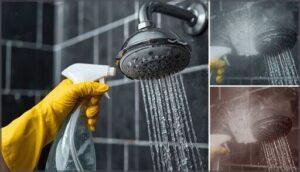
Even with the best intentions, you can accidentally make hard water stains worse if you’re not careful. A few common missteps can damage your shower head’s finish, create dangerous chemical reactions, or let buildup spiral out of control.
Here are the mistakes you need to avoid to keep your prevention efforts on track.
Using Abrasive Scrubbers
You might think scrubbing away hard water stains with steel wool or coarse pads saves time, but abrasive materials destroy your shower heads. These harsh scrubbing methods scratch chrome finishes, dull protective coatings, and create surface damage that traps mineral deposits faster.
Stick to gentle cleaning techniques like soft cloths or nylon brushes when removing hard water stains—your shower head cleaning routine will actually prevent buildup instead of making it worse.
Mixing Incompatible Cleaners
When you mix cleaners like white vinegar with bleach or CLR with ammonia-based products, you’re triggering chemical reactions that release toxic fumes into your bathroom. These hazardous combinations create chlorine gas and other irritants that burn your lungs and eyes within minutes.
Never combine these cleaner interactions:
- Bleach with white vinegar or lemon juice — releases chlorine gas causing respiratory distress
- Ammonia with acid mixtures — produces chloramines that irritate throat and lungs
- CLR with bleach — generates dangerous fumes in enclosed spaces
- Bar Keepers Friend with bleach — creates toxic compounds harmful to breathe
- Multiple products simultaneously — unpredictable reactions increase exposure risks
Neglecting Regular Maintenance
Skipping your Shower Head Maintenance routine for just two weeks lets mineral buildup accelerate, turning simple prevention into costly repair. Regular maintenance delays compound as deposits bond to chrome and clog nozzles, reducing water flow by up to 30 percent.
Preventive Measures through consistent Shower Cleaning Tips protect Fixture Durability far better than reactive scrubbing after Neglect Effects appear.
Frequently Asked Questions (FAQs)
How to prevent calcium buildup on shower head?
Wipe your shower head dry after every use to stop water droplets from evaporating. Soak weekly in distilled white vinegar.
Install an inline filter to trap minerals before they reach the nozzle.
How to stop hard water in shower head?
Water softening systems remove calcium and magnesium before they reach your shower heads.
Install a whole-house softener, point-of-use filter, or electronic descaler device to tackle mineral deposits at the source and prevent buildup.
Can rainwater harvesting reduce hard water issues?
Looking to reduce mineral buildup at its source? Rainwater harvesting systems offer natural softening alternatives by capturing low-mineral water, markedly reducing calcium and magnesium deposits that create hard water stains on fixtures.
Do shower head materials affect stain resistance?
Yes, materials make a significant difference. Stainless steel and chrome-plated shower heads resist mineral deposits better than plastic models.
Silicone nozzles repel buildup most effectively, allowing you to wipe away stains with minimal effort.
Will higher water pressure increase mineral buildup?
Like a firehose forcing more water through, higher water pressure does push extra mineral-laden flow through your shower heads.
That elevated turbulence and contact time speeds up scale formation on internal passages and external nozzles.
Are DIY water softeners effective for showers?
DIY cleaning with inline water filters and compact softeners can reduce mineral buildup on shower heads, though effectiveness varies by water hardness levels.
Whole-house water treatment systems deliver more consistent hard water stain prevention results.
Does water temperature influence stain formation rate?
Hotter water accelerates mineral deposits by increasing evaporation rates and calcium carbonate precipitation. Every 10°C rise doubles residue concentration on shower heads, making thermal cycling and high temperatures major drivers of stubborn scale formation.
Conclusion
Think of hard water stains like rust on a chain—ignored long enough, they lock everything in place. The difference between a shower head that flows freely and one that sputters starts with what you do today.
Wipe down surfaces after each use. Schedule weekly vinegar soaks. Install a filter if your water runs hard.
Learning how to prevent hard water stains on shower head issues means choosing action over delay—and your fixtures will reward that choice with years of reliable performance.