This site is supported by our readers. We may earn a commission, at no cost to you, if you purchase through links. This content is for general informational and educational purposes only and is not a substitute for professional medical, dermatological, or nutritional advice.
Most people grabbing a pair of clippers for the first time make the same mistakego straight for the blade understanding what the guard does, and the results speak for themselves.
That small plastic attachment isn’t an accessory; it’s the entire system controlling how much hair you remove and keeping the blade from touching skin.
Every professional barber builds their craft around understanding guard sizes, from the tight fade at a #1 to the fuller texture of a #4.
Once you understand what hair clipper guards are used for—length control, safety, and consistency—everything from basic trims to clean fades starts making a lot more sense.
Table Of Contents
- Key Takeaways
- What Are Hair Clipper Guards Used For?
- How Do Clipper Guards Work?
- Common Types of Clipper Guards
- Clipper Guard Sizes and Numbering Explained
- Choosing The Right Clipper Guard for Your Haircut
- Achieving Even and Consistent Haircuts
- Safety Benefits of Using Clipper Guards
- Maintaining and Cleaning Clipper Guards
- Advanced Haircutting Techniques With Guards
- Frequently Asked Questions (FAQs)
- What does 1, 2, 3, 4, 5 mean in haircuts?
- Is a 4 or 5 guard shorter?
- Which haircut is shorter, 4 or 5?
- Can clipper guards work on all clipper brands?
- How often should clipper guards be replaced?
- Are metal guards better than plastic guards?
- Can guards be used on wet hair safely?
- Do clipper guards work for thick curly hair?
- Conclusion
Key Takeaways
- Clipper guards aren’t optional accessories — they control exactly how much hair gets cut and keep the blade from ever touching your skin directly.
- Every guard number maps to a specific hair length, and knowing that system means you can replicate any style consistently without guessing.
- Hair texture changes how a guard reads on the finished cut, so coarse, curly, or thick hair almost always needs you to size up to get the look you’re after.
- Clean, dry, and lightly oiled guards last longer and perform better, so a quick maintenance routine after each use protects both your tools and your client’s scalp.
What Are Hair Clipper Guards Used For?
Clipper guards are small attachments that snap onto your clippers and do more work than most people realize.
They typically snap on in seconds and come in sizes from 1mm to 25mm—so whether you’re trimming a stubble shadow or shaping a full beard, there’s a guard for that, as this beard shaping guide with clippers walks through nicely.
They’re not just about shape the whole experience — they shape the whole experience, from safety to consistency.
Here’s what they’re actually used for.
Purpose of Clipper Guards
A clipper guard is your first line of defense against a bad haircut. It attaches to your clipper blades and controls hair length while providing skin protection at the same time.
Whether you’re after style replication of a previous look or building beginner confidence at home, the right guard size manages both. It’s that straightforward. Remember that higher guard numbers length when choosing a guard.
How Guards Control Hair Length
Guards work by setting a fixed gap between the blade and your scalp — that gap is your actual hair length. The comb-like guard teeth lift strands upright before they reach the blade, so only hair exceeding that gap gets cut. Lower guard numbers mean shorter lengths; higher ones leave more.
Fine-tune length further using your clipper’s taper lever for precise in-between results. Understanding different guard types helps match hair texture.
Role in Safe Haircutting
Beyond length control, safety is where guards genuinely earn their place in your toolkit. They create barrier distance between the blade and your scalp, distributing pressure evenly across a wider plastic surface rather than concentrating force on one sharp edge.
That angle control keeps the clipper riding flat, which means sensitive spots near your ears or neck stay protected — beginner confidence included.
How Do Clipper Guards Work?
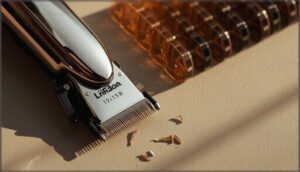
Understanding how clipper guards actually work makes everything else click into place.
It’s not complicated once you break it down into a few key parts. Here’s what you need to know.
Mechanism of Attachment
Attachment isn’t complicated once you understand what’s actually happening. Most clipper guards use a Snap‑on Hook at the front that anchors under the stationary blade edge, then the rear clicks over the housing using flexible Dual Contact Points.
Magnetic Lock designs pull the guard into Blade Alignment automatically. Either way, you’re looking for:
- Front hook seated flush
- Rear latch clicked
- No visible gap at the blade base
- Guard releasing only via the Release Tab
Relationship Between Guard Size and Hair Length
Every guard number maps directly to a hair length, and knowing that relationship puts you in control.
Guard sizes generally run from 1 through 8, leaving hair between 3 mm and 25 mm.
Length increment precision matters here — lower guard numbers mean more scalp visibility, while higher numbers add coverage.
Hair texture impact also shifts results, so coarser hair may read slightly shorter than the guard suggests.
Preventing Accidental Cuts
A good barrier design is what separates a clean cut from a painful one. Clipper guard sizes create blade clearance so bare metal never drags directly across skin — and that matters most in tricky spots. Here’s what proper skin guarding actually protects you from:
- Ear nicks — ear protection keeps curved cartilage clear of moving blades
- Neck folds — neck safety prevents pinching when skin bunches during tilting
- Scalp moles — blade clearance lets the guard glide past raised spots cleanly
- Beginner slips — guard numbers give you a safety margin while haircutting techniques develop
- Heat irritation — the guard face, not the blade, contacts skin during long sessions
Keep your guards on, keep them clean through regular hair clipper maintenance, and they’ll keep you safe.
Common Types of Clipper Guards
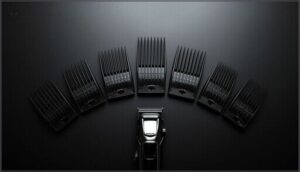
Not all clipper guards are built the same, and knowing the difference can change how your cuts turn out.
Some guards clip too close, others leave bulk, so brushing up on proper beard grooming and hygiene practices helps you match the right tool to the right look.
Each type is designed with a specific purpose in mind, whether you’re working on a full head of hair, touching up a fade, or trimming a beard.
Here are the main types you’ll want to know.
Fixed-Length Guards
Fixed-length guards are your most reliable haircutting tools when consistency matters. Each guard size locks the blade at a precise distance from the scalp — no guesswork, no surprises.
Guard numbers increase with cutting length, so higher guard numbers always leave more hair. Their blade protection design, material durability, and magnetic attachment options make them compatible with most professional clippers, keeping guard transitions predictable every time.
Adjustable Guards
Adjustable guards give you blade distance control that fixed guards simply can’t match. By shifting the taper lever — your fade precision lever — you move through mini‑guard steps without swapping attachments, enabling real‑time length adjustment mid‑cut.
- Bridge gaps between clipper guard sizes during a fade
- Fine-tune guard size without changing attachments
- Smooth taper lines using lever tuning alone
- Control guard numbers with one fluid motion
Specialty Guards for Beards and Mustaches
Beard and mustache guards are built differently than standard clipper guards — narrower, slightly curved, and sized in precise millimeter steps that match real facial hair goals.
| Guard Type | Best Use |
|---|---|
| Beard length guards (1–3 mm) | Designer stubble, 5 o’clock shadow |
| Curved facial guards | Jawline contouring, chin shaping |
| Mustache edging guards | Lip line, soul patch definition |
| Textured beard guards | Coarse or curly beard trimming |
These grooming tools make men’s grooming far more controlled and intentional.
Clipper Guard Sizes and Numbering Explained
Once you understand how guard numbers work, choosing the right one gets a lot easier. Each number maps to a specific length in millimeters or inches, and knowing that the system takes the guesswork out of your cuts.
Here’s a breakdown of what you need to know about guard sizes, how they’re measured, and how to match them to the look you’re going for.
Numbering System and Millimeter/Inch Equivalents
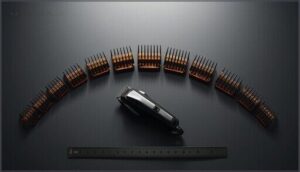
Most clipper guard sets follow a haircut number system running from 1 to 8, where each number represents a fixed hair length — usually stepping up by 1/8 inch. Metric conversions round those fractions to whole millimeters, so a #2 guard reads about 6 mm on the plastic.
Watch for brand variations, though, since a #4 can differ slightly between manufacturers. Half‑step sizes and chart interpretation help you navigate those gaps confidently.
Typical Size Range and Their Uses
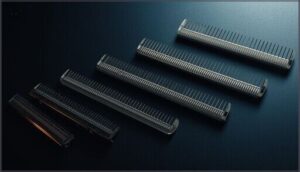
Once you move past the numbering system, the real picture becomes clear.
Extra Short Applications — guards 0 to 1.5 — handle skin fades and military buzz cuts.
Short Guard Styles around 2 to 3 suit clean everyday haircuts.
Medium Guard Versatility covers tapers and blended looks.
Long Guard Maintenance preserves length without a buzzed appearance.
Beard Guard Lengths follow the same logic — shorter for stubble, longer for full beards.
Visual Guide to Guard Lengths
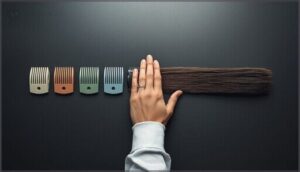
Knowing your guard sizes on paper is one thing — seeing them in action is another.
Length charts pair each number with its millimeter conversion, but hair texture impact changes everything.
A guard size that looks like a soft taper on straight hair can read as a full fade haircut on thick curls.
Color coding helps you track visual fade steps without second-guessing yourself mid-cut.
Choosing The Right Clipper Guard for Your Haircut
Picking the right guard isn’t guesswork — it’s about understanding a few key factors that work together.
Your hair type, the style you’re going for, and the length you want all point you toward the right choice.
Here’s what to think about before you snap that guard on.
Factors Influencing Guard Selection
Picking the right guard size isn’t just about how short you want to go — several factors pull that decision in different directions at once. Hair density, head shape, scalp sensitivity, lifestyle needs, and tool compatibility all shape what actually works on a given client. Before you reach for any hair clipper guards, consider these key influences:
- Hair density — thick, dense hair reads shorter after being cut, so going one size up prevents an overly close result
- Head shape — rounder heads often need longer guard sizes on the sides to avoid a shaved-ball appearance
- Scalp sensitivity — moles, bumps, or irritation-prone skin call for longer guards that keep blades riding further from the surface
- Lifestyle needs — athletes or helmet-wearers usually prefer shorter fade or taper lengths to reduce bulk and heat
- Tool compatibility — a weaker motor can snag under short guards through thick hair, so matching the clipper’s power to the guard matters
Guard Size for Different Hair Styles
Different styles call for different guard sizes — and the gap between them matters more than most people expect.
A buzz cut usually runs between 3mm and 13mm depending on how close you want it, while fade progressions step through 1.5mm up to 13mm for smooth blending.
Crew cut lengths usually sit around 6mm on sides, with beard trim guards and pompadour top guard choices varying by style preference.
Matching Guard to Hair Texture and Thickness
Hair texture changes everything about which guard size works best. Here’s what to keep in mind:
- Straight Hair Guard choices show every imperfection — overlap your passes carefully.
- Fine Hair Length looks shorter than it, so go one guard up.
- Thick Hair Bulk compresses, making cuts appear tighter than the number suggests.
- Curly Hair Shrinkage means always sizing up to preserve the curl pattern.
- Coarse Hair Teeth need wider-spaced guards to avoid snagging.
Achieving Even and Consistent Haircuts
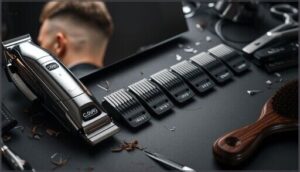
Getting a consistent cut every time isn’t luck — it’s the right technique paired with the right guard.
Once you understand how guards work with your clippers, even results stop feeling like guesswork.
Here’s what you need to know to make every haircut clean and controlled.
Guard Role in Uniform Results
The secret to a uniform cut is fixed gap control — hair clipper guards keep blades at a consistent length from the scalp on every pass. Even blade pressure matters too, because tilting the guard shifts that distance and breaks uniform hair distribution across sections.
Clipper guards deliver uniform cuts through fixed gap control — tilt the blade and consistency disappears
| Guard Size | Hair Length | Predictable Cut Outcome |
|---|---|---|
| #1 | 3mm | Very short, near-scalp buzz |
| #4 | 13mm | Medium coverage, forgiving margin |
| #6 | 19mm | Fuller length, visible texture |
Blending and Tapering Techniques
Blending and tapering come down to three things working together: guard lever adjustments, blade angle control, and disciplined fade shift steps.
Moving through guard sizes in small increments — say, a #2 to a #3 — keeps the taper zone definition clean.
Finishing pass techniques then erase any leftover weight lines.
- Use the taper lever to bridge gaps between clipper guard sizes
- Tilt blade angle slightly outward on upward strokes for softer blending techniques
- Rework overlap zones on your finishing pass to eliminate visible bands
Tips for Beginners
Every beginner’s biggest mistake? Skipping straight to a short guard size. Start Long — #4 or higher — so you’ve got room to work down gradually.
Run your clippers against the grain, keep flat guard placement throughout, and use overlap strokes to avoid stripes. Check lengths often as you go.
| Tip | Why It Matters | Guard Size |
|---|---|---|
| Start Long | Prevents cutting too short | #4 or higher |
| Work Against Grain | Feeds every strand evenly | Any |
| Overlap Strokes | Eliminates missed patches | Match target length |
Safety Benefits of Using Clipper Guards
Using clipper guards isn’t just about getting the length right — it’s also one of the smartest safety decisions you can make. Whether you’re cutting your own hair at home or helping someone else, guards take a lot of the risk out of the equation.
Here’s a closer look at the key safety benefits they bring to the table.
Protection Against Nicks and Cuts
Running bare blades near skin is where most haircutting mishaps happen.
A solid blade guard design puts physical distance between the cutting edge and your scalp, so slip-resistant grip and steady hand movement do the rest.
Magnetic attachment security keeps the guard locked in place throughout the cut, and ear guard protection helps you trim cleanly around delicate areas — all without skin contact, preventing it from becoming a second thought.
Guards as a Barrier for Sensitive Scalps
Sensitive scalps don’t forgive rough tools.
Hair Clipper Guards act as a blade-skin buffer, keeping the cutting edge off irritated skin entirely. Plastic guards offer a gentle glide with natural friction reduction, while magnetic safety locks the guard firmly so it won’t shift mid-pass. Pair the right Guard Sizes with good Grooming Tips and Personal Grooming Hair Care advice, and scalp cushioning becomes automatic.
Advantages for Home Haircutting
Beyond scalp protection, Hair Clipper Guards make home haircutting genuinely practical.
With Guard Sizes clearly labeled, even first‑timers can follow solid Personal Grooming Advice without second‑guessing themselves — that’s a real Confidence Boost.
Smart Haircutting Techniques at home deliver serious Family Budget savings too.
- Time Efficiency: 15‑minute cuts, no appointment needed
- Family Budget: save $1,000+ annually for families of four
- Quick Touch‑ups: maintain shape between full cuts
- Space Saving: Clippers store neatly in any drawer
- Confidence Boost: consistent Guard Sizes remove guesswork entirely
Maintaining and Cleaning Clipper Guards
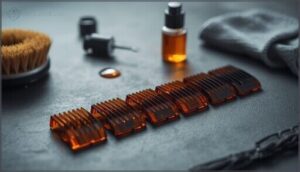
Taking care of your clipper guards is just as important as knowing how to use them.
A little routine maintenance goes a long way toward keeping your guards performing like new and extending their lifespan.
Here’s what you need to know to keep them clean, rust-free, and properly stored.
Proper Cleaning Methods
Cleaning your clipper guards doesn’t have to be complicated. A little consistency goes a long way in keeping your grooming tools and equipment performing at their best.
| Step | What To Do |
|---|---|
| Brush Debris Removal | Dry‑brush teeth with a stiff nylon brush after every use |
| Soap Soak Guidelines | Soak plastic guards 5 min; metal guards up to 15 min |
| Disinfectant Application | Wipe with 70% isopropyl alcohol or spray Barbicide |
| Thorough Rinsing Steps | Rinse under lukewarm running water until completely clear |
| Air Drying Tips | Air dry 30+ minutes on open racks before reattaching |
Follow this routine after every session, and your hair clipper guards will stay sharp, safe, and ready.
Preventing Rust and Wear
Once your guards are dry, keeping rust and wear at bay comes down to smart habits. A drop or two of clipper oil on metal guards daily shields against moisture damage, while polycarbonate and nylon builds offer built‑in rust‑resistant materials that handle salon heat and disinfectants without warping.
- Apply protective lubrication after every cleaning session
- Choose guards with durable construction features like reinforced ribs
- Look for heat‑chemical resistance if you use alcohol sprays regularly
- Secure attachment design prevents friction wear between guard and clipper blades
- Match guard sizes to your haircut number system for consistent, lasting results
Storing Guards Safely
Once your guards are oiled and dry, where you put them matters just as much as how you clean them.
Use color‑coded slots in a wall rack or caddy to keep guard sizes sorted and teeth protected.
Travel cases with foam inserts handle transport, while lockable cabinets satisfy hygiene protocols in shared spaces—solid clipper maintenance that ties together your entire barber equipment guide for personal grooming.
Advanced Haircutting Techniques With Guards
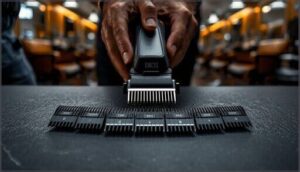
Once you’ve got the basics down, guards open the door to a whole new level of precision.
There are techniques that separate a decent cut from one that actually turns heads.
Here’s where things get interesting.
Using Tapering and Texturizing Guards
Once you move past basic cuts, specialty guards open up a whole new level of control. Ear taper guard follows the ear’s natural curve for clean sideburn blending, while the toe-to-heel motion produces smooth graduation without harsh lines.
Freestyla thinner guards and adjustable texturizing blade settings let you run blending texturizing passes that remove bulk, add movement, and keep your clipper guard work looking intentional — not accidental.
Mastering Guard Transitions for Fades
Building a clean fade starts with zone mapping — dividing the head into sections and assigning specific guard sizes before a single stroke lands.
Work each zone using micro‑transitions by breaking lever positioning into open, half, and closed settings between guards.
Stroke pressure and regular symmetry checks on both sides keep the taper balanced, so no harsh lines survive the final pass.
Specialty Guards for Precise Detailing
Specialty guards are the detail work of barbering tools — each one built for a job-standard guard sizes can’t handle.
Mini guards handle ultra-short detailing down to 1.5mm, while edger guards sharpen necklines with 1mm precision.
Magnetic attachment keeps everything locked during fast transitions.
T-blade guards suit beard outlines, and half-size guards smooth skin fades.
Master these hair trimming techniques, and your haircutting techniques reach another level.
Frequently Asked Questions (FAQs)
What does 1, 2, 3, 4, 5 mean in haircuts?
Those numbers aren’t random — they’re a standardized Haircut Number System where each digit equals a specific length.
Using Clipper Guard sizes 1 through 5, you get Scalp Exposure Levels ranging from 3mm up to 16mm.
Is a 4 or 5 guard shorter?
The 4 guard is shorter, leaving ½ inch of hair, while the 5 guard leaves ⅝ inch. That extra ⅛ inch impacts texture, volume difference, and styling flexibility noticeably.
Which haircut is shorter, 4 or 5?
The 4 clipper guard is shorter, leaving half an inch of hair versus the 5’s 5/8 inch. That 1/8-inch length delta affects visual scalp exposure, texture suitability, and fade blending noticeably.
Can clipper guards work on all clipper brands?
Not all hair clippers share the same guard system.
Snap‑on and magnetic designs vary by brand, so cross‑brand incompatibilities are common.
Universal guard options exist, but always verify compatibility before assuming your guards will fit.
How often should clipper guards be replaced?
Replace your clipper guards every 12–24 months for home use, or every 3–6 months if you’re cutting daily. Cracked teeth and loose fit are your clearest wear indicators that it’s time.
Are metal guards better than plastic guards?
Both have their place. Metal guards win on durability and heat dissipation for daily professional use, while plastic guards offer better skin comfort and cost efficiency for occasional home haircutting.
Can guards be used on wet hair safely?
Most guards aren’t built for wet hair.
Wet‑Hair Risks include uneven feeding, Guard Fit Stability issues, and potential Moisture‑Induced Warping.
Unless your Electric Clippers are Waterproof Trimmers, stick to the Dry‑Finish Technique for safer, cleaner results.
Do clipper guards work for thick curly hair?
clipper guards work well on thick curly hair.
Start with a longer guard for curl spring control, use slow clipping speed, and apply steady guard pressure to get an even cut without exposing the scalp.
Conclusion
Picture every great haircut as a house built on a solid foundation—without the right structure underneath, everything above it falls apart.
That’s exactly what understanding what hair clipper guards are used for gives you: a foundation of control, safety, and consistency that makes every cut predictable rather than guesswork.
Whether you’re maintaining a tight fade or a simple trim at home, the guard isn’t just an attachment.
It’s the difference between a clean result and starting over.
- https://wahlusa.com/how-to/haircutting/haircuts-101/guide-combs
- https://www.ripeinsurance.co.uk/small-business/hair-and-beauty-insurance/blog/hair-clipper-guards-sizes/
- https://hairandbeautykingdom.com.au/blogs/blog-post/how-to-cut-men-s-hair-for-beginners-an-ultimate-guide-to-hair-clipper-guard-sizes