This site is supported by our readers. We may earn a commission, at no cost to you, if you purchase through links. This content is for general informational and educational purposes only and is not a substitute for professional medical, dermatological, or nutritional advice.
Most bathrooms average under 50 square feet—roughly the size of a walk-in closet—yet somehow need to store everything from spare toilet paper to a hair dryer collection. That tension between limited space and endless stuff is where bathroom chaos begins. The good news: the problem is almost never the room itself. It’s the space gets used.
Small bathrooms hide surprising amounts of storage potential in walls, corners, and the back of cabinet doors. You don’t need a renovation to access it. The right system—built around your specific habits and the items you actually use—turns a cramped bathroom into one that runs smoothly every day.
Table Of Contents
- Key Takeaways
- Identify Your Bathroom Storage Needs
- Use Vertical and Wall Space
- Install Floating Shelves Above The Toilet and Vanity
- Add Wall-mounted Cabinets for Concealed Bathroom Storage
- Use Tall Shelving Units to Maximize Near-ceiling Space
- Mount Towel Hooks and Racks to Reduce Counter Clutter
- Add Corner Shelves for Unused Wall Areas
- Use Recessed Shower Niches for Shampoo, Soap, and Body Wash
- Combine Open Shelves With Baskets and Labeled Containers
- Upgrade Vanity and Hidden Storage
- Organize Under-sink Space With Pull-out Bins and Tiered Shelves
- Work Around Plumbing With Slim Baskets and Stackable Organizers
- Choose Vanities With Drawers, Dividers, and Adjustable Shelving
- Use Mirrored Medicine Cabinets for Double-duty Storage
- Add Storage Inside Cabinet Doors for Small Tools and Accessories
- Store Backup Items in Closed Cabinets to Keep Surfaces Clear
- Improve Layout With Space-Savers
- Replace Hinged Doors With Pocket Doors to Free Up Clearance
- Choose Floating Vanities and Sinks to Open Floor Space
- Add Over-the-door Organizers for Skincare and Toiletries
- Fit Slim Cabinets Between The Toilet and Wall
- Use Over-the-toilet Shelving for Towels and Extra Supplies
- Add Corner Cabinets or Narrow Carts in Tight Gaps
- Replace Towel Bars With Hooks for More Flexible Storage
- Maintain an Organized Storage System
- Assign Zones for Daily Essentials, Linens, and Cleaning Supplies
- Use Labeled Bins to Keep Categories Easy to Find
- Store Only What The Bathroom Can Realistically Hold
- Return Items to Their Designated Spots After Each Use
- Clean Shelves, Baskets, and Drawers Regularly to Prevent Buildup
- Reassess Storage Needs After Renovations or Lifestyle Changes
- Frequently Asked Questions (FAQs)
- Conclusion
Key Takeaways
- Measure your walls, corners, and floor before buying anything—knowing your exact space prevents wasted money on storage that doesn’t fit.
- Vertical space is your biggest untapped resource; floating shelves, tall units, and wall-mounted cabinets can double your storage without touching the floor.
- Match every item to the right storage type based on how often you use it, how heavy it is, and how much space it takes up.
- A storage system only stays organized if you return items to their spots, label everything clearly, and reassess after any major life change.
Identify Your Bathroom Storage Needs
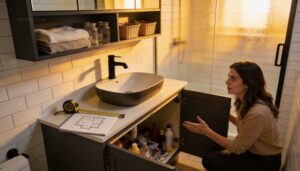
Before you buy a single shelf or basket, you need to know exactly what you’re working with. That means stock of your space and what actually needs to live in it.
Think of it like building a skincare routine — you wouldn’t grab random products before understanding what your skin actually needs.
Start with these five steps.
Measure Available Wall, Corner, and Floor Space
Before buying a single shelf, measure everything. Use a laser distance meter for wall-to-wall accuracy, then apply the baseboard subtraction method to get your true usable surface. Don’t forget corner angle verification — not every corner is a perfect 90°.
- Map floor clearance around toilets and vanities
- Sketch a wall length grid noting doors and windows
- Mark corner depth to plan shelving without blocking drawers
Create a rough outline of the room helps organize measurements.
List Toiletries, Towels, Cleaning Supplies, and Grooming Tools
Once you’ve got your measurements, the next step is taking stock of what you actually own.
Group everything into four categories: Toiletry Essentials like toothpaste and body wash, Towel Varieties from bath to hand sizes, Cleaning Supply Types, and Grooming Tool Basics like hair dryers and razors.
This Storage Categorization shapes every bathroom storage decision — from towel racks to wall-mounted storage to stackable bins.
Separate Daily-use Items From Backup Stock
Now that you know what you own, split it into two groups: daily use and backup stock. This keeps your space calm and functional.
- Place daily items at eye level in open, color-coded bins.
- Use shelf dividers to create high-level storage zones for backstock.
- Follow an inventory rotation schedule so older supplies get used first.
Drawers with dividers help too.
Prioritize Hard-to-store Items Like Hair Tools and Bulk Paper Goods
Some items just don’t fit neatly anywhere.
Hair dryers, curling irons, and bulk toilet paper rolls need dedicated spots.
Use wall-mounted storage solutions with adjustable drawer dividers to keep heat tools separate and accessible.
Store heated tools on heat-resistant mats inside ventilated cabinets.
Tuck bulk paper goods into moisture-proof bins with color-coded labels.
Lockable tool cabinets protect high-value items from little hands.
Match Storage Types to Item Size, Weight, and Frequency of Use
Not all storage works for every item — matching the right solution to what you’re storing makes everything easier to reach and safer to keep.
- Frequency Zoning — Daily items stay within 18 inches of reach; rarely used tools go high.
- Size‑Specific Bins — Stackable bins and vertical compartments fit toiletries without wasted space.
- Weight‑Based Shelving — Load‑rated cabinets and pullout shelves handle heavier loads reliably.
- Adjustable Depth Racks — Adjustable shelving and smart storage flex as your needs change.
Use Vertical and Wall Space
Your walls are doing nothing for you right now — and that’s wasted potential. In a small bathroom, going vertical is one of the smartest moves you can make.
Here’s how to put every inch of wall space to work.
Install Floating Shelves Above The Toilet and Vanity
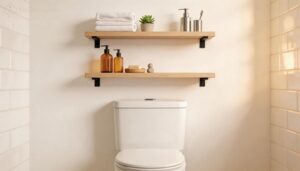
Floating shelves turn dead wall space into smart, accessible storage. Mount your first shelf 24–30 inches above the toilet, then space a second one 12–18 inches below it.
For the shelf closest to the sink, a dedicated bathroom organizer for makeup and skincare keeps your brushes and products separated, fresh, and within easy reach.
| Shelf Height Guidelines | Recommendation |
|---|---|
| First shelf above toilet | 24–30 inches |
| Second shelf spacing | 12–18 inches below |
| Bracket Selection | Brushed nickel or matte black |
| Moisture Resistant Materials | Sealed MDF or polyurethane wood |
Balance Aesthetic Styling with Weight Distribution — keep heavier items low.
Add Wall-mounted Cabinets for Concealed Bathroom Storage

Wall-mounted cabinets do more than store — they disappear into your bathroom’s design. Deep profile cabinets and recessed frames align flush with tile, so nothing interrupts the wall.
Soft-close hinges reduce daily wear, while moisture-resistant materials handle humidity without warping.
Adjustable shelf arrangements let you fit tall bottles or small tools as needs change.
It’s wall-mounted storage that works without showing off.
Use Tall Shelving Units to Maximize Near-ceiling Space

Tall shelving units turn dead vertical space into your bathroom’s hardest-working real estate. Anchor them to wall studs using L-brackets — anchoring safety isn’t optional when shelves carry towels and toiletries.
Choose moisture-resistant materials, add LED shelf lighting for upper visibility, and use color-coded bins to separate daily items from backup stock. Adjustable shelf height keeps these wall-mounted storage solutions flexible as your needs shift.
Mount Towel Hooks and Racks to Reduce Counter Clutter

Damp towels on the counter are a fast track to clutter. Mount wall-mounted storage hooks instead — stainless steel durability means they won’t rust or weaken over time. A door-mounted rack benefits tight layouts by reclaiming hidden vertical space.
- Use multi-size hook sets for bath and hand towels
- Try color coordinated hooks to assign towels by person
- Replace towel bars with hang hooks for flexible spacing
- Apply corner rack optimization in underused wall sections
Add Corner Shelves for Unused Wall Areas
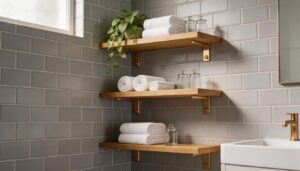
Corner shelves turn dead wall angles into real storage. Those 90-degree gaps beside your vanity or above the toilet are prime real estate.
Material selection matters here — bamboo and sealed wood handle moisture protection better than bare MDF.
Mind the weight capacity, usually 10 to 30 pounds, and use proper installation hardware anchored into both walls.
Simple styling ideas: baskets below, a small plant on top.
Use Recessed Shower Niches for Shampoo, Soap, and Body Wash

recessed shower niche takes bathroom storage into the wall itself. Aim for placement height at shoulder level — that keeps bottles within reach without awkward bending.
Standard niche depth accommodates most shampoo and body wash bottles flush with the tile.
Waterproofing details matter here: seal every edge properly to prevent moisture damage.
Unlike wall-mounted storage solutions, niches save vertical space without adding bulk.
Combine Open Shelves With Baskets and Labeled Containers

Open shelves work best when baskets do the heavy lifting. Group similar items into moisture-resistant containers — hair tools in one, skincare in another.
For basket material choice, stick to coated fabric or BPA-free plastic. Label durability tips matter here: humidity ruins paper fast, so use laminated or vinyl labels.
Color-coded organization by category makes restocking easy at a glance.
Upgrade Vanity and Hidden Storage
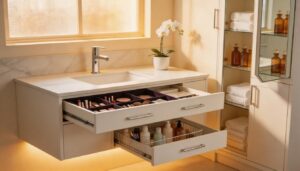
Your vanity and the cabinets around it hold more potential than most people use. A few smart upgrades can turn that wasted space into a system that actually works. Here’s how to make every inch count.
Organize Under-sink Space With Pull-out Bins and Tiered Shelves
The under-sink cabinet is prime real estate — most people just ignore it. Pull-out bins with full-extension slide track options put everything within reach, while moisture-resistant bins protect your cabinet from drips.
Try these under-sink organization ideas to take control:
- Use adjustable tier heights around your plumbing
- Plan load capacity carefully — bins hold 10–25 lbs
- Add modular under-sink kits for flexible layouts
- Label stackable bins for instant visibility
Vertical storage solutions for bathrooms start right here.
Work Around Plumbing With Slim Baskets and Stackable Organizers
Plumbing doesn’t have to steal your storage. Trap-Friendly Baskets with open fronts slide right around P-traps — no awkward removal needed. Pair them with Adjustable Height Rails and stackable bathroom storage systems, and you’ve doubled your vertical space overnight.
| Feature | What It Does | Why It Matters |
|---|---|---|
| Slim Design | Fits around curved pipes | Maximizes Pipe Clearance Solutions |
| Drainage Hole Design | Prevents moisture buildup | Stops mold before it starts |
| Moisture-Resistant Organizers | Withstands humidity and cleaners | Keeps baskets looking new |
| Adjustable Height Rails | Customizes shelf tiers | Fits tall bottles easily |
| Stackable Bathroom Storage Systems | Creates multiple levels | Doubles usable vertical space |
These space saving ideas turn dead cabinet zones into smart bathroom storage.
Choose Vanities With Drawers, Dividers, and Adjustable Shelving
Your vanity does the heavy lifting when it’s built right.
Deep Drawer Depth Options — often 12 to 18 inches — handle bulk items without stacking chaos. Divider Material Choices, like clear acrylic, let you spot everything fast.
Shelf Height Flexibility accommodates tall bottles easily. Add Soft-Close Mechanisms, a Customizable Finish, and you’ve got vanity storage ideas that actually stick.
Use Mirrored Medicine Cabinets for Double-duty Storage
A mirror cabinet pulls double duty — it reflects your space and hides your clutter. With adjustable glass shelves, LED lighting integration, and soft-close hinges, it’s one of the smartest bathroom storage upgrades you can make.
Three reasons to install one:
- Anti-fog technology keeps the mirror usable after hot showers
- Magnetic door storage holds grooming tools in reach
- Vertical storage solutions for bathrooms start here — floor to ceiling, without the footprint
Add Storage Inside Cabinet Doors for Small Tools and Accessories
The inside of your cabinet doors is prime real estate you’re probably ignoring.
Mount Pegboard Door Panels with removable hooks for grooming tools, or install Magnetic Tool Strips for quick-grab access to metal accessories.
Clear Pocket Organizers and Foldout Tackle Trays keep small items sorted, while Built-in Hutch Bins turn a single door into smart cabinet storage with room for everything.
Store Backup Items in Closed Cabinets to Keep Surfaces Clear
Closed storage is your secret weapon against counter chaos. Tuck backup supplies into vanity cabinets using Stackable Cabinet Bins to build upward without wasting space.
Adjustable Shelf Inserts let you fit items of any height. Add Clear Labeling Systems so nothing gets lost, and use Moisture Control Solutions like desiccant packs to protect contents.
A simple Cabinet Inventory Tracking list inside the door keeps you stocked without the clutter.
Improve Layout With Space-Savers

Sometimes the biggest storage wins come from rethinking your layout, not adding more stuff. Small swaps — like a different door style or a smarter fixture placement — can free up space you didn’t know you’d have.
Here’s how to make your bathroom work harder with a few smart layout changes.
Replace Hinged Doors With Pocket Doors to Free Up Clearance
A hinged door can quietly steal 8 to 10 square feet of floor clearance — space you could actually use. Sliding pocket door installation solves this through smart wall cavity prep and a reliable track system selection.
Soft-close options keep things quiet. Retrofit installation challenges exist, but the design aesthetic impact is worth it for serious small bathroom space optimization.
Choose Floating Vanities and Sinks to Open Floor Space
Floating vanities lift everything off the floor, giving you 6 to 12 inches of clear space underneath. That’s real room for slim baskets, rolling carts, or just easier cleaning.
Floating vanity height usually sits between 32 and 36 inches — comfortable and practical.
Moisture resistant materials handle humidity well.
For small bathroom ideas, floating fixtures for floor clearance deliver a minimalist aesthetic without sacrificing under vanity storage.
Add Over-the-door Organizers for Skincare and Toiletries
The back of your bathroom door is wasted space — and over-the-door bathroom organizers fix that fast.
Rust-resistant baskets separate skincare, razors, and toothpaste by zone. Transparent pockets let you spot products without digging. Flip-lid compartments contain spills, while adjustable dividers fit everything from cotton swabs to bottles.
Follow weight-capacity guidelines so hooks stay secure. Over-the-door storage adds real bathroom storage solutions without touching a single wall.
Fit Slim Cabinets Between The Toilet and Wall
That gap between your toilet and wall is prime real estate for slim cabinets — usually 6 to 8 inches deep, built specifically for depth optimization in tight bathrooms.
- Adjustable shelves handle tall bottles and hair tools
- Anti-tip hardware anchors units safely to the wall
- Moisture resistant materials prevent warping over time
- Installation anchoring into studs keeps everything stable
Narrow shelving units turn dead space into real vertical storage solutions for bathrooms.
Use Over-the-toilet Shelving for Towels and Extra Supplies
Over-the-toilet shelving concepts turn wasted vertical space into real storage. Most units hold 30 to 40 pounds per shelf — so follow weight distribution tips and keep heavier items low.
Choose moisture-resistant materials to handle humidity, and use safety straps installation to prevent tipping.
Aesthetic finish choices like white, oak, or espresso blend in easily.
Some designs even offer integrated lighting options for better visibility.
Add Corner Cabinets or Narrow Carts in Tight Gaps
Corner cabinets and narrow rolling carts are built for exactly those awkward gaps. Dual-level corner units stack storage vertically without widening your footprint, and slim carts — under 12 inches wide — slide neatly beside fixtures.
Choose moisture-resistant materials to handle humidity, and look for locking casters so nothing shifts underfoot.
Integrated cabinet lighting and sliding door mechanisms keep tight spaces functional without feeling cramped.
Replace Towel Bars With Hooks for More Flexible Storage
Swapping towel bars for hooks is one of the smartest space utilization strategies you can make. Hooks free up wall real estate and give you flexibility that towel bars simply can’t match.
- Hook Load Capacity accommodates towels, robes, and bags in one consolidated zone
- Aesthetic Hook Designs in matte metal, blend with existing bathroom storage hardware
- DIY Hook Installation takes minutes with adhesive or basic drilling
- Hook Hygiene Benefits improve drying by keeping towels fully exposed to airflow
- Seasonal Hook Adjustments let you swap hooks and hangers as needs change
Maintain an Organized Storage System
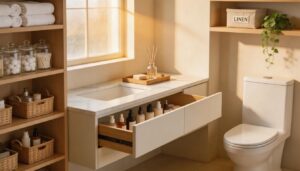
A good storage system doesn’t happen by accident — it takes a few consistent habits to keep things from sliding back into chaos. The right approach makes your bathroom easier to use every day, not just after a big cleanout.
Here’s what actually works.
Assign Zones for Daily Essentials, Linens, and Cleaning Supplies
Think of your bathroom layout as a map with clear territories. Place daily essentials at eye level for instant accessibility levels, and keep linens on mid-height shelves using zone color coding for quick grabs.
Store cleaners in a moisture control cabinet, and isolate hazardous items in a lockable bin.
Rotate seasonal products quarterly. These smart storage habits turn chaos into a system that runs itself.
Use Labeled Bins to Keep Categories Easy to Find
Labels turn guesswork into a system you can trust. High-contrast labels with bold category names let anyone find what they need fast — no rummaging required.
Moisture-resistant tags hold up in humid bathrooms, and color-coded labeling by zone reinforces where everything belongs.
- Assign each bin a unique color by category
- Place labels at eye level on stackable bin designs
- List key items directly on the tag
Store Only What The Bathroom Can Realistically Hold
Your bathroom isn’t a storage unit — it has real volume constraints. A small vanity holds 15 to 25 liters of daily essentials, and under-sink cabinets fit maybe four cleaning bottles.
Smart storage habits start with item prioritization: keep only what you regularly use. Capacity planning and regular decluttering prevent overflow. Maximizing small spaces means editing ruthlessly, not just organizing more.
Return Items to Their Designated Spots After Each Use
Every item needs a home — and returning it is the habit that holds everything together. Smart storage habits only work if the system gets used consistently. Research shows that returning items after each use cuts daily rummaging time by up to 30 percent.
Every item needs a home, and the habit of returning it is what makes any storage system last
- Use visual cues like labels and color-coded bins to reinforce correct placement
- Run a quick end-of-day audit to confirm everything is back in its spot
- Try family coordination tools like shared reminders or a simple checklist for multi-person households
- Build habit reinforcement through a quick reset routine when items drift out of place
Clean Shelves, Baskets, and Drawers Regularly to Prevent Buildup
Dust and soap residue build up faster than you’d expect. Wipe shelves weekly using a microfiber cloth, and don’t skip the corners.
Use moisture-resistant liners inside baskets and drawers to prevent staining.
A simple drawer disinfectant routine, monthly, keeps bacteria from spreading.
Follow a basket rotation schedule so nothing expires unnoticed.
Add odor-control sachets to maintain freshness between deep cleans.
Reassess Storage Needs After Renovations or Lifestyle Changes
Your storage setup shouldn’t stay frozen after a renovation or major life change.
Do a post-renovation audit to spot gaps, then run a lifestyle inventory shift — new baby, new roommate, or new routine, all change what you need.
Future-proof capacity planning and seasonal item rotation keep things manageable.
Adaptable modular solutions let you reconfigure without starting over.
Frequently Asked Questions (FAQs)
How do lighting choices affect bathroom storage perception?
Strategic lighting shapes how spacious your bathroom feels.
Cool white illumination opens shelves visually, backlit mirror depth adds dimension, and LED shelf lighting highlights organized zones.
Large mirrors and ambient brightness zones complete the visual illusion.
What materials work best for humid storage environments?
Bathrooms don’t forgive weak materials. Stick with stainless steel, powder-coated steel, HDPE bins, or ceramic shelves.
Marine plywood, thick sturdy plastic, wire baskets, plastic bins, and glass display cases hold up well too.
Can renters add storage without damaging walls?
Yes, renters can add storage without wall damage.
Use adhesive hooks, tension rods, freestanding shelves, over-the-door storage, or magnetic strip storage — all removable, renter-friendly solutions that work well in any bathroom.
How do you store items in a shared bathroom?
Think of a shared bathroom like a shared kitchen — everyone needs their own drawer.
Assign individual baskets per person, use transparent storage containers, and keep a digital inventory list so nothing runs out unnoticed.
Which storage solutions work best for kids bathrooms?
Wall-mounted storage with rounded-edge shelves keeps kids safe. Use colorful, interactive labeling on basket storage solutions so children know exactly where things go — making cleanup faster and genuinely stress-free.
Conclusion
Think of maximizing bathroom storage as turning a puzzle into a smooth operation. By applying these practical tips, you’ll reveal your bathroom’s full potential.
Start by evaluating your needs, then use vertical space, upgrade your vanity, and incorporate space-savers.
As you implement these strategies, you’ll find your bathroom becoming more efficient. Effective storage isn’t just about hiding clutter; it’s about creating a peaceful space.
Master how to enhance bathroom storage space, and enjoy a more efficient routine daily.