This site is supported by our readers. We may earn a commission, at no cost to you, if you purchase through links.

first-time clipper users make the same mistake: they pick up the tool, skip the basics, and wonder why the cut looks rough or why the blade keeps tugging.
Hair clippers are safe for beginners, but only when you understand what the risks actually are and how to avoid them. the blades, the guards, the battery level—each one plays a role in whether your cut goes smoothly or sideways.
Get those details right, and clippers become one of the most forgiving tools you can use at home.
Table Of Contents
Key Takeaways
- Hair clippers are beginner-safe, but you’ll get rough, uneven cuts if you skip the basics—like checking your blade, keeping your hair dry, and setting up in good light before you even power on.
- Always start with the longest guard; it acts as a buffer so you don’t take off too much on your first pass, and you can always go shorter from there.
- Clean and oil your blades after every single use—skipping this one step is what causes tugging, overheating, and a clipper that dies way before it should.
- Clippers beat scissors for beginners because the guarded cutting head keeps the blade safely spaced from skin, so you get consistent results without years of hand-skill practice.
Are Hair Clippers Safe for Beginners?
Yes, hair clippers are safe for beginners — but only if you know what to watch for. A few smart habits and the right features can make a big difference between a clean cut and a costly mistake.
One detail worth knowing upfront: using hair clippers on wet hair carries real risks that catch a lot of beginners off guard.
Here’s what every first-timer should know before picking up a pair of clippers.
Why Hair Clippers Are Beginner-friendly
Hair clippers are designed with beginners in mind from the start.
An ergonomic grip keeps your hand steady without strain, and low noise motors won’t make anyone flinch.
Simple controls mean you’re not guessing which button does what. Cordless freedom lets you move naturally around your subject, while color coded guide combs and self-sharpening blades make safe, consistent cuts easier to achieve.
Common Risks to Avoid While Trimming
Even beginner-friendly tools come with real risks if you rush or skip the basics.
- Unplugging Mistakes and Wet Hair Dangers can cause nicks or electric shock before you even start.
- Dull Blade Hazards and Incorrect Guard Setup lead to tugging, patchy cuts, and harder-to-fix mistakes.
- Rushed Blending Risks leave uneven lines that are frustrating to correct.
Slow down — control beats speed every time.
Features That Improve Safety and Control
right clipper practically does the heavy lifting for you. Anti-snag guards and round-tipped blades keep the blade from catching or nicking your scalp.
low vibration design steadies your hand, and an ergonomic design for first-time users means less fatigue mid-cut.
Color-coded guide combs simplify length choices, while an LED display, safety lock switch, battery protection, low noise operation, and safe ceramic blades all keep you confidently in control.
When Clippers Are Safer Than Scissors
Scissors demand hand control that takes years to develop. Clippers, on the other hand, give you a guarded cutting head that keeps blades spaced safely from skin—no pinching, no guesswork. Electric motion control does the work while you steer.
Clippers do the cutting while you steer, no years of practice required
- Blade hair contact stays predictable with guard attachments
- Short-cut use reduces risky precision passes near ears
- Hair type matching matters—clippers handle thick, coarse hair best
- Safe ceramic blades and quiet operation make child‑safe hair cutting realistic
Clippers give bulk removal speed for quick trims.
Pre-Cut Safety Checklist
Before you even turn on the clipper, a quick once-over can save you from a lot of headaches. Most trimming mishaps don’t happen mid-cut — they happen because something was off from the start.
Run through these four checks before you begin.
Inspect Cords, Blades, and Plugs First
Before you plug in or power up, give your tools a proper once-over. A quick Cord Integrity Check means scanning for cracks, fraying, or heat discoloration along the cable. A Cable Strain Assessment catches tight bends near the plug — a common failure point. Don’t skip Plug Grounding Verification either; loose or corroded prongs create real shock risk.
| Check | What to Look For | Action If Found |
|---|---|---|
| Blade Attachment Security | Wobble or misalignment | Reattach or replace |
| Blade Sharpness Test | Dull edges, nicks, buildup | Clean, oil, or sharpen |
| Plug Grounding Verification | Bent prongs, corrosion | Stop use immediately |
Inspect tools regularly — it takes two minutes and protects both you and your client.
If you’re just starting out, a facial skincare set for college students often bundles quality tools and products together, making it easier to build consistent habits from day one.
Work Only on Dry Hair and Hands
Always trim on dry hair and dry hands — it’s one of the simplest safety considerations for hair grooming that beginners overlook. Dry Hair Friction stays consistent, so your blade moves cleanly through each pass.
Wet hair clumps and throws off Guard Placement Accuracy and Blade Visibility.
Dry hands and dry scalp also give you a Secure Hand Grip, improving control and reduced tugging whether you’re working wet or dry hair.
Set Up a Bright, Stable Workspace
Good lighting and a stable surface aren’t optional — they’re your first line of defense.
Position adjustable task lighting so it shines directly on the cutting area, and place a non-slip work mat under your setup for a proper workstation setup for haircutting.
Use a mirror positioning guide to check angles clearly.
A well-lit area eliminates shadows that cause uneven cuts.
Keep a Cape and Tools Nearby
A cape does more than protect your shirt — it keeps you focused. Without one, you’re chasing clippings and repositioning fabric instead of cutting. Set up your space so everything is within arm’s reach before you start.
- Adjust the neck closure snugly to prevent stray strands from slipping behind the collar during passes.
- Use a small tool tray for guide comb variety and length selection, cord placement strategy, and blade cleaning supplies.
- Keep your grooming accessory kit, protective hair clipper case, or travel case close so guard swaps stay controlled.
Cape coverage benefits every pass you make, and an immediate access layout means fewer interruptions mid-trim.
Beginner Guard and Length Choices
Picking the right guard makes all the difference when you’re just starting out. It’s less about guessing and more about knowing which length to reach for first.
Here are four simple rules that’ll keep your cuts clean and your confidence growing.
Start With The Longest Guard First

Think of the longest guard as your safety net. Snapping it onto the blade raises the cutting edge away from the scalp, so gradual length reduction happens naturally without the risk of going too short on the first pass.
Proper blade guard alignment keeps results consistent, and symmetry checking becomes easier when there’s still plenty of hair left to compare. That built-in error buffering makes stepwise blending far less stressful.
Use Color-coded Guards for Easier Selection
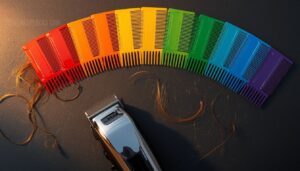
Color coded guide combs take the guesswork out of guard color organization by giving you instant visual length mapping at a glance. Instead of squinting at numbers, quick color identification lets you grab the right guard in seconds.
Red runs shorter, green sits longer, and contrast lighting benefits make each distinction clear even in a dim bathroom.
Color coded guard systems for length accuracy genuinely simplify beginner hair clipping.
Learn Guard Numbers and Hair Lengths
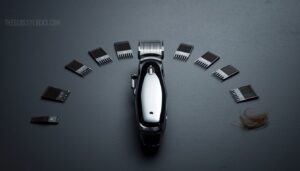
Once you understand the color system, pairing it with a guard number hierarchy makes length decisions even clearer.
Guard number 1 leaves about 1.5 mm of hair — nearly a close shave. Guard 4 gives you around 13 mm, and guard 8 reaches 25 mm.
This millimeter-inch chart thinking helps with fade blending sequences and buzz guard guides, so your adjustable blade length choices always make sense.
Trim Small Sections to Avoid Mistakes
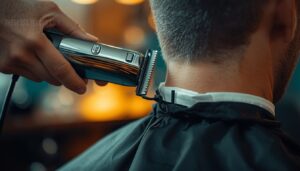
Once you know your guard numbers, how you apply them matters just as much as which one you pick. Sectioned trimming keeps mistakes small and fixable.
- Incremental Length Adjustments — Progressive guard reduction, one step at a time, prevents harsh lines.
- Comb Check Integration — Comb between passes to catch uneven spots early.
- Angle Control Tips — Keep the blade flat; angling it digs in.
- Small sections — Basic trims stay cleaner when you work in manageable areas.
Cleaning and Blade Care Basics
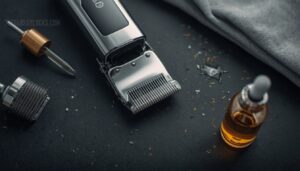
Your clippers won’t last long without a little routine care after each use. Keeping the blades clean and properly maintained is what separates a smooth trim from a snagging, pulling mess.
Here’s what you need to do to keep your clippers in good working shape.
Remove Hair Buildup After Every Use
Right after every trim, take a minute to brush out the cutter head — that’s your first step in solid hygiene maintenance. Use the included cleaning brush to clear blade debris from between the teeth, including the full blade face.
quick dry blade clean while clippings are still loose makes the next detachable blade wash faster and keeps your clipper running smoothly.
Oil Blades to Reduce Tugging
Once the hair’s cleared out, blade oil is your next move. A few drops — corners first, then the foot — are all it takes.
Turn the clipper on and let it spread.
Proper oil application technique cuts down on friction, keeps heat low, and protects the edge from wearing out fast.
Dedicated blade oil won’t gum up the way household products do.
Rinse Detachable Blades When Permitted
If your clipper has detachable blades, rinsing them is straightforward — but only when the manual says it’s allowed. Pop off the blade assembly, then hold it under a lukewarm water rinse to clear away debris.
Skip the towel afterward; the air drying method prevents lint from settling on the cutting edges. Always do a quick post rinse inspection before reattaching.
Store and Charge Clippers Safely
Where you store and charge your clippers matters more than most beginners realize. Keep them in a dry, dust-free spot at room temperature — roughly 60 to 75°F — and always use a stable charging stand to avoid tipping. Before plugging in, do a quick battery swelling inspection. A few smart habits go a long way:
- USB charging cables along edges to avoid tripping — clean cable management practices prevent accidents.
- Never charge near heat sources; temperature monitoring protects battery life and charging performance.
- Dry storage conditions shield waterproof designs from unnecessary moisture exposure over time.
- Unplug cordless clippers once fully charged to reduce battery stress.
Top 6 Beginner Hair Clippers
Finding the right clipper as a beginner comes down to a few key things: battery life, blade safety, and ease of use.
These six options check those boxes without overwhelming you with complicated features. Each one brings something different to the table, so let’s break them down.
1. Wahl Color Pro Cordless Hair Clipper
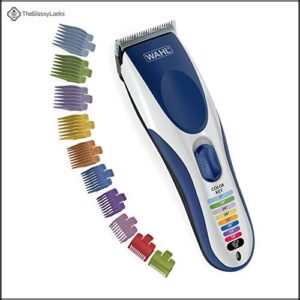
The Wahl Color Pro Cordless (Model 9649P) is a solid starting point if you’re new to home cutting. It runs up to 60 minutes on a full charge, requires a 2–3‑hour recharge, and works cordless or plugged in — so a low battery won’t stop you mid-trim.
The self-sharpening stainless-steel blades rinse clean easily, and the dual-voltage support means you can take it anywhere.
At 1.4 lb, it’s light enough to control without straining your hand.
| Best For | Anyone just getting into home haircuts who wants something simple, reliable, and easy to travel with. |
|---|---|
| Power Source | Cordless rechargeable |
| Blade Material | Stainless steel |
| Guide Combs | Color-coded included |
| Cleaning Method | Rinse + brush |
| Storage Case | Hard case included |
| Weight | 1.4 lb |
| Additional Features |
|
- Color-coded guide combs make it genuinely beginner-friendly — no guessing which length you’re grabbing
- Cordless with a solid 60-minute runtime, and you can keep cutting while it charges if needed
- Dual-voltage support and a hard-case kit make it a great travel companion
- No indicator for a full charge, so you have to watch the clock yourself
- A bit bulkier than true travel clippers, which might be annoying in a packed bag
- Thick or coarse hair may need slower, repeated passes to get a clean cut
2. Wahl Color Pro Haircutting Kit
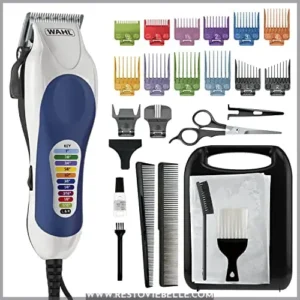
If you want everything in one box, this kit delivers.
The Wahl Color Pro Haircutting Kit comes with 26 pieces total — 14 color-coded guide combs ranging from 1/16 inch to 1 inch, scissors, a styling comb, blade oil, a cleaning brush, a cape, and a portable case.
The corded 120V motor runs without interruption, so dense or coarse hair won’t slow you down. Self-sharpening blades stay reliable long-term, and the color-coded guards take the guesswork out of length selection.
| Best For | Families and home users who want a complete, all-in-one grooming kit that handles haircuts, beard trimming, and more without extra purchases. |
|---|---|
| Power Source | Corded 120V |
| Blade Material | Stainless steel |
| Guide Combs | 14 color-coded combs |
| Cleaning Method | Oil + brush |
| Storage Case | Portable case included |
| Weight | 1.1 lb |
| Additional Features |
|
- 14 color-coded guide combs make it easy to pick the right length and stay consistent cut after cut.
- The corded motor delivers steady power through thick or coarse hair without losing speed.
- Self-sharpening blades mean less maintenance and reliable performance over time.
- You need to oil the blade regularly — skip it and you’ll notice the motor straining or the blade dragging.
- The power screw often needs adjusting right out of the box before it cuts properly.
- The cord limits where you can use it, and the motor runs louder than most cordless options.
3. FadeKing Cordless Hair and Beard Clippers
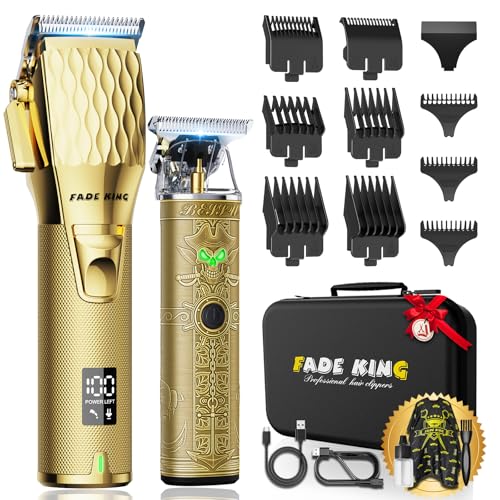
Running cordless for up to 300 minutes on a single 2.5-hour charge, the FadeKing Q1S-Y5 gives you plenty of runway for a full cut without scrambling to find an outlet. The built-in LED display shows your exact battery level, so you won’t get caught mid-fade.
You get 9 guide combs, a precision beard trimmer, cleaning brush, blade oil, and a travel case — all for $54.99.
The zinc-alloy housing feels solid, and the quiet rotary motor manages thick hair without pulling.
| Best For | Anyone who wants to cut their own hair or do clean beard work at home without paying for regular barber visits — especially people who travel or want a solid all-in-one kit. |
|---|---|
| Power Source | Cordless rechargeable |
| Blade Material | Stainless steel |
| Guide Combs | 9 sizes included |
| Cleaning Method | Brush included |
| Storage Case | Travel case included |
| Weight | 2.2 lb |
| Additional Features |
|
- Insane battery life — 300 minutes of cordless runtime means you can get through multiple cuts on a single charge
- Everything you need is in the box: 9 guide combs, beard trimmer, travel case, and dual charging cables for $54.99
- Solid zinc-alloy build with a quiet motor that handles thick or wet hair without bogging down
- The guide comb attachments feel a little loose, which can throw off consistency when you’re trying to nail a precise fade
- Blade sharpness is decent but won’t satisfy barbers who need razor-sharp lines right out of the box
- The included beard trimmer is on the lighter side — if you’ve got heavy stubble or need serious detailing work, you may want a dedicated trimmer
4. Silent Ceramic Baby Hair Clippers
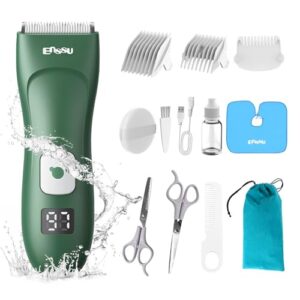
Trimming a baby’s hair feels like defusing a bomb — one wrong move and everyone’s crying. That’s exactly where the Silent Ceramic Baby Hair Clippers earn their place.
The rounded ceramic blades stay cooler than steel, so there’s no heat buildup against a sensitive scalp. At around 45 dB, it’s quiet enough to keep most little ones calm.
It’s IPX7 waterproof, charges in about an hour via USB-C, and the 13-piece kit covers everything you need for a quick five-minute home trim.
| Best For | Parents of infants, toddlers, or kids with autism or sensory sensitivities who want a quiet, stress-free at-home haircut. |
|---|---|
| Power Source | Cordless rechargeable |
| Blade Material | Ceramic |
| Guide Combs | 3 sizes included |
| Cleaning Method | IPX7 washable |
| Storage Case | Compact storage |
| Weight | 0.6 lb |
| Additional Features |
|
- Rounded ceramic blades stay cool and won’t snag or irritate a sensitive scalp
- IPX7 waterproof and easy to clean — works wet or dry, no fuss
- Compact and cordless with a full kit included, so you’re ready for a quick five-minute trim anywhere
- Small size and awkward button placement can cause accidental shutoffs mid-cut
- The plastic build feels a little light, which may not hold up to heavy daily use
- "Silent" is a stretch — at 45 dB, it’s quieter than most, but still audible enough to bother highly sensitive kids
5. LQT Professional Cordless Hair Clippers Set
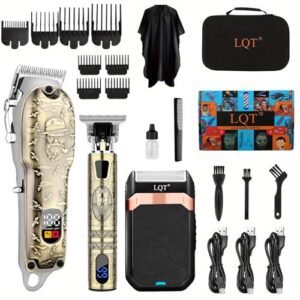
If you need something a step up from a baby trimmer, the LQT Professional Cordless Set manages adult hair without overcomplicating things. The high-torque rotary motor cuts through thick hair steadily, and low vibration keeps your hand from tiring out on longer sessions.
You get up to 180 minutes of cordless runtime, stainless steel blades with an R-shaped edge that won’t dig into the scalp, and guide combs ranging from 3 mm to 13 mm for flexible length control.
| Best For | Home users and hobbyists who want an all-in-one grooming kit for haircuts, beard trimming, and body shaving without needing multiple devices. |
|---|---|
| Power Source | Cordless rechargeable |
| Blade Material | Stainless steel |
| Guide Combs | 4 hair + 4 beard |
| Cleaning Method | Rinse + brush |
| Storage Case | Not specified |
| Weight | 2.38 lb |
| Additional Features |
|
- Long 180-minute runtime on the hair clipper means you can get through multiple cuts on a single charge
- R-shaped blade edge is gentler on skin, making it a solid pick for anyone prone to irritation
- Comes loaded with accessories — combs, a barber cape, cleaning brushes, and cables — so you’re ready to go out of the box
- The guide comb attachments feel flimsy and can be a pain to snap on and off cleanly
- At 2.38 lb, it’s noticeably heavier than most travel-friendly clippers, so extended use can wear on your hand
- It’s consumer-grade, not built for the demands of a busy barbershop or heavy professional use
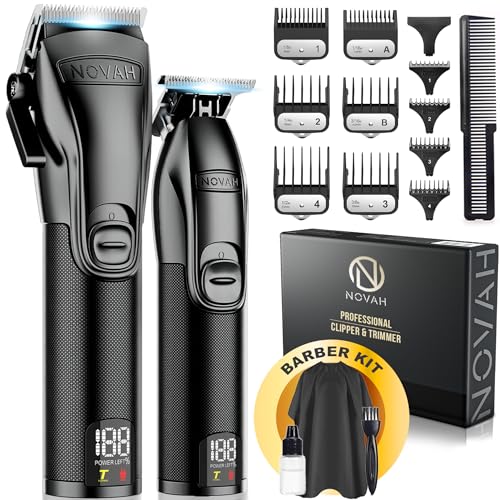
6. Novah Professional Cordless Hair Clippers
 View On Amazon
For those who want a professional-grade option, the Novah Professional Cordless Hair Clippers step things up.
The all-metal unibody feels solid in your hand, and the cross-etched grip keeps it from slipping mid-cut.
Turbo speed settings handle everything from fine hair to thick, coarse strands.
You get six clipper guards plus four trimmer guards, and the LED display shows your battery level in real time so you’re never caught halfway through a cut.
| Best For | Home users and barbers who want a durable, cordless clipper that handles professional-level cuts without being tethered to an outlet. |
|---|---|
| Power Source | Cordless rechargeable |
| Blade Material | Stainless steel |
| Guide Combs | 6 hair + 4 trimmer |
| Cleaning Method | Brush, no submerge |
| Storage Case | Not specified |
| Weight | 2.12 lb |
| Additional Features |
|
- All-metal build with an ergonomic grip makes it comfortable to hold through long cutting sessions
- Ten guards total (six clipper, four trimmer) give you a wide range of length options for different styles
- LED display keeps you updated on battery and speed mode so there are no surprises mid-cut
- Blade pulling has been reported, and getting a true zero-gap cut may take some adjusting
- Turbo mode can drain the battery faster, so runtime isn’t always consistent
- The trimmer blades are very sharp and can nick sensitive areas like around the ears if you’re not careful
Frequently Asked Questions (FAQs)
Can you catch anything from hair clippers?
Yes, you can.
Clippers can carry bacteria, fungi like ringworm, and even traces of blood between uses. Micro-nicks open the door for pathogens, so sanitizing blades between every use isn’t optional.
Can beginners cut their own hair alone?
Absolutely — if you keep things simple. Buzz cuts and single-length trims are manageable solo. Stick to longer guards, work in good lighting, and check your progress in a mirror often.
How often should beginners trim their hair?
How often depends on your hair type. Short styles need a trim every 4 to 6 weeks, while longer hair can go 8 to 12 weeks between cuts.
What hairstyles are easiest for beginners?
Low ponytails, messy buns, and simple three-strand braids are your best starting points. They’re forgiving, fast, and easy to fix if something looks off.
Should beginners practice on a mannequin first?
Want to skip the nerve-wracking first cut moment on a real person?
A mannequin lets you build control, repeat passes, and spot mistakes before any real hair—or trust—is on the line.
Are clippers suitable for all hair types?
Yes, clippers work on most hair types, but technique matters.
Fine hair needs a longer guard to avoid taking off too much, and thick or coily hair requires slow, steady passes to cut evenly.
Conclusion
Hair clippers are safe for beginners when you treat the learning curve as part of the process—not a reason to hesitate. You’ve got the checklist, the guard numbers, and the blade care basics.
Now it’s just about picking up the tool and starting. One guard too long beats one inch too short, every time. Start slow, stay consistent, and your clippers will reward you with clean, confident cuts that only get sharper from here.
- https://hairandbeautykingdom.com.au/blogs/blog-post/how-to-cut-men-s-hair-for-beginners-an-ultimate-guide-to-hair-clipper-guard-sizes
- https://mengrip.com/what-do-haircut-numbers-mean-for-men/
- https://bestbomg.com/blogs/news/how-to-oil-hair-clippers
- https://www.scribd.com/document/1005740211/Oil-Analysis-Handbook
- https://www.usa.philips.com/c-f/XC000002109/how-do-i-clean-my-philips-oneblade