This site is supported by our readers. We may earn a commission, at no cost to you, if you purchase through links.

A coarse beard isn’t a character flaw—it’s a maintenance problem. Most guys scratching at their faces every morning are one or two habits away from hair that feels completely different. The culprit is usually something invisible: stripped sebum, mineral buildup from tap water, or air dry enough to pull moisture straight out of the hair shaft.
Your beard grows the same keratin protein as the hair on your head, but facial skin produces far less natural oil to coat it. That gap between what your follicles produce and what your beard needs is exactly where roughness takes hold. Knowing how to soften a coarse beard naturally means closing that gap with the right oils, washing habits, and nutrition—not expensive products or complicated routines.
Table Of Contents
Key Takeaways
- Your beard feels rough because facial skin produces far less natural oil than your scalp does, and harsh soaps, hard water, and dry air make that gap even worse.
- Washing with a sulfate-free beard wash just 2–3 times a week and applying jojoba or argan oil right after — while your beard is still slightly damp — is the fastest way to close that moisture gap.
- Weekly deep treatments like a coconut oil soak (2 tablespoons, 30 minutes) or a honey-and-olive-oil mask deliver lasting softness that daily oiling alone can’t match.
- Long-term softness comes down to stacking small habits — trimming split ends every 2–4 weeks, eating omega-3s and keratin-building foods like eggs and salmon, and staying consistent with daily oiling — not finding one magic product.
Why Beards Feel Coarse

A coarse beard usually isn’t random bad luck — something specific is causing it. Before you fix the problem, you need to know what you’re actually dealing with.
Once you’ve nailed down the cause, the right beard grooming products for coarse beards can make a real difference fast.
Here are the four most common reasons your beard feels rough.
Harsh Cleansers Stripping Natural Sebum
That "squeaky clean" feeling after washing? That’s actually a warning sign.
Strong foaming agents and high surfactant strength in regular body soap and shampoo dissolve your natural sebum oil right off your face. This triggers barrier lipid depletion, raises pH imbalance, and blocks oil absorption later. Overwashing makes it worse.
Switch to a sulfate-free shampoo and use proper washing technique — 2–3 times weekly, max. Excessive cleansing can increase increased transepidermal water loss, weakening the barrier.
Hard Water Buildup on Facial Hair
Here’s the Hard Water Buildup on Facial Hair section:
Stripping oils isn’t the only thing wrecking your beard. Hard water is doing quiet damage too.
When calcium and magnesium mineral deposits coat your beard hairs, they raise the cuticle — that outer layer — and block natural oils from getting in. Your beard looks dull, feels like sandpaper, and tangles constantly. That’s hard water detection 101: a chalky film after drying, waxy resistance after washing, and beard softening products that just stop working.
Here’s how to fight it:
- Apple cider vinegar rinse — Mix 1 part vinegar with 3 parts water, spray onto your beard after washing, wait 5 minutes, then rinse with cool water. The acidity dissolves hard water minerals fast.
- Chelating shampoo — A chelating shampoo (one with EDTA or citric acid) binds directly to calcium and magnesium and washes them out. Use it once or twice monthly.
- Water softener or shower filter — Installing one stops hard water minerals from reaching your beard in the first place.
- Natural oils after washing — Lightweight natural oils like jojoba or argan displace leftover mineral residue and restore slip to each strand.
Dry Air, Cold Weather, and Brittleness
Hard water isn’t the only seasonal enemy. Cold weather cuts blood flow to your follicles, slowing natural oils before they reach your beard tips — that’s cold sebum reduction at work.
Low humidity effects compound the damage: dry air pulls moisture straight through your moisture barrier, leaving strands dry and brittle.
Static friction increase makes every touch feel rougher, and heat loss and hair damage only deepens the dryness.
Split Ends That Make Beard Hair Feel Rough
Cold air dries your beard out, but split ends are what make it feel like sandpaper. Split-end propagation means damage doesn’t stay put — it travels up the strand over time.
collar friction and UV-induced damage wear down the cuticle, causing cuticle erosion and protein depletion that weaken each tip.
Once those ends fray, no amount of natural oils or deep conditioning fixes them — only trimming does.
Once beard ends fray, no oil or conditioner can save them — only scissors can
Wash Without Stripping Oils

How you wash your beard matters just as much as what you put on it afterward. The wrong routine strips away the natural oils your skin works hard to produce, leaving your beard dry and rough before you even reach for the conditioner.
Here’s how to clean your beard the right way without undoing all that work.
Use a Sulfate-free Beard Wash 2–3 Times Weekly
Stripping your beard clean every day is like mopping a floor with bleach — effective, but brutal. Sulfate-free beard washes use milder surfactants that lift dirt without gutting your natural oils.
Stick to a wash frequency of 2–3 times weekly for real moisture preservation and reduced flaking. That balance keeps skin calmness in check and your surfactant choice working with your beard, not against it.
Rinse With Lukewarm Water on Off Days
On off days, skip the cleanser and let warm water do the work. A gentle rinse technique using lukewarm water flushes sweat and grime without touching your natural oils — that’s off-day consistency in action.
- Lukewarm advantage: loosens buildup without drying out your cuticle protection layer
- Finish with a cold water splash to seal the hair shaft
- Moisture retention stays intact, setting up your daily oiling routine
Avoid Body Soap and Regular Shampoo
Your body soap is basically a wrecking ball for your beard. Surfactants like sodium lauryl sulfate (SLS) — the foaming agent in most regular shampoos and soaps — are designed to blast oil off your scalp, not your face. Use them on your beard, and they strip the sebum your follicles worked hard to produce, killing oil absorption in beard hair and leaving fibers stiff and scratchy.
Switch to a pH-balanced wash or sulfate‑free natural shampoo built for facial hair. A natural beard wash, gentle face cleanser, or even a simple DIY beard wash (castile soap + a few drops of jojoba) keeps surfactant‑free cleansing in your corner.
| Cleanser Type | What It Does to Your Beard | Better Alternative |
|---|---|---|
| Body Soap | Strips sebum, raises pH, causes dryness | Natural beard wash |
| Regular Shampoo | Over‑cleanses facial skin, worsens hard water buildup | Sulfate‑free natural shampoo |
| Synthetic Fragrance Wash | Irritates skin, blocks oil absorption in beard | pH‑balanced wash or DIY beard wash |
Alternative cleansing methods like a cold water splash on rinse days pair perfectly with a gentle face cleanser on wash days — your beard stays clean without paying the price.
Gently Towel-dry Instead of Rubbing Hard
Rubbing your beard dry is like sandpaper on fresh wood — it lifts cuticles and creates frizz before you’ve even applied softening agents for hair.
Instead, press a microfiber towel against your damp beard using controlled patting pressure. Work top-down with blotting motion steps, rotating to a dry section as needed. This drying time reduction method keeps cuticles flat, making air-dry vs towel-dry techniques far more effective afterward.
Use Natural Softening Oils

Once your beard is clean, the next move is putting the right oils to work. Not all oils are created equal — some go deeper, some sit lighter, and some do both.
Here are four natural options worth keeping in your rotation.
Apply Jojoba Oil to Mimic Sebum
Jojoba isn’t really an oil — it’s a wax ester, which makes it the closest thing to your skin’s natural sebum oil. That sebum-mimic barrier quality is exactly why it works so well for beard softening.
Here’s how to use it right:
- Warm palm transfer: Rub 3–5 drops between your palms first
- Light coating method: Press gently into your beard — don’t scrub
- Wax ester compatibility: It blends with your skin’s lipids naturally
- Start at the skin: Work upward toward the tips
- Frequency adjustment: Cut back if your beard looks greasy
Use Argan Oil for Lightweight Moisture
Argan oil is your go-to when jojoba feels like too much. It lays down a thin conditioning film — Film Thickness Control at its finest — that smooths coarse beard fibers without weight.
For Grease-Free Finish results, Drop Size Optimization matters: start with 3 drops. Damp Beard Application helps it spread evenly. Absorption Timing is quick, so moisture retention kicks in fast.
Try Coconut Oil for Deeper Softness
Coconut oil goes deeper than argan — think of it as deep conditioning from the inside out. Warm Oil Penetration happens because Melted Oil Distribution spreads evenly through every strand, improving hair porosity and boosting moisture retention. That creates an Occlusive Moisture Barrier that locks hydration in.
Use 2 tablespoons, leave it for 30 minutes, then rinse.
Smart Residue Management means less is more. Always do a Patch Test Safety check first.
Add Shea Butter for Extra Protection
Shea butter is the finishing coat after deep conditioning. Its occlusive barrier locks in everything your oils just delivered.
Fatty acid nourishment — oleic, stearic, linoleic — coats each strand for real texture smoothing.
The vitamin E antioxidant fights dryness at the follicle level.
post-wash application, rub a pea-sized amount between your palms and press it into your beard while it’s still slightly damp.
Deep Condition Weekly

Weekly deep conditioning is where real softness gets built. Think of it as a reset button for your beard — it restores what daily wear slowly takes away.
Here are four treatments worth adding to your weekly routine.
Coconut Oil Treatment for Quick Softness
Want quick results? This is your go-to move.
Warm 2 tablespoons of coconut oil between your palms — its low melting point means it liquefies fast with body heat. Work a small amount, spread evenly through your beard, root to tip.
Lauric acid benefits your hair through deep conditioning and oil penetration.
Leave it for 30 minutes, then rinse. One treatment, a noticeably softer beard.
Always do a skin sensitivity check first.
Honey and Olive Oil Mask for Moisture
Coconut oil works fast, but for lasting moisture, the honey and olive oil mask goes deeper.
Mix 1 tablespoon raw honey with 2 tablespoons extra-virgin olive oil. Apply to a post-shower beard and leave it on for 20–30 minutes.
- humectant benefits pull moisture into each strand
- emollient action smooths the cuticle surface
- sticky consistency keeps the mask in place longer than thinner treatments
Always patch test first.
Avocado and Olive Oil for Dry Beards
If your beard feels like sandpaper no matter what you try, this mask is built for you. Mash half a ripe avocado with 1 tablespoon olive oil. The fatty synergy between avocado conditioning oils and olive oil boosts deep conditioning and oil absorption fast.
Apply at room temperature to avoid skin irritation. Leave on for 15 minutes, then rinse.
Aloe Vera for Sensitive Skin Support
Got sensitive skin under that dry beard? Aloe vera is your answer.
Its polysaccharide moisture — mainly acemannan — creates an aloe hydration film that soothes without grease.
Apply a generous layer of pure gel for gentle sensitivity relief and anti‑inflammatory soothing. Leave it 15–20 minutes, then rinse cool.
These natural moisturizers deliver barrier repair boost and real skin barrier support, one of the best natural softeners for reactive skin.
Seal in Moisture

Getting oils into your beard is only half the job — keeping them there where most guys fall short.
Once you’ve washed and oiled up, you need something to act as a barrier so that moisture doesn’t just evaporate throughout the day.
Here are three ways to seal it all in, depending on your beard’s length and thickness.
Apply Beard Oil Right After Washing
Timing is everything. The best window for damp beard application is right after your shower — pat dry, leave it slightly damp, then apply.
- Warm water opens pores, boosting oil absorption timing
- Use the palm warmth technique: rub 3–8 drops between hands first
- Massage carrier oils into roots, then work to tips
- Make sure post shower distribution reaches the skin underneath
- Avoid overapplication — damp hair absorbs better, so less goes further
Follow With Beard Balm to Lock in Hydration
Think of beard balm as the seal on an envelope — it locks everything in. Apply it 2–3 hours after your oil, not right away.
That layering with oil lets both products work together through ingredient synergy.
The wax seal benefits kick in as heat-activated softening from your skin warms the balm, delivering deep moisture all day long.
Use Butter for Thicker, Longer Beards
If your beard runs long and thick, oil alone won’t cut it. That’s where beard butter earns its place in your grooming routine.
Butter texture benefits go deeper — shea and cocoa butters lock moisture into the hair cuticle and tame coarse beard strands. Warm a pea-sized amount in your palms, then work it root to tip using the butter sealing technique for full, even deep moisture coverage.
Brush and Trim Correctly
Oils and balm are only half the job. How you brush and trim your beard decides whether all that moisture actually reaches every strand.
Here’s what to do to get it right.
Use a Boar-bristle Brush to Spread Oils

A boar bristle brush is your secret weapon for oil transfer mechanics — it pulls natural oils from the root and carries them down each strand.
The bristle material benefits come from animal hair that actually absorbs and releases sebum as you stroke.
Apply your natural oils for beard softening first, then use a sectioned brushing technique to coat every layer evenly.
Brush Damp Beard From Root to Tip

Now that your brush is loaded with oil, timing matters. Wet hair snaps easily, so wait until your beard is about 80 percent dry before brushing.
Starting at the roots, use your boar bristle brush with steady pressure control, working through sectioned brushing passes toward the tips. Brush angle guides cuticle smoothing along each strand naturally.
- Drying timing protects weak, water-logged hair from breaking
- Bristle choice determines how well natural softeners actually transfer
- Sectioned brushing ensures every patch gets even daily oiling coverage
- Root-to-tip strokes gradually flatten the cuticle layer for real softness
Trim Split Ends With Sharp Scissors
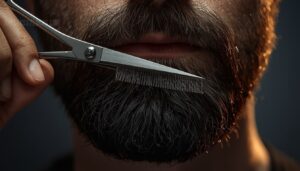
Once your oils are distributed evenly, split-end management becomes your next move. Scissor sharpness matters here — dull blades crush hair instead of cutting it cleanly.
For dry hair trimming, work section by section using section control: pinch a small bunch, smooth your fingers down, and watch the frayed tips pop out. Precise snipping means cutting just 0.125–0.25 inches above the split.
| Step | Split-End Detection | Action |
|---|---|---|
| 1 | Twist a small section | Frayed tips stand out visibly |
| 2 | Smooth fingers downward | Feel rough, coarse beard tips |
| 3 | Hold section firm | Position scissors above the split |
| 4 | Precise snipping | Cut 0.125–0.25 inches above damage |
| 5 | Repeat each section | Cover full beard consistently |
Keep Edges Neat to Reduce Roughness

Clean edges aren’t just about looks — rough hairlines make your whole beard feel scratchier. After you trim the beard along the neckline and cheeks, run a boar bristle brush along the edge using Gentle Edge Brushing strokes to smooth the cuticle layer.
Edge Hydration Routine, beard grooming tools, Collar Friction Management, Nighttime Edge Protection, and Static Reduction Strategies all keep that coarse beard feeling away.
Eat and Hydrate for Softer Hair

What you put in your body shows up in your beard. The right foods and enough water can make a real difference in how soft your hair feels over time.
Here’s what to focus on.
Drink Enough Water Daily for Follicle Hydration
Your beard starts from the inside out. Hitting your daily water goal of about 2 liters keeps follicle hydration steady and fights dry beard texture from the root.
A morning hydration boost — two cups right after waking — replaces overnight losses fast. Use fluid tracking methods like a marked bottle, and add water-rich foods like cucumber and spinach. Timing and consistency matter most.
Get Omega-3s, Zinc, and Vitamin E
Three nutrients quietly do the heavy lifting inside your follicles — and most guys overlook them.
- Oily Fish Choices + Omega‑3 Seed Mix: Eat salmon twice weekly or add flaxseed and walnuts for omega‑3 fatty acids that strengthen hair fibers.
- Zinc‑Rich Shellfish: Oysters cover zinc and omega‑3s together — one serving, two wins.
- Vitamin E Nuts: Almonds and sunflower seeds supply Vitamin E, protecting natural ingredients in your beard softening routine against oxidation that hardens a coarse beard.
Include Biotin Only if You’re Deficient
Here’s the truth about biotin: unless you’re showing real biotin deficiency signs — hair loss, brittle nails, skin rashes — a biotin supplement won’t soften your beard.
Biotin testing confirms whether you actually need it.
Certain medications carry medication interactions and supplementation risks worth knowing. Skip the hype. Lean on alternative nutrients like omega-3s — those are proven players in any natural beard softening routine.
Eat Foods That Support Keratin Production
Your beard is built from keratin, and keratin is built from what you eat. Stock your plate with these four:
- Eggs for Keratin — complete amino acids, straight fuel for hair structure
- Beef Zinc Boost — enhances protein synthesis and cell repair
- Kale Vitamin A — drives keratin health from the inside
- Bell Peppers Vitamin C and Almonds Vitamin E — protect and support every strand
Top 4 Beard Softening Products
Sometimes the DIY route isn’t always realistic, and a good ready-made product can do the heavy lifting for you. The right beard oil or shampoo makes a real difference when you’re short on time, but still want results.
Here are four products worth keeping on your shelf.
1. Jack Black Beard Oil
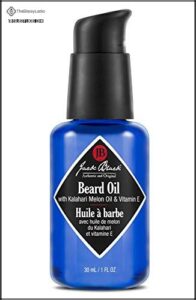
Jack Black’s Beard Oil earns its spot at the top for good reason. It packs marula oil for fast-absorbing hydration, plum oil to soften brittle strands, and Kalahari melon oil with vitamin E and carrot extract for antioxidant protection.
No parabens, no synthetic fragrance — just a clean, certified-organic blend.
At $28 for 3.17 oz, it’s not cheap, but one pump covers an average beard, giving you 100+ uses per bottle. That’s solid value for what’s inside.
| Best For | Guys who want a premium, clean-ingredient beard oil that softens coarse hair and won’t overpower everyone around them. |
|---|---|
| Price | $28.00 |
| Volume | 3.17 fl oz |
| Grease Level | Non-greasy finish |
| Fragrance | Mild, clean scent |
| Skin Benefit | Moisturizes skin |
| Hair Benefit | Softens coarse hair |
| Additional Features |
|
- One pump does the job, so that 3.17 oz bottle stretches to 100 uses
- Non-greasy finish means your beard feels soft, not slicked down with oil
- Mild, clean scent works just as well in a packed office as it does at the gym
- At $28 for a small bottle, it costs more than most beard oils on the shelf
- Can feel a little oily in your palm before it absorbs, which throws some people off at first
- The scent is subtle, but if you need completely fragrance-free, this still isn’t it
2. Every Man Jack Vanilla Cedar Beard Oil
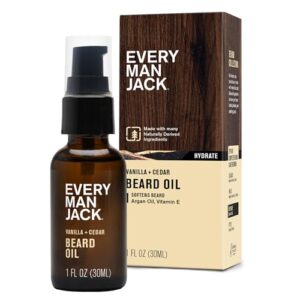
Every Man Jack keeps it simple — and that’s exactly why it works. At $9.47 for 1 oz, it’s the budget-friendly pick that doesn’t cut corners.
Argan oil reduces frizz, shea butter softens coarse strands, and vitamin E protects the skin underneath.
The vanilla cedar scent is warm without being loud, so it won’t clash with your cologne.
It absorbs fast, leaves no grease, and a pea-sized amount manages most beards.
It is a Great daily driver for guys just building their routine.
| Best For | Guys just starting out with beard care who want an affordable, everyday oil that smells great and keeps things simple. |
|---|---|
| Price | $9.47 |
| Volume | 1 fl oz |
| Grease Level | Non-greasy texture |
| Fragrance | Warm vanilla & cedar |
| Skin Benefit | Reduces irritation |
| Hair Benefit | Softens wiry hair |
| Additional Features |
|
- Argan oil, shea butter, and vitamin E work together to soften coarse hair and calm itchy skin underneath
- The vanilla cedar scent is warm and subtle — it won’t fight with your cologne
- Fast-absorbing and non-greasy, so a little goes a long way for daily use
- The 1 oz bottle runs out faster if you’ve got a thick beard or you’re sharing it
- Guys with very dry or coarse beards may need more product to actually feel the moisture
- The scent, while mild to most, might still be too much if you prefer something completely unscented
3. Black Men’s Biotin 360 Wave Shampoo
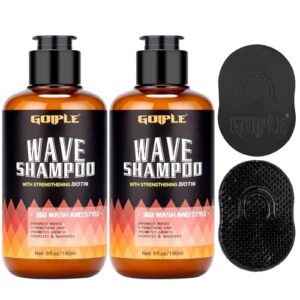
Cleaning your beard is step one — and this kit makes it easy. Black Men’s Biotin 360 Wave Shampoo ($14.99 for two 6 oz bottles) is sulfate-free, so it cleans without stripping the oils your beard needs.
Biotin boosts strand strength, and the hydration-lock blend helps reduce dryness and frizz.
The included wave combs help distribute shampoo evenly and stimulate the scalp.
It’s a solid starter kit, especially if you’re building a consistent wash routine from scratch.
| Best For | Men with coarse or curly hair who are just starting out with a 360 wave routine and want an affordable all-in-one wash kit. |
|---|---|
| Price | $14.99 |
| Volume | 12 fl oz total |
| Grease Level | Standard shampoo |
| Fragrance | Unspecified scent |
| Skin Benefit | Hydrates scalp |
| Hair Benefit | Reduces frizz |
| Additional Features |
|
- Sulfate-free formula keeps natural oils intact, so your hair stays moisturized instead of dried out
- Biotin plus the hydration-lock blend works to strengthen strands and cut down on frizz
- Comes with wave combs, so you’ve got everything you need to get started in one box
- Results aren’t guaranteed — at least one buyer saw no wave formation at all
- Built mainly for textured Black hair, so it may not work as well on other hair types
- The included combs are pretty basic and don’t seem to be built to last
4. Bevel Moisturizing Beard Oil
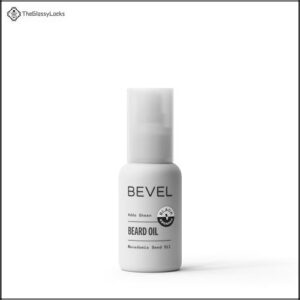
Once your wash routine is locked in, the next step is moisture — and Bevel Beard Oil delivers that without the grease. $7.47 for 1 oz, it’s affordable and effective.
The blend of jojoba, argan, and avocado oils conditions each strand while hydrating the skin underneath. No alcohol, silicones, or parabens — just clean ingredients that work.
A few drops after your wash add natural sheen and cuts down dryness, frizz, and breakage fast.
| Best For | Guys who want a simple, clean beard oil that softens hair and soothes the skin underneath without any greasy residue. |
|---|---|
| Price | $7.47 |
| Volume | 1 fl oz |
| Grease Level | Non-greasy formula |
| Fragrance | Subtle natural scent |
| Skin Benefit | Prevents flakiness |
| Hair Benefit | Reduces breakage |
| Additional Features |
|
- Jojoba and argan oils condition the beard and moisturize the skin beneath, helping cut down on itch and flakiness
- Lightweight, non-greasy formula means you can apply it and get on with your day without feeling like you over-did it
- Pump dispenser gives you control over how much you use, so you’re not wasting product
- One ounce goes fast — if you’ve got a thick or long beard, you’ll be restocking pretty often
- Hair growth claims are anecdotal at best, so don’t buy it expecting a magic fix for patchy spots
- The scent is pretty subtle, which is great for some guys but might feel like a letdown if you want something with more presence
Keep Beard Soft Long Term

Getting a soft beard is one thing — keeping it that way is where most guys fall short. The good news is it doesn’t take much, just a few smart habits built into your routine.
Here’s what actually makes the difference long term.
Protect Beard From Heat, Dyes, and Cold
Heat, dyes, and cold are silent beard killers. Keep heated tools below 350°F and always finish with a cold water splash to close cuticles after heat styling.
Synthetic dyes increase dryness and stiffness, so moisturize immediately after coloring. Build a protective barrier with beard balm before heading outside — it provides UV protection, chlorine resistance, and cold weather shielding all at once.
Use a Humidifier in Dry Indoor Air
Dry indoor air is just as damaging as cold wind outside. A humidifier fights environmental dryness impact by keeping your space between 40–50% humidity — ideal for hydrating beard fibers from the outside in.
Follow these three steps for best results:
- Humidity Level Monitoring — Use a hygrometer to track levels daily
- Ideal Humidifier Placement — Center the unit in your room, away from walls
- Water Quality Choice — Use distilled water to prevent mineral buildup
Sleep on a Silk Pillowcase to Reduce Friction
Your humidifier manages the air — but your pillowcase manages direct contact for seven-plus hours.
Silk surface smoothness means less abrasive rubbing along each hair shaft overnight. That reduced hair tangling and static cling reduction keep hairs aligned while you sleep.
Silk’s thermal insulation benefits also support moisture balance overnight, making using a silk pillowcase to retain beard moisture a genuinely smart nighttime beard conditioning move.
Stay Consistent With Daily Oiling and Weekly Care
Skipping days is where most beard care routines quietly fall apart. Daily oiling — just 2 to 4 drops of beard oil — keeps your natural beard care consistent without weighing hair down.
Pair that with a weekly deep treatment every wash day. Review your weekly progress to adjust your oil amount guidelines as seasons shift, since environmental oil impact changes how much your beard actually absorbs.
Frequently Asked Questions (FAQs)
Why is my beard so coarse and wiry?
Your beard looks full and strong — yet runs your hand through it, and it feels like sandpaper.
Genetic texture, hormonal influence, moisture loss, and a roughed-up cuticle layer are usually to blame.
Does beard softness improve with regular trimming?
Yes, trimming helps. Removing split, frayed tips through consistent trim frequency impact reduces that sandpaper feel. Every 2–4 weeks delivers real tip damage reduction, making your softening routine noticeably more effective.
How long before diet changes soften beard?
Diet changes don’t work overnight — think of it like planting seeds. The protein intake timeline, hair growth cycle, and water intake lag mean most men see softer results in 4–8 weeks.
Does beef tallow work better than plant oils?
Beef tallow’s high saturation profile gives it strong oxidation resistance and forms a solid occlusive barrier that outlasts most carrier oils, making it a dependable natural moisturizer for serious beard softening.
Conclusion
Most guys figure out how to soften a coarse beard naturally right around the time they stop overthinking it. Funny how that works.
The moment you swap harsh soap for a gentle wash, add jojoba oil after rinsing, and drink enough water daily, your beard starts responding.
No single step transforms it overnight—but stack these habits together and the scratchy wire brush on your face quietly becomes something you’re actually proud to wear.
- https://www.healthline.com/health/how-to-soften-beard
- https://honorinitiative.com/blogs/articles/ultimate-guide-to-soften-beard-techniques-tips-and-products
- https://hairmayraki.com/mayraki-blog/natural-oils-for-beard-conditioning/
- https://ghc.health/blogs/all-about-men/simple-techniques-to-soften-your-beard
- https://www.thebeardstruggle.com/blog/how-to-take-care-of-a-coarse-beard