This site is supported by our readers. We may earn a commission, at no cost to you, if you purchase through links. This content is for general informational and educational purposes only and is not a substitute for professional medical, dermatological, or nutritional advice.

Most people applying hair growth serum are accidentally wasting half of it. Not because the product doesn’t work—but because it’s landing on hair strands instead of the scalp skin where follicles actually live. A serum packed with rosemary extract, peptides, or minoxidil can’t do much sitting on dead keratin.
Knowing how to apply hair growth serum correctly is the difference between real regrowth and an expensive habit that goes nowhere.
The technique matters as much as the formula—and once you nail it, the results follow.
Table Of Contents
Key Takeaways
- Most people waste their serum by dropping it on hair strands instead of the scalp — section your hair first so every drop hits the skin where follicles actually live.
- Scalp prep matters as much as the serum itself — wash with a sulfate-free shampoo, towel-dry until just damp, and wait 15–20 minutes before applying so the product actually absorbs instead of sliding off.
- Massage with your fingertips in small circular motions for 1–2 minutes after applying — this isn’t just feel-good fluff, it actively boosts circulation and drives the formula deeper.
- Consistency beats everything — skip days and you’re basically starting over, but stay the course and you’ll see shedding slows by week 4–6 and real new growth by months 4–6.
Choose The Right Hair Growth Serum

Not all hair serums are built the same, and picking the wrong one can waste months of effort. Before you even open the dropper, you need to know what you’re actually putting on your scalp.
The same applies to your shampoo—ingredients really do make or break results, so it helps to check out the best shampoos for dry, itchy scalp before committing to one.
Here’s what to look for when choosing a serum that’s worth your time.
Scalp Serum Vs Hair Strand Serum
Not all serums are created equal — and grabbing the wrong one can actually work against you.
Scalp serums are lightweight, fast-absorbing, and follicle-compatible, designed for optimal follicle health.
Hair strand serums, however, coat the surface for shine and frizz control, but their heavier texture poses a follicle-clogging risk.
The key differences between scalp and strand serums come down to weight differences, usage frequency, and where each one belongs.
Key Growth Ingredients to Look For
Once you’ve ruled out the wrong type, ingredient quality is what separates a serum that works from one that just sits on your shelf.
Look for these four science-backed actives:
- Biotin Benefits — promotes keratin production, especially if a deficiency is thinning your strands
- Saw Palmetto — targets DHT pathways that quietly sabotage follicles
- Rosemary Extract — boosts scalp circulation naturally
- Niacinamide Support — calms redness and strengthens your scalp barrier
Minoxidil, Peptides, Caffeine, and Botanicals
Those four ingredients set the foundation — but the real power comes from how they work together. Minoxidil drives circulation, peptides support follicle signaling, caffeine extends the growth phase, and botanicals calm the scalp barrier. It’s a synergistic blend, not a solo act.
Still, solvent choice matters for tolerability, so patch testing before committing is smart. Irritation monitoring keeps your regimen on track.
Clinical results from a topical compounded formulation study reported an average increase of roughly one hair per cm² after six months.
Lightweight Formulas for Better Absorption
Formula texture isn’t just a feel thing — it directly affects how much active ingredient actually reaches your follicles. A lightweight formula with a Fast-Drying Base evaporates quickly, so the serum penetrates rather than just sitting there. Low-Grease Feel keeps your scalp comfortable, while Humectant Balance aids Enhanced Spreadability across thinning zones.
What makes a formula worth your shelf space:
- Fast-evaporating carriers push actives deeper into the scalp
- Stable Emulsion means consistent texture every single application
- Low-viscosity bases flow easily through thinning areas without pooling
- Humectants prevent that tight, dry feeling post-application
- Lightweight formula promotes the correct way to apply hair growth serum without residue
Matching Serum to Your Hair Concerns
Not every serum is built for your situation. Hair thinning from androgenetic alopecia calls for a different Loss Pattern Fit than stress-triggered shedding.
Your Scalp Type Match matters too — oily scalps need non-greasy formulas, while sensitive ones demand Ingredient Sensitivity checks before committing.
Factor in Medication Compatibility and Lifestyle Considerations, and you’ll choose hair growth serum ingredients that actually work with your scalp preparation before the serum routine.
Prepare Your Scalp Before Applying
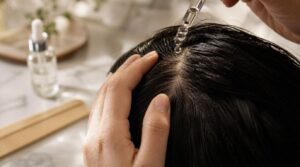
Think of your scalp like a sponge — it absorbs best when clean and clear. Leftover oil, dry shampoo, and product buildup block the serum from doing its job.
Here’s exactly how to prep your scalp before every application.
Start with clean, dry hair and part your strands so the solution reaches the skin directly—our step-by-step guide to applying Rogaine along the hairline walks through the exact technique for even coverage.
Wash With a Gentle Sulfate-Free Shampoo
Think of your scalp as a canvas — serum won’t absorb into a dirty one. Washing with a sulfate-free shampoo is your first real move for clean scalp prep.
Its gentle lather respects your scalp’s natural pH balance, maintaining scalp hydration without stripping it dry. This simple step is your foundation for effective Hair Growth Serum Application Tips and maximum product absorption.
Color protection and frizz control come as a bonus, ensuring your hair care routine starts on the right note.
Remove Oil, Sweat, and Product Buildup
Even after shampooing, sweat, excess oil, and styling residue can linger — and that leftover film is exactly what blocks your serum from reaching the skin. A clean scalp absorbs; a coated one doesn’t.
Good scalp preparation starts with smart oil control: use a clarifying shampoo occasionally, manage sweat with a Post‑Workout Wipe before washing, and commit to residue‑free styling products. Scalp cooling after exercise also matters, ensuring optimal absorption.
Towel-Dry Until Slightly Damp
Your scalp’s dampness level matters more than you’d think. After washing, towel-dry until the surface moisture is just right — damp, not dripping. Soaking-wet hair dilutes the serum before it even reaches your follicles, instantly killing your product dilution prevention strategy.
Slight, post-wash dampness actually reduces scalp friction and improves absorption timing, helping the serum settle in rather than slide off.
Avoid Heavy Oils or Conditioners on Scalp
Heavy oils and thick conditioners act as roadblocks for your serum. Applying them to your scalp before treatment creates product buildup that clogs follicles and disrupts sebum interaction, preventing your serum from penetrating effectively.
Conditioner residue also triggers irritation and compromises scalp barrier maintenance. These issues arise because the serum cannot reach the intended areas due to the obstructive layer left by heavy products.
Keep those oils on your ends only, and opt for lightweight styling alternatives instead. This ensures your scalp remains clear, allowing treatments to work as intended.
Wait 15–20 Minutes After Showering
Patience here isn’t just a virtue — it’s science. Waiting 15–20 minutes after towel-drying allows evaporation timing to work in your favor, cooling scalp temperature to baseline and restoring moisture balance.
Apply too soon, and excess water causes adhesion to fail — your serum literally slides off. This dilution effect undermines the product’s efficacy, wasting both effort and resources.
That short absorption time window means the difference between clean, dry scalp readiness and wasted product. Timing is everything for optimal results.
Section Hair for Even Coverage
Dumping serum randomly onto your hair is basically pouring it into a black hole — most of it lands on your strands instead of your scalp. Sectioning changes everything because it gives you real access to where the growth actually happens.
Here’s exactly how to break it down so every drop counts.
Create Four Scalp Sections
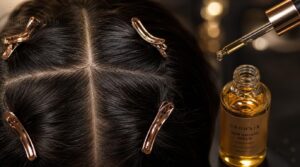
Dividing your hair into four sections isn’t just a styling trick — it’s the foundation of even coverage. Think of it as the four-section, four-step method for serum: each quadrant gets its own clip placement, keeping hair lifted and out of the way.
Proper section depth and boundary confirmation guarantees every drop lands on your scalp, not your strands.
Part Hair Front-to-Back and Ear-to-Ear
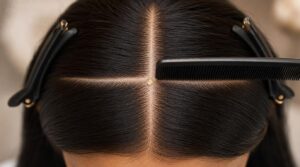
Once your four sections are clipped back, grab a fine-tooth comb. Draw one clean line front-to-back, then another ear-to-ear—comb-stroke precision matters here, so drag slowly and deliberately. That cross-shaped part is your scalp channel, your actual serum roadmap.
Check symmetrical alignment in a mirror, reposition anything that is off, and keep each channel stable so every drop hits the scalp, not hair.
Expose Thinning Areas Clearly

Now that your scalp channels are mapped, look closely — this is your lighting assessment moment. Check part line visibility for gaps or widening along the top. If thinning hides under your center part, shift to a side part camouflage technique to expose it honestly.
Hair length management also matters here; longer strands can mask sparse zones during your sectioned application method. Gently lift and pin them back before applying your hair growth serum for thinning areas.
Focus on Hairline, Temples, and Crown
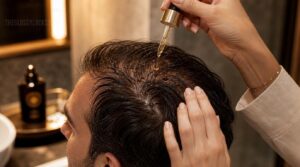
Your hairline curve analysis starts at the front edge — trace where density visibly thins, then assess temple recession signs at the upper corners.
Crown whorl mapping follows; this spiral pattern guides your drop placement. Think of it as a reverse progress photo guide: you’re targeting the gaps, not covering them.
Apply Directly to The Scalp, Not Hair
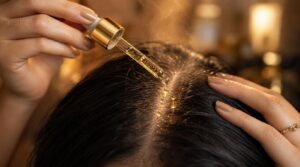
Serum doesn’t grow hair — your follicles do. That’s why direct skin dosing matters more than you’d think. Every drop needs to land on your scalp, not your strands. Here’s how proper scalp application techniques actually work:
- Part hair to expose the skin, then apply — follicle contact advantage is lost if serum hits hair first.
- Use your dropper tip to touch the skin directly, preventing product from spreading across lengths.
- Minimize shaft residue to keep roots from feeling greasy after application.
- Focused placement enhances circulation during your massage step.
- Scalp preparation before serum ensures the scalp is clean and ready to absorb, not just coated.
Apply The Correct Serum Amount
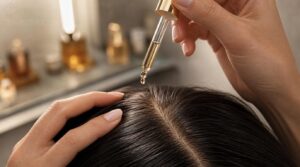
More isn’t better with hair serum — the right amount is what actually moves the needle. Using too little means your follicles miss out, and too much just clogs things up and wastes product.
Here’s exactly how to nail the dosage every time.
Follow The Product’s Recommended Dosage
Think of label instructions as your serum’s rulebook — and with minoxidil in the mix, breaking that rulebook actually matters. Your product’s recommended daily dosage exists for a reason: ingredient potency and safety thresholds are calibrated per formula. Most serums are used once daily; some, every other day.
Dosage compliance is not optional: Exceeding the maximum daily dose won’t fast-track growth; it’ll just irritate your scalp.
Use a Dropper for Precise Placement
Using a dropper puts you in control. Hold it nearly vertical — that’s your Dropper Angle — so small drops land precisely where you want them.
Master your Dropper Grip Technique: squeeze gently for Consistent Drop Size every time.
Wipe the tip between zones for Tip Hygiene and Preventing Cross-Contamination.
Dispense with the pipette slowly, letting each drop settle before moving on.
Distribute Serum Across Each Section
Don’t just dump the serum in one spot and hope for the best. Instead, work each of your four sections using Precise Drop Placement—small, evenly spaced points with a Controlled Spacing Pattern.
This ensures Even Point Distribution, maintaining consistent coverage. Apply the Section Overlap Technique at the borders to eliminate gaps.
The key to success lies in your Consistent Application Rhythm. This disciplined approach—your Fourstep 4-by-4 serum application method—distinguishes genuine results from wishful thinking.
Avoid Over-Applying Product
More isn’t better here — your scalp has an absorption ceiling, and anything beyond that just sits on the surface. Dosage errors are a real cost of overuse: irritation warning signs like itching, redness, or burning can show up fast. Excess residue effects build up over time too.
Stick to the recommended daily dosage of hair serum, and correct any dosage error by simply dialing back.
Prevent Greasiness and Scalp Buildup
Greasy roots aren’t just a bad hair day — they’re a sign your scalp is overwhelmed. Sebum, sweat, and leftover styling products pile up fast, especially in humidity.
Build a residue-free styling routine, try oil-absorbing powders between washes, and rinse thoroughly every time. A nighttime scalp refresh with a scalp clarifying rinse cuts through buildup before it blocks absorption — keeping your serum actually working.
Massage Serum Into The Scalp
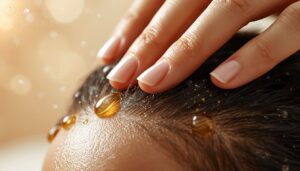
Dropping the serum on your scalp is only half the job — how you work it in matters just as much. A good massage moves the product where it needs to go and gets your blood flowing at the same time.
Here’s exactly how to do it right.
Use Fingertips, Not Fingernails
Regarding massage technique, your fingertips are doing the real work — not your nails. The soft pad delivers gentle pressure that spreads serum evenly across the scalp, a proper hair serum application technique that actually works. Here’s why fingertips win every time:
- Reduced scalp irritation — the pad absorbs force instead of scraping
- Even serum distribution — soft contact covers more surface area
- Precise placement — dab and spread exactly where thinning occurs
- Consistent massage technique — no digging, no displacement
Massage in Small Circular Motions
Once your fingertips are in place, use small circular motions to spread the serum evenly. Think of it like buffing a surface—consistent rotation direction and steady pressure regulation ensure uniform coverage across each section.
The friction warmth you feel signals improved scalp circulation. This gentle technique combines tight circles and repeated follicle stimulation, enhancing absorption and scalp health.
The contact mechanics are straightforward: maintain a gentle scalp massage technique with rhythmic, focused pressure. This method maximizes serum distribution while promoting relaxation and follicle vitality.
Spend 1–2 Minutes Massaging
One to two minutes is your sweet spot. That’s all it takes—long enough to boost scalp circulation, short enough to stay consistent daily. Keep the pressure light and use gentle rotation across each section, spending about 20–30 seconds per area.
- Maintain light pressure—no pressing hard
- Monitor scalp warmth as a positive sign
- Use gentle scalp massage technique with sectioned timing
Use a Silicone Scalp Massager Optional
Want to level up your massage game? A silicone scalp massager makes it easy. Its nubbed contact surface distributes serum evenly, while the anti-slip design ensures controlled use.
Crafted from hygienic silicone, it prevents bacteria buildup. The ergonomic grip fits naturally in your hand, accommodating wet or dry use effortlessly.
| Feature | Why It Matters |
|---|---|
| Hygienic Silicone | Resists bacteria between uses |
| Ergonomic Grip | Reduces hand fatigue |
| Nubbed Contact | Spreads serum evenly |
| Anti-Slip Design | Keeps pressure consistent |
| Wet/Dry Use | Works in any routine |
Improve Product Spread and Scalp Stimulation
Combining the Warm Hand Technique with Light Pressure Rhythm genuinely changes how your serum performs. Warm fingertips help the formula glide across sections, while small circular motions cover more ground than straight rubbing.
- Steady rhythm across every section keeps stimulation even
- Moderate, consistent pressure aids scalp microcirculation without irritation
- Circular strokes beat straight lines for full coverage every time
Dropper Angle Optimization — tilting slightly toward the scalp — reduces runoff so actives land where they belong.
Let Serum Absorb Properly

You’ve applied the serum—now don’t undo all that work by rushing through the next step.
How your scalp absorbs it matters just as much as how you put it on. Here’s what to keep in mind after application.
Do Not Rinse After Application
Once you apply the serum, put the rinse idea out of your mind entirely. This is a leave-in treatment — water is the enemy here.
Rinsing kills your contact time, strips the protective layer you just built, and undermines the whole point. Avoid dilution by letting it sit. Consistent non-rinsing is one of the simplest consistency benefits you’ll ever get.
Leave Serum on for 6–8 Hours
Six to eight hours is your minimum — that’s the window where leave-in serum absorption guidelines actually work. The drying period matters, so let it fully set before touching your hair.
For overnight comfort, apply in the evening and use an older pillowcase for wear time hygiene.
Watch for monitoring cues for irritation like redness or itching, and practice smart transfer prevention by keeping hair off your face.
Let It Dry Before Styling Products
Think of your serum as a foundation layer — styling product integration only works when that base is fully set. Perform a quick serum dryness check by touching your scalp; if it feels cool or tacky, wait longer.
Rushing product layering guidelines causes product migration control issues, greasiness, and frizz minimization goes right out the window.
Dry first, style second — always.
Avoid Heat Styling Immediately After Use
Heat tools and fresh serum don’t mix. Flat irons and curling wands applied too soon can interfere with scalp protection and undermine thermal injury prevention entirely.
Give your scalp a proper cooling period first. When urgent heat styling is needed after serum application, lean on heat-free alternatives—braids, rollers, wraps.
If you must style, low heat settings are your safest bet. Prioritize scalp safety above all else.
Overnight Application for Better Convenience
Evening is the best time for serum application. Your scalp does its best repair work while you sleep, so overnight absorption gives actives like minoxidil uninterrupted hours to work.
Let it dry fully — Nighttime Drying matters for Pillowcase Prep, so residue doesn’t transfer to fabric.
Sleep Schedule Sync keeps your routine consistent, and Scalp Irritation Checks each morning help catch sensitivity early.
Use Serum Consistently for Results

Consistency is the part most people skip — and it’s exactly why they don’t see results. Hair growth is slow, biological work, and your serum can only do its job if you show up for it daily.
Hair growth demands daily commitment — skip consistency, and your serum cannot save you
Here’s what that actually looks like in practice.
Apply Once Daily or as Directed
Apply your serum once daily — no more, no less. Frequency consistency is everything here; overuse risks scalp irritation, oiliness, and buildup that can actually slow progress.
Missed a dose? Don’t double up. Just continue your regular schedule.
Label interpretation matters too — “as directed” controls the recommended daily dosage of hair serum, so follow those instructions exactly. Set application reminders to stay on track.
Best Time to Apply Hair Growth Serum
Consistency beats flawlessness — but when you apply matters more than most people realize. Your scalp absorbs best when it’s clean, undisturbed, and not about to meet a blow dryer.
Build your timing of hair serum application around your real life:
- Late-Night Application works well after workouts — post-exercise timing means a freshly washed scalp
- Evening routines keep the serum untouched overnight
- Meal-Linked Timing (applying after dinner) builds a habit naturally
- Weekend Consistency resets any weekday drift
- Shift-Work Scheduling just means picking your consistent window, not the clock’s
Morning Vs Evening Application
Both work — it really comes down to your lifestyle.
| Factor | Morning Application | Evening Application |
|---|---|---|
| Absorption Rate | Lower — sweat and heat styling impact absorption | Higher — scalp stays undisturbed overnight |
| Sweat Buildup | More likely during daytime activity | Minimal while sleeping |
| Product Transfer | Risk with hats, hands, tools | Reduced — limit pillowcase contact by drying first |
| Heat Styling Impact | Can interfere if serum hasn’t dried | Avoided entirely |
| Routine Consistency | Pairs with morning grooming habits | Fits naturally into bedtime rituals |
Overnight vs morning serum application isn’t a competition — frequency matters more than the clock.
Expected Results After 4–6 Weeks
By weeks 4–6, consistent use starts paying off. Shedding Reduction is usually the first sign — you’ll notice fewer strands on your brush.
Scalp Oiliness Decrease, Flake Minimization, and a calmer overall feel follow closely.
Hair Thickness Boost becomes visible too, especially along your part line — Part Line Definition improves noticeably.
That 30-day mark? It’s your first real checkpoint.
Baby Hairs Around 8–12 Weeks
Around the 8–12 week mark, something exciting happens — baby hair starts showing up. That’s your Shedding Phase wrapping up and Fine New Growth taking over. Your hair growth timeline is finally moving.
Watch for these Regrowth Indicators:
- Short, wispy strands along your hairline
- Regional thinning filling back in
- Texture evolution — finer, softer new hair
- Staggered regrowth across different scalp zones
Noticeable Thickness After 4–6 Months
By the 4–6 month mark, hair density improvement becomes genuinely visible—not just on good hair days, but consistently.
This progress stems from strand maturation doing its job, as earlier shedding reduction cleared the path and optimized hair cycle timing.
Behind the scenes, scalp barrier healing and nutrient support enabled these advancements, laying the foundation for sustained growth.
Ultimately, proper hair serum application technique made this transformation possible.
Support Results With Healthy Hair Habits
Your serum does the heavy lifting, but combining serum with healthy hair habits is what locks in lasting results. Think of it as building a strong team.
- Protein Intake & Iron: Feed your follicles from the inside out
- Gentle Detangling: Wide-tooth comb only — no aggressive tugging
- Low-Heat Styling: Less thermal stress, stronger strands
- UV Scalp Shield: Cover up outdoors to protect your progress
Frequently Asked Questions (FAQs)
How long should you leave hair growth serum in for?
Leave it on for at least 6–8 hours. Overnight absorption is ideal. Most formulas are leave-in treatments — rinsing early cuts results short. Always check label-specified duration first, since formulations vary.
What are common mistakes when using serum?
Wrong serum type, skipping scalp prep, bad sectioning, incorrect dosage, and poor aftercare are the most common mistakes
that quietly sabotage your results before you even give the product a fair chance.
Is hair growth serum safe during pregnancy or breastfeeding?
Not every ingredient on that bottle is pregnancy-friendly. Minoxidil, in particular, carries real dermal absorption risk — skip it without medical clearance.
Stick to peptide- or caffeine-based, non-drug alternatives until your dermatologist gives the green light.
Conclusion
Right serum, right scalp, right technique — that’s the formula that actually moves the needle. When you learn how to apply hair growth serum correctly, you stop gambling with expensive products and start seeing real change in the mirror.
Your follicles don’t need more options — they need better delivery. The growth you’ve been chasing has been waiting on your method, not your medicine cabinet.
Stay consistent, section your scalp, massage it in, and let it work.
- https://vivafollica.blog/2025/10/28/the-correct-way-to-apply-hair-growth-serum-timing-frequency-application-tips/
- https://rootiva.co/blogs/hair-care/how-to-use-hair-serum-for-hair-growth-dos-and-donts?srsltid=AfmBOopAur2ZerHipernjVCaf65H-TuYGSIHyX1JICRffKZ4QDcDQWt3
- https://www.uklash.com/en-us/blogs/news/how-to-apply-hair-growth-serum-step-by-step-guide