This site is supported by our readers. We may earn a commission, at no cost to you, if you purchase through links.
A cartridge razor chews through five blades a week per chair, and the cost adds up fast when you’re running six clients a day. Switch to a quality double-edge blade, and you’re looking at $0.10 to $0.30 per shave instead—with a handle that’ll outlast your lease. That’s the math old-school barbers figured out decades ago, and it’s why safety razors for barbers never really left the trade, they just went quiet for a while.
Weight, blade gap, handle balance—these details separate a $35 chrome model from an $80 brass workhorse, and picking wrong means fighting your tool on every lineup. Get it right, and your hand stops doing the compensating.
What follows breaks down which razors earn their keep in a working chair, and which specs actually matter when coarse hair or sensitive skin walks through your door.
Table Of Contents
- Key Takeaways
- Top 6 Safety Razors for Barbers
- Best Razor Types for Barbers
- Professional Barber Buying Criteria
- Best Picks by Shaving Need
- Blade Compatibility and Replacement
- Sanitation and Barber Safety
- Safety Razor Cost Comparison
- Frequently Asked Questions (FAQs)
- What razors do professional barbers use?
- Why are safety razors not used anymore?
- What kind of razor is best for folliculitis?
- What is the safest razor for men?
- How often should barbers replace safety razor blades?
- Can safety razors be used on all hair textures?
- What causes razor burn during a barber shave?
- How long does a quality safety razor typically last?
- Do safety razors work well with all shaving creams?
- Conclusion
Key Takeaways
- Switching from cartridge razors to double-edge safety razors cuts per-shave costs from $0.75+ down to $0.10–$0.30, while a quality handle can last 5–10 years compared to a cartridge’s one-year lifespan.
- Matching razor specs to your work matters most: blade gap, weight (90–130g), and handle grip determine whether the tool fights your hand or becomes an extension of it, with closed-comb designs suiting sensitive skin and beginners while open-comb or slant bar razors handle coarse growth.
- Strict sanitation practices—single-use blades disposed in sharps containers, disinfecting handles between clients, and using autoclave-safe materials like 316L stainless steel—are non-negotiable for protecting your license and preventing cross-contamination.
- Proper technique (a consistent 30-degree angle, letting the razor’s weight do the cutting rather than pressure, and replacing blades every 5–7 shaves) prevents razor burn and ingrown hairs regardless of which safety razor model you choose.
Top 6 Safety Razors for Barbers
If you’ve ever stood behind the chair debating which razor earns a permanent spot in your kit, you’re not alone, and the six below are the ones that keep proving themselves shift after shift. Each one brings something different to the table, whether that’s weight, grip, or blade gap control. Here’s how they stack up against each other.
For a deeper breakdown of what separates these standouts from the rest, this guide to the best single blade razors for a barbershop-quality shave is worth a look.
1. Merkur Mk34c Heavy Duty Razor

If there’s one razor that earns its keep in a barbershop, it’s the Merkur 34C. That chrome-plated brass handle gives you real heft, around 78 grams, so your hand does less work fighting for control.
The closed-comb head keeps things forgiving on skin while still cutting clean at a 0.71mm blade gap. Running about $60, it’s a solid investment that’ll outlast cheaper razors many times over, no fuss.
| Best For | The Merkur 34C is best for both beginners and experienced wet-shavers who want a precise, long-lasting razor without the ongoing cost of cartridge refills. |
|---|---|
| Weight | 2.08 oz |
| Dimensions | 2 x 4 x 4 in |
| Primary Material | Brass, chrome finish |
| Target User | Beginners and experts |
| Key Benefit | Smooth precise shave |
| Standout Feature | Twist-open two-piece design |
| Additional Features |
|
- Heavy-duty brass handle with a chrome finish gives excellent control and durability
- Closed-comb head design offers a smooth, precise shave while minimizing irritation
- Twist-to-open construction makes blade changes quick and easy
- The heavier weight may lead to hand fatigue during longer shaves
- Only works with standard double-edge blades, so cartridge users will need to adjust
- Needs regular cleaning to prevent buildup in the blade gap and comb area
2. Edwin Jagger Chrome Lined Safety Razor
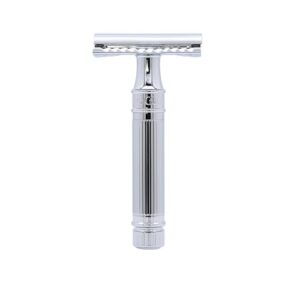
Weight isn’t the only way to earn control at the chair—grip matters just as much, and that’s where Edwin Jagger shines.
Its chrome lined handle runs about 83mm, giving you a textured, secure hold even when your hands are slick with lather. The closed-comb head keeps the shave mild enough for detailing work while still tracking clean along the jaw.
Solid brass underneath means it won’t wobble after years of daily use, a trait barbers notice fast.
| Best For | This razor is best for men and women who want a barbershop-quality shave with better control and less irritation than disposable multi-blade razors. |
|---|---|
| Weight | 2.4 oz |
| Dimensions | 83mm length |
| Primary Material | Brass, chrome finish |
| Target User | Men and women |
| Key Benefit | Reduced irritation |
| Standout Feature | Recyclable blade system |
| Additional Features |
|
- Solid brass construction with a triple-plated, hand-polished finish that holds up over years of daily use
- Chrome-lined handle offers a secure, non-slip grip even when wet
- Closed-comb head delivers a close yet gentle shave, reducing nicks and skin irritation
- Double edge blades must be purchased separately, adding an extra step before first use
- Short handle length may take some getting used to for those accustomed to longer razors
- Requires practicing proper technique to manage the razor’s weight and pressure
3. Bevel Brass Weighted Safety Razor
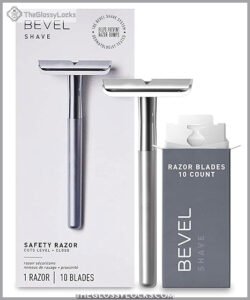
If you want gravity doing some of the work instead of your wrist, this one delivers. The brass weighted handle adds real heft, letting the blade glide with minimal pressure—great for coarse, curly hair prone to bumps and ingrown strands.
Loading’s simple: no butterfly or screw-off fuss, just standard DE blades dropped in. It ships with 10 refills, and brass cleans up fine with tap water and mild detergent between clients.
| Best For | People with coarse or curly hair who deal with razor bumps and ingrown hairs and want a sustainable, plastic-free shaving option. |
|---|---|
| Weight | 4.16 oz |
| Dimensions | 0.97 x 1.85 x 4.25 in |
| Primary Material | Brass |
| Target User | Coarse or curly hair |
| Key Benefit | Reduced razor bumps |
| Standout Feature | Includes 10 blade refills |
| Additional Features |
|
- Weighted brass handle lets the blade glide with minimal pressure, reducing irritation
- Eco-friendly, plastic-free build with easy cleanup using just tap water and mild detergent
- Comes with 10 double edge blade refills to get you started right away
- Requires a specific 30 degree angle, so there’s a learning curve for beginners
- Manual technique is needed to avoid nicks and cuts
- Best results depend on also using pre-shave oil and lather, adding extra steps
4. Rockwell 6C Adjustable Safety Razor
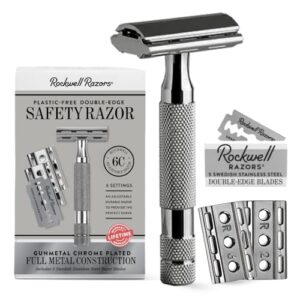
Six settings, one head—that’s the pitch, and it holds up chair-side. Flip the base plate and you’ve got all six aggression levels covered, from 0.20mm up to 0.79mm, no swapping razors mid-shift.
Zinc alloy build keeps it around 100 grams, light enough for detailing but stable in hand. The 85mm knurled handle grips fine even when soapy.
Ships with five blades, and cleanup between clients is quick since the plates pop off for sanitizing without hassle.
| Best For | This razor is best suited for shaving enthusiasts and experienced users who want a customizable, cost-effective alternative to disposable cartridge systems. |
|---|---|
| Weight | 6.4 oz |
| Dimensions | 3.94 x 1.57 x 0.98 in |
| Primary Material | Alloy, gunmetal chrome |
| Target User | Beginners and experts |
| Key Benefit | Customizable shave depth |
| Standout Feature | Six adjustable shave settings |
| Additional Features |
|
- Six adjustable settings let you fine-tune blade angle for your skin type and hair density
- Durable alloy construction with a lifetime craftsmanship warranty
- Plastic-free, eco-friendly design that’s gentler on skin, reducing nicks and irritation
- Heavier weight (about 200 grams) may take some getting used to compared to lighter razors
- Requires manual adjustment for different shave depths, adding a learning curve
- Uses traditional double-edge blades instead of multi-blade cartridges
5. Merkur Progress Adjustable Safety Razor
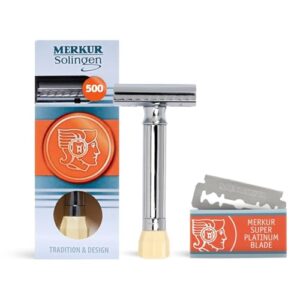
Five settings, one twist of the base knob, and you’ve got everything from a light touch-up to an aggressive clean-shave in your hand—no swapping heads mid-shift.
Just dial up the aggressiveness gradually, since wider blade gaps demand sharper attention to angle—get it wrong and you’ll trade a smooth finish for painful ingrown hairs, so brush up on proper razor angle to prevent ingrown hairs before cranking past the middle settings.
Solingen-made and chrome-plated brass at 90-95 grams, it’s got the heft for control without wearing on your wrist through a full day of clients.
The two-piece build pops open fast for blade changes, and standard double-edge blades keep costs low while giving you real range across skin types and beard textures.
| Best For | barbers and stylists who want one adjustable razor that handles everything from light touch-ups to aggressive clean-shaves without switching tools between clients. |
|---|---|
| Weight | 3.17 oz |
| Dimensions | 4.75 x 1.8 x 1 in |
| Primary Material | Chrome-finished brass |
| Target User | Sensitive skin users |
| Key Benefit | Reduced nicks and irritation |
| Standout Feature | Adjustable blade gap |
| Additional Features |
|
- Five adjustable settings let you dial in the right aggressiveness for each client’s skin and beard type
- Durable Solingen-made chrome-plated brass construction holds up to daily professional use
- Standard double-edge blades keep per-shave costs low while still delivering a close, quality shave
- Heavier than aluminum or plastic razors, which may tire the wrist over a long shift
- Requires a specific technique, including holding a consistent 30-degree angle, so there’s a learning curve
- Blade gap must be adjusted manually between settings rather than switching instantly
6. Parker 96R Butterfly Safety Razor

If quick blade changes matter to you, the 96R’s twist-open butterfly head is hard to beat—no fumbling, just a clean flip and swap between clients.
At 3 ounces with a solid brass center and 4-inch textured handle, it’s built for bigger hands and soapy grips without slipping.
Standard double-edge blades keep costs down, and the beginner-friendly loading makes this a smart pick for new barbers still building blade confidence.
| Best For | New barbers and stylists with larger hands who want a precise, no-slip razor for face, neck, or head shaves with fast blade swaps between clients. |
|---|---|
| Weight | 3 oz |
| Dimensions | 6 x 6 x 6 in |
| Primary Material | Brass, graphite finish |
| Target User | Users with large hands |
| Key Benefit | Reduced pressure and irritation |
| Standout Feature | Butterfly head mechanism |
| Additional Features |
|
- Twist-open butterfly head makes blade changes quick and beginner-friendly
- Solid brass construction adds balanced weight, reducing pressure and irritation
- Extended 4-inch textured handle offers a secure, slip-resistant grip
- Only compatible with standard double-edge blades, so you’ll need to keep those on hand
- Butterfly mechanism requires a specific twisting motion, which may take some getting used to
- The longer handle may feel less precise for users with smaller hands
Best Razor Types for Barbers
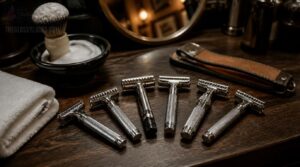
Not every safety razor suits every chair, and knowing which head style matches which client saves you time and grief. Some setups favor beginners and sensitive skin, while others are built for barbers chasing sharp lines or plowing through coarse growth.
Here’s how the five main types stack up.
Closed-comb Safety Razors
Think of the closed-comb design as your steady hand on a nervous client’s jaw—that solid safety bar keeps blade exposure minimal while distributing pressure evenly across the skin. Scalloped bars channel lather smoothly, cutting irritation on sensitive faces.
You’ll get consistent passes every time, which makes this beginner-friendly geometry ideal for new barbers building confidence with barber-grade equipment before graduating to more aggressive precision shaving tools.
These closed comb safety razors offer enhanced safety by minimizing direct blade exposure.
Open-comb Safety Razors
Ever wonder why old-school barbers swear by that toothy razor head? The open comb design exposes more blade for aggressive shaving performance on coarse hair.
- Guiding teeth position hair for closer cuts
- Gaps prevent clogging with thick lather
- Fewer passes needed on tough stubble
- Rewards experienced barber technique
Ideal barber-grade tools for detailing and precision shaving—provided you keep pressure light.
Adjustable Safety Razors
One dial, endless versatility—that’s the appeal of an adjustable safety razor. Twist the head to change blade gap and exposure, going mild for sensitive necklines or aggressive for coarse growth.
Models like the Merkur Progress offer micro-adjustment precision across a genuine tuning range, while base plate swapping adds options. You get real precision and control, plus tactile feedback that keeps every pass consistent.
Slant Bar Safety Razors
Slant bar razors get their bite from a twisted head design that angles the blade diagonally against the guard, creating a slicing motion rather than a straight cut.
That diagonal contact makes quick work of stout stubble, giving you an aggressive shave with real precision and control on coarse growth—perfect for barbers wanting fewer passes without sacrificing a clean double edge razor shave.
Single-edge Precision Razors
Slant bars twist for aggression, but single-edge razors play a different game entirely.
Edge geometry here sits on a fixed spine, giving real spine rigidity and tactile feedback for lineups and other precision areas. Some feature pivot head mechanics for contour control along jawlines. It’s a barbergrade tool built for detail work, not speed.
Professional Barber Buying Criteria

If you’ve narrowed down your razor type, the next step is matching the tool to how you actually work behind the chair. A few key factors separate a razor that feels like an extension of your hand from one that fights you all day. Here’s what to weigh before you commit to a handle.
Blade Gap and Aggression
Two millimeters can mean the difference between a smooth pass and a nicked chin. Blade gap sets exposure, and higher exposure means faster cutting but less forgiveness.
That’s why adjustable safety razors let you dial aggression per client, tightening for a closed-comb feel on sensitive skin or opening up for an open-comb razor’s bite on coarse growth—always pairing gap with proper shaving angle.
Handle Grip and Balance
Dialing in gap does nothing for you if your hand’s fighting the tool. Handle diameter (usually 9-12mm) plus knurled texture keeps wrist stability locked in during wet passes.
Three things matter most:
- Center of gravity aligned with your grip
- Textured, non-slip surfaces
- Contoured shoulders reducing fatigue
Get the razor handle ergonomics right, and vibration reduction happens naturally—your line ups stay clean.
Razor Weight and Control
Grip stability only gets you halfway; handle inertia does the rest. Barbers running 90–130 g barbergrade equipment notice less hand tremor and steadier glide through contours, especially on lineups.
Weight distribution toward the head keeps blade contact consistent without extra pressure, which is why razor ergonomics matter as much for precision detailing as for comfort during long shifts.
Blade Loading Speed
Rarely do barbers talk about loading speed, but it’s the difference between a smooth lineup and a client wincing. Faster loading concentrates pressure near the edge, raising thermal edge rise and accelerating edge wear patterns.
What you want is loading speed consistency—steady shear force stability and pressure distribution control through the stroke, whether you’re running a butterfly mechanism or a standard head opening.
Long-term Durability
Every razor in your kit takes a beating—autoclave heat, wet lather, dropped grips between clients. Corrosion resistance and mechanical fatigue matter most for barbergrade tools.
Look for:
- Stainless steel or chrome plating
- Pivot tolerances holding after 100,000 cycles
- Threaded joints staying stable past 1,500 uses
- Finishes resisting salt-air pitting for years
- Modular parts serviceable in minutes
That’s durable razor design—premium shaving gear built for daily punishment, not a drawer queen.
Best Picks by Shaving Need

Not every client sits in your chair for the same reason, so your razor choice should shift with the job. A tricky-skinned regular, a guy with a beard like steel wool, and a five-minute neckline cleanup all call for different tools. Here’s how to match your razor to exactly what’s in front of you.
Sensitive Skin Clients
That thin, easily-provoked stratum corneum on sensitive clients means your razor choice matters as much as your product line. Reach for a closed comb design first—it shields skin from drag while you work on skin irritation prevention. Keep pressure light, angle steady, and pair with fragrance-free aftercare for barrier restoration.
Watch for temperature triggers and wind exposure, since flare-ups often follow, not precede, the shave itself.
Coarse Beard Growth
Wiry, dense, and shaped by DHT sensitivity, coarse beards demand more bite from your blade gap. Look for open-comb or slant designs to slice through thick strands without dragging.
- Higher blade gap for aggressive cutting
- Double edge blades for repeat passes
- Weighted grips for steady control
Nutrient-rich diets and hormonal growth factors mean density varies client to client, so adjust razor aggressiveness accordingly.
Daily Cleanup Shaves
Speed and comfort rule the daily cleanup shave. You want a closed-comb safety razor with mild aggression, so stubble removal stays quick without punishing sensitive skin.
Gentle exfoliation preps the face while warm water softens hair. Keep strokes short and light, then finish with cold water and a lightweight balm for hydration—minimizing irritation while keeping your double edge blade sharp and rust-free.
Lineups and Detailing
A crisp lineup lives or dies on precision, and that means checking symmetry reference points—chin center, temple width—before your blade touches skin. Note beard growth direction and lay down clean edge definition notes first.
Skin prep protocols matter here too. A slant bar or adjustable safety razor controls tight lines beautifully. Finish with proper aftercare, and men’s grooming clients notice the difference immediately.
Beginner Barber Use
Once your lineup skills sharpen, back it up to basics. Every new barber should train on a beginner safety razor with mild aggression, mastering shaving angle mastery at 15-30 degrees before touching a slant bar.
Practice skin tension techniques and growth pattern identification on synthetic skin first. Build muscle memory training through short sessions, then move to clients—always finishing with clear client aftercare guidance for trust and repeat business in mens grooming.
Blade Compatibility and Replacement
If you’ve settled on the right razor type and feel for your chair, the next question is how fast and safely you can get a fresh blade in and out between clients.
Some designs pop open in seconds, others ask you to unscrew the whole handle, and a few use a cartridge system that keeps your fingers well clear of the edge.
Here’s what you need to know about loading, swapping, and tossing blades the right way, one client at a time.
Double-edge Blade Options
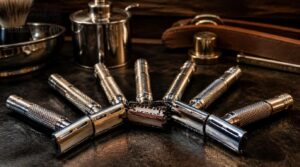
One blade fits nearly every safety razor on your station, and that universal double edge razor design is exactly why it dominates men’s grooming. A symmetric bevel gives even contact on both sides, while stainless steel resists rust between sanitizer dips. Coatings like PTFE or platinum cut friction and smooth the glide.
- Standard edge
- Milled edge
- Platinum-coated edge
Fast Butterfly Loading
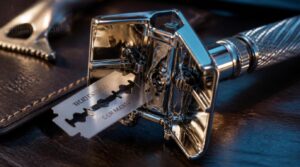
Twist the head and both flaps pop open, exposing the slots so you can seat a fresh DE blade in 2 to 4 seconds flat.
That butterfly mechanism cuts finger fatigue since there’s no screwing or prying involved.
A sprung latch snaps everything back into precise alignment, and stainless hinges shrug off constant disinfecting between clients.
Screw-off Head Designs
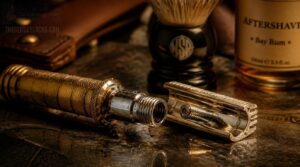
Old-school and reliable, the screwoff top unscrews from a threaded neck, giving you a true two-piece design with brass or stainless build for corrosion resistance.
Thread pitch standards run 0.8–1.0mm, so internal thread lubrication prevents galling while keeping blade alignment tolerances tight.
That head seating geometry matters, too, some conical, some flat, but this traditional screw setup remains a barbershop staple among men’s grooming products.
Injector-style Blade Safety
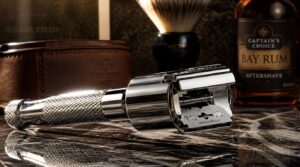
Injector systems earn their keep in safety, thanks to a spring-loaded mechanism that shields the blade edge during handling. A loading window lets you confirm placement before it locks, and that snap gives real tactile feedback.
Rigid channels cut blade chatter, while retractable edge shields on some models add extra protection—solid, barbershop-quality engineering for any manual shaving instrument.
Single-client Blade Disposal

Once you strip a used blade from the head, it goes straight into a puncture-proof sharps container—no exceptions, no setting it on the counter "for later." That’s immediate blade deposition in action, and it’s non-negotiable under most sharps waste protocols.
Every client gets a fresh single blade, every time, which keeps your single-use hygiene routine tight and your license inspection-ready.
Sanitation and Barber Safety

No razor, no matter how sharp or handsome, means anything in a shop if it isn’t handled safely between clients. Sanitation isn’t a suggestion in this trade, it’s the line between a trusted barber and a health code violation waiting to happen. Here’s what you need to lock down before you ever touch blade to skin again.
Sharps Container Disposal
Where does that used blade actually go? Straight into a dedicated sharps container, positioned within arm’s reach, off the floor, and never past the fill line.
Seal it when full, transport upright via cart, and let trained biomedical waste personnel handle destruction. Regular audits confirm proper labeling and disposal timing—because in grooming tools and men’s personal care, biohazard compliance protects you and every client sitting in your chair.
Disinfecting Reusable Handles
A 1:100 bleach solution disinfects most reusable grips between clients, but stainless steel and brass tolerate it far better than nickel-plated grips, which flake under harsh chemicals.
Wipe first, disinfect second, then rinse and air dry—residue buildup invites corrosion.
Match your cleaner to the material:
- Quaternary ammonium for metal
- Hydrogen peroxide for chrome
- 70% alcohol for quick turnarounds
Autoclave-safe Materials
Not every safety razor survives the autoclave, and that’s the real test of barbershop quality.
Look for 316L stainless steel grips or heads—they resist pitting far better than standard grades.
Polymer accessories need polypropylene or PEEK for real thermal stability under 250°F cycles.
Skip elastomer seals unless they’re silicone or Viton, and favor titanium nitride or hard chrome coatings for lasting corrosion resistance.
Preventing Cross-contamination
One shared razor between clients is all it takes to spread an infection you can’t see coming.
All it takes is one shared razor to pass an invisible infection from client to client
Color-coded tools by station keep contamination contained, while a strict one-tool-per-client policy and fresh gloves for every appointment matter just as much.
Sanitization logs prove you’re doing the work. Wipe grips, replace blades, disinfect surfaces—your safety razor maintenance routine is only as good as its weakest link.
Safe Shaving Technique
Sanitizing tools means nothing if your technique invites nicks and razor burn. Hold your safety razor at a 30-degree angle, map hair growth first, and let weight—not pressure—do the cutting. Go with the grain initially, rinse often, and finish with a light pass for a close shave.
Cool water and moisturizer afterward speed post-shave skin recovery and prevent irritation.
Safety Razor Cost Comparison
If you’re trying to justify the upfront cost to yourself, or to a shop owner watching the budget, the numbers actually make a solid case for switching over. A safety razor isn’t just a one-time purchase, it’s a shift in how you think about spending on blades month after month. Let’s break down what your money actually buys, from the handle in your hand to the blade you toss after every client.
Handle Investment Costs
Sixty bucks buys a solid stainless razor, but material cost variance between chrome, brass, and stainless swings prices 20-40%. Bulk order savings of 8-20% help shops stocking multiple stations. Premium finishes add durability but cost more upfront.
| Handle Type | Typical Price Range |
|---|---|
| Chrome/Zinc | $35-$50 |
| Brass/Steel | $55-$80 |
Warranty value impact matters—longer coverage cuts maintenance expense projections down the road.
Blade Cost Per Shave
Where your handle investment pays off long term, the blade cost per shave is where daily savings show up. Double-edged blades run $0.10-$0.30 each, and brand price variance matters—store brands stretch dollars. Hair coarseness impact means coarse beards dull blades faster.
| Blade Type | Cost Per Shave |
|---|---|
| Store-Brand | $0.10-$0.15 |
| Premium | $0.20-$0.30 |
Blade rotation strategies and subscription models keep replacement blades cost effective.
Cartridge Razor Comparison
Cartridge razors run three to five blades stacked in a pivoting head, and that blade count irritation trade-off matters for sensitive-skin clients. Pivoting head contouring and lubrication strips help, but replacements add up fast.
| Feature | Cartridge | Safety Razor |
|---|---|---|
| Blade Count | 3-5 | 1 |
| Replacement Speed | Under 5 sec | Seconds |
| Per-Shave Cost | $0.75+ | $0.10-$0.30 |
Barbershop Supply Budgeting
Six chairs deep in razors, blades, and cleaning supplies? That’s where rent allocation and inventory turnover collide. Budget 25-35% of inventory spend on tools and grooming products, hunt bulk discounts, and don’t skimp on sanitation expenses—300-900 euros yearly for autoclave service protects your license and your clients.
| Category | % of Budget | Notes |
|---|---|---|
| Inventory | 25-35% | Double edge blades, tools |
| Staffing overhead | 25-35% | Wages, benefits |
| Sanitation | Varies | Autoclave, disinfectant |
Long-term Value Factors
A five-year-old Merkur still cutting clean beats a landfill of disposable cartridges. That’s equipment depreciation working for you, not against it.
| Factor | Cartridge | Safety Razor |
|---|---|---|
| Tool lifespan | 1 year | 5-10 years |
| Warranty | None | 5-10 years |
| Maintenance ROI | Low | High |
Capital reinvestment into quality steel builds brand equity—clients notice cost-effective shaving done right.
Frequently Asked Questions (FAQs)
What razors do professional barbers use?
Most pros reach for double edge safety razors, favoring stainless steel builds that hold up through high-volume shaving and daily sterilization. They offer better blade availability, consistent grain control across different client hair textures, and long-term durability that cheap cartridges simply can’t match.
Why are safety razors not used anymore?
Post-war rapid mass production made cartridge razors cheap and easy, feeding convenience culture and perceived safety myths.
Traditional wet shaving requires patience and technique most folks skipped, letting cartridge market dominance and modern grooming trends push real blade-and-technique shaving toward niche status.
What kind of razor is best for folliculitis?
For inflamed follicles, go with a closed-comb design paired with a heavier handle for steady, light-pressure passes. It minimizes blade drag and skin irritation while proper stretching technique and wider blade gaps prevent ingrown hairs and stubborn razor bumps.
What is the safest razor for men?
For most guys, a closed-comb design with milder blade exposure wins out, cutting nick risk and irritation while still delivering a close, comfortable shave—proof that in mens grooming products, gentler often beats aggressive.
How often should barbers replace safety razor blades?
Every 5 to 7 shaves is your rule of thumb, though thicker hair and moisture-induced rust shorten that window fast. Watch for dragging, tugging, or a less close shave—those blade dullness signs mean it’s time to swap.
Can safety razors be used on all hair textures?
Yes, with the right approach: coarse hair needs adjusting blade aggression and open combs, curly texture calls for lighter passes to prevent ingrown hairs, and fine hair does best under a gentler setup to minimize skin irritation.
What causes razor burn during a barber shave?
A million tiny blade passes can turn skin into a warzone in seconds. Blade friction, dull edges, shaving against the grain, heavy pressure, and low skin hydration all combine to trigger razor burn and lasting irritation.
How long does a quality safety razor typically last?
With rust-resistant stainless steel and proper drying after each shave, a well-built handle and head can serve you 10 to 20 years—blades wear out and get replaced constantly, but the frame itself is a genuine long-term investment.
Do safety razors work well with all shaving creams?
Not quite a one-size-fits-all deal. Most creams play nice with wet shaving, but cream texture impact matters: thick, rich lather boosts glide and cushion, while thin foams dry fast, raising friction and irritation risk during your pass.
Conclusion
Old-timers had a trick: drag the blade across your thumbnail, and if it grabs clean without catching, that razor’s earned its place in the chair. That instinct still holds up.
Choosing among safety razors for barbers isn’t about chasing chrome or bragging rights—it’s matching gap, weight, and grip until the tool disappears in your hand. Buy once, sharpen your technique, and let the blade quietly outwork every cartridge you’ll ever toss.