This site is supported by our readers. We may earn a commission, at no cost to you, if you purchase through links. This content is for general informational and educational purposes only and is not a substitute for professional medical, dermatological, or nutritional advice.

Most ingrown hairs aren’t caused by your razor—they’re caused by angle you hold it.
Tilt too steeply and the blade scrapes instead of cuts, slicing hairs at a sharp bevel that curls back under the skin. Too shallow and it skips entirely, forcing you into extra passes that inflame follicles before the hair even gets a chance to grow wrong.
That 5-degree difference between a clean shave and a face full of bumps is real, measurable, and completely fixable.
Proper razor angle for ingrown hairs comes down to technique, preparation, and knowing exactly what your skin needs at each curve of your face.
Table Of Contents
Key Takeaways
- Most ingrown hairs come down to blade angle, not the razor itself — stay between 25 and 30 degrees, and let the cap or guard touch your skin to keep that angle steady.
- Prep work matters as much as the shave: soak your skin in warm water, exfoliate a few times a week, and map your hair’s growth direction before you ever pick up the blade.
- Let the razor’s own weight do the cutting, keep strokes short (1–3 inches), stick to two passes per area, and rinse the blade after every stroke to avoid drag and irritation.
- After shaving, cool rinse your skin, moisturize within five minutes, and never pick at a trapped hair — a warm compress works far better and avoids infection or scarring.
Find Your Razor Angle
The angle you hold your razor at matters more than most people realize — get it wrong, and ingrown hairs are almost guaranteed. Every razor type has its own ideal range, and knowing yours is the first real fix. Here’s what to look for with each one.
Once you’ve dialed in your angle, pairing it with proper shaving techniques for preventing ingrown hairs makes a noticeable difference in how your skin responds after each shave.
Safety Razor Sweet Spot

The safety razor sweet spot sits between 27 and 30 degrees. Start by resting the razor head flat against your skin, then slowly tilt the handle down until the blade begins cutting. That’s your angle.
Blade gap and exposure determine aggressiveness — wider gaps cut closer but punish poor angles fast. Let the razor’s weight do the work.
The single blade reduces ingrown hairs when you maintain proper angle.
Straight Razor Angle Range

Straight razors demand a shallower angle than safety razors — 20 to 30 degrees relative to skin.
- Lay the blade nearly flat against your skin
- Lift the spine slightly until the edge bites cleanly
- Hold that position; don’t chase a steeper angle
Too steep scrapes. Too shallow skips. That narrow range is where clean cuts and fewer ingrown hairs live.
Electric Shaver Positioning
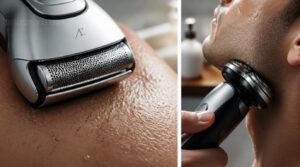
Electric shavers flip the angle rule entirely. Hold foil shavers at 90 degrees — nearly flat against skin. The foil acts as a barrier, guiding hairs into the cutting slots.
For rotary head alignment, let the contour head pivot naturally across curves. Apply only the shaver’s weight. If you feel resistance rising, you’re pressing too hard.
Cap and Guard Contact

The cap and guard aren’t decorative — they’re your angle guides. When both touch skin simultaneously, the blade sits at the correct depth: roughly 0.2 mm above the follicle opening. That mechanical barrier prevents cuts and keeps hairs from being pushed below the surface, directly reducing ingrown risk.
Distribute pressure evenly across this contact area. Don’t lean into the guard alone.
Listen for Soft Rasp

Your blade talks. At the correct 30° shaving angle, it produces a soft, consistent rasp — clean cutting, not dragging.
That audible feedback confirms proper contact.
If the rasp turns harsh or muffled, your angle has drifted, or the pressure is too heavy. Lighten your grip until the sound clears.
Let the tonal cue guide every stroke.
Prep Skin Before Shaving

Getting your angle right is only half the battle — what you do before the blade ever touches your face matters just as much. Prepped skin shaves cleaner, cuts down on irritation, and gives you a real shot at preventing those stubborn ingrown hairs. Here’s what your pre-shave routine should include.
Warm Water Softening
Warm water is your first line of defense. Soak your face for 5–10 minutes before shaving — this raises surface moisture by up to 25% and softens hair shafts noticeably.
Softer hair means less blade resistance and fewer chances for hairs to bend and grow back inward. Keep the skin wet right up until you apply lather.
Gentle Exfoliation Schedule
Exfoliating 2–3 times weekly with 2–3% salicylic acid clears follicular blockage by up to 40%, directly cutting your ingrown-hair risk.
Dry or sensitive skin? Once weekly is enough — overdoing it strips your barrier. Watch for redness or tightness; those signal damage.
Exfoliate at night, after cleansing, so skin recovers before morning.
Pre-shave Oil Application
Think of pre-shave oil as your skin’s first line of defense. Apply 2–3 drops and massage into cheeks, jawline, chin, and neck for 1–2 minutes before lathering.
- Jojoba or argan carrier oils reduce friction by up to 30%
- Essential oil blends condition skin and protect the barrier
- Absorbed oil lets the blade glide at the correct angle — not drag
Rich Lather Coverage
Lather isn’t just soap — it’s your angle’s safety net. Build it in a bowl for precise control, using a badger brush with 100–110°F water, roughly a 1:4 cream-to-water ratio, until glossy and yogurt‑thick.
Face lathering works too, scrubbed in circles for quick coverage. Either way, proper cushioning lets your blade hold 27–30° without scraping or dragging.
Map Hair Growth Direction
Before your blade touches skin, know where it’s heading. Let stubble grow to ¼ inch, then drag a cotton ball across each zone — smooth glide means with the grain, snagging means against it.
Confirm using a credit card. Sketch arrows on a face diagram.
Shave those mapped directions to cut ingrown risk greatly.
Shave With Controlled Technique

Angle alone won’t save your skin. Technique decides whether that angle actually works for you or against you. Here are five habits that turn good positioning into a clean, bump-free shave.
Shave With The Grain
Moving the razor with the grain is the single most effective technique for reducing razor burn and ingrown hairs. Your facial hair doesn’t grow uniformly — cheeks commonly grow downward, while your neck often grows sideways or upward.
Map each zone first. Skipping this step means you’ll be cutting against hair, increasing tugging and follicular trauma without realizing it.
Use Short Light Strokes
Once you’ve mapped your grain direction, stroke length becomes your next lever. Keep each pass to 1–3 inches. Short strokes let you correct blade angle after every movement — before drift becomes a nick.
Long sweeping strokes increase drag and blade pressure. They compound errors. Instead, treat each inch independently, especially around jawline transitions where the angle must shift.
Avoid Pressing Down
Short strokes already reduce drift. Now eliminate the other silent saboteur: downward pressure.
Your razor’s own weight is enough. Pressing harder doesn’t improve the cut — it bends the blade edge microscopically, dulling it up to 30% faster and stripping away your stratum corneum, the skin’s outermost protective layer.
- Excess pressure causes redness and razor burn within minutes
- Deeper cuts create sharp hair tips that curl back into follicles
- Pressure accelerates blade dulling — you’ll feel it as drag, not glide
- Multi-blade razors already increase skin contact by up to 40%; adding force compounds friction dramatically
Let the blade glide. That’s the entire technique.
Limit Repeated Passes
Once the pressure’s gone, the next mistake is going back too many times.
Each area: two passes maximum. More than that raises follicular trauma by roughly 28% — the follicle wall thins, and sharp hair tips curl inward. If skin feels warm or turns red mid-shave, stop. That’s your cue.
| Pass | Purpose |
|---|---|
| First | With-grain cut |
| Second | Across-grain refinement |
| Third | High ingrown risk |
| Beyond | Avoid entirely |
Closeness comes from angle and preparation, not repetition.
Rinse Blade Frequently
Dirty blades are a hidden saboteur of your shaving angle.
Rinse your razor after every stroke under warm running water. Hair and lather packed between blades force uneven pressure — that’s what causes blade drag and angle drift.
Once you’ve rinsed and dried it properly, a few razor blade maintenance habits for shaving cream users will keep the edge sharp much longer.
Proper prep makes rinsing even more effective — see these chest shaving cream application techniques to ensure blades glide cleanly from the very first stroke.
- Shake gently to dislodge trapped hairs
- Warm water dissolves foam residue without damaging edges
- Clean blades maintain consistent contact for ingrown hair prevention
Adjust Angle Around Curves

Flat surfaces are easy — curves are where angles go wrong fast. Your jawline, chin, and neck each demand a slightly different approach to stay in that 25–30° sweet spot. Here’s how to handle each one without losing control.
Jawline Angle Control
The jawline is where most shavers lose control. Hold your safety razor at 30 degrees relative to skin — no steeper. Use jaw tension methods: close your mouth, open your jaw slightly, and pull skin taut with your free hand. Let gravity-guided shaving do the work. Adjusting angle for jawline curves prevents ingrown hairs.
| Jawline Zone | Blade Angle | Skin Technique |
|---|---|---|
| Side jawline | 30° | Pull skin upward |
| Jaw corner | 25–30° | Puff cheek outward |
| Lower jaw | 28–30° | Stretch skin taut |
| Jaw-neck join | 25° | Lighten pressure |
| Curved contour | 27–30° | Cap-guard contact |
Chin Shaving Technique
The chin demands its own strategy. Map your chin grain first — use a fingertip to feel hair direction across each small zone before touching the razor.
- Hold your safety razor at 30 degrees from skin
- Use short controlled strokes of 1–2 inches
- Practice riding the cap on curved chin contours
- Let blade weight cut; never press down
Neck Growth Patterns
Your neck doesn’t follow rules. Hair can grow upward on the left, downward on the right, and spiral near the Adam’s apple — all on the same neck.
| Zone | Growth Direction |
|---|---|
| Upper neck | Upward toward ears |
| Lower neck | Downward or inward |
| Jawline junction | Abrupt directional shift |
| Adam’s apple | Sparse, multidirectional |
Map each zone before shaving. Adjust your blade angle — staying within 25–30° — as direction changes.
Stretch Skin Lightly
Skin tension is your secret weapon. Pull skin opposite to your stroke direction — if you’re shaving downward, gently lift upward first. This aligns hairs and creates a smooth surface.
- Use minimal tension — firm but not painful
- Protect sensitive zones like the neck with zero pull
- Stretch, shave, release — repeat that rhythm every stroke
Fix Skipping or Scraping
When the blade skips or scrapes, your angle is off. Skipping means you’re too shallow — below 20°. Scraping means too steep.
| Problem | Fix |
|---|---|
| Blade skipping | Increase angle slightly |
| Skin scraping | Ride the cap, reduce steepness |
| Vibration/chatter | Lighten pressure immediately |
| Rasp turns harsh | Reset to 27–30° |
Top 4 Shaving Essentials
The right tools make every technique you’ve learned actually work. Your angle control, stroke length, and prep routine all depend on what’s in your hand. Here are four essentials worth having in your kit.
1. Philips Norelco OneBlade 360 Hybrid
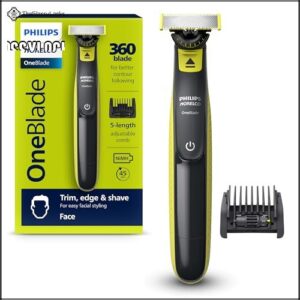
The Philips Norelco OneBlade 360 Hybrid is built for shavers who want versatility without sacrificing skin safety. Its 360° pivoting blade flexes in all directions, maintaining consistent contact across curves. The cutter runs at 12,000 strokes per minute, minimizing tugging.
You get five adjustable length settings — 1 mm to 5 mm — for beard control.
It’s fully waterproof and USB-rechargeable, delivering around 45 minutes of runtime.
Replace the blade every four months to maintain performance.
| Best For | Anyone who wants a flexible, skin-friendly shave or trim for face and body — especially those with sensitive skin or a need for a versatile travel-friendly groomer. |
|---|---|
| Model Number | QP2724/90 |
| Irritation Reduction | Minimizes razor burn and cuts |
| Sensitive Skin Suitability | Suitable for sensitive skin |
| Primary Use | Wet/dry electric shaving |
| Dimensions | 7.76 x 3.86 x 1.42 in |
| Weight/Volume | 5.43 oz |
| Additional Features |
|
- The 360° pivoting blade stays in contact with every curve, so you get a smooth shave with minimal irritation even on tricky areas like the neck and jawline
- Works wet or dry and rinses right under the tap, making cleanup effortless
- The 5-in-1 adjustable comb gives you precise control from light stubble to a longer beard length
- The blade needs replacing roughly every four months, and that replacement cost adds up over time since it’s not included
- 45 minutes of battery life sounds fine for most, but heavy users or those shaving multiple body areas may find themselves recharging more often than they’d like
- It’s not great at cutting through very long or thick hair in one pass — you may need to trim things down first before getting a clean result
2. Sandalwood Shaving Cream Bowl
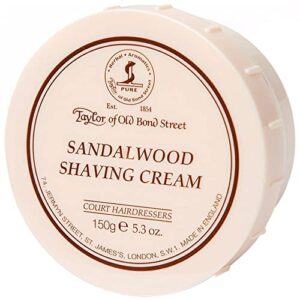
A good razor means nothing without the right lather underneath it. The Sandalwood Shaving Cream Bowl changes that immediately. Its paraben-free formula — built with glycerin and coconut fatty acid — softens hair and cuts blade friction by up to 30%. That directly lowers your nick risk.
Load a small amount onto a damp brush. The cream builds dense, cushioning lather fast. The classic sandalwood fragrance is warm and moderate. Use within 12 months of opening.
| Best For | Anyone who shaves with a safety razor or brush and wants a close, irritation-free shave with a classic sandalwood scent. |
|---|---|
| Model Number | AD1564 |
| Irritation Reduction | Reduces nicks and irritation |
| Sensitive Skin Suitability | Suitable for sensitive or normal skin |
| Primary Use | Shaving lather |
| Dimensions | 8 x 8 x 6 mm |
| Weight/Volume | 150 g |
| Additional Features |
|
- Paraben-free formula with glycerin and coconut fatty acid keeps skin soft and moisturized without a greasy feel
- A little goes a long way — the dense, cushioning lather stretches the product over many shaves
- Suitable for sensitive skin, reducing nicks and blade friction for a smoother experience
- The bowl interior can have irregular cavities and a slightly rough texture, which may look like a defect (though it doesn’t affect performance)
- Scent longevity is hit or miss — some users find the sandalwood fragrance fades quickly after rinsing
- Has a 12-month shelf life once opened, and improper storage or excess water can degrade the texture sooner
3. Merkur Classic Gold Safety Razor
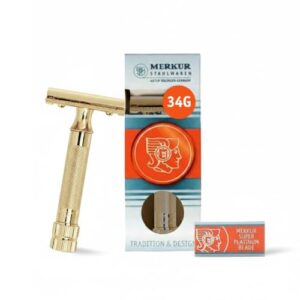
Lather needs a steady tool underneath it, and that’s where the Merkur Classic Gold Safety Razor earns its spot. The closed-comb head, made in Solingen, keeps blade exposure consistent pass after pass.
Its brass handle and balanced two-piece build practically teach you the right angle. Hold it loosely. The fixed blade gap does the rest, guiding you toward that 25–30° sweet spot without guesswork. Beginners gain confidence fast.
| Best For | Beginners and everyday shavers who want a smooth, forgiving shave with minimal irritation and easy maintenance. |
|---|---|
| Model Number | 9034003 |
| Irritation Reduction | Reduces nicking and irritation |
| Sensitive Skin Suitability | Mild, beginner-friendly shave |
| Primary Use | Wet shaving with DE blades |
| Dimensions | 4.75 x 1.8 x 1 in |
| Weight/Volume | 3.2 oz |
| Additional Features |
|
- Mild, consistent shave that reduces nicking — great for those still finding their technique
- Two-piece design makes cleaning and blade swaps quick and straightforward
- Handsome gold finish gives it a premium look on the shelf or in your dopp kit
- The gold plating is thin and can wear off over time, especially with harsh cleaning
- The shorter handle may feel tiring during longer sessions like head shaving
- Not aggressive enough for users who want an ultra-close, highly efficient cut
4. Art of Shaving Sandalwood Aftershave Balm
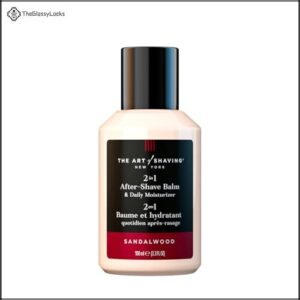
After a close shave, your skin needs real recovery. The Art of Shaving Sandalwood Aftershave Balm delivers up to 8 hours of hydration through a glycerin, shea butter, and jojoba oil blend — no alcohol, no synthetic dyes. It’s clinically tested and non-comedogenic, so it won’t clog freshly cleared pores.
Apply it within five minutes of rinsing. The formula calms visible redness and seals moisture in. One note: the small pump can stick occasionally, so prime it before use.
| Best For | Men with sensitive skin who want a premium, alcohol-free aftershave balm with long-lasting hydration and a subtle, natural fragrance. |
|---|---|
| Model Number | M-BB-2230 |
| Irritation Reduction | Calms irritation and redness |
| Sensitive Skin Suitability | Non-comedogenic, dermatologically tested |
| Primary Use | Post-shave moisturizing |
| Dimensions | 2.4 x 2.4 x 4.6 in |
| Weight/Volume | 3.3 fl oz |
| Additional Features |
|
- Keeps skin hydrated for up to 8 hours with a nourishing blend of shea butter, glycerin, and jojoba oil
- Clinically and dermatologically tested — safe for sensitive skin, non-comedogenic, and free of alcohol and synthetic dyes
- Sustainably sourced sandalwood essential oil adds a clean, masculine scent without being overpowering
- At $40, it’s on the pricier side compared to everyday drugstore alternatives
- The small pump can stick and may need a manual reset before each use
- The scent fades quickly, and the oil content can leave skin feeling slightly greasy for some users
Prevent and Treat Ingrowns

Getting a clean shave is only half the battle — what you do right after matters just as much. Ingrown hairs don’t have to be a given, and treating them early keeps them from turning into something worse. Here’s what actually works, from the rinse you take right off the blade to how you handle a bump that’s already forming.
Cool Rinse After Shaving
The moment your razor lifts, temperature becomes your next tool. Finish with lukewarm water first, then immediately switch to a 10–15°C cool rinse. This triggers vasoconstriction — blood vessels tighten, redness drops by roughly 25%, and pores begin closing before irritants can enter.
- Cool water flushes away residual lather that clogs follicles
- Vasoconstriction seals pores, blocking shaved hairs from re-entering skin
- Reduces post-shave inflammation linked to ingrown hair formation
- Prevents thermal shock — no sudden cold blasts on warm skin
- Conditions skin to absorb your next product more effectively
Alcohol-free Balm Use
Apply your alcohol-free balm within five minutes of rinsing — while skin is still slightly damp. That timing isn’t arbitrary; open pores absorb active ingredients like aloe vera and glycerin far more effectively.
A nickel-sized amount is enough. Massage upward for 30 seconds.
Ingredients like allantoin and jojoba oil work best when skin isn’t competing with fragrance, so wait before applying cologne.
Moisturize Sensitive Skin
Your skin just took a hit from the blade. Now it needs rebuilding.
Choose a glycerin or ceramide-based moisturizer — these restore barrier function without stinging freshly shaved skin. Skip anything with fragrance, dyes, or alcohol.
- Apply within 5 minutes of rinsing
- Choose gel for oily skin, cream for dry
- Patch test new products on your jawline first
- Spread a thin, even layer — no thick buildup
Warm Compress for Bumps
A razor bump is inflammation with a trapped hair underneath. Heat is your tool to release it.
Soak a clean washcloth in water between 85–95°F — warm to the wrist, never hot. Hold it against the bump for 5–10 minutes. That warmth softens keratin, swells the hair shaft, and lets it break through the surface naturally.
Avoid Picking Trapped Hairs
Picking feels instinctive. Don’t.
When you dig at a trapped hair, you push bacteria deeper into the follicle, risking infection and scarring. Picking can also trigger excess melanin production, leaving dark spots for up to 12 weeks. Use a warm compress instead, or see a dermatologist for sterile extraction. Hands off heals faster.
Picking a trapped hair drives bacteria deeper, trading one bump for infection, scarring, and weeks of dark spots
Frequently Asked Questions (FAQs)
How often should razor blades be replaced?
Think of your blade like a kitchen knife going dull. Replace it every 5 to 10 shaves, sooner with coarse hair or tugging. Rust, redness, or rough strokes mean swap now, not later.
Can diet affect skins response to shaving?
Yes.
Vitamin A speeds cell renewal, zinc strengthens barrier protection, omega-3s boost hydration, and vitamin C reinforces collagen.
Together they help skin resist nicks, fight irritation, and lower ingrown hair risk—proof, good shaving starts on your plate, not just your face.
Which aftershave ingredients worsen ingrown hairs?
Some aftershave ingredients are like roadblocks for healing skin. Alcohol-based formulas — especially those with 60–75% ethanol — strip natural oils and tighten pores, trapping hairs. Avoid synthetic fragrances, petroleum ingredients, and heavy oils; choose an alcohol-free balm instead.
Does shaving frequency increase ingrown hair risk?
Daily shaving raises the risk. Shorter regrowth length, repeated skin barrier disruption, and faster blade wear all contribute.
Correct shaving angle and clean technique reduce follicle blockage, razor burn, and ingrown hairs—even on a frequent shaving schedule.
Are ingrown hairs more common on certain skin types?
Buckle up, gladiator-style — your skin’s battle isn’t random.
Curly hair risks, thicker keratin layer buildup, dry skin barriers, and friction‑prone areas all raise the odds.
Underlying follicle‑altering conditions matter too, alongside sloppy shaving angle and technique.
Conclusion
Shaving is a blade conversation—and angle is your opening word. When you hold the razor correctly, hairs cut cleanly and lie flat, giving follicles no reason to rebel.
Proper razor angle for ingrown hairs isn’t a trick you learn once; it’s a habit you build every morning. Prep your skin, read the grain, adjust around curves, and let the blade do exactly what it’s designed for.
Control the angle. End the bumps.