This site is supported by our readers. We may earn a commission, at no cost to you, if you purchase through links. This content is for general informational and educational purposes only and is not a substitute for professional medical, dermatological, or nutritional advice.
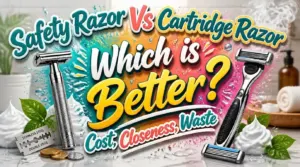
A safety razor blade costs about 10 to 50 cents. A cartridge refill costs $3 to $4. Run that gap for five years and you’ll keep roughly $478 to $507 in your pocket.
Money isn’t the only difference. Cartridges lift the hair and cut it below the skin, which can curl a blunt retracted tip into the follicle and leave bumps along your neck. A safety razor slices once, flush, with no retraction.
So safety razor vs cartridge razor, which is better? It depends on your skin, your patience, and how much plastic you want to throw away. Here’s how each one holds up.
Table Of Contents
- Key Takeaways
- Safety Razor Vs. Cartridge Razor at a Glance
- How Safety and Cartridge Razors Cut Hair
- Shave Closeness, Razor Burn, and Ingrown Hairs
- Shaving Technique and Everyday Convenience
- Upfront Costs and Long-Term Blade Savings
- Handle Durability, Waste, and Blade Recycling
- Frequently Asked Questions (FAQs)
- Conclusion
Key Takeaways
- A safety razor’s $0.10 to $0.50 blades beat $3 to $4 cartridge refills, so you’ll save roughly $478 to $507 over five years and earn back the $55 starter kit in about six months.
- Cartridges cut hair below the skin, where the tip can retract and curl into the follicle, while a safety razor cuts flush, which means fewer ingrown hairs and less irritation on your neck.
- Cartridges win on convenience, since you can use one well on day one, but a safety razor takes two to four weeks to learn and needs a 30-degree angle with zero pressure to avoid nicks.
- A well-made steel or brass safety razor can last decades and leaves only small metal blades to throw out, while cartridges produce 26 to 52 mostly unrecyclable plastic heads a year.
Safety Razor Vs. Cartridge Razor at a Glance
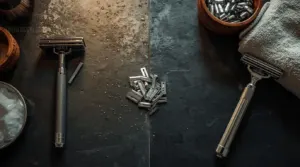
A safety razor rewards patience, while a cartridge razor rewards speed. Neither one is wrong. They just suit different priorities.
Whichever razor you choose, an even lather matters just as much, and these shaving cream application tips for beards show how to get it right.
On cost over time, the safety razor wins clearly. Blades run $0.15 to $0.50 each, against $3.00 to $4.00 for a cartridge, and the roughly $55 starter kit pays for itself in about 26 weeks. It also produces far less plastic waste, which matters if you care about environmental impacts. Because only the small metal blades need replacing, safety razors minimize plastic waste compared with throwing away entire plastic cartridge bodies and attachments.
Cartridges win on convenience. You can use one well on day one and buy refills at any gas station. A safety razor takes two to four weeks to learn, and careless angles or heavy pressure can cause skin irritation. (Airport rules matter too: loose blades can’t go in carry-on bags.)
How Safety and Cartridge Razors Cut Hair
Both razors cut hair, but they get there in very different ways. That’s the real gap between a patient tool and a fast one.
A safety razor uses a single blade held at roughly 30 degrees. The weighted handle does the work, so you add no downward pressure. Blade gap and exposure set how aggressive the cut feels.
A cartridge razor works differently. Its multiple blades pass over the same skin in one stroke, and here’s the sequence:
- The leading blade lifts the hair slightly.
- Trailing blades sever it.
- The cut lands below the skin surface.
- The tip retracts as the hair settles.
Marketers call it "lift-and-cut." A safety razor skips all of it: one edge, one clean slice, flush.
If your skin is on the sensitive side, this guide to shaving a sensitive face as a man shows how a single blade and going with the grain keep things comfortable.
Shave Closeness, Razor Burn, and Ingrown Hairs
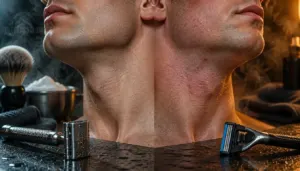
That cut depth shows up on your skin afterward. A cartridge delivers a very close shave, and that’s its appeal. The cost comes later.
Hair cut below the surface retracts, and its blunt tip can curl into the follicle wall. That’s an ingrown hair, and it’s the driver of bumps on the neck, where growth spirals in several directions. Multiple blades scrape the same patch, which strips protective oils and adds to hair follicle irritation. Glide strips with PEG derivatives can bother sensitive skin too.
A safety razor cuts flush, so the dermatological effects of shaving are milder: fewer passes, less friction, no retracting tip. That’s shaving irritation prevention built into the tool, which beats chasing skin irritation relief afterward.
Shaving Technique and Everyday Convenience
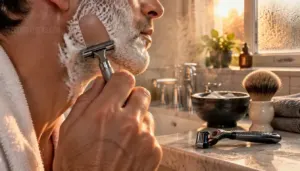
How you shave matters as much as what you shave with. Each razor asks for a different kind of attention, and that shapes how your mornings go. Below, we’ll look at angle and pressure with a safety razor, then at how a cartridge takes on curves and contours.
Safety Razor Angle and Pressure
Picture a first-timer who shaves like he did with cartridges: leaning in, pressing hard. The result is nicks and skin irritation.
- Rest the safety razor head flat.
- Lower the handle until the blade bites, around 30 degrees.
- Let the weight do the work, with zero shaving pressure.
- Take short strokes, one to two inches.
Good razor ergonomics help a lot.
Cartridge Razors on Curves and Contours
Where does a cartridge razor shine? On curves. The pivoting head follows the contours of your face and body, so multiple blades stay at a steady angle.
Press down gently to engage it. Here’s how it experiences common trouble spots:
| Area | Result |
|---|---|
| Neck | Easy |
| Knees | Easy |
| Under nose | Tricky |
| Jawline | Good |
Expect a higher blade cost, though, so budget accordingly.
Upfront Costs and Long-Term Blade Savings

The upfront gap is real, but it’s smaller than you’d expect. A safety razor handle runs $30 to $50, while a cartridge handle is often $10 to $18. That cheaper initial investment is the hook (the handle is sold near cost on purpose).
The refills are where the math flips. Here’s how the numbers compare:
- Double-edge replacement blades cost $0.10 to $0.15 each in packs of 100.
- Cartridge heads run $3 to $4 apiece.
- Yearly spending falls from roughly $100 to $120 to $10 to $20.
- The handle pays for itself in six months.
Over five years, you’d save around $478 to $507. For cost-effective shaving, that’s hard to ignore. Blade cost is the whole story in long-term grooming economics.
Handle Durability, Waste, and Blade Recycling

A cartridge razor is built to be replaced. A safety razor is built to be handed down. That gap in durability shapes the waste picture.
One razor is designed to be thrown away, the other to be passed down, and the difference shows up in your trash
A solid stainless steel or brass handle can last decades. Budget models made from chrome-plated zinc alloy corrode sooner, so check the material before you buy. If your shower water is hard or salty, 316L resists rust best.
Waste is where the two diverge most. A daily cartridge user throws out 26 to 52 plastic cartridges a year, and almost none get recycled because the plastic, rubber, and steel are bonded together. A safety razor user discards 52 bare steel blades instead.
Blade disposal is easy: use a metal blade bank, recycle it as scrap when full.
Frequently Asked Questions (FAQs)
How often should you change safety razor blades?
MÜHLE suggests 3–5 shaves per blade, which means about weekly if you shave every other day. Coarse hair or sensitive skin? Change sooner. Tugging, nicks, or redness mean it’s done.
Can you take a safety razor on a plane?
Yes, but only the handle. Take the blade out before you reach security, because officers won’t do it for you and will confiscate the razor if a blade is still in. Loose blades go in checked luggage.
Can women use safety razors for legs and underarms?
Yes, they can, and many do. Hold the razor at roughly 30 to 40 degrees, use no downward pressure, and shave legs with the grain. For underarms, go down, up, then across. Rinse often.
What shaving prep products work best with either razor?
A good lather is a cushion between blade and skin. For a safety razor, use a shave brush with soap or cream. Cartridges need less: a clear gel will do. Skip oils there.
Conclusion
Cartridges promise speed, but a safety razor rewards patience. That’s the trade. So safety razor vs cartridge razor which is better? If you want lower long-term costs, less plastic, and fewer bumps, the safety razor wins, once you learn the angle and keep your pressure light.
If mornings are rushed and your skin is forgiving, a cartridge still does the job. Pick the tool that fits your routine, then stick with it for a month.