This site is supported by our readers. We may earn a commission, at no cost to you, if you purchase through links. This content is for general informational and educational purposes only and is not a substitute for professional medical, dermatological, or nutritional advice.
Yes, women can grow beards. It’s not common, but it happens when your body produces higher levels of androgens—the hormones responsible for male characteristics. About 5-10% of women experience hirsutism, a condition that causes thick, dark hair to grow in places where men usually have it: the face, chest, and back. You might notice coarse hairs sprouting on your upper lip, chin, or jawline.
Sometimes it’s genetic. Other times it signals an underlying issue like polycystic ovary syndrome, thyroid problems, or a reaction to certain medications.
The emotional toll can be significant—many women feel embarrassed or anxious about facial hair in a culture that prizes smooth, hairless skin. Understanding what drives this growth helps you decide whether you need medical evaluation and which treatment options, from laser removal to hormonal therapies, might work for you.
Table Of Contents
Key Takeaways
- About 5-10% of women experience hirsutism—thick, dark facial hair growth driven by elevated androgen hormones, often linked to conditions like polycystic ovary syndrome, thyroid problems, or genetic factors.
- Treatment options range from temporary removal methods like shaving and waxing to longer-term solutions like laser hair removal (76-84% reduction) and hormonal therapies that target the root cause by lowering androgen levels.
- The psychological impact runs deep, with 30% of affected women experiencing clinical depression and 40% avoiding social situations due to stigma around cultural beauty standards that equate femininity with hairlessness.
- Sudden or rapid facial hair growth—especially paired with irregular periods, unexplained weight gain, voice deepening, or increased muscle mass—signals the need for immediate medical evaluation to rule out underlying hormonal or metabolic conditions.
Can Women Grow Beards?
Yes, you can grow a beard—though it’s not common. A small number of women develop enough facial hair to form what looks like a beard, a pattern known as hirsutism. This happens in about 5% to 15% of women across different backgrounds.
It’s usually tied to androgen hormones like testosterone or conditions like polycystic ovary syndrome (PCOS). Sometimes it’s just hereditary. Your face has the same hair follicles as men, but hormonal influence and evolutionary context determine how much grows.
This condition is often linked to elevated androgen levels.
Causes of Facial Hair in Women

When facial hair shows up in places you didn’t expect, there’s usually a reason behind it. Your body’s chemistry, genetics, or even medications can flip the switch on hair growth.
Let’s look at what might be causing those extra strands to appear.
Hormonal Imbalances and Androgens
When androgen hormones flood your system beyond normal levels, your hair follicles respond by producing thicker, darker strands—exactly where men generally grow beards. This hormonal imbalance drives hirsutism through four key mechanisms:
- Androgen production surges from your ovaries or adrenal glands
- Testosterone levels climb above 200 ng/dL, signaling potential tumors
- Hormone receptors in your skin become hypersensitive
- Enzyme activity converts testosterone into dihydrotestosterone—ten times more potent at follicles
Your metabolic effects matter too: studies show hyperandrogenemia links directly to metabolic syndrome, regardless of weight. The Ferriman-Gallwey scoring system is often used to diagnose this condition.
Polycystic Ovary Syndrome (PCOS)
PCOS stands as the most frequent cause of hirsutism, accounting for 72–82% of cases worldwide. This hormonal imbalance triggers androgen overproduction, which fuels unwanted beard growth and affects 5–26% of reproductive-age women globally.
Yet up to 70% remain undiagnosed—missing early treatment that could prevent metabolic risks like insulin resistance, cardiovascular disease, and infertility complications that worsen without intervention.
Genetic and Ethnic Factors
Your DNA plays a powerful role in facial hair growth. Women of Hispanic, Middle Eastern, South Asian, and African American heritage carry shorter CAG repeats in their AR Gene, making follicles more sensitive to androgens—even when hormone levels look normal.
This Familial Hirsutism passes through generations, and your Ethnic Prevalence risk climbs when relatives share similar Hair Characteristics. Heredity outweighs hormones in shaping your beard.
Medications and Medical Conditions
Beyond genetics, certain medications can trigger Drug-induced hirsutism—minoxidil, anabolic steroids, danazol, and some antipsychotics push androgen levels higher.
Medical conditions increase this: PCOS connection dominates 72–82% of cases, while Cushing’s syndrome, adrenal tumors, and thyroid disorders create hormonal imbalances that fuel unwanted facial hair. Polycystic ovary syndrome remains the leading culprit behind excess androgen production.
How Age and Weight Influence Beard Growth

Your body doesn’t stay the same forever, and neither do your hormones. As you age or carry extra weight, your hormone levels shift in ways that can trigger beard growth where you never had it before.
Let’s break down how these two factors—aging and weight—play a role in facial hair development.
Effects of Aging on Hair Patterns
As you age, your hair tells a different story. Hormonal shifts during menopause increase androgen secretion relative to estrogen, causing facial coarseness—thicker chin hairs become more noticeable after 40.
Hair density decreases as follicular function slows down, shortening the growth phase. Meanwhile, texture changes transform your hair from smooth to coarser and wiry.
These body changes and facial hair patterns reflect the impact of age on facial hair, with old age bringing visible differences in both thickness and appearance.
Impact of Obesity on Androgen Levels
Carrying extra pounds disrupts your hormonal balance. Adipose tissue isn’t just storage—it actively produces androgens and increases aromatase activity, converting testosterone to estrogen while paradoxically raising free testosterone due to reduced binding proteins.
Obesity amplifies androgen secretion through several pathways:
- Insulin resistance triggers excess androgen production in your ovaries
- Fat distribution patterns affect how your body metabolizes hormones
- Increased body mass stimulates testosterone synthesis in adipose tissue
These effects of obesity on hormones explain why overweight women often experience unwanted facial hair growth.
Symptoms and Signs of Hirsutism
Spotting hirsutism isn’t always straightforward—what’s normal for one woman might signal a hormonal issue in another. The key lies in understanding where the hair grows and how it differs from typical female hair patterns.
Let’s break down the telltale signs that separate everyday fuzz from something worth addressing.
Areas Commonly Affected
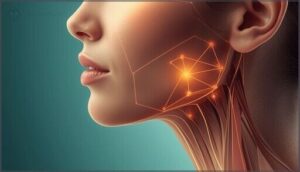
Hirsutism commonly shows up where men grow facial hair—think upper lip, chin, and cheeks. You’ll notice thick, dark hair in these androgen-sensitive zones, not just light peach fuzz.
Hair distribution matters during clinical assessment because it helps doctors understand what’s driving excessive hair growth. Beyond facial hair sites, you might see changes on your chest, lower abdomen, back, or inner thighs.
These body hair patterns reveal how androgens are affecting your system, guiding treatment decisions.
Differences Between Normal and Excessive Growth
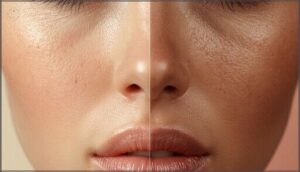
Normal facial hair looks like soft, fine peach fuzz—light in color and barely noticeable. Excessive growth from hirsutism means you’re dealing with thick, dark terminal hairs on your chin, upper lip, or cheeks.
Hair density, texture, and pigmentation levels change dramatically. Clinical grading evaluates growth location and coarseness to distinguish normal from problematic patterns.
Androgen overproduction drives this transformation, turning delicate vellus hairs into coarse strands. Hormonal imbalances in women shift what should be subtle into something harder to ignore.
Treatment Options for Unwanted Facial Hair

If unwanted facial hair is bothering you, the good news is that you have options. Some treatments work by physically removing the hair, while others target the root cause by adjusting your hormone levels.
Let’s look at what’s available so you can find what works best for your situation.
Hair Removal Methods (Shaving, Waxing, Laser, Electrolysis)
You have several effective facial hair removal options to choose from. Here’s a method comparison to help you decide:
- Shaving – Quick and painless, but requires frequent upkeep since 11% of women shave daily to manage regrowth.
- Waxing – Lasts longer than shaving despite waxing pain, and hair grows back finer over time.
- Laser hair removal – Reduces facial hair by 76-84%, though laser cost is higher upfront.
- Electrolysis – Permanent solution with 10-30 sessions needed, but electrolysis regrowth rates vary at 15-40%.
Medical Therapies (Hormonal Treatments, Topical Creams)
If hair removal methods aren’t enough, medical therapy can target the root cause. Hormonal treatments like oral contraceptives and anti-androgens reduce androgen levels that trigger hirsutism. Spironolactone is commonly prescribed, though hormonal side effects like irregular periods may occur.
Topical cream efficacy is proven with eflornithine (Vaniqa), which slows facial hair growth in about 58% of women. Combination therapies work best for moderate cases, but antiandrogen risks include birth defects, so reliable contraception is essential.
Treatment guidelines recommend starting with hormones, then adding options as needed.
Social and Psychological Impacts

Having facial hair as a woman can feel like you’re walking through life with a spotlight on something you’d rather keep hidden. The effects go way beyond what you see in the mirror—they seep into how you feel about yourself and how you move through the world.
Let’s look at what this really means for your mental health and daily life.
Stigma and Cultural Beauty Standards
Society often equates femininity and hairlessness, making visible facial hair on women feel like breaking an invisible rule. This cultural perception leads to real consequences:
- Social discrimination: About 40% of women with unwanted facial hair avoid social situations entirely due to judgment and stigma.
- Media representation gaps: Mainstream beauty ideals rarely show women with facial hair, reinforcing the idea that it’s abnormal.
- Ethnic variations ignored: Women of South Asian, Middle Eastern, and Mediterranean descent face hair growth more commonly, yet beauty standards don’t reflect this diversity.
- Gender and body image pressures: Social norms push the message that smooth skin defines femininity, marginalizing those who don’t fit the mold.
Emotional Well-being and Self-esteem
Beyond public perception, the inner toll runs deep. Unwanted facial hair directly impacts your mental health: 30% of women with visible growth experience clinical depression, while 75% struggle with anxiety.
Your self-perception shifts, leaving you feeling less feminine and confident in your own skin. This isn’t vanity—it’s how rigid gender roles and social norms shape body image.
Feeling less feminine from facial hair isn’t vanity—it’s how gender norms and social expectations shape your self-image
The good news? Proper treatment and supportive communities offer a real confidence boost, helping you reclaim comfort in social settings.
When to Seek Medical Advice

Facial hair growth isn’t always something to worry about, but sometimes it signals a health issue that needs attention. Knowing when to check in with a doctor can help you catch underlying conditions early and get the right treatment.
Here’s what to watch for and when it’s time to reach out to a healthcare professional.
Signs of Underlying Health Conditions
Sometimes facial hair isn’t just about genetics—it’s your body waving a red flag. Hormonal imbalances linked to hirsutism often signal deeper health issues that need attention. Watch for these warning signs:
- Irregular or missing periods alongside facial hair may point to polycystic ovary syndrome or other hormonal disruptions
- Acne outbreaks concentrated on your jawline and chin, especially with excess hair growth
- Unexplained weight gain paired with insulin resistance or thyroid dysfunction
- Deepened voice or increased muscle mass, indicating elevated androgen levels beyond typical causes of hirsutism
Consulting a Healthcare Professional
When facial hair appears suddenly or progresses rapidly over a few months—especially with red-flag symptoms like voice changes or breast size reduction—you need urgent medical attention.
Your initial evaluation may include hormone tests for testosterone and DHEAS to identify causes of hirsutism. Depending on findings, specialist types involved could include endocrinologists for hormonal issues or dermatologists for laser therapy.
Treatment duration often spans 6–12 months, with follow-up care monitoring both symptom improvement and any underlying medical conditions associated with hirsutism.
Frequently Asked Questions (FAQs)
Is facial hair growth in women reversible?
Yes, it’s often reversible with treatment. Hormonal therapies and topical interventions can reduce facial hair growth over six months, though stopping medication usually leads to regrowth. Complete reversal remains challenging without ongoing management.
Can diet changes reduce female facial hair?
Dietary fiber, low-carb eating, calorie restriction, and inositol supplementation can reduce androgens and improve hirsutism in PCOS.
Weight loss and low-glycemic diets lower testosterone, addressing the hormonal imbalance that drives unwanted facial hair.
Does pregnancy affect beard growth in women?
As they say, life brings unexpected changes. Hormonal changes during pregnancy boost testosterone levels, triggering new facial hair growth in roughly 30% of women. PCOS impact intensifies this effect, though postpartum regression generally reverses hormonal imbalance in women naturally.
Are there natural remedies for female hirsutism?
You’ve got options beyond prescriptions. Spearmint tea, inositol supplements, and vitamin D can help lower androgens. Cinnamon benefits insulin resistance, while diet influence—especially low-glycemic patterns—can ease hirsutism.
Still, medical treatments for hirsutism remain essential.
Can stress trigger facial hair in women?
Chronic stress elevates cortisol and androgens, worsening hirsutism—especially in PCOS. It disrupts hair cycles, and metabolic stressors like insulin resistance intensify hormonal influences on hair growth, making treatment options for hirsutism essential.
Conclusion
Nearly one in ten women wrestles with unwanted facial hair at some point—a reminder that hormones don’t follow a script. If you’ve wondered whether women can grow beards, the answer is yes, and you’re far from alone.
Whether it’s a few stray hairs or a fuller pattern, you deserve clarity, not shame. Track your symptoms, explore your options, and consult a doctor when changes feel sudden or troubling. Your body tells a story worth listening to.