This site is supported by our readers. We may earn a commission, at no cost to you, if you purchase through links.

The quest for a fuller beard has led thousands of men to raid their bathroom cabinets for an unlikely ally: a scalp hair loss treatment originally designed for balding heads. Minoxidil—better known by its brand name Rogaine—has developed a cult following in beard-growing communities, with online forums buzzing about dramatic before-and-after transformations.
But here’s the catch: the FDA has never approved this drug for facial hair, and the science behind its off-label use exists in a gray zone between promising clinical evidence and individual trial-and-error.
Your genetics, hormones, and even your age play starring roles in whether this approach will work for you. Understanding how minoxidil actually interacts with facial hair follicles can help you set realistic expectations and avoid the common pitfalls that derail many first-time users.
Table Of Contents
- Key Takeaways
- Does Rogaine Work for Beard Growth?
- How Does Minoxidil Stimulate Facial Hair?
- What Results Can You Expect With Rogaine?
- How to Apply Rogaine for Beard Growth
- What Are The Side Effects of Rogaine on Beards?
- How Safe is Minoxidil for Facial Use?
- How Long Should You Use Rogaine for Beards?
- Can Rogaine Help With Mustache Growth?
- Who Can Benefit Most From Rogaine for Beards?
- Are There Alternatives to Rogaine for Beard Growth?
- Frequently Asked Questions (FAQs)
- Does Rogaine work for beards?
- Can minoxidil (rogaine) help a thinning beard?
- Does minoxidil (rogaine) help thinning hair?
- Is Rogaine good for hair growth?
- How effective is minoxidil (rogaine)?
- Is Rogaine safe?
- Is Minoxidil Beard Growth Permanent?
- Is Minoxidil 5 or 10 better?
- Can you use Minoxidil once a day for a beard?
- How long does Rogaine’s beard last?
- Conclusion
Key Takeaways
- Rogaine (minoxidil) can help some men grow fuller beards, but results depend heavily on your genetics, hormones, and consistency in application.
- Minoxidil is not FDA-approved for facial hair, so using it on your beard is considered off-label and comes with potential risks like skin irritation and unwanted hair growth in other areas.
- Most users see noticeable improvements after 3–4 months of regular use, but stopping treatment usually leads to gradual loss of any new beard growth.
- Safer and more reliable results happen when you use the right dose, avoid sensitive areas, and work with a doctor to watch for side effects or rare complications.
Does Rogaine Work for Beard Growth?
You’ve probably seen guys online swearing by Rogaine for filling in patchy beards, but the real question is whether the science backs up the hype. Minoxidil wasn’t designed with facial hair in mind, so it’s worth understanding what the research actually shows and what “off-label” really means for your face.
Let’s break down the evidence, the FDA’s stance, and what you should know before trying it on your beard.
Scientific Evidence for Minoxidil on Beards
Clinical trials offer solid proof that minoxidil can work for beard growth. A randomized, double-blind study on 48 men using 3% minoxidil twice daily showed considerably more facial hair after 16 weeks compared to placebo. Higher concentrations, like 5%, tend to produce more substantial gains. You’ll generally see measurable improvements in density around four months, with side effects remaining mild.
The efficacy of oral minoxidil for treating hair loss is supported by research on hair growth factors.
FDA Approval Status for Facial Hair
While those trial results sound promising, the FDA hasn’t officially approved Rogaine for your beard. It’s only FDA-approved for scalp hair loss, so any facial use is off-label. That means:
- No standardized dosing exists for beards
- Facial hair growth is listed as a potential side effect, not a therapeutic goal
- Labeling restrictions specify scalp-only application
- You won’t find regulatory guidance on safety parameters for facial skin
This regulatory gap doesn’t mean it won’t work—just that you’re venturing beyond the approved territory. Rogaine contains the active ingredient minoxidil.
Off-Label Use Considerations
Off-label uses of minoxidil for beard growth raise important legal ramifications. You need informed consent documenting the experimental nature, limited evidence quality, and potential side effects—including systemic absorption risks like palpitations or unwanted body hair.
Risk assessment matters: if you have cardiovascular issues or hypotension, avoid minoxidil entirely. State medical boards differ on what constitutes acceptable off-label practice, so consult your doctor first.
How Does Minoxidil Stimulate Facial Hair?

Understanding how minoxidil works on your beard can help you set realistic expectations. The drug doesn’t create new hair follicles from scratch, but it does wake up dormant ones and keeps existing hairs in their growth phase longer.
Let’s break down the three main ways minoxidil stimulates facial hair growth.
Mechanism of Action on Hair Follicles
Think of minoxidil as a master switch for your hair follicles. Once you apply it, an enzyme in your follicle converts it into minoxidil sulfate, which flips open potassium channels in the follicle cells. This triggers a cascade:
- Potassium channel opening signals follicles to wake up and grow
- Hair cycle modulation pushes resting follicles into active growth phase
- Dermal papilla effects boost the cells that control hair thickness
- Growth factor induction ramps up proteins like VEGF that feed follicles
Your body’s sulfotransferase levels determine how well this works.
Blood Flow and Nutrient Delivery
Beyond waking up follicles, minoxidil widens blood vessels beneath your beard area, boosting oxygen transport and nutrient supply to each hair root. This vascular remodeling creates lasting improvements in beard perfusion—think of it as upgrading your follicles’ supply lines. Enhanced follicle metabolism follows naturally when microvascular vasodilation delivers more amino acids, glucose, and growth factors.
| What Minoxidil Delivers | How Your Beard Benefits |
|---|---|
| Increased oxygen | Healthier, thicker shafts |
| More nutrients | Faster keratin production |
| Growth factors | Vellus-to-terminal transformation |
| Better circulation | Sustained follicle support |
Hair Growth Cycle Effects
Once you start minoxidil, your hair follicles shift gears through the hair growth cycle. Here’s what actually happens:
- Anagen Phase Extension – Follicles stay in the growth phase longer, producing thicker, longer hairs.
- Telogen Shortening – Resting periods shrink, pushing dormant follicles back into action faster.
- Shedding Dynamics – Expect temporary hair loss around weeks 2–8 as old fibers make way for new growth.
- Vellus Conversion – Some fine hairs darken and thicken, though full terminal transformation isn’t guaranteed.
Cycle considerations matter: your beard may shed before it fills in.
What Results Can You Expect With Rogaine?

If you’re considering Rogaine for your beard, you’re probably wondering when you’ll see results and how much growth to expect. The truth is, timelines and outcomes aren’t the same for everyone.
Let’s look at what usually happens, what influences your results, and why your genetics play a bigger role than you might think.
Typical Timeline for Visible Changes
Your beard growth journey with minoxidil unfolds in distinct phases. Initial vellus hairs may appear within 2–8 weeks, followed by a shedding phase around weeks 4–12 as follicles reset.
Noticeable improvement generally emerges at 3–4 months, with terminal conversion strengthening between months 4–12.
Long-term gains often peak around one year, though individual minoxidil effectiveness varies considerably based on your unique biology.
Factors Influencing Effectiveness
Your response to minoxidil hinges on several factors you can’t ignore. Hormonal influence and genetic predisposition determine whether hair follicles are androgen-sensitive enough to respond.
Skin health matters—irritation can force you to cut back, blunting results. Treatment adherence is key; skipping applications tanks progress within months.
Lifestyle factors like nutrition and smoking also play a role, as do ethnicity and baseline beard density, shaping your eventual beard growth outcome.
Variability Based on Genetics
Your genetics load the dice before you ever apply minoxidil. AR gene variants from your mother’s side and SULT1A1 polymorphisms determine whether follicles convert the drug efficiently.
Your mother’s AR gene variants and your SULT1A1 polymorphisms decide whether minoxidil will work on your beard before you even start
Ancestral patterns and family history set your baseline density, while follicle heterogeneity means neighboring beard hairs may respond differently.
This genetic lottery explains why facial hair growth results vary so widely among users.
How to Apply Rogaine for Beard Growth
If you’re going to use minoxidil on your beard, getting the application right matters more than you might think. The difference between foam and liquid can affect your results, and a few simple precautions will help you avoid growing hair where you don’t want it.
Here’s what you need to know about applying Rogaine safely and effectively to your facial hair.
Step-by-Step Application Process
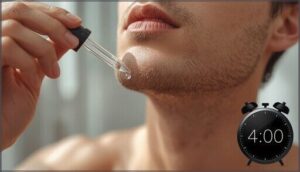
Getting the most from minoxidil application starts with proper skin preparation—wash your beard area with a gentle cleanser and pat it completely dry before you begin.
Here’s your routine:
- Measure carefully: Use about 1 ml (roughly 6 sprays or one dropper fill) of 5% minoxidil twice daily, spacing doses 10–12 hours apart
- Target patchy spots: Place small amounts directly on thin areas—cheeks, jawline, chin—then massage gently for 30–60 seconds to spread evenly
- Respect absorption time: Leave minoxidil on for at least 4 hours before washing, then moisturize to combat dryness
Wash your hands thoroughly after each application to prevent unwanted hair growth elsewhere, and never exceed two applications daily—dosing frequency matters for both safety precautions and results.
Liquid Vs. Foam Formulations

Once you’ve nailed down application control, choosing between liquid and foam-based formulas matters for your comfort and consistency. Foam spreads more precisely on patchy areas without dripping down your neck, while solution can run onto unintended spots.
Foam also dries faster—usually within minutes—and skips propylene glycol, which cuts down on skin irritation and flaking if you’re prone to sensitivity.
Cost comparison? Solutions generally run cheaper, but foam’s tolerability often wins out for facial use.
Tips to Avoid Unwanted Hair Growth

Precise application control keeps minoxidil on target and off your forehead. Stick to the FDA-approved 1 mL twice daily—overdosing won’t speed results but will spike side effects like contact transfer to pillowcases or partners.
Wash your hands immediately after use, let treated skin dry before touching fabric, and watch for early detection of stray hairs spreading beyond your beard zone.
What Are The Side Effects of Rogaine on Beards?
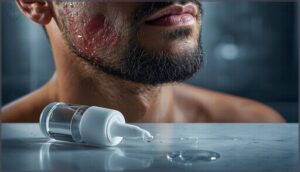
Using Rogaine on your beard isn’t without risks, and you should know what you’re getting into before you start.
Most side effects are mild and localized to the skin, but there are some less common systemic reactions worth understanding.
Let’s walk through the main concerns you might face and how to handle them if they come up.
Skin Irritation and Allergic Reactions
When you apply minoxidil to your beard area, skin irritation is the most common side effect you’ll face. Around 59% of beard users report dryness, while 22% experience irritation.
Allergic dermatitis occurs less often but deserves attention—patch testing confirms minoxidil allergies in about 75% of suspected cases. Symptoms can appear within days or emerge years later, showing as redness, itching, and flaking.
Systemic Side Effects
Beyond skin reactions, minoxidil can trigger systemic side effects through absorption. About 1.4% of topical Rogaine enters your bloodstream, potentially raising your heart rate by 3-5 beats per minute. Some users report headaches, dizziness, or mild blood pressure changes.
Hypertrichosis—unwanted hair growth in non-treated areas—affects roughly 4% of users, especially with frequent application. These minoxidil side effects remain uncommon but warrant attention.
Managing and Minimizing Risks
With careful allergy screening and smart application techniques, you can cut down on most side effects. Patch testing helps catch reactions early—usually within 90 days—and using the right dose limits systemic absorption and unwanted growth elsewhere.
- Start with a patch test on your inner forearm 48 hours before full facial application
- Stick to 1 mL per dose to minimize systemic absorption and off-label use of Rogaine risks
- Switch to foam formulas if propylene glycol triggers irritation or adverse reactions
- Let product dry completely before sleep to prevent transfer and unwanted hair on your neck
- Schedule medical follow-up every 3–6 months to monitor Minoxidil safety concerns
How Safe is Minoxidil for Facial Use?

When you’re putting anything on your face day after day, safety matters more than promises. The skin on your beard area is thinner and more reactive than your scalp, which changes how minoxidil behaves and what precautions you need to take.
Let’s look at what makes facial use different, when medical oversight is smart, and who should skip minoxidil altogether.
Safety on Sensitive Beard Area Skin
The skin on your face is thinner and more reactive than your scalp, making it prone to Rogaine-related side effects like dry skin, itchiness, and redness.
Up to 60% of users experience mild irritation with topical treatment. Formulation differences matter—liquid versions contain propylene glycol, a common allergen, while foam options reduce this risk.
Systemic absorption remains low, but Irritation Management and Minimizing Risks are still essential.
Medical Supervision and Precautions
Before you start, your doctor should check your blood pressure and review any cardiovascular medications you’re taking. Off-label use for beards requires careful documentation and informed consent, especially since this isn’t FDA-approved for facial hair.
Regular dermatology follow-ups help catch adverse reactions early—like irritation or unwanted hair growth elsewhere—and allow your provider to adjust dosage if side effects arise or medical conditions change.
Who Should Avoid Minoxidil?
If you have heart conditions like unstable angina or recent heart attack, pregnancy risks make minoxidil a no-go—case reports link it to fetal abnormalities.
Breastfeeding safety is uncertain for newborns, and skin sensitivity or active facial dermatitis can worsen with use.
Low blood pressure, systemic illness, or pheochromocytoma mean the side effects of minoxidil outweigh cosmetic benefits, so consult your doctor first.
How Long Should You Use Rogaine for Beards?
If you’re thinking about using Rogaine on your beard, you’re probably wondering how long you need to keep applying it before you see results—and what happens if you stop. The answer isn’t one-size-fits-all, but there are some general timelines and patterns most men follow.
Let’s walk through how long treatment usually takes, what signs tell you it’s working, and what you can expect if you decide to quit.
Minimum Recommended Duration
Most people want to know: how long do you really need to stick with minoxidil before deciding if it works? Early visible response generally appears around 3 months, but that’s just the beginning. Clinical minimums suggest a different story for off-label duration on facial hair.
- Initial changes: You’ll notice fine “peach fuzz” hairs emerging around 8 weeks as follicles wake up
- Measurable density: Clinical studies document clear beard thickening at the 3-month mark with continuous treatment minimum
- Full cycle alignment: Your facial follicles need roughly 4 months to complete one hair-growth alignment phase
- Recommended evaluation: Dermatology guidelines advise maintaining twice-daily minoxidil application and results for at least 16 weeks before judging effectiveness
- Maximum benefit window: Most men see their best beard growth treatment outcomes between 6 and 12 months of consistent minoxidil usage duration
Don’t bail early—hair growth doesn’t happen overnight, and stopping before 6 months might mean missing your beard’s potential.
Signs of Progress and When to Stop
How do you know if it’s working—or time to call it quits? Early progress signs include fine vellus hairs appearing around 8 weeks, developing into terminal thickness by months 4–6. Your reassessment timeframe should be 6 months: if you see no measurable coverage boost by then, minoxidil efficacy for you is low.
Watch for safety concerns like persistent irritation or palpitations—those stable results indicators mean stop immediately.
What Happens After Discontinuation
Once you stop using minoxidil, expect hair shedding to begin within 2–8 weeks as follicles shift back to the resting phase. Here’s the shedding timeline breakdown:
- Months 1–3: Noticeable thinning as minoxidil-dependent hairs shed
- Months 3–6: Hair status generally returns to your pre-treatment baseline
- Terminal persistence: Whether thicker beard hairs stay permanently remains unknown—controlled data for facial hair are lacking
Most dermatologic effects, like irritation, resolve quickly after stopping.
Can Rogaine Help With Mustache Growth?

The same principles that apply to beard growth with minoxidil extend to the mustache area, though the upper lip presents its own set of practical challenges.
Application requires more precision due to proximity to the mouth, and the skin here can be particularly sensitive.
Let’s look at how to approach mustache growth safely and what kind of results you might realistically expect.
Application Techniques for Mustache
When tackling mustache hair growth with minoxidil, precision matters more than you might think. You’ll want to start with clean, dry skin—washing your upper lip removes oils and residue that can block absorption.
Use only a small fraction of the recommended dose, since the mustache area is much smaller than the scalp; a few drops of liquid or a fingertip-sized dab of foam spread gently along the upper lip line is enough. Keep minoxidil strictly within your desired mustache zone to limit unwanted growth on your cheeks or nose, and let it dry completely for at least four hours before touching your face.
Expected Results for Upper Lip Hair
After you’ve applied minoxidil correctly, the question becomes: what should you actually expect? Most users notice fine, wispy mustache hair within the first month of using 5% minoxidil, with those initial strands reaching roughly 1 cm by three months.
By the four-to-six-month mark, you’ll likely see vellus hairs develop into thicker, terminal mustache hair—though this timeline varies based on your genetics and enzyme activity.
Hair density improvements become statistically significant around 16 weeks with consistent twice-daily use, but patience is key for lasting facial hair growth.
Who Can Benefit Most From Rogaine for Beards?

Not everyone will see the same results with minoxidil for beard growth. Your age, ethnic background, and genetic makeup all play a role in how your facial hair reacts to treatment.
Here’s a closer look at who’s most likely to benefit and what you can realistically expect.
Age and Ethnicity Factors
Your age and ethnicity both shape how Rogaine might work on your beard. Younger guys—especially those in late adolescence—often see better results because their facial hair follicles are still maturing under natural hormonal influence.
Ethnic variations matter too: Mediterranean and Middle Eastern men generally start with denser beards, while East Asian men may have sparser baseline growth, affecting overall outcomes and skin sensitivity.
Genetic Predisposition and Hair Follicle Density
The role of genetics in hair growth can’t be overstated: your AR gene and EDAR variants largely determine follicle density and androgen sensitivity across your face.
If you’ve got sparse cheeks despite good chin coverage, you’re likely dealing with fewer hair follicles in those zones—and Rogaine can only work with what’s already there, not create new follicles from scratch.
Limitations and Realistic Expectations
Even with proper use, you’ll face significant limitations: minoxidil effectiveness for beards remains off-label with evidence gaps, efficacy variability means you might see five new hairs while your friend sees none, and side effects like skin irritation can derail progress.
Anecdotal evidence floods online forums, but limited approval means no regulatory assurance.
Long-term use is required, yet what happens after you stop remains uncertain.
Are There Alternatives to Rogaine for Beard Growth?

If Rogaine isn’t the right fit for you, there are other paths worth exploring. Some options work alongside or instead of minoxidil, ranging from other topical products to adjustments in your daily habits.
Let’s look at what’s actually backed by evidence and what medical professionals can offer.
Other Topical Treatments
You might wonder what else can boost beard growth beyond minoxidil. Topical finasteride showed minimal impact on beard thickness in most users. Bimatoprost analogs look promising in animals, but human data is lacking.
Herbal topicals like peppermint oil have anecdotal support but no solid clinical proof. Eflornithine actually slows hair growth, so skip it.
Microneedling synergy with minoxidil may help, though beard-specific evidence remains thin.
Lifestyle and Dietary Factors
You can’t out-supplement a poor lifestyle—good beard growth relies on old-fashioned basics. Prioritize Sleep Quality and regular exercise, since both fuel hormones and circulation needed for healthy hair growth.
Make Dietary Protein a staple, manage stress, and keep up beard care and maintenance. Ditching smoking? That’s a smart move. Beard care’s foundation is built on solid health.
Professional Medical Options
When topical minoxidil isn’t cutting it, you’ve got heavier hitters. Oral therapies like low-dose minoxidil or finasteride show promise in clinical trials, though they’re off-label for beards. Injectable options such as platelet-rich plasma and transplant surgery offer more definitive fixes. Device therapies like low-level laser can also help.
Before diving in, book a specialist consultation—your dermatologist or hair-restoration surgeon will tailor a plan that’s safe and realistic for you.
Frequently Asked Questions (FAQs)
Does Rogaine work for beards?
Yes, Rogaine can boost beard growth. A 16-week trial of 3% minoxidil showed significant increases in facial hair density and coverage compared to placebo, though it’s an off-label use requiring medical guidance.
Can minoxidil (rogaine) help a thinning beard?
Minoxidil can improve beard density in areas where thin or patchy facial hair already exists.
It works by activating dormant follicles and boosting hair thickness, though results depend on your genetics and treatment duration.
Does minoxidil (rogaine) help thinning hair?
When hair loss causes thinning on your scalp, minoxidil (Rogaine) can help.
Clinical trials show 5% minoxidil strengths increase hair regrowth by 45% more than 2% solutions after consistent scalp application over the treatment duration.
Is Rogaine good for hair growth?
For scalp androgenetic alopecia, Rogaine efficacy is well-established. 55% of men report fuller hair after 16 weeks, and hair thickness measurably improves in 74%. Long-term effects depend on consistent treatment duration and individual hair follicles.
How effective is minoxidil (rogaine)?
A controlled study found that twice-daily 3% topical minoxidil for 16 weeks increased beard hair count by an average of 5 hairs versus 35 in placebo groups, with photographic assessment confirming improvements.
If minoxidil alone isn’t enough to activate stubborn follicles, exploring proven methods for fixing patchy beard spots can help address gaps that androgen receptor sensitivity leaves behind.
If patchy growth is your main obstacle, pairing minoxidil with proven techniques for filling in a mustache naturally can help even out sparse areas above the lip.
Is Rogaine safe?
When using topical minoxidil for beard enhancement, you’re stepping into off-label territory—but does that mean you’re rolling the dice with your health?
Early evidence shows it’s generally safe, though skin irritation, allergic reactions, and rare systemic risks like palpitations remain possible concerns.
Is Minoxidil Beard Growth Permanent?
No controlled long-term studies confirm permanence. Terminal hairs may persist after stopping minoxidil, but vellus hairs generally regress within months.
Practical expectations suggest variably lasting beard growth, not reliably permanent density without continued application.
Is Minoxidil 5 or 10 better?
For beard growth, 5% topical minoxidil delivers best results with fewer side effects than 10%.
Research shows 10% doesn’t boost effectiveness—it just increases irritation, dryness, and discomfort on sensitive facial skin without meaningful gains.
Can you use Minoxidil once a day for a beard?
Yes, you can apply minoxidil once daily for beard growth. While twice-daily application generally yields faster results, once-daily use remains effective and may reduce skin irritation for those with sensitive facial skin.
How long does Rogaine’s beard last?
Hair obtained from Rogaine usually sheds within three to six months after you stop treatment.
Continuous application maintains beard density, but once discontinued, follicle changes reverse and your natural growth pattern gradually returns.
Conclusion
The excitement around beard transformation stories contrasts sharply with the reality that results vary wildly from person to person. Does Rogaine work for beards? It can—but your genetics, commitment to consistent application, and tolerance for side effects will ultimately determine your outcome.
Before you start, consult a dermatologist who can assess your individual risk factors and help you set realistic goals. The best beard-growing strategy combines evidence-based treatments with patience and proper medical guidance.