This site is supported by our readers. We may earn a commission, at no cost to you, if you purchase through links. This content is for general informational and educational purposes only and is not a substitute for professional medical, dermatological, or nutritional advice.
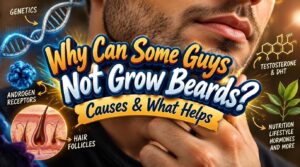
Some men hit their thirties still waiting for a beard that never comes, and the answer isn’t a matter of effort or patience. Beard growth is largely decided before you’re born, written into your androgen receptor genes and the follicle density your skin developed in the womb.
That matters because it changes what’s actually fixable. A patchy beard caused by genetics behaves very differently from one caused by an autoimmune condition or a nutritional deficiency, and confusing the two leads to wasted time and money on the wrong products.
Understanding why some guys can’t grow beards points you toward what might genuinely help.
Table Of Contents
- Key Takeaways
- Why Can Some Guys Not Grow Beards?
- Can Your Beard Still Fill in With Age?
- Can Low Testosterone or Medical Conditions Cause Sparse Beard Growth?
- Can Lifestyle Changes or Beard Growth Products Help?
- When Should You See a Doctor About Beard Growth?
- Frequently Asked Questions (FAQs)
- What does it mean if a guy can’t grow a beard?
- Why do some men struggle to grow beards?
- Can some men just not grow beards?
- Does no beard mean low testosterone?
- Does shaving more often make beards grow thicker?
- At what age does beard growth stop completely?
- Are there prescription medications for improving beard density?
- Can certain medications suppress or inhibit beard growth?
- Is a patchy beard different from uniformly sparse growth?
- Does strong beard growth increase the risk of baldness?
- Conclusion
Key Takeaways
- Your beard’s potential is set before birth by androgen receptor genes and follicle density, meaning no product or habit can override what your genetics didn’t build in.
- A patchy beard and uniformly sparse growth are different problems with different causes — confusing them leads to wasted time on the wrong treatments.
- Follicles keep responding to DHT into your early thirties, so giving patches three to four uninterrupted months of growth often closes gaps that looked permanent at 22.
- Sudden circular bald patches, shiny skin in the beard area, or sparse growth paired with low libido are signs to see a doctor — these point to treatable conditions, not just genetics.
Why Can Some Guys Not Grow Beards?

If you can’t grow a full beard, the most likely explanation comes down to biology, not effort. Your beard growth is shaped by a few interconnected factors that have nothing to do with how healthy or masculine you are. Understanding which one applies to you is the first step toward knowing what, if anything, you can do about it.
Once you understand your biology, you can make smarter choices about beard growth products that actually work with your hair type rather than against it.
Genetics and Follicle Density
Facial hair genetics determine how many follicles you’ve got, a number fixed before birth. Your genetic predisposition shapes density through AR gene variants and dermal signaling pathways, which differ by ethnicity.
Facial skin carries fewer hair follicles per square centimeter than your scalp skin. Sparse facial hair follicles almost always reflect this inherited baseline more than anything you’re doing wrong.
DHT Receptor Sensitivity
Even with adequate follicle density, your beard growth still depends on DHT receptor sensitivity.
Dihydrotestosterone, converted from testosterone by 5-alpha reductase in local skin tissue, binds androgen receptors inside face hair follicles to trigger terminal hair conversion. Your sensitivity to DHT ultimately determines whether that signal’s strong enough to flip follicles from fine, vellus-type growth to coarser, terminal beard hairs.
Ethnic Beard Growth Patterns
Ethnic differences in hair growth shape what your beard can look like. Ethnic variation in androgen receptor expression explains why similar testosterone doesn’t mean an identical beard.
These inherited differences in androgen receptor sensitivity — explored in depth in this guide to beard growth genetics and ethnic variation — explain why men with similar hormone levels can develop vastly different beards.
- Chinese men tend toward lower cheek density but fuller neck coverage
- Caucasian men show more uniform jaw and sideburn distribution
- Men of African descent often develop denser goatee zones
These differences are genetic.
Can Your Beard Still Fill in With Age?

The short answer is yes, for most men under 35. Beard maturation age extends well past your twenties, because facial hair development is a gradual process. Follicles keep responding to DHT into your early thirties, so patches that looked bare at 22 can fill in by 28 or later.
Your genetic predisposition to beards sets the ceiling, but androgen receptor sensitivity determines how quickly you reach it. That’s why patience matters more than anything you can buy. Give any patchy area at least three to four months of uninterrupted growth before judging it, since overlapping hairs often close gaps on their own. While you wait for those patches to fill, a beard growth kit grooming set can help keep new growth healthy and conditioned during the process.
Your genes set the beard ceiling, but patience — not products — determines how close you get
After 30, testosterone declines about 1% yearly, so gains slow. As you age, does age change your beard becomes a real question, since slower, thinner growth and graying hairs are driven by natural hormonal and follicular shifts. Ethnic differences in hair growth also shape your timeline, and knowing your baseline helps you set realistic expectations.
Can Low Testosterone or Medical Conditions Cause Sparse Beard Growth?
Most men with patchy beards have perfectly normal hormone levels, but a few medical causes deserve your attention.
For a deeper look at why patches form and what actually helps, patchy beard causes and fixes breaks down the role of genetics, follicle sensitivity, and when to seek medical advice.
You’ll want to know the difference between genetic variation and an actual hidden condition, because the treatments differ completely.
The three possibilities below cover the warning signs that suggest your sparse beard isn’t just genetics at work.
Signs of Low Testosterone

If your beard is patchy because your testosterone levels are genuinely low, you’ll usually notice other clues first: reduced libido, erectile difficulties, fatigue, and mood changes.
Since facial hair growth depends on androgen receptor sensitivity and DHT conversion, sparse facial hair growth alone rarely points to hypogonadism.
If several symptoms cluster together, ask your doctor for morning testosterone testing.
Before your appointment, an at-home testosterone test kit can give you a useful baseline to bring into the conversation.
Alopecia Areata Barbae
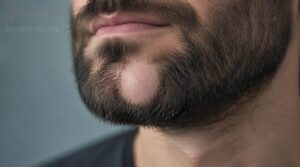
Notice a round, bald patch in an otherwise healthy beard? That’s likely alopecia barbae, a T-cell driven autoimmune condition where your immune system attacks the follicle and halts growth.
Dermatologists confirm it with dermoscopy, spotting exclamation mark hairs and yellow dots.
Treatment usually starts with intralesional corticosteroid injections or corticosteroid creams, and roughly half of limited cases regrow within a year.
Scarring and Follicle Damage
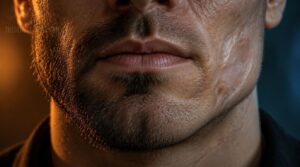
Picture a smooth, shiny patch on your face where beard hair should grow. That glossy texture signals follicle destruction, not temporary thinning.
Chronic inflammation damages hair follicle health by replacing follicular tissue with scar, ending any chance of regrowth. Burns, persistent folliculitis, and certain dermatological conditions are common drivers.
Fine or chemically treated hair is especially vulnerable, as even moderate tension can worsen follicular stress — understanding why rubber bands damage hair at the follicle level helps illustrate how inflammation and mechanical strain compound each other.
Once deep fibrosis sets in, dermatology simply can’t reverse the damage.
Can Lifestyle Changes or Beard Growth Products Help?

Take someone who’s been eating poorly, sleeping badly, and noticing patchier facial hair than a year ago. Addressing those gaps won’t bring back follicles that were never there, but nutritional deficiencies in zinc, iron, vitamin D, and protein can genuinely suppress hair follicle function, so correcting them matters. A targeted zinc, iron, and vitamin D supplement can help fill those dietary gaps when food alone isn’t cutting it.
Topical minoxidil is the most evidence-backed of available beard growth products. It extends the anagen phase of the hair cycle, though responses vary widely and require consistent, long-term use. Serums and oils mainly support skin and follicle conditions, like reducing inflammation or improving hydration, rather than creating new follicles.
If you already have some existing stubble that won’t thicken, these interventions stand a better chance than in areas of near-zero active follicle presence.
When Should You See a Doctor About Beard Growth?

Most sparse beard growth traces back to genetics, and a doctor’s visit won’t change your hair follicles’ programming. But certain signs do warrant professional evaluation.
If you notice sudden patchy hair loss, particularly in well-defined circular areas, you may be dealing with alopecia areata barbae rather than typical undergrowth. That distinction matters clinically.
Skin that looks shiny, smooth, or atrophic in the beard area suggests scarring alopecia, which can permanently destroy follicles. Early evaluation limits irreversible damage.
If sparse beard growth comes alongside reduced libido or erectile dysfunction, low testosterone or a broader hormonal imbalance could be the cause. Hormone therapy is an option worth discussing with your doctor.
Any redness, crusting, or tenderness signals infection or inflammation. Don’t wait.
Frequently Asked Questions (FAQs)
What does it mean if a guy can’t grow a beard?
It usually means your facial hair growth is limited by genetics, androgen sensitivity, or follicle activity, rather than growth being entirely impossible. Many men still have vellus hair where terminal hair hasn’t fully developed yet.
Why do some men struggle to grow beards?
Ironically, no amount of patience grows what your follicles aren’t built to produce. Genetics and androgens determine whether follicles generate terminal facial hair or undergo miniaturization, which quietly limits your beard growth potential from birth.
Can some men just not grow beards?
Picture you at 28, with facial vellus hair that stays fine and simply never converts to terminal hair. Yes, some men genuinely can’t grow beards. Follicle distribution and androgen receptor sensitivity set that biological ceiling.
Does no beard mean low testosterone?
Not necessarily. Low testosterone can reduce secondary male traits broadly, but sparse facial hair growth alone isn’t a reliable clinical indicator. Your follicles’ androgen receptor sensitivity shapes beard potential more than your hormonal balance does.
Does shaving more often make beards grow thicker?
You’ve probably heard that shaving more often will thicken your beard. It won’t. Shaving cuts hair at the skin surface, leaving a blunt tip that only feels coarser, not a change in terminal hair diameter.
At what age does beard growth stop completely?
There’s no single fixed cutoff age. Your facial hair density usually peaks in your late 20s to early 30s, but some men see gradual thickening well beyond that. Genetics determines when your growth timeline plateaus.
Are there prescription medications for improving beard density?
Like trying to wake a stubborn seed, achieving better facial hair density isn’t straightforward. No medication is FDA-approved for this, but dermatologists sometimes prescribe topical minoxidil off-label, and it shows the most consistent results available.
Can certain medications suppress or inhibit beard growth?
Yes, certain medications can nearly obliterate your beard growth. Finasteride and dutasteride block 5alpha reductase, cutting DHT and leaving androgen receptors in your follicles understimulated. Corticosteroids can suppress your androgens indirectly when taken long term.
Is a patchy beard different from uniformly sparse growth?
They’re distinct patterns. A patchy beard shows normal density on the chin but sharp bare gaps on the cheeks. Uniformly sparse growth means thin, translucent hair spread across every facial area, with no isolated gaps.
Does strong beard growth increase the risk of baldness?
A thick beard doesn’t predict your baldness risk. DHT influences both processes, but entirely separate genetic pathways control your scalp’s follicle sensitivity and your facial hair density, so one tells you nothing about the other.
Conclusion
Genetics isn’t a dead end, but it does set the ceiling. Understanding why some guys can’t grow beards helps you separate what’s fixed from what’s genuinely treatable, whether that means addressing alopecia, correcting a nutritional deficiency, or getting your hormone levels checked by a doctor.
Minoxidil and consistent lifestyle habits can improve density for some men. But without knowing your specific cause, you’re guessing. That clarity is what makes any next step actually worth taking.