This site is supported by our readers. We may earn a commission, at no cost to you, if you purchase through links. This content is for general informational and educational purposes only and is not a substitute for professional medical, dermatological, or nutritional advice.

Thirty volume bleach sits on your hair like a ticking clock—too short and you’re left with brassy orange, too long and you’re dealing with fried straw that snaps at the slightest touch. The standard 20-45 minute window sounds straightforward until you factor in your hair’s texture, your starting color, and whether you’ve chemically treated it before.
Professional colorists know that timing isn’t just about watching the clock; it’s about reading your hair’s signals as hydrogen peroxide breaks down pigment molecules and opens the cuticle. The difference between achieving that perfect platinum lift and causing irreversible damage often comes down to understanding how these variables interact with developer strength and knowing exactly when to rinse.
Table Of Contents
- Key Takeaways
- How Long to Leave Bleach in Hair 30 Vol
- Factors Affecting Bleach Timing
- Risks of Overprocessing With 30 Volume
- How to Perform a Strand Test
- Step-by-Step Bleaching Process With 30 Vol
- How to Check Hair During Bleaching
- Top 5 Bleach Products for 30 Volume Use
- Post-Bleach Hair Care Essentials
- How to Minimize Damage From 30 Vol Bleach
- Signs You Should Rinse Bleach Immediately
- Frequently Asked Questions (FAQs)
- Can a 30-volume Developer Damage Hair?
- Can You Use a Developer Without Bleach?
- Can You Bleach Your Hair With Just 30 Volume Developer?
- How Many Levels Will 30 Volume Lift With Bleach?
- Can 30 Developer Damage Hair?
- Should I Use 30 or 40 Volumes of Bleach?
- Can I Brighten My Hair With 30 Volume Developer?
- How Much Bleach Did You Mix With 30 Developers?
- Can I bleach wet or damp hair safely?
- How soon can I rebleach my hair?
- Conclusion
Key Takeaways
- Processing time with 30 volume bleach ranges from 20-45 minutes, but your hair’s texture, starting color, and previous chemical treatments determine the exact duration—fine hair may max out at 15-20 minutes while thick, virgin hair can handle closer to 40 minutes without crossing into damage territory.
- Monitoring progress every 5-10 minutes isn’t optional; you’re watching for visual lift, checking strand elasticity, and reading your scalp’s signals because the moment hair feels gummy or your scalp stings, you’ve hit the point where continued processing causes irreversible structural damage regardless of target color.
- Overprocessing with 30 volume developer destroys disulfide bonds in your hair’s keratin structure, triggering protein loss exceeding 50%, compromising cuticle integrity, and creating breakage that no amount of conditioning can reverse—making conservative timing and immediate rinsing at target lift non-negotiable.
- Post-bleach care requires alternating between protein treatments to rebuild broken keratin bonds and deep conditioning masks to restore moisture balance, with at least 4-8 weeks recovery time between sessions to prevent cumulative damage that leads to permanent hair weakness.
How Long to Leave Bleach in Hair 30 Vol
When you’re working with 30 volume bleach, timing isn’t just important—it’s everything. Leave it on too short and you won’t see the lift you’re after; push it too long and you’re risking serious damage to your hair’s integrity.
Let’s break down exactly how long you should process based on your hair’s unique characteristics and what you need to watch for along the way.
Recommended Time Range (20-45 Minutes)
You’ll want to keep 30 volume bleach on your hair for 20 to 45 minutes, depending on your starting color and how much lift you’re after. Most pros recommend checking every 5 to 10 minutes to avoid overprocessing—because once you’ve pushed past that maximum processing limit, chemical reactions don’t stop causing hair damage.
Stick to manufacturer timing, monitor closely, and rinse the moment you hit your target lightness to protect your strands. Understanding the hair lightening process is essential for achieving the desired results safely.
Timing for Fine Vs. Thick Hair
Fine hair demands your attention at the 10–15 minute mark with 30 volume bleach—its thinner cuticle allows faster penetration, so you risk serious bleach damage and breakage if you push past 20 minutes.
Thick hair can handle closer to 30 minutes because denser cortical mass slows lightening, but porosity issues still spike when you exceed manufacturer limits, leaving strands rough and overly porous.
Understanding the proper hair bleaching process is essential to achieving the desired results while minimizing damage.
Monitoring Progress During Bleaching
Set a timer and check your 30 volume bleach application every 5–10 minutes—professionals never walk away from lightener. Visual color lift, texture changes, and scalp sensation tell you when to rinse, regardless of planned processing time.
Fine or fragile sections may reach pale yellow in 15 minutes, while resistant areas take longer. If hair feels mushy or your scalp burns, rinse immediately to maintain damage control.
Factors Affecting Bleach Timing

Bleaching isn’t a one-size-fits-all process, and timing depends on more than just watching the clock.
Your hair’s unique characteristics and history determine how quickly it lifts and when you should rinse.
Understanding these variables gives you control over your results and keeps your hair safe from unnecessary damage.
Hair Type and Texture
Your hair’s texture and type dictate how quickly bleach penetrates and how much structural punishment it can take. Fine strands—measuring just 40–60 micrometers—allow alkaline mixtures to diffuse faster, reaching comparable lift in 20–30 minutes, while coarse fibers up to 100 micrometers thick often demand 25–40% longer processing.
Curl patterns with elliptical cross-sections create weak points that compromise fiber strength and hair elasticity, amplifying hair damage and shortening safe bleaching time for textured types.
Starting Hair Color
Your starting level determines everything. Black or level-1 hair packed with eumelanin needs 35–40 minutes with 30 volume bleach to reach 3 levels of lift, while medium brown (level 4) hits dark blonde in 30–35 minutes.
Dark blonde hair at level 6 requires only 25–30 minutes—less pigment means faster bleach penetration and tighter color shift risks if you overshoot your timing.
Desired Lightness Level
Your lightness targets dictate how long 30 volume bleach sits on your hair and whether damage control outweighs the lift. Here’s what each level demands:
- Level 7–8 (dark to medium blonde): 20–30 minutes; underlying orange pigment remains, requiring warm-neutralizing toner.
- Level 9 (light blonde): 30–40 minutes; yellow pigment persists, needing violet correction.
- Level 10 (platinum): 40–45 minutes; maximum lift, maximum hair porosity and breakage risk.
- Pastel or vivid bases: Clean level 9–10 required; multiple bleach sessions safer than one marathon application.
- Color correction goals: Lift only to minimum needed; over-bleaching destroys fiber without visible benefit.
Previous Chemical Treatments
Prior treatments compound bleaching risks beyond what timing adjustments can salvage. If you’ve dyed, relaxed, or previously bleached your hair, expect accelerated chemical damage and hair weakening—studies show protein loss exceeding 50% with layered oxidation.
Scalp sensitivity spikes, color shift becomes unpredictable, and structural integrity plummets. Treatment risks demand conservative bleach application and timing: reduce 30 volume exposure by 10–15 minutes or switch to 20 volume for hair damage prevention during chemical hair processing.
Risks of Overprocessing With 30 Volume

Pushing 30 volume bleach past its safe processing window doesn’t just compromise your results—it attacks your hair’s structural integrity and can leave lasting damage.
The higher the developer strength, the narrower your margin for error becomes, and overprocessing creates a cascade of problems that go beyond aesthetics.
Understanding these risks equips you to recognize warning signs before irreversible damage occurs.
Dryness and Breakage
Overprocessing with 30 volume doesn’t just lighten—it strips your hair’s structural integrity. Hydrogen peroxide oxidizes disulfide bonds in keratin, triggering Protein Loss and irreversible Cuticle Damage that spikes Hair Porosity and plummets Moisture Levels.
Recognizing and preventing bleach-induced Hair Damage:
- Monitor for mid-shaft snapping and extreme dryness, hallmarks of oxidative Hair Breakage
- Limit processing under 45 minutes for Breakage Prevention and damage control
- Use intensive protein treatments post-bleach to rebuild weakened keratin structure
- Space sessions to allow partial recovery and preserve Hair Moisture
- Follow expert Bleach Hair Care Tips: condition aggressively and avoid heat styling immediately after
Chemical Burns and Scalp Sensitivity
Leaving 30 volume bleach on too long triggers Chemical Reactions beyond the hair shaft. Persulfate salts in bleach powder cause protein denaturation and Scalp Irritation at concentrations near 60%.
You’re risking Skin Sensitization, burns, and even Hair Follicle Damage that destroys growth permanently.
For Burn Prevention and Hair Health and Safety, rinse immediately if you feel stinging. Hair Damage Prevention Methods start with respecting Chemical Processing and Safety limits during Bleach Application and Timing.
Uneven or Unwanted Color Results
When 30 volume developer sits too long or saturates unevenly, you get patchy lift, banding, and tonal imbalance—common overprocessing risks that demand color correction and damage repair.
To avoid these bleach application and timing pitfalls, follow hair bleaching techniques that control bleach duration and support hair damage prevention methods:
- Section hair into small, uniform subsections.
- Mix bleach in hair thoroughly to prevent weak pockets.
- Apply mid-lengths first to dodge hot roots.
- Monitor every 10 minutes for consistent lift.
- Rinse darker zones early if needed.
How to Perform a Strand Test

A strand test is your safety net before committing to a full bleach application—it shows you exactly how your hair will respond to 30 volume developer. Think of it as a rehearsal that prevents disaster and saves you from overprocessing or miscalculating timing.
Here’s how to execute a proper strand test that gives you accurate, reliable results.
Mixing Bleach and Developer Safely
To master your bleach mixture, always combine one part bleach powder with two parts 30 volume developer in a non-metallic bowl—metal triggers unwanted chemical reactions that compromise developer strength. This bleach ratio ensures ideal lifting power without becoming too runny.
Slip on nitrile gloves and work in a ventilated space to shield yourself from persulfate dust and peroxide fumes during mixing, maintaining full control over protective gear and developer safety throughout the process.
Applying to a Small Section
Once your mixture is ready, reclaim control by isolating a pencil-width strand—about 0.6 to 1.25 centimeters—from behind your ear or beneath a lower layer for discreet small area testing.
Brush a thin, even film of 30 volume bleach onto this section from mid-lengths to ends, keeping product off your scalp to guarantee safe hair strand evaluation and accurate bleach timing during your strand test.
Determining Ideal Processing Time
Check your test strand every five minutes once you hit the fifteen-minute mark, documenting each stage as chemical reactions develop. When you reach the target lift—usually within twenty to thirty-five minutes depending on hair porosity—note that exact bleach timing as your processing limit.
Rinse immediately, towel-dry, and assess elasticity; if the strand feels mushy or breaks easily, you’ve identified your damage prevention threshold for the full application.
Step-by-Step Bleaching Process With 30 Vol
Now that you’ve tested your hair’s response, it’s time to take control of the full bleaching process with confidence and precision.
Bleaching with 30 volume developer demands careful preparation, strategic application, and proper aftercare to achieve your desired results without unnecessary damage.
Here’s how to execute each phase of the process like a pro.
Preparing Your Hair and Workspace

You wouldn’t walk into battle without armor—so don’t bleach without prep. Start with a patch test 48 hours early to rule out allergy reactions. Skip shampooing for 24–48 hours so natural oils shield your scalp.
Before you begin, consider your skin’s undertones—at-home beard coloring techniques can help you understand how to match your shade so you sidestep an unwanted orange or ashy finish.
If you’re curious how this shadowed technique differs from traditional highlights, this reverse balayage guide breaks down the contrast before you commit to the chair.
Section hair into six quadrants for controlled bleach application and even timing.
Wear nitrile gloves, apply petroleum jelly along your hairline, and open windows or run ventilation systems to clear chemical vapors.
Mixing Bleach and Developer Properly

Measure your bleach powder and 30 volume developer at a 1:2 ratio—commonly 30 grams powder to 60 grams developer—using a digital scale for precision. Pour powder into a non-metal bowl first, then add developer gradually while stirring until you reach a thick yogurt consistency.
This mixing technique prevents clumping and controls chemical reactions, ensuring your bleach mixture spreads evenly during application without runny drips or patchy lift.
Application Techniques for Even Results

Divide your head into four quadrants—front left, front right, back left, back right—to take control of even coverage. Start in the back sections where density runs 10 to 30 percent higher, then move forward, saving your hairline for the final 10 to 15 minutes since it lightens fastest.
- Take subsections no wider than 0.6 to 1.3 centimeters for thorough bleach saturation
- Complete application within 10 to 20 minutes to prevent uneven lift between first and last sections
- Apply 30 volume bleach to mid-lengths first, leaving roots for the last 15 to 25 minutes to avoid hot-root banding
Rinsing and Neutralizing After Bleaching

Once you hit your target lift or the 45-minute mark, rinse immediately with lukewarm water for three to five minutes—this halts oxidation and protects cuticle integrity.
Follow with a sulfate-free shampoo to strip persulfate residues, then apply an acidic neutralizing conditioner (pH 3.5–4.5) for five to ten minutes.
This pH-rebalancing step tightens lifted cuticles, reduces protein loss, and preps hair for toning without further damage.
How to Check Hair During Bleaching

You can’t just set a timer and walk away when you’re bleaching with 30 volume developer. Checking your hair throughout the process isn’t optional—it’s how you catch problems before they become disasters.
Here’s what to watch for and how to assess your hair’s condition without causing additional damage.
Starting with a women’s hair restoration guide can help you understand what you’re seeing before jumping to conclusions or treatments.
Visual Signs of Lightening
Hair bleaching demands your eyes as much as your timer. During processing, you’ll witness a dramatic color shift from your starting shade through red, orange, and finally yellow tones—each stage signals progressive pigment loss and increasing lift levels.
Check every 10 minutes, sectioning strands to reveal interior layers, because surface hair often misleads. Uneven tone change or banding means you’ve got application issues, not true lightening.
Stop when you hit your target level, not when the clock runs out.
Texture and Elasticity Checks
Beyond color, your strands tell the truth about structural damage. Gently stretch a damp section between your fingers—healthy Hair Elasticity means it extends about 30–50% and springs back. If you feel mushy, gummy Fiber Strength or immediate snapping, you’re hitting breakage territory.
This Texture Analysis beats any clock for Bleach in Hair timing and Breakage Prevention, catching Hair Damage before it’s irreversible.
What to Do if Discomfort Occurs
Tingling isn’t the same as pain—if you feel sharp stinging, bleach processing stops now. Chemical reactions can escalate from mild scalp irritation to serious bleach burn care territory in minutes, so trust your gut on emergency response:
- Rinse immediately with cool water for at least 15 minutes to dilute the developer and halt hair damage.
- Don’t reapply that day—your scalp protector (natural oils) is compromised.
- Monitor symptoms like swelling or breathing changes that signal skin allergies requiring urgent medical attention.
Bleach timing bends to your body’s signals, not the clock.
Top 5 Bleach Products for 30 Volume Use
Choosing the right bleach powder matters as much as timing when you’re working with 30 volume developer. Not all lighteners are created equal—some offer better lift on dark hair, while others minimize damage on fragile strands.
Here are five professional-grade products that consistently deliver controlled results when paired with 30 vol.
1. Ion Bright Hair Lightener Cream
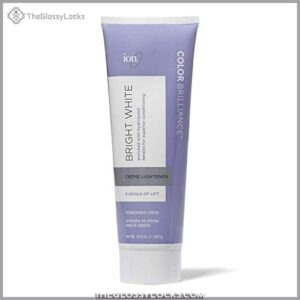
For bold transformations on your terms, Ion Bright White Creme Lightener delivers up to 8 levels of lift with hydrolyzed keratin and chamomile to cushion against hair damage. Its swelling texture and gentle formula make hair lightening more forgiving, especially when color results matter most.
When you mix this cream lightener 1:1 or 1:2 with 30 volume developer for off-scalp work, you’re looking at 30–45 minutes of processing—never exceeding 50 minutes total. The conditioning actives soften bleach safety concerns, though you’ll still need vigilant bleach timing checks.
Best For: People who want dramatic lift—up to 8 levels—without the dust and mess of powder bleach, especially if you’re doing balayage, foils, or off-scalp highlights and prefer a creamier formula with conditioning ingredients.
- Lifts up to 8 levels and includes hydrolyzed keratin and chamomile to help protect hair during the lightening process
- Cream format is less messy than powder bleach and easier to control during application
- Works well for different techniques like balayage, foil highlights, or all-over color with flexible 1:1 or 1:2 mixing ratios
- Can be pricey compared to other lighteners, and some users find it doesn’t always reach ultra-white tones even after 50 minutes
- The mixture swells a lot during processing and can travel during rinse-out, sometimes stripping color from lengths you didn’t mean to lighten
- Requires careful timing and the right developer strength—30 or 40 volume off-scalp only—so it’s easy to overprocess or damage hair if you’re not experienced
2. Clairol Professional Hair Lightener Powder
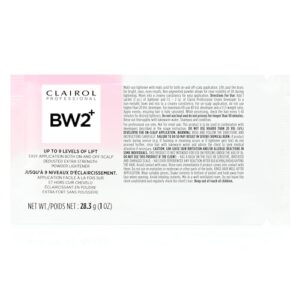
Clairol Professional’s powder lightener claims up to 9 levels of lift, offering aggressive power for those chasing platinum. Mix it 1:1 with 30 volume developer, and process for 20–45 minutes depending on your texture: fine hair usually maxes out around 25 minutes, while thick strands demand closer to 45.
Vegan formulas reassure the ethically driven, and its non-pigmented powder consistency spreads evenly across highlights or balayage.
Check every 10 minutes to guard against hair damage—this lightener doesn’t negotiate with overprocessing. Bleach safety still rules your timeline, no matter the brand promise.
Best For: People with experience bleaching hair who need serious lift—especially those going from dark to platinum or doing high-contrast balayage work.
If you’re starting near level 1 or 2, understanding the best professional bleach for dark hair can help you plan a safer, multi-session path to platinum.
- Delivers up to 9 levels of lift, which is strong enough to get dark hair blonde in one session
- Vegan formula mixes into a smooth, creamy consistency that’s easy to apply for highlights, balayage, or all-over lightening
- Works fast with flexible timing (20–45 minutes) so you can adjust based on your hair texture and desired result
- Powerful formula can cause breakage and damage if you’re not careful with timing or developer strength
- Some customers received containers that were half empty or smaller than expected
- Not beginner-friendly—requires experience and careful monitoring every 5–10 minutes to avoid overprocessing
3. Dark And Lovely Hair Bleach
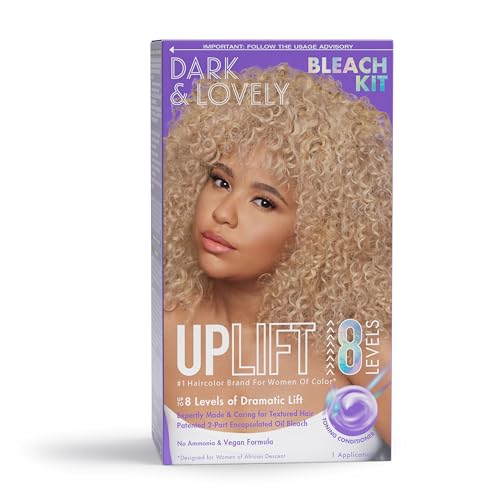
Dark and Lovely’s Uplift Bleach Kit targets coily and curly textures with its ammonia-free bleach formulation paired with a 30 volume developer, claiming up to 8 levels of lift while preserving curl patterns. The encapsulated oils promise hydration, but product efficacy on finer textures gets mixed reviews.
Process mid-lengths for 30–40 minutes, then tackle roots for another 20–30, capping total bleach duration at 60 minutes. Hair lightening demands vigilance to dodge bleach damage. Check a strand every 5 minutes once you hit the minimum window.
Hair bleaching still requires rigorous monitoring, even with gentler formulas.
Best For: People with coily or curly hair (types 3 and 4) who want dramatic lift without ammonia and are willing to monitor processing closely.
- Ammonia-free formula with encapsulated oils helps maintain curl pattern and provides 4x more hydration than untreated hair
- Achieves up to 8 levels of lift on dark hair with the included 30-volume developer and violet toning conditioner to reduce brassiness
- Clear timing guidelines (30–40 minutes on mid-lengths, 20–30 on roots, 60-minute hard cap) with built-in strand testing protocol
- Mixed results on thinner or fine hair textures, with inconsistent color coverage and longevity reported by users
- May require multiple applications to reach desired lightness, which can increase breakage risk on textured hair
- Despite gentler formulation, still carries standard bleach risks like cuticle damage and dryness if processing time isn’t carefully monitored
4. Vegan Hair Lightening Cream Kit

Arctic Fox’s vegan bleach kit pairs a 35 volume developer with a cream formula enriched with acai, cocoa, and sunflower oil—plant-based ammunition for up to 8 levels of lift without ammonia or animal-derived ingredients. Cruelty-free and PETA-certified, it channels the ethical claims driving vegan cosmetics’ 6.85% annual growth while addressing hair lightening and coloring with sustainable packaging.
Process for 20–40 minutes depending on texture, checking every 10. Persulfate salts still pack oxidative punch, so a strand test remains non-negotiable before committing to full-head bleach duration.
Best For: People with darker hair wanting salon-level lift at home who care about vegan, cruelty-free products and are comfortable handling strong developer.
- Lifts up to 8 levels with plant-based oils (acai, cocoa, sunflower) that help condition while bleaching
- PETA-certified vegan and cruelty-free with no ammonia or animal ingredients
- Cream formula stays put better than powder, reducing mess and uneven processing
- 35 volume developer is harsh—can cause damage or breakage if you’re not careful with timing
- Persulfate salts can still irritate sensitive scalps despite the ammonia-free formula
- Oils in the mix might leave hair feeling sticky or oily after rinsing
5. Sally Hansen Facial Hair Bleach Cream
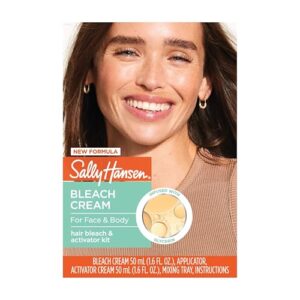
Sally Hansen’s facial creme bleach operates in a different arena—an 8-minute processing window that stretches to 13 maximum, designed for delicate facial hair lightening rather than scalp-level bleach duration.
The 2:1 creme-to-activator ratio sidesteps ammonia yet carries skin irritation risk for 20% of users, making patch testing non-negotiable bleach safety protocol. Dermatologist-tested doesn’t eliminate chemical burn potential when bleach processing exceeds manufacturer limits.
If you’re tackling facial hair lightening and coloring, respect the clock—this formula won’t tolerate the extended bleach in hair timelines that scalp applications demand.
Best For: Anyone looking to lighten facial or body hair quickly at home without the commitment of removal, especially if you have darker hair that you want to blend with your skin tone.
- Works fast with results in 8–13 minutes, so you’re not sitting around all day waiting for hair to lighten.
- Comes with everything you need in the kit—mixing tray, applicator, and clear instructions make it pretty foolproof.
- Gentle vegan formula with aloe vera that’s dermatologist-tested, so it’s designed to be kinder to skin than harsher bleaching products.
- About 20% of users experience irritation, redness, or burning, so a patch test isn’t optional if you want to avoid a bad reaction.
- Results vary a lot depending on your hair type and color—very dark or coarse hair might need multiple treatments spaced 24 hours apart.
- The smell can be strong and unpleasant, and some people notice their skin looks lighter or red afterward, which takes time to fade.
Post-Bleach Hair Care Essentials

Bleaching with 30 volume developer strips your hair of moisture and protein, leaving it vulnerable to breakage and dryness. Your post-bleach routine isn’t optional—it’s the difference between healthy, vibrant hair and a damaged, brittle mess.
Here’s what you need to prioritize immediately after lightening.
Deep Conditioning Treatments
After bleaching with 30 volume developer, your hair craves immediate moisture restoration—think of it as emergency triage for chemical damage.
Deep conditioning treatments should be applied for 20–30 minutes weekly to rebuild hydration and combat breakage. Look for formulas rich in humectants like glycerin and panthenol, which can increase hair fiber water content by 5–10%, transforming brittle strands into softer, more manageable hair.
Protein and Moisture Balance
After 30 volume bleach processing, your hair’s internal architecture demands strategic repair—oscillating between protein repair to rebuild keratin loss and moisture replenishment to combat porosity. This balance determines fiber strength and prevents hair damage that escalates with improper hair care.
- High-porosity bleached strands gripping moisture treatments yet snapping without protein reinforcement
- Stiff, protein-overloaded hair resisting combs despite appearing stronger structurally
- Gummy, over-moisturized fibers stretching excessively before breaking under minimal tension
- Alternating weekly protein treatments with hydrating masks to restore hair health equilibrium
- Tactile assessment—brittleness signals protein need; excessive softness demands structural support
How to Minimize Damage From 30 Vol Bleach

You don’t have to choose between bold results and healthy hair—damage control starts before you even mix your bleach.
The difference between fried, broken strands and glossy, lifted color comes down to three smart strategies that pros use every single time.
Here’s how to protect your hair while still getting the lift you’re after.
Limiting Processing Time
Think of processing time as your damage control dial—every minute beyond what’s necessary cranks up the risk. Keep 30-volume developer on your hair for no longer than 45 minutes absolute maximum, but aim to rinse at 20 to 30 minutes once you hit your target level. Checking every 10 minutes lets you catch ideal lift before the hydrogen peroxide becomes a liability, preserving strength while achieving your desired lightness.
Professional colorists stress that bleach processing isn’t about hitting a timer—it’s about watching your hair’s response. Once the chemical reaction slows around 30 minutes, additional time mainly oxidizes protein without delivering proportional lift. Safety precautions demand you remove bleach the moment you see your target underlying pigment, even if that’s only 20 minutes in, because bleach duration directly correlates with fiber degradation and breakage potential.
Bleach processing isn’t about timers—it’s about watching your hair’s response and rinsing the moment you hit your target lift
| Processing Window | Recommended Action | Damage Risk |
|---|---|---|
| 15–20 minutes | First checkpoint for fine or pre-lightened hair | Low |
| 20–30 minutes | Target range for most hair types; rinse when desired lift is reached | Moderate |
| 30–40 minutes | Extended window for darker, resistant hair with active monitoring | High |
| 40–45 minutes | Hard safety limit; rinse immediately regardless of lift | Very High |
| Beyond 45 minutes | Never exceed; cuticle damage accelerates without further lightening | Severe |
Using Lower Volume for Fragile Hair
When your strands show high porosity or past chemical wear, swap 30 volume developer for a gentler 10 or 20 volume formula to safeguard fragile hair care integrity. The lower concentration requires slightly longer bleach duration—55 to 60 minutes total—but professional trichology confirms this “low and slow” approach prevents hair breakage and preserves internal bonds better than aggressive 30 volume on compromised hair.
Why lower volume protects fragile strands:
- Reduces cuticle lifting – Gentle bleaching minimizes structural damage and bond repair needs after processing
- Extends safe processing – Low volume tips allow longer bleach in hair contact without triggering excessive hydrogen peroxide oxidation
- Prevents irreversible snapping – Hair damage and repair become manageable when you avoid overwhelming weakened disulfide bonds
- Preserves elasticity – Gradual lift maintains fiber flexibility, essential for porous or previously lightened hair
Scheduling Bleaching Sessions Safely
Your hair needs at least 4–8 weeks between full 30 volume developer sessions for adequate bleach recovery—rushing bleaching frequency compounds chemical risks exponentially.
Scalp safety demands this interval, allowing your barrier to heal and cortex fibers to rebuild after bleach duration stress.
Ignoring this timeline invites permanent hair damage: fragmented cuticles, compromised elasticity, and burns no bleaching techniques can reverse once the bleach volume has already destroyed structural integrity.
Signs You Should Rinse Bleach Immediately
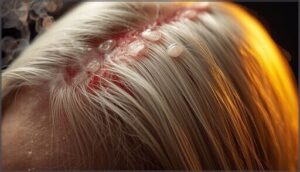
When you’re bleaching with 30 volume developer, your instincts are your best ally—if something feels wrong, it probably is. Certain red flags demand immediate action, no matter where you’re in the processing timeline.
Here’s what to watch for so you can protect your hair and scalp from serious damage.
Burning or Stinging Sensation
Discomfort during processing is your body’s alarm bell—a signal that hydrogen peroxide is crossing the line from chemical reaction to chemical burn. If you feel a burning or stinging sensation beyond mild warmth, rinse immediately with cool water.
Scalp sensitivity varies, but pain thresholds shouldn’t be tested. Persulfates and high-concentration bleach in hair formulations can provoke skin irritation, especially when 30 volume developer exceeds safe bleach duration, turning a bold move into lasting damage.
Excessive Hair Weakness
Beyond scalp discomfort, watch your fibers themselves. When strands snap with minimal tension or feel gummy between your fingers, cortical degradation has begun—protein depletion signals you’ve crossed into structural weakening territory.
Hydrogen peroxide in bleach oxidizes keratin bonds, and excessive exposure destroys them entirely. If you notice rubbery elasticity or sudden breakage patterns mid-process, rinse now. Hair fiber damage compounds quickly once you hit that threshold.
Unexpected Color Changes
Structural weakness aside, watch for tonal shifts that signal chemical interference. Unexpected color changes—brassiness swinging toward orange, green discoloration in previously highlighted sections, or patchy bands—indicate your bleach mixture is reacting with prior treatments, minerals, or oxidized deposits.
When you spot these porosity issues mid-process, rinse immediately:
- Copper oxidation turning lightened strands khaki
- Metallic salts from box dyes producing purple or red
- Uneven lift creating distinct horizontal bands
Color correction later beats compounding hair damage now.
Frequently Asked Questions (FAQs)
Can a 30-volume Developer Damage Hair?
Yes—this powerhouse lifts 2–4 levels but brings serious hair damage risks.
Studies show 30 volume developer causes breakage in over 60% of at-home cases, especially when hair porosity increases from chemical reactions and bleach overuse.
Can You Use a Developer Without Bleach?
You can use a 30 volume developer alone for slight lightening—about 1–2 levels—but hydrogen peroxide without bleach triggers oxidation risks, dryness, and uneven tones while still causing hair damage and potential chemical reactions on your scalp.
Can You Bleach Your Hair With Just 30 Volume Developer?
Attempting hair bleach with 30 volume developer alone triggers chemical reactions that produce wildly uneven, unpredictable lift and severe damage.
Developer safety demands pairing it with proper bleach powder—anything less risks hair porosity disasters and total structural collapse.
How Many Levels Will 30 Volume Lift With Bleach?
When you mix 30 volume developer with hair bleach, expect about 3–4 levels of lift on virgin hair in one session—darker bases may need multiple rounds to reach pale blonde safely.
Can 30 Developer Damage Hair?
Absolutely—30 volume developer can severely damage hair through hydrogen peroxide’s chemical reactions, causing hair breakage and brittleness.
Proper damage control, bleach safety protocols, and post-treatment hair restoration are critical to maintaining hair health despite bleach mixture risks.
Should I Use 30 or 40 Volumes of Bleach?
Bleach strength matters, but damage control matters more. Thirty volume developer lifts two to three levels with moderate risk.
40 volume pushes seven to eight but doubles your chance of breakage, burns, and irreversible structural compromise. Choose wisely.
Can I Brighten My Hair With 30 Volume Developer?
Yes, 30 volume developer delivers 2–3 levels of lift in one session, making it ideal for brightening medium to coarse hair from darker shades to caramelized tones without excessive processing.
How Much Bleach Did You Mix With 30 Developers?
You’ll want to follow a standard 1:2 ratio—one part bleach powder to two parts 30 volume developer.
This mixing guideline ensures proper chemical reactions while maintaining safety precautions for effective hair coloring results.
Can I bleach wet or damp hair safely?
Technically, you can bleach damp hair, but it’s risky business. Water swells your strands and dilutes the hydrogen peroxide, leading to unpredictable lift, increased porosity, and amplified chemical damage—especially with 30 volume.
How soon can I rebleach my hair?
You should wait at least 4 to 6 weeks between sessions to prevent bleach damage and allow bleach recovery.
Hair regrowth, scalp sensitivity, and rebleaching risks all demand patience before your next bleaching time.
Conclusion
Mastering how long to leave bleach in hair 30 vol is like learning to play with fire—you need respect, precision, and unwavering attention. Those 20-45 minutes demand constant monitoring, not passive waiting.
Your hair telegraphs every chemical shift through texture changes and lift progression, giving you the data to make split-second decisions. Trust your strand tests, honor your hair’s limits, and never let ambition override safety. The difference between transformation and destruction lives in those calculated moments.