This site is supported by our readers. We may earn a commission, at no cost to you, if you purchase through links. This content is for general informational and educational purposes only and is not a substitute for professional medical, dermatological, or nutritional advice.

Your hair looks fried, stretchy, and dull—classic signs you pushed bleach too far, too fast. That eagerness to go lighter makes sense, but your hair’s internal structure needs real recovery time before it can handle another round of chemicals.
Most stylists recommend waiting 4-6 weeks minimum between bleaching sessions, though your specific timeline depends on your hair type, current damage level, and how drastic your color change was. Fine or curly hair often needs even longer to rebuild strength, while skipping proper recovery can lead to breakage that no treatment can fully repair.
Understanding what your hair needs between sessions—and recognizing the warning signs that it’s not ready—protects you from permanent damage while still getting you to that dream shade.
Table Of Contents
- Key Takeaways
- How Long Should You Wait to Bleach Again?
- Factors That Affect Bleaching Frequency
- Signs Your Hair is Ready for Bleaching
- How to Assess Hair Health After Bleaching
- Essential Hair Care Between Bleaching Sessions
- Tips to Prevent Damage From Repeated Bleaching
- When to Seek Professional Hair Advice
- Frequently Asked Questions (FAQs)
- How long should I wait between bleaching sessions?
- Can I bleach my hair again after 2 days?
- Can I bleach my hair twice in 2 weeks?
- How long should I bleach the second time?
- Can you bleach your hair twice in one day?
- Why you should not skip the strand test before bleaching your hair?
- Can I Bleach My Hair After Dying It?
- Can I bleach wet or damp hair safely?
- Does hair color affect bleaching wait time?
- Are at-home bleach kits safer than salon treatments?
- Conclusion
Key Takeaways
- Wait at least 4-6 weeks between bleaching sessions to let your hair rebuild protein and cuticle strength, though fine or curly hair often needs 8 weeks or more to avoid serious breakage.
- Check your hair’s readiness by testing elasticity (healthy strands stretch 50% and bounce back), porosity (high porosity means more damage), and texture (smooth equals healthy, rough equals damaged).
- Deep condition 1-2 times weekly right after bleaching and use protein treatments to repair broken bonds, while skipping heat styling and sulfate shampoos that strip moisture.
- Never bleach twice in one day or within 2 weeks—rushing causes up to 70% more breakage risk, scalp burns, and permanent damage that no treatment can fully repair.
How Long Should You Wait to Bleach Again?
You’re probably wondering how soon you can touch up those roots or go even lighter. The truth is, your hair needs time to recover after bleaching, and rushing the process can lead to serious damage.
Let’s break down the recommended waiting periods and what factors might change that timeline for you.
Recommended Waiting Periods (4-6 Weeks)
After bleaching hair again, the recommended waiting period sits at 4–6 weeks minimum—that’s the interval most colorists and dermatologists agree on for hair recovery. This timeline lets your cuticle layer repair itself and reduces protein loss, which keeps hair health and bleaching risks in balance.
If you’ve had recent chemical services or your hair condition is fragile, push that window closer to eight weeks. Consider that hair porosity matters when re-bleaching your hair.
Risks of Bleaching Too Soon
Rush into bleaching hair again and you’ll face real trouble. Too-soon applications cause fiber damage—your cuticle lifts, the cortex weakens, and hair elasticity disappears fast. Hair breakage becomes routine, with strands snapping under normal combing.
Scalp burns happen more often than you’d think, even in salons. Protein degradation accelerates, mechanical weakness sets in, and systemic sensitivities can flare up. The process uses hydrogen peroxide to cause this cuticle lifting.
Hair bleaching risks multiply when you skip proper recovery time.
Adjustments for Hair Type and Condition
Your hair type and condition determine how long you should actually wait. Fine hair needs 6–8 weeks between sessions since it breaks faster, while coarse hair might handle the standard 4–6 weeks. Curly hair is often drier, so give it extra recovery time.
Damaged hair with poor elasticity or high porosity? Wait even longer—your hair health assessment should always guide timing, especially if you’re dealing with scalp sensitivity.
Factors That Affect Bleaching Frequency
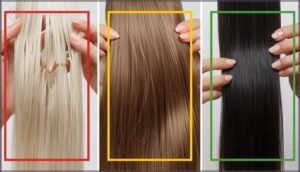
Not everyone’s hair is on the same schedule for bleaching. Your personal timeline depends on a handful of key factors that determine how much stress your strands can handle.
Let’s look at what influences how often you can safely lighten your hair.
Hair Health and Previous Damage
Think of your strands like a bridge: each bleaching session chips away at the beams. Protein loss weakens hair elasticity, while cuticle erosion disrupts moisture balance and mechanical strength.
If you’re starting with previous damage, your hair can’t handle another round as quickly. The cumulative impact means already-compromised hair needs extra recovery time—sometimes 8 weeks or more—to avoid serious breakage.
Hair Type and Texture
Your texture matters more than you’d think. Fine hair shows 30–40% strength loss from repeated bleaching and higher porosity, so you’ll need closer to 8 weeks between sessions. Coarse hair holds up slightly better but still weakens considerably.
If your fine or bleached strands need extra care, comparing Keratin Express vs traditional keratin treatment recovery times can help you choose the gentler option for damaged hair.
Curly and kinky textures? They’re already fragile—bleach amplifies breakage risk. Always assess your hair’s elasticity and porosity before booking that next appointment.
Level of Lightening Desired
How drastic is your color change? Going from dark brown to platinum demands multiple sessions spaced 2–3 weeks apart—jumping more than four levels in one go spikes damage risk by over 60%.
Desired lift directly affects bleach strength and session spacing. Higher porosity from aggressive lightening means longer recommended waiting periods between treatments.
Your hair health depends on pacing that transformation wisely.
Scalp Sensitivity
Between bleaching sessions, your scalp’s sensitivity directly influences hair bleaching frequency. About 56% of people report some scalp discomfort after bleaching—tingling, warmth, or persistent burning signals trouble.
- Bleach shifts your scalp’s pH from 4.5–5.5 up to 9–11, weakening natural barriers
- Hydrogen peroxide and persulfates trigger irritant reactions or allergic responses
- Pre-existing skin conditions multiply risk factors for chemical burns
- Immediate rinsing and soothing agents minimize symptom severity after exposure
Prioritize scalp health between treatments.
Signs Your Hair is Ready for Bleaching

Before you grab that bleach bottle again, your hair needs to pass a few important tests. Think of it like checking if a cake is done—you wouldn’t skip that, right?
Let’s walk through three simple ways to tell if your hair is strong enough and ready for another round of lightening.
Assessing Elasticity and Strength
Want to know if your hair can handle another round? Your best bet is a simple hair elasticity check. Gently stretch a wet strand—healthy hair stretches about 50% before bouncing back. If it snaps quickly or feels gummy, that’s strength degradation in action.
If your strands fail this test, skip the second bleach session altogether and check out this guide on how often you can safely bleach your hair before reaching for the developer again.
Biochemical mechanisms from bleaching have weakened those protein bonds, so you’ll need more recovery time before re-bleaching timelines even matter.
Checking for Moisture and Porosity
Your hair porosity test is like reading your hair’s report card—it tells you how well it’s holding onto moisture. Try the porosity float test: drop a clean strand in water and watch what happens. High porosity means bleach has opened up those cuticles wide.
If your strand sinks fast, pairing that knowledge with tips for applying semi-permanent dye over permanent color can help you seal those open cuticles and keep your shade vibrant longer.
- Spray test accuracy beats float tests, showing 85% correlation to lab results
- Moisture retention impact drops up to 50% post-bleach from natural oil loss
- Microscopic analysis reveals bleach triples surface area, creating tons of new pores
Check your hair assessment before booking that next session.
Identifying Damage and Breakage
Think of your strands like rubber bands—healthy hair bounces back when stretched. Damaged hair? It snaps. Research shows bleaching can strip over 50% of your protein, leaving behind serious cuticle layer damage and shaft degradation. You’ll see melanin dissolution creating weak spots, plus hair thinning from breakage.
Bleaching strips over 50% of hair protein, turning elastic strands brittle enough to snap like damaged rubber bands
| Sign | What It Looks Like | What It Means |
|---|---|---|
| Inelasticity | Strand stretches but won’t bounce back | Protein loss weakening structure |
| Split ends | Frayed, forked tips | Cuticle layer damage exposing cortex |
| Excessive shedding | Clumps in brush or shower | Hair thinning from breakage |
How to Assess Hair Health After Bleaching
After you’ve bleached your hair, knowing how healthy it is makes all the difference for your next move. Think of it like checking the oil in your car—you wouldn’t skip it before a road trip, right?
Here are three simple ways to assess whether your hair is ready for another round or needs more recovery time.
Conducting a Porosity Test

Ready to figure out your hair porosity level? A quick float test can reveal a lot. Grab a clean strand, drop it in room-temperature water, and wait 2–5 minutes. Here’s what to watch for:
- Floats on top: Low porosity—your cuticle’s tight
- Sinks fast: High porosity—you’ve got damage
- Hovers mid-glass: Medium porosity—pretty balanced
- Spray method: Mist water on clean hair; fast absorption means high porosity
- Laboratory analysis: Gas sorption gives precise readings
Test accuracy improves when hair’s product-free.
Evaluating Hair Texture and Sheen
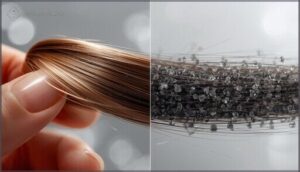
Once you know your porosity level, shift your focus to texture and shine. Run your fingers down a strand—healthy hair feels smooth and silky, while damaged cuticles create rough, bumpy patches.
Check your reflection: flat-lying cuticles bounce light evenly, giving you that natural sheen. Dull, matte hair with zero gloss? That’s a red flag your surface integrity took a hit.
Recognizing Signs of Over-Processing

Beyond dullness, watch for these warning signs: strands that snap when you gently stretch them signal elasticity loss and protein depletion from overprocessing. Cuticle erosion shows up as extreme roughness and chronic frizz—texture changes you can literally feel.
If your scalp burns, turns red, or flakes after bleaching, that’s irritation telling you to pump the brakes.
Hair breakage and limp, straw-like strands? Your hair condition needs serious repair time before round two.
Essential Hair Care Between Bleaching Sessions

Your hair needs some serious TLC between bleaching sessions if you want to keep it healthy and strong. Think of this time as your hair’s recovery period—it’s when you repair the damage and prep for the next round.
If you’re eyeing a curl upgrade too, it’s worth checking whether your strands can handle it—this guide on perming bleached hair safely breaks down the risks and timing.
Here are the three essential care steps you’ll want to focus on.
Deep Conditioning Treatments
Deep conditioning treatments are your hair’s best friend after bleaching damage. Right after you bleach, aim for 1–2 intensive sessions per week to restore moisture and softness. As your hair bounces back, you can dial it down to once weekly.
Application techniques matter—focus on mid-lengths and ends to avoid product buildup. Look for ingredient benefits like glycerin or hyaluronic acid in your hair repair treatments for maximum hydration.
Protein and Bond-Building Products
Protein treatments and bond-building mechanisms help repair broken disulfide bonds deep inside bleached hair. Products with hydrolyzed keratin boost tensile strength, while bond-builder formulas reconnect damaged cystine residues. Here’s what works:
- Apply bond-building treatments before, during, and after bleaching
- Use protein treatments weekly to strengthen weakened fibers
- Choose products with silk proteins or maleate chemistry
- Rotate between protein and moisture treatments
- Track market trends for newer peptide-based formulas
Your hair’s internal structure depends on this disulfide repair.
Scalp and Moisture Care
Because bleach raises your scalp pH above 7 and strips protective lipids, you’ll notice faster water loss and tightness.
Combat that barrier damage with aloe vera, argan oil, or shea butter to restore moisture and reduce TEWL-related dryness.
Switch to gentle, sulfate-free cleansers, skip harsh dry shampoos, and try hair oiling benefits between sessions—your scalp barrier repair depends on this consistent hydration routine.
Tips to Prevent Damage From Repeated Bleaching

If you’re going to bleach your hair more than once, you’ve got to protect it between sessions.
The good news is that a few simple habits can make a huge difference in keeping your hair strong and healthy.
Here are the key steps to follow after bleaching so your hair stays in good shape for your next color adventure.
Avoiding Heat Styling
Your flat iron might feel like your best friend, but when it comes to bleaching hair, heat styling can turn into your worst enemy. Bleached hair is already fragile—add high temperatures, and you’re asking for trouble.
Hair damage prevention starts with understanding this: heat styling precautions aren’t optional after bleaching. Skip the hot tools when possible and embrace air-drying benefits instead. Your hair will thank you later with less breakage and better shine.
Trimming Split Ends Regularly
Scissors can be your secret weapon against bleach damage. Regular trims stop split ends from traveling up the shaft, helping you keep the length you’ve worked so hard to grow.
Here’s your trim frequency game plan:
- Schedule cuts every 6–8 weeks to remove damaged ends before they worsen
- Remove about ¼ to ½ inch each time—just enough to protect hair health
- Watch for dryness and roughness as signs you’re due for professional guidance
- Prioritize length retention by trimming small amounts consistently rather than waiting for a big chop
Using Gentle, Sulfate-Free Products
Your shampoo bottle makes a bigger difference than you might think. Sulfate-free benefits start the moment you lather up—gentle surfactants preserve lipids your bleached fiber structure desperately needs. Studies show conventional shampoos strip 15–20% more color per wash, while sulfate-free formulas maintain hair moisture and slow damage progression.
Check product labeling carefully, though: “sulfate-free” doesn’t always mean truly gentle. Pair smart hair care choices with bond-building hair treatment between sessions for maximum protection.
| Surfactant Type | Impact on Bleached Hair | Best For |
|---|---|---|
| Sodium Lauryl Sulfate (SLS) | Strips lipids, increases dryness | Avoid on damaged hair |
| Cocamidopropyl Betaine | Mild, low irritation | Sensitive scalps |
| Sodium Cocoyl Isethionate | Gentle cleansing, preserves moisture | Color-treated hair |
| Sulfate-free blends | Reduces fading, maintains vibrancy | Post-bleach care |
| Nonionic surfactants | Minimal cuticle disruption | Highly porous hair |
When to Seek Professional Hair Advice

Sometimes bleaching gets tricky, and that’s when it’s smart to call in a pro. A stylist can spot damage you might miss and create a plan that keeps your hair healthy.
Here’s when you should definitely book that consultation.
Assessing Severe Damage
When your hair snaps like a dry twig or your scalp feels raw, you’ve crossed into serious damage territory. Some signs demand professional eyes—your stylist can spot what you might miss.
Look for these red flags:
- Cuticle scale damage and rough, torn surfaces under bright light
- Cortex fissures—deep cracks running along your hair shaft
- Protein loss causing limp, lifeless strands that won’t hold shape
- Elasticity reduction—hair that breaks instead of stretches when gently pulled
- Scalp burns with lingering pain, redness, or weeping areas
Don’t wait if you’re seeing these warning signs.
Personalized Bleaching Timelines
Professional consultation value shows up when you need a custom hair bleaching timeline that fits your life. No two heads are identical—your bleaching sessions depend on individual hair traits, bleach history impact, desired lightness level, and lifestyle considerations. A skilled colorist reads your strands better than any generic chart.
They’ll assess factors affecting bleaching you can’t spot yourself—protein loss, cortex health, porosity shifts—and create a hair health assessment methods plan that keeps your strands strong while chasing your color goals.
| Your Hair Factor | How It Changes Your Timeline |
|---|---|
| Fine texture | Wait 6–8 weeks minimum between sessions |
| Previous damage | Extend to 8–10 weeks or longer |
| Dramatic lift goal | Space sessions further apart |
| Active lifestyle | Consider maintenance frequency |
Safe Color Correction Methods
When your color goes sideways—brassy patches, uneven color, or unintended orange—you don’t need another round of bleach right away. Smart hair color correction methods save your strands and your sanity.
Here’s how pros fix color disasters without demolishing your hair:
- Color removers shrink unwanted dye molecules gently, skipping harsh re-bleaching
- Multi-session correction spreads lifting across appointments, protecting cuticle integrity
- Bond-building additives preserve up to 85–90% of your hair’s strength during lightening
- Strand testing on problem areas reveals the safest formula before full application
- Toner and scalp protection perfect tone while guarding against irritation and chemical burns
Professional hair color correction often relies on strategic toner application and weaving techniques rather than blanket bleaching.
Frequently Asked Questions (FAQs)
How long should I wait between bleaching sessions?
Think of your hair like a rubber band—stretch it too often, and it snaps.
Most hair needs 4 to 6 weeks between bleaching sessions, giving the cuticle time to rebuild and regain strength.
If you’re working with darker strands that need extra lift, this guide to the best professional bleach for dark hair breaks down which formulas minimize damage during that waiting period.
Can I bleach my hair again after 2 days?
Absolutely not. Bleaching hair again after just two days spikes breakage risk by 70% and can cause severe scalp irritation.
Your strands need weeks to rebuild strength and moisture after bleaching sessions.
Can I bleach my hair twice in 2 weeks?
Bleaching hair twice in two weeks carries serious risk. Professional opinions agree that such rapid bleach overlap devastates hair elasticity and often causes scalp irritation. Most stylists strongly advise against it.
How long should I bleach the second time?
Your second bleaching session shouldn’t be longer than the first—keep it around 30-45 minutes, depending on developer strength and strand testing.
Watch for signs of bleach buildup, and always conduct patch tests before processing.
Can you bleach your hair twice in one day?
You really shouldn’t bleach hair twice in one day. Doing so risks serious breakage, protein degradation, and even scalp burns.
Professional colorists prohibit this practice because hair elasticity loss and immediate damage risks are just too high.
Why you should not skip the strand test before bleaching your hair?
A strand test is your safety net for predicting results, preventing damage, and catching scalp risks before they happen.
It reveals hidden hair history and helps improve formula strength—basically, evaluating hair health before committing to the full bleach.
Can I Bleach My Hair After Dying It?
Yes, but hold on—you’ll want to wait at least 4 to 6 weeks between the hair color and bleaching. Dye removal and chemical interactions can lead to serious hair damage if your processing order doesn’t allow proper recovery time. Professional consultation helps!
Can I bleach wet or damp hair safely?
Imagine this: water droplets clinging to your strands as you reach for the bleach. Technically, yes—but damp hair’s wet vulnerability amplifies hair damage risks.
Safety damp bleaching demands gentler formulas, shorter sessions, and careful monitoring to protect hair health.
Does hair color affect bleaching wait time?
Your starting hair color absolutely affects how long you’ll wait between bleaching sessions. Darker levels need more aggressive lifting and multiple appointments, so cumulative damage builds faster than with light targets or virgin hair.
Are at-home bleach kits safer than salon treatments?
At-home kits and salon treatments aren’t about “safer”—they’re about control. Professional application reduces technical errors that cause fiber damage and scalp injury, while DIY bleaching often leads to uneven results and over-processing.
Conclusion
Think of your hair like a rubber band—stretch it too often without recovery, and it snaps. Knowing how long to wait to bleach your hair again protects you from irreversible damage while still reaching your color goals.
Listen to what your strands are telling you through elasticity, texture, and shine. Patience between sessions isn’t about delaying your dream look—it’s about making sure your hair survives the journey there, healthy and intact.