This site is supported by our readers. We may earn a commission, at no cost to you, if you purchase through links. This content is for general informational and educational purposes only and is not a substitute for professional medical, dermatological, or nutritional advice.
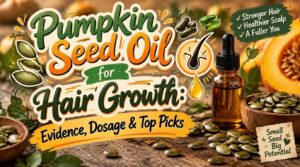
Most hair loss supplements promise a lot and deliver almost nothing. Pumpkin seed oil stands apart: a small but rigorous 2014 trial found that men taking 400 mg daily for 24 weeks saw noticeably reduced shedding and improved hair count, with no pharmaceutical side effects to speak of.
That kind of evidence is rare in the supplement world, and it’s worth understanding why this oil gets traction among clinicians. The proposed mechanism points to 5-alpha reductase inhibition, the same pathway targeted by prescription DHT blockers.
Here’s what the science actually backs, how to use it correctly, and which products are worth your money.
Table Of Contents
- Key Takeaways
- Does Pumpkin Seed Oil Help Hair Growth? Clinical Evidence and Limitations
- How Pumpkin Seed Oil May Block DHT and Support Hair Follicles
- How to Use Pumpkin Seed Oil for Hair Growth
- Top 4 Pumpkin Seed Oil Products for Hair Growth
- Pumpkin Seed Oil Safety, Side Effects, and Suitability
- Frequently Asked Questions (FAQs)
- Is there a downside to taking pumpkin seed oil?
- Is pumpkin seed oil good for hair regrowth?
- Does Pumpkin Seed Oil Help Hair Growth?
- Is Pumpkin Seed Oil Good for the Scalp?
- Does Pumpkin Seed Oil Block Dht?
- Does Pumpkin Seed Oil Have Biotin?
- Does Pumpkin Seed Oil Thicken Hair?
- Can pumpkin seed oil prevent premature graying?
- How long until visible hair growth results?
- Does it work for eyebrow or beard growth?
- Conclusion
Key Takeaways
- A single small 2014 trial found men taking 400 mg of pumpkin seed oil daily for 24 weeks saw roughly 40% more hair count and reduced shedding, likely through mild inhibition of 5-alpha reductase, the enzyme that produces DHT.
- The evidence is promising but thin—one modest study isn’t proof—so treat pumpkin seed oil as a supportive addition to proven treatments, not a replacement for them.
- Take 400 mg orally with a meal and stay consistent for at least six months, expecting reduced shedding by weeks four to eight and possible density changes around month three.
- Side effects are generally mild but real: GI upset at higher doses, possible scalp irritation with topical use, and interaction risks if you take anticoagulants or hormone-sensitive medications.
Does Pumpkin Seed Oil Help Hair Growth? Clinical Evidence and Limitations

How well does pumpkin seed oil actually perform when clinically tested? The honest answer is: the clinical evidence is limited. One small randomized double-blind placebo-controlled trial showed improved hair count in men with androgenetic alopecia after 24 weeks, but this was a single study with a modest sample size. That’s a promising signal, not a confirmed verdict.
If you want to compare products, this guide to the best pumpkin seed oil for hair breaks down which cold-pressed options are actually worth trying.
Most hair regrowth claims you’ll see online lean on the oil’s nutritional profile rather than rigorous clinical endpoints. A placebo-controlled study can tell us whether something outperforms belief alone, and pumpkin seed oil simply hasn’t yet been tested enough to draw firm conclusions. If you’re in the early stages of thinning, it may be worth considering alongside proven treatments, not instead of them.
Pumpkin seed oil’s hair regrowth claims rest on thin evidence, so treat it as a companion to proven treatments, not a replacement
How Pumpkin Seed Oil May Block DHT and Support Hair Follicles
So the clinical picture is limited, but what’s the proposed mechanism? Pumpkin seed oil is thought to act as a 5-alpha reductase inhibitor, interfering with the enzyme that converts testosterone into DHT. In androgenetic alopecia, DHT binds to androgen receptors in hair follicles, triggering miniaturization.
Here’s what it may do:
- Partially inhibit 5-alpha reductase activity, reducing DHT production
- Deliver linoleic and oleic acids that affect cell membrane signaling
- Provide tocopherols that may lower follicular oxidative stress
- Dampen local inflammation that can disrupt follicle cycling
- Support scalp conditions that let hair follicles function longer
The key word is "may." Fatty acids and vitamin E show promise in lab settings, but whether they meaningfully lower DHT in scalp tissue isn’t well quantified.
How to Use Pumpkin Seed Oil for Hair Growth
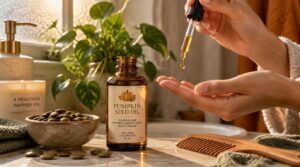
Getting the most out of pumpkin seed oil comes down to how and when you use it. There are two main routes: oral supplementation and topical scalp application, each with its own protocol. Here’s what the evidence recommends for both.
Oral Dosage and Timing
One small 2014 study found men taking 400 mg daily experienced noticeably less shedding after 24 weeks of oral ingestion. That’s worth noting, even if it’s not a large trial.
If you’re weighing other options, this guide to supplements that reduce hair fall breaks down which ingredients actually have research behind them.
| Factor | Guidance |
|---|---|
| Daily dosage | 400 mg |
| When to take | With a meal |
Consistent dosage matters most. Take your pumpkin seed oil oral supplement with food, not on an empty stomach. Fat-soluble compounds absorb better alongside dietary fats, and your gut benefits too.
Topical Scalp Application
Oral intake controls absorption internally, but topical scalp application works quite differently. Apply a few drops directly to thinning areas, massaging gently to encourage circulation. The oil’s anti-inflammatory compounds may calm the scalp environment around hair follicles, though direct DHT blocking topically isn’t proven. Always patch test first. Scalp nourishment is the realistic goal here, not a guaranteed follicle rescue.
Hair Growth Results Timeline
Tracking your progress with pumpkin seed oil takes real patience. The hair growth cycle moves slowly, so the earliest wins usually look like reduced shedding, not visible new growth.
By months three to four, you might start noticing subtle shifts in hair density. Meaningful improvements in hair thickness usually need six full months or more before changes become clearly measurable.
Top 4 Pumpkin Seed Oil Products for Hair Growth
Not all pumpkin seed oil products are created equal, and quality directly affects results.
Below are four options worth considering, covering both oral supplements and topical treatments. Each one meets the basic benchmarks you’d want to see: cold-pressed, third-party tested, and dosed appropriately for hair support.
1. Pumpkin Seed Oil Saw Palmetto Softgels
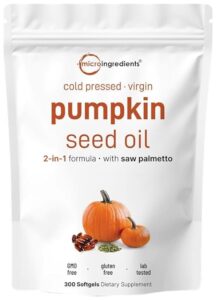
These softgels simplify the dual-ingredient approach. Each three-capsule serving delivers 3,000 mg cold-pressed pumpkin seed oil alongside 75 mg of saw palmetto, targeting the DHT pathway while supplying your follicles with the fatty acids and phytosterols they actually need.
Cold-pressed extraction isn’t just a label detail. It preserves heat-sensitive omega-6 and omega-9 compounds that cheaper processing methods would degrade, so the oil you absorb retains a more complete nutritional profile.
You get 300 softgels per pouch, enough for a full 100-day supply. They’re third-party tested, allergen-free, and hold a solid 4.5-star rating from tens of thousands of verified buyers.
| Best For | Anyone looking to support hair health and reduce shedding through a clean, dual-ingredient formula without allergens or synthetic additives. |
|---|---|
| DHT Support | Yes |
| Pumpkin Seed Oil | Yes |
| Form | Softgels |
| Cold-Pressed | Yes |
| Allergen-Free | Yes |
| Application Method | Oral |
| Additional Features |
|
- Delivers a meaningful 3,000 mg dose of cold-pressed pumpkin seed oil per serving, preserving heat-sensitive omega-6 and omega-9 fatty acids that cheaper extraction methods destroy.
- Combines two well-known DHT-targeting ingredients in one convenient softgel, removing the need to manage separate supplements.
- Third-party tested and free from common allergens like soy, dairy, gluten, and tree nuts, making it suitable for people with dietary sensitivities.
- The three-softgel daily serving size is on the larger side, which some users find inconvenient or difficult to swallow.
- A small number of users report mild digestive side effects such as nausea or oily burping.
- Not evaluated by the FDA, so any hair or wellness benefits rely on user experience and third-party research rather than regulatory approval.
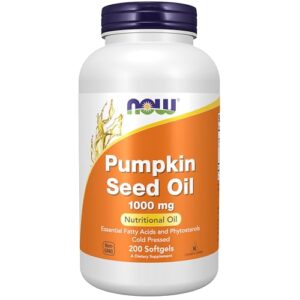
2. NOW Pumpkin Seed Oil Softgels
Think of it like adding a measured, daily dose of follicle-supporting lipids to your routine without guesswork.
NOW Foods cold-presses their pumpkin seed oil from non-GMO seeds, delivering 1,000mg per softgel, so two capsules give you a clean 2,000mg serving. Each 200-count bottle covers 100 servings, manufactured in GMP-certified facilities and free of common allergens. That’s consistent, standardized dosing you can actually track.
The oil supplies polyunsaturated and monounsaturated fats alongside phytosterols, which may support the follicle microenvironment from within. Take two softgels once or twice daily with food. If your stomach protests at first, start with one capsule and build up gradually.
| Best For | People looking to support hair growth, reduce shedding, or promote urinary and prostate health with a clean, standardized daily supplement. |
|---|---|
| DHT Support | Yes |
| Pumpkin Seed Oil | Yes |
| Form | Softgels |
| Cold-Pressed | Yes |
| Allergen-Free | Yes |
| Application Method | Oral |
| Additional Features |
|
- Cold-pressed from non-GMO seeds with no solvents, so you get pure oil without unwanted additives
- Each softgel delivers a precise 1,000mg dose, making it easy to track and adjust your intake
- Supplies essential fatty acids and phytosterols that may support follicle health, urinary function, and general wellness
- The softgels are on the larger side, which some people find hard to swallow
- Capsules can stick together inside the bottle, making them tricky to separate
- Natural dark particulates and color variation in the oil may be off-putting to some users
3. Organic Pumpkin Seed Oil Cold Pressed
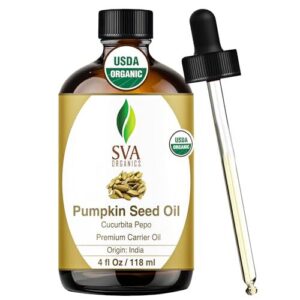
Picture delivering delivering concentrated fatty acids directly to thinning spots, without the weight or residue of a heavy oil. SVA Organics’ cold-pressed version does exactly that. Extracted from organic Cucurbita Pepo seeds at temperatures below 40°C, it retains the linoleic and oleic acids your scalp needs to support a healthier follicle environment.
The 4-ounce bottle includes a dropper, making targeted application simple and controlled. It absorbs without leaving greasiness or stickiness, so you can work it into your scalp before a wash or mix it straight into your shampoo or conditioning mask.
Worth noting: its natural, nutty scent can be noticeably strong.
| Best For | Anyone looking to support a healthier scalp and address thinning hair with a lightweight, organic oil that can be used alone or blended into existing hair care products. |
|---|---|
| DHT Support | Yes |
| Pumpkin Seed Oil | Yes |
| Form | Liquid oil |
| Cold-Pressed | Yes |
| Allergen-Free | N/A |
| Application Method | Topical |
| Additional Features |
|
- Cold-pressed below 40°C to preserve linoleic and oleic acids that support follicle health
- Absorbs cleanly with no greasy or sticky residue, making it easy to use before washing or mixed into shampoos and masks
- Includes a dropper for precise, controlled application with no waste
- The natural nutty scent is noticeably strong and may be off-putting for some users
- Customer opinions on value for money are mixed, so it may not suit every budget
- Pre-wash use requires a follow-up cleanse with a mild shampoo to fully remove it
4. BosleyMD Revive Thickening Hair Treatment
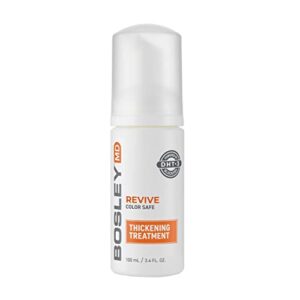
BosleyMD Revive takes a different approach. Instead of a capsule, it’s a leave-in foam treatment you apply directly to the scalp after shampooing, targeting the root zone where thinning often starts.
The formula is alcohol-free and built around a DHT-3 Blockers Complex, designed to reduce dihydrotestosterone activity at the scalp while adding visible volume at the root. Panthenol also helps keep strands strong throughout.
Apply it to problem areas, then style as usual. At around $30 for 5.29 ounces, it’s on the pricier side for a topical, and user feedback is genuinely mixed on real hair growth results. Some users also report leakage issues with the bottle, so handle it carefully.
| Best For | People dealing with rapid or visible hair thinning who prefer a topical foam treatment over pills or supplements. |
|---|---|
| DHT Support | Yes |
| Pumpkin Seed Oil | Yes |
| Form | Foam |
| Cold-Pressed | N/A |
| Allergen-Free | N/A |
| Application Method | Topical |
| Additional Features |
|
- Alcohol-free formula adds instant volume at the root without drying out strands
- DHT-3 Blockers Complex targets thinning at the scalp level where it starts
- Easy to work into your routine — just apply after shampooing and style as normal
- User feedback is mixed on whether it actually slows or reverses hair loss
- Some customers find it leaves hair feeling dry rather than silky
- Reports of leakage issues with the bottle make it tricky to store and travel with
Pumpkin Seed Oil Safety, Side Effects, and Suitability
Most supplements carry some caveats, and pumpkin seed oil is no different. Its overall safety profile is fairly mild, but a few specific risks are worth knowing before you commit.
Here are four side effects and suitability concerns to take seriously:
- Scalp redness or itching can develop with topical use, especially if the product isn’t cold-pressed and contains additional formulation ingredients.
- GI upset at higher dosage is common with oral forms, including nausea and loose stools.
- Drug interaction risks are a real concern if you take anticoagulants or hormone-sensitive medications.
- Pregnancy and nursing require extra caution since oral safety data for these groups is limited.
If you have a seed allergy or an active scalp condition like psoriasis, start cautiously.
Frequently Asked Questions (FAQs)
Is there a downside to taking pumpkin seed oil?
I once had a client swear off pumpkin seed oil after weeks of stomach upset. The truth? Side effects exist. GI upset, allergy risk, and drug interaction risks with anticoagulants mean your safety profile deserves a check first.
Is pumpkin seed oil good for hair regrowth?
Honest answer: probably not dramatically. Clinical efficacy for hair regrowth treatments is unproven; pumpkin seed oil may modestly influence dihydrotestosterone in androgenetic alopecia, but evidence is limited, so treat it as a supportive extra.
Does Pumpkin Seed Oil Help Hair Growth?
Short answer: yes, with caveats. One Korean trial reported a 40% increase in hair count after 24 weeks of oral pumpkin seed oil, likely tied to reduced dihydrotestosterone activity. Clinical efficacy evidence remains limited, so expect modest results.
Is Pumpkin Seed Oil Good for the Scalp?
Think of it as mulch for your roots. Yes, pumpkin seed oil helps scalp health: its fatty acids ease scalp inflammation, balance sebum, and condition dry skin, improving the scalp microenvironment.
Patch-test first, since heavy oils can clog follicles.
Does Pumpkin Seed Oil Block Dht?
One small trial found men taking pumpkin seed oil saw about 40% more hair count, so does it actually block DHT? Yes, modestly.
Its phytosterols inhibit 5alpha reductase, the enzyme converting testosterone into dihydrotestosterone DHT. That’s why it’s called a gentle DHTblocking option for androgenetic alopecia, though it’s far weaker than finasteride and human DHT measurements remain limited.
Does Pumpkin Seed Oil Have Biotin?
Think of biotin as water-soluble: it clings to the seed, not the oil. Whole pumpkin seeds carry about 64 micrograms per 100 grams, but cold-pressing leaves biotin behind in the meal.
Analyses of pumpkin seed oil confirm no measurable biotin, so any nutritional supplement must declare it separately for verified bioavailability.
Does Pumpkin Seed Oil Thicken Hair?
You may see modest gains. One small trial found oral pumpkin seed oil (400 mg daily) improved hair density in androgenetic alopecia over six months, but rigorous studies on true hair thickening are still lacking.
Can pumpkin seed oil prevent premature graying?
A patient once asked me if any oil could restore her color. Honestly, no. No research shows pumpkin seed oil prevents graying. Its antioxidant, oxidative stress reduction benefits support hair growth, but melanocyte decline isn’t reversible through topical application.
How long until visible hair growth results?
Expect reduced shedding first, around weeks four to eight. Visible density usually emerges near the three-month mark as new hairs surface. Track progress at six months; if nothing changes, reassess your routine.
Does it work for eyebrow or beard growth?
Let’s clear the air: pumpkin seed oil has no clinical evidence for eyebrows or beards. Only scalp androgenetic alopecia trials support topical application, so beard oil claims about follicle stimulation remain unproven testimonials.
Conclusion
Another miracle supplement? Usually yes, and usually no. Pumpkin seed oil for hair growth is the rare exception with actual trial data behind it.
Start with 400 mg daily, stay consistent, and give it a full six months before judging. Pair it with a healthy scalp routine, manage expectations, and track your shedding photos.
Hair regrowth rewards patience, not hype. You’ve got the evidence now, so use it.