This site is supported by our readers. We may earn a commission, at no cost to you, if you purchase through links. This content is for general informational and educational purposes only and is not a substitute for professional medical, dermatological, or nutritional advice.

You’ve likely stared at that box of semi-permanent dye and thought about stretching it with a dollop of conditioner, or maybe you’ve heard whispers online about mixing shampoo with leftover color to keep your hue fresh between salon visits.
The truth is, mixing hair dye with conditioner or shampoo isn’t just some beauty hack—it’s a chemistry experiment that can either give you gorgeous, tailored results or leave you with patchy, faded disappointment.
The difference comes down to understanding which dye formulas tolerate dilution, how conditioner and shampoo interact with color molecules differently, and what happens when you disrupt the delicate pH balance that permanent dyes rely on.
Whether you’re hoping to soften an intense shade, refresh faded color, or create a custom toner, knowing the science behind these mixtures helps you avoid costly mistakes and achieve the precise control you’re after.
Table Of Contents
- Key Takeaways
- Can You Mix Hair Dye With Conditioner or Shampoo?
- Why Mix Hair Dye With Conditioner?
- Risks of Mixing Conditioner With Permanent Dye
- How to Mix Semi-Permanent Dye With Conditioner
- Mixing Hair Dye With Shampoo: When and How
- Step-by-Step Guide to Application
- Best Practices for Safe and Effective Results
- Choosing Compatible Products for Mixing
- Alternatives and Precautions for Hair Dye Mixing
- Frequently Asked Questions (FAQs)
- Should I mix hair dye with shampoo or conditioner?
- Can I mix hair dye with conditioner instead of developer?
- Can you mix hair dye with conditioner to make it lighter?
- Can conditioner damage hair?
- How often should I use conditioner?
- What is the difference between semipermanent and permanent hair dye?
- Can I use purple shampoo on non-blonde hair?
- How do I correct brassy hair?
- Can I mix box dye with regular drugstore conditioner?
- How long does conditioner-diluted dye last on hair?
- Conclusion
Key Takeaways
- You can safely mix semi-permanent or direct dyes with conditioner to create softer, customizable shades, but mixing permanent dye with conditioner disrupts the alkaline pH chemistry needed for proper color deposit and will give you patchy, muddy results.
- The standard dilution ratio is one part semi-permanent dye to two or three parts sulfate-free, silicone-free conditioner, though you can stretch it to 1:4 for pastel effects—always perform a strand test first to assess how your specific hair porosity will respond.
- Mixing semi-permanent dye with shampoo works differently than conditioner because shampoo’s surfactants penetrate deeper, making it ideal for refreshing faded color or toning brassiness with quick pigment deposits that rinse out in three to five minutes.
- Post-dye care determines whether your color lasts or fades fast—switch immediately to sulfate-free shampoo, rinse with cool water to seal cuticles, and skip clarifying formulas that strip pigment before it fully sets into your hair’s cortex.
Can You Mix Hair Dye With Conditioner or Shampoo?
You can mix hair dye with conditioner or shampoo, but whether you should depends entirely on the type of dye you’re using and what result you’re chasing.
If you’re leaning toward dilution, check out this guide on how to dilute hair dye for step-by-step instructions and common mistakes to avoid.
The two mixing methods work differently, interact with your hair’s chemistry in distinct ways, and aren’t interchangeable despite what some online tutorials might suggest.
Before you grab that bottle and start experimenting, you need to understand which dye formulas play nice with dilution and which ones will absolutely punish you for it.
Differences Between Conditioner and Shampoo Mixing
Here’s the real difference: conditioner coats and seals your cuticles for moisture and slip, while shampoo uses surfactants that penetrate deeper, cleansing away oils and residues.
When you mix hair dye with shampoo, you’ll usually see stronger color deposit than mixing conditioner because of how each interacts with hair porosity and pH levels—the product interactions matter more than you’d think.
For a detailed explanation of, understanding their unique purposes is essential for healthy hair care.
Hair Dye Types and Compatibility
Not all dyes play well with dilution. Permanent formulations rely on ammonia and hydrogen peroxide—mixing conditioner disrupts the alkaline pH needed to lift cuticles, ruining color chemistry and dye stability.
Permanent dyes need ammonia and peroxide to work—mixing conditioner sabotages the alkaline chemistry that lifts your cuticles and locks in color
Semi-permanent color and direct dyes, however, lack oxidative developers, so adding conditioner won’t sabotage product interactions.
Your hair porosity matters too: high-porosity strands grab pigment fast, while low-porosity hair needs stronger dye formulation to achieve even results.
For more insight into how the structure of hair layers relates to dye effectiveness, explore the science behind professional coloring.
Why Mix Hair Dye With Conditioner?
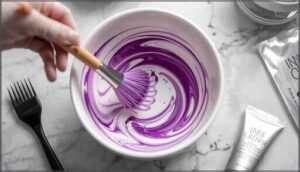
You might wonder why anyone would dilute their hair dye with conditioner, especially when manufacturers provide specific instructions for application. The answer comes down to two main advantages that appeal to people looking for more control over their color results.
Mixing conditioner with semi-permanent or direct dyes offers practical benefits that standard application methods simply can’t deliver.
Benefits for Semi-Permanent and Direct Dyes
Flexibility sits at the heart of why you’d mix conditioner with hair dye application techniques involving semipermanent and direct dyes. These gentle formulas already skip ammonia and peroxide, so blending in conditioner boosts hair moisture without sabotaging color vibrancy.
You’ll notice smoother fading patterns and better color longevity on pre-lightened strands, while your scalp stays comfortable throughout processing.
Achieving Softer, Subtler Color Results
Beyond smoother fading, mixing conditioner unlocks precise control over color depth and subtle toning. Dye dilution techniques help you balance hair porosity issues, giving high-porosity sections the same gentle formulas as resistant zones. Your color deposit becomes more forgiving, and softening techniques prevent harsh demarcation lines. You’re basically building a buffer that tames aggressive pigment while preserving the intentional tone you mixed.
- Start with a 1:2 dye-to-conditioner ratio for pastel effects
- Use translucent conditioners to avoid tint interference
- Apply in thin sections for even saturation
Risks of Mixing Conditioner With Permanent Dye
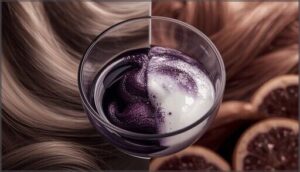
Permanent hair dye relies on a precise alkaline environment to lift your hair cuticles and deposit color molecules deep within the cortex, which is why mixing it with conditioner can throw off the entire chemical process.
If you’re battling brassiness after coloring, learning how to use purple shampoo correctly helps neutralize those unwanted warm tones without disrupting your hair’s chemical balance.
When you introduce conditioner into the equation, you’re basically disrupting the pH balance and diluting the developer that makes permanent color work.
Here’s what actually happens when you mix conditioner with permanent dye, and why it’s a mistake you’ll want to avoid.
Chemical Reactions and Color Failure
When you mix conditioner with permanent hair dye formulation, you’re sabotaging the chemical hair processing at the molecular level. Conditioner’s acidic pH neutralizes the alkaline environment needed for cuticle lifting, preventing proper color deposit control.
This pH shift disrupts oxidation states in the dye molecules, leading to chromophore degradation and unpredictable color shift mechanisms.
The result? Muddy, patchy color that doesn’t match your expectations.
Potential Hair Damage and Uneven Results
Damage control becomes a nightmare when you introduce conditioner into permanent dye. Bleach and peroxide already weaken cuticle layers, and uneven application creates porosity issues that cause patchy color deposition—some areas grab pigment while others resist.
You’ll face hair breakage from overprocessing, scalp irritation from prolonged contact, and faster color fading as porous strands shed moisture. The hair coloring process demands precision you simply can’t achieve with this risky mix.
How to Mix Semi-Permanent Dye With Conditioner
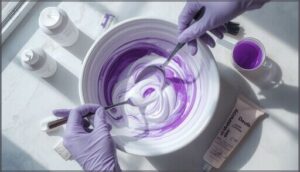
Mixing semi-permanent dye with conditioner isn’t complicated, but getting the formula right makes all the difference between a beautiful, even tint and a patchy mess.
The technique hinges on three essential steps that control how the color deposits, how long it lasts, and whether you’ll damage your hair in the process.
Let’s break down the key factors you need to nail before you start mixing.
Choosing The Right Conditioner
Not all conditioners play nice with semi-permanent hair dye, and the wrong formula can sabotage your color before you even start. You need a sulfate-free, silicone-free base that won’t interfere with dye deposit or create a moisture imbalance that blocks pigment penetration.
- Match conditioner ingredients to your hair type analysis — fine hair needs lightweight humectants, while coarse textures demand richer emollients for proper product compatibility
- Verify sulfate alternatives like gentle cleansing agents that won’t strip color depositing conditioner molecules
- Choose medium-creamy textures that mix conditioner with hair dye smoothly without clumping or separation during application
Recommended Mixing Ratios
The standard starting point is one part semi-permanent dye to two or three parts conditioner, which delivers noticeable color depth without overwhelming your hair. If you’re aiming for a whisper of tint, stretch that mixing ratio to 1:4—perfect for root touch-ups where you want minimal staining risk.
Document your exact dye concentration and results to adjust product compatibility for next time.
Performing a Strand Test
Before you commit your entire head to a new formula, isolate a one-inch strand from your nape and apply your dye-conditioner mix.
Processing Time determines whether you’ll achieve your target shade or end up disappointed, so set a timer and check color development every five minutes.
This strand test reveals how your hair reacts to the mixture, flagging any damage risk or uneven color assessment before full dye application.
Mixing Hair Dye With Shampoo: When and How
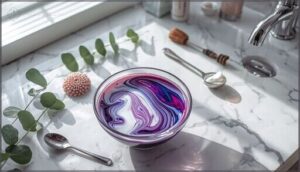
Mixing hair dye with shampoo works differently than using conditioner, and it fulfills a specific purpose in your color maintenance routine. This technique is particularly useful when you want to refresh faded color or correct unwanted tones without committing to a full dye application.
Let’s look at the two main scenarios where adding dye to your shampoo actually makes sense.
Refreshing Faded Color
When your vibrant shade starts looking tired between full dye jobs, mixing semi-permanent dye with shampoo offers quick pigment restoration for hair rejuvenation. You’ll dilute the dye considerably—usually one part color to four parts product—so it deposits just enough tone for color revival without over-saturating.
This hair color refresh method addresses faded color gently, making vibrancy maintenance simple while mixing conditioner with dye remains your deeper treatment option.
Toning and Correcting Brassiness
Beyond reviving faded color, mixing dye with shampoo excels at toning and correcting hair color issues—especially brassiness control in lightened strands. You’ll prevent brassiness by depositing violet toning pigments that neutralize yellow, or blue hues that cancel orange, within three to five minutes of contact. Hair porosity determines how aggressively those corrective tones grab, so here’s your color correction game plan:
- Purple shampoo mixtures combat yellow blonde brassiness instantly
- Blue-based formulas target stubborn orange undertones in lifted hair
- Demi-permanent glosses extend toner application results four to six weeks
- Regular color depositing sessions maintain cool tones between salon visits
Step-by-Step Guide to Application
Now that you understand when and why to mix hair dye with conditioner or shampoo, let’s walk through the actual application process.
Getting the technique right makes all the difference between a beautiful, even result and a patchy mess. Here’s what you need to know before you start mixing and applying.
Preparation and Tools Needed

Before you mix conditioner with hair dye, gather your essentials: a plastic bowl, hair dye brush, disposable gloves, and an old towel for your workstation setup.
Inspect your hair’s current condition and porosity under good lighting—this hair assessment determines how well the color will take.
Keep a timer nearby for timing control, and guarantee proper ventilation as your safety precaution.
Mixing and Applying The Product
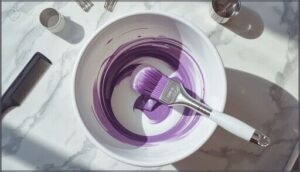
Once your tools are ready, start your mixing techniques by combining 1 part semi-permanent dye with 1–3 parts sulfate-free conditioner in your plastic bowl—this ratio controls color deposit intensity. Strand test first to assess dye penetration based on your hair porosity.
When you mix conditioner with hair dye:
- Blend thoroughly with your tint brush until completely uniform
- Section hair into quarters for systematic coverage
- Apply from roots outward, combing to distribute evenly
Processing Time and Rinsing

After application, leave your conditioner-dye blend on for 5–20 minutes—semi-permanent formulas usually process faster at 5–10 minutes, while direct dyes need 10–15.
Rinse with warm water (37–45°C) to lift dye residue, then finish with a cool rinse below 30°C for hair cuticle sealing and color fade prevention. Continue until water runs mostly clear.
Best Practices for Safe and Effective Results
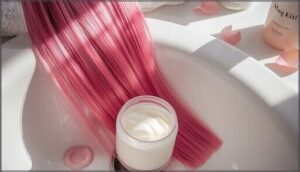
You’ve mixed your dye and conditioner, applied it carefully, and now you’re wondering how to make sure the results actually stick. The truth is, even a perfect application can fall flat if you skip a few essential steps afterward.
Let’s cover the mistakes that sabotage your color and the post-dye care that keeps it looking fresh.
Avoiding Common Mistakes
You wouldn’t eyeball measurements in a lab, so don’t do it with dye—incorrect ratios destroy dye stability and pH balance, causing patchy results. Skipping strand tests on porous hair? That’s how you end up with neon instead of pastel.
When you mix conditioner with hair dye, always protect against damage by avoiding clarifying shampoos that strip color protection before your pigment sets properly.
Post-Dye Hair Care Tips
Color Preservation starts the moment you rinse—your cuticle’s still open, vulnerable to rapid fade. Lock in results with these hair care tips for lasting vibrancy:
- Switch to sulfate-free shampoo to prevent dye stripping and maintain hair hydration between washes.
- Apply color-safe conditioner after every wash for Damage Repair and Fade Prevention.
- Rinse with cool water to seal cuticles and support Hair Moisturizing.
- Schedule weekly deep conditioning for hair maintenance and Scalp Protection.
- Limit heat styling to preserve pigment integrity in your hair care routine.
Choosing Compatible Products for Mixing

Not all conditioners and shampoos play nice with hair dye, and choosing the wrong formulas can sabotage your color before you even rinse. The ingredient list matters more than the brand name, since certain compounds actively interfere with dye deposit while others support it.
Here’s what to look for when you’re picking products to mix, and which ingredients will work against you.
Recommended Conditioners and Shampoos
You want to mix conditioner with hair dye? Look for sulfate-free formulas with a medium-creamy texture, no silicones, and a pH around 4.5 to 5.5. The best candidates contain humectants like glycerin, panthenol, or natural oils such as argan or jojoba.
For shampoo mixing, choose gentle, color-safe options without harsh sulfates. These choices preserve moisture balance while letting the dye perform.
Ingredients to Avoid When Mixing
Think of your conditioner as a chemistry experiment—certain ingredients sabotage the mix. Skip products with heavy silicones, which block dye uptake and create patchy results. Avoid sulfates that strip oils and trigger color shifts. Watch for denatured alcohol content, which accelerates fade and irritates your scalp. Fragrance effects matter too; synthetic parfum can interfere with pigment deposition.
When you mix conditioner with hair dye, sulfate-free formulas guarantee hair dye safety through better cosmetic chemistry and safety principles, protecting color stability.
Alternatives and Precautions for Hair Dye Mixing
If mixing dye with conditioner feels too risky or unpredictable, there are safer alternatives that give you control without compromising your color results.
From ready-made color-depositing formulas to strategic deep conditioning treatments, you have options that protect your hair while enhancing your shade.
Here’s what works when you want the benefits of mixing without the guesswork.
Using Color-Depositing Conditioners
If you’re not ready to experiment with conditioner-hair dye cocktails, color depositing conditioners offer a safer route. These product formulations deliver temporary pigment while conditioning, sidestepping the chemistry chaos of mixing actual dye.
They work by depositing color molecules onto your hair’s surface—hair porosity matters here, since bleached strands grab pigment faster.
You’ll maintain vibrancy without worrying about color fading between full coloring sessions, and color theory guides your shade selection.
Moisturizing Treatments Before and After Dyeing
Pre-Dye Care sets the stage for healthier color—deep conditioning 24 to 72 hours before dyeing boosts moisture content by 15 to 25 percent, reducing strand dryness during chemical processing.
Post-Color Hydration restores shine by up to 30 percent when you use sulfate-free shampoos and weekly Hair Masking with humectants.
Scalp Moisture management and proper hair porosity management complete your hair damage prevention strategy.
Frequently Asked Questions (FAQs)
Should I mix hair dye with shampoo or conditioner?
Skip the salon shortcuts—mixing hair dye with conditioner works beautifully for semi-permanent hair color, creating softer tones and protecting hair porosity, but pair it with permanent formulas and you’ll sabotage your color chemistry completely.
Can I mix hair dye with conditioner instead of developer?
No, conditioner can’t replace developer in permanent hair dye formulas. Developer triggers the oxidation process that opens the hair cuticle and allows color chemistry to penetrate the cortex—conditioner simply moisturizes without activating pigment deposition.
Can you mix hair dye with conditioner to make it lighter?
Yes, mixing hair dye with conditioner dilutes pigment for lighter shades, especially with semi-permanent color. However, uneven color dilution can create patchy results if you don’t mix thoroughly, so always test a strand first.
Can conditioner damage hair?
Like feeding a plant too much water, overusing conditioner can suffocate follicles, triggering scalp irritation and buildup that weighs hair down, causes color fading, and ironically leads to hair breakage rather than nourishment.
How often should I use conditioner?
Most hair types benefit from conditioning 2–3 times per week after shampooing, though dry or curly hair often needs it daily.
Adjust your routine based on moisture needs, scalp health, and seasonal changes.
What is the difference between semipermanent and permanent hair dye?
Semi-permanent color coats the cuticle and fades over 4–12 washes, while permanent dye uses ammonia and developer to penetrate the cortex, delivering lasting results and full grey coverage until regrowth appears.
Can I use purple shampoo on non-blonde hair?
You can use purple shampoo on non-blonde hair to neutralize brassiness in highlighted or lightened brown strands.
Though violet pigments may create temporary tints on lighter sections, it’s ideal for toning and brass reduction between color corrections.
How do I correct brassy hair?
To neutralize brassy tones through color correction, apply a violet-based toner for yellow brass or blue formulas for orange undertones.
Purple shampoo offers effective maintenance between professional toning treatments, preserving your cool shade.
Can I mix box dye with regular drugstore conditioner?
Mixing box dye with regular drugstore conditioner is like throwing a wrench into a precision machine. You’ll disrupt the oxidative chemistry, weaken color deposit methods, and risk patchy, unpredictable results that no strand test can fully predict.
How long does conditioner-diluted dye last on hair?
Conditioner-diluted dye usually lasts four to six washes, though hair porosity, shampooing frequency, and shade depth all influence color retention.
Darker semi-permanent tones hold longer than pastels, while porous hair fades faster.
Conclusion
The theory that you can mix hair dye with conditioner or shampoo holds true—but only when you respect the chemistry. Semi-permanent formulas thrive with conditioner dilution, giving you customizable intensity and gentler application, while shampoo mixtures refresh faded color between touch-ups. Permanent dyes, however, demand their developer ratios to stay intact.
Understanding these distinctions transforms guesswork into precision, letting you manipulate color molecules confidently without sacrificing vibrancy or hair health along the way.