This site is supported by our readers. We may earn a commission, at no cost to you, if you purchase through links. This content is for general informational and educational purposes only and is not a substitute for professional medical, dermatological, or nutritional advice.
Leave purple shampoo on too long and you won’t get cooler blonde, you’ll get a lavender halo you can’t wash out. Colorists see it every week: clients grab a bottle, slather it on like regular shampoo, and end up booking an emergency toner correction. The truth is purple shampoo works fast and unevenly, punishing guesswork with patchy, purple-tinged results.
Knowing how to use purple shampoo means matching timing to your hair’s porosity, texture, and current tone, not eyeballing it in the shower.
Get the ratios, timing, and technique right, and brassiness stays gone for good.
Table Of Contents
- Key Takeaways
- What Does Purple Shampoo Do for Hair?
- How to Use Purple Shampoo Step by Step
- How Long Should Purple Shampoo Stay On?
- How Often Should You Use Purple Shampoo?
- Purple Shampoo Mistakes and Fixes
- Frequently Asked Questions (FAQs)
- Can purple shampoo be used on dark hair?
- Is it necessary to wear gloves when applying purple shampoo?
- Can purple shampoo work on natural blonde hair?
- Does purple shampoo damage or dry out hair?
- Can I use purple shampoo with other treatments?
- Whats the difference between purple shampoo and toner?
- How do I store purple shampoo properly?
- Can you use purple shampoo on wet hair?
- Does purple shampoo work on eyebrows or beards?
- Can purple shampoo replace regular conditioner entirely?
- Conclusion
Key Takeaways
- Purple shampoo neutralizes brassy yellow tones through color theory, since violet pigment sits opposite yellow on the color wheel and cancels it out on contact.
- Processing time must match your hair’s porosity and type, ranging from just 1-3 minutes for platinum or high-porosity hair up to 5-7 minutes for low-porosity strands.
- Applying purple shampoo to damp, sectioned hair and focusing extra product on brassy mid-lengths and ends gives more even, effective results than blanket application.
- Leaving purple shampoo on too long causes overtoning into a lavender or ashy cast, so using a timer and checking color development every minute is essential to avoid this common mistake.
What Does Purple Shampoo Do for Hair?
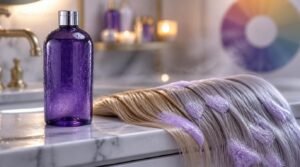
Purple shampoo works like magic for one specific reason: color theory. Once you get why violet cancels out yellow, the rest just clicks into place. Here’s what’s actually happening in that bottle, and who it’s really meant for.
If your hair leans warm instead of yellow, though, it’s worth checking whether purple shampoo actually works on brown hair before you commit to a bottle.
Violet Pigments Cancel Yellow
Grab a color wheel and you’ll see it instantly: violet sits directly across from yellow. That’s basic color wheel physics—opposites cancel each other out.
Violet pigment absorbs yellow wavelengths (around 570–590 nm) while reflecting violet light back, neutralizing brassy yellow tones on contact. Understanding complementary color theory is essential for neutralizing unwanted pigments.
Concentration matters too:
- 0.5–2.5% violet pigment
- Balanced pH (4.5–5.5)
- Even application
- Proper processing time
- Consistent rinsing
Brassiness Versus Warmth
Not all warm tones are bad. Brassiness is that harsh yellow-orange cast; warmth is the golden glow you actually want. Sunlight exposes brass fast, while indoor lighting can hide it.
| Trait | Brassiness | Warmth |
|---|---|---|
| Look | Harsh, dull | Soft, rich |
| Cause | Faded pigment | Intentional tone |
| Fix | Neutralize | Maintain |
Purple shampoo neutralizes brass without stripping intentional gold—color wheel balance at work.
Best Hair Colors
Purple shampoo works best on blonde, silver, or platinum hair—the lighter the base, the more brass it fights. Think platinum blonde undertones staying icy-cool, or silver gray maintenance staying bright, not yellowed.
It won’t touch brunette shade dimension or darker bases. Copper red warmth and bronde color transitions need different toners entirely, since there’s no yellow pigment here to cancel out.
Purple Versus Blue Shampoo
So which bottle do you actually reach for? It comes down to undertone identification.
Blonde and silver hair throws yellow, so purple shampoo cancels it out. Brunette hair throws orange or red, and that’s where blue shampoo takes over. The color wheel doesn’t lie: purple neutralizes yellow, blue neutralizes orange. Match the pigment to your undertone, not your hair color alone.
The color wheel doesn’t lie: match your toning shampoo’s pigment to your undertone, not just your hair color
How to Use Purple Shampoo Step by Step
Using purple shampoo the right way makes all the difference between a salon-fresh tone and a muddy mess. It’s not complicated, but the order of steps matters more than you’d think. Here’s exactly how to do it, start to finish.
If you’re unsure whether your strands actually need it, this guide on what purple shampoo does to brown, black, and blonde hair breaks down exactly how it reacts with different shades.
Start With Damp Hair
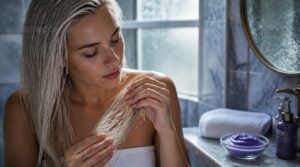
Skip the shower blast—your hair’s natural sponge-like state does the real work here.
Towel-blot until damp, not dripping, since hair sits most porous and absorptive right after rinsing. This is your quick porosity test: fast-absorbing strands need lighter toning sessions. Damp hair allows deeper product penetration, letting violet pigment reach the cuticle evenly instead of sliding off wet strands, setting up better blonde maintenance results before you even start applying.
Apply Roots to Ends
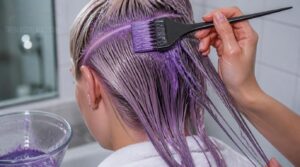
Section off your hair in 1 to 1.5 cm partings, working root to tip in one smooth motion. Keep the brush close to the scalp, feathering pressure as you move down to avoid harsh lines or pooling.
Use a firm tint brush for control, cleaning it between sections. This prevents cross-contamination and keeps your toning shampoo application even from root to end.
Focus on Brassy Areas
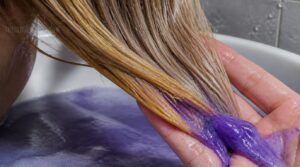
Where does brass hide hardest? Usually your mid-lengths and ends, since lightening hits those areas hardest.
Target these hotspots with extra product for real color neutralization. High-porosity strands soak up pigment fast, so adjust pressure accordingly.
Work in thin, targeted sections, concentrating shampoo where yellow or orange tones show strongest. This hotspot neutralization approach beats blanket application every time for stubborn brassy tones.
Leave on Briefly

Set a timer — don’t guess. Platinum hair needs just 1-3 minutes, natural blonde 2-5, color-treated 4-7.
- High porosity: start at 1 minute
- Low porosity: try 3-5 minutes
- Medium porosity: 2-3 minutes works well
Check color development every minute or so. Longer times mean more pigment deposit — great for stubborn brass, risky for overtoning into lavender territory.
Rinse and Condition

Cold water is your friend here — rinse at 32-38°C to seal the hair cuticle and lock in tone. Follow with a deep condition to restore moisture and pH balance.
| Water Temp | Purpose | Time |
|---|---|---|
| Cool (32-38°C) | Seals cuticle | 30-60 sec |
| Conditioner | Restores moisture | 1-3 min |
| Final rinse | Removes residue | 15 sec |
Match conditioner to your porosity for best results.
How Long Should Purple Shampoo Stay On?
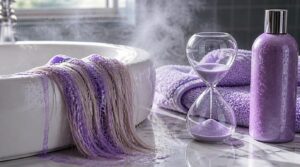
Timing isn’t one-size-fits-all with purple shampoo. Your hair type and color history both change the clock. Here’s how long to leave it on based on what you’re working with.
Platinum and Silver Hair
Platinum and silver hair need the shortest processing time of any shade—just 1-3 minutes. These bases are already lifted so high that pigment absorbs fast, especially with high-porosity hair.
Watch the clock closely here. Leaving purple shampoo on longer risks a dull, lavender cast instead of that icy, reflective shine you’re after during toning maintenance.
Natural Blonde Hair
Give natural blondes a touch more time, 2-5 minutes, since their strands never saw bleach and pigment absorbs slower.
Genetics play a role here: lower eumelanin production means finer hair, so check strands at the two-minute mark. Sun exposure often lightens roots naturally, creating brassy yellow tones that purple shampoo neutralizes beautifully during regular toning maintenance.
Color-Treated Blonde Hair
Bleached and dyed strands need the longest processing time, 4-7 minutes, since chemically treated hair has higher porosity and grabs pigment fast but fades faster too.
Watch for these color-killers between sessions:
- Hard water minerals dulling your tone
- UV rays breaking down pigment molecules
- Chlorine exposure stripping color fast
Bond-strengthening treatments help lock in that hard-earned blonde.
High-Porosity Hair Timing
Here’s the catch with high-porosity strands: those raised, open cuticles grab pigment fast, so 1-3 minutes is plenty. Set a timer, don’t eyeball it.
Overprocessing causes straw-like texture and dullness. Since porous hair loses moisture quickly too, seal with a lightweight oil right after rinsing, and space protein treatments every 4-6 weeks to prevent brittleness.
Low-Porosity Hair Timing
Low-porosity hair plays by different rules—those tight cuticles resist pigment, so you’ll need 5-7 minutes for purple shampoo to work.
- Pre-treat with warm oil or steam for 10-15 minutes to lift cuticles
- Apply toner while hair’s still warm for better absorption
- Layer lightweight products first, heavier creams last
Warm water opens things up; skip hot water, it strips moisture instead.
How Often Should You Use Purple Shampoo?
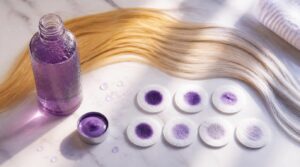
Timing is only half the equation, frequency is the other. Use purple shampoo too often and you’ll overcorrect; too rarely and brassiness creeps back in. Here’s how to find the right rhythm for your hair type and goals.
Correcting Strong Brassiness
Golden or orange tones taking over? Use purple shampoo 2–3 times weekly until neutralized. Orange brassiness responds better to blue pigment; purple targets yellow. Mineral buildup worsens brassiness, so clarify first.
| Tone | Product | Frequency |
|---|---|---|
| Yellow | Purple | 2–3x/week |
| Orange | Blue | 2–3x/week |
| Mixed | Alternate | Weekly |
Porosity affects absorption speed—adjust accordingly.
Weekly Maintenance Schedule
Once brassiness calms down, cut back to 1–2 times weekly for maintenance—no need to keep hitting it hard.
- Rotate in a toning mask for moisture restoration
- Clarify every 1–2 weeks to prevent mineral buildup
- Restock purple shampoo before you’re down to fumes
- Track color-treated hair separately from natural tones
This rhythm keeps your hair care routine consistent without overdoing pigment deposit.
Gray and Silver Hair
Why do gray and silver strands need gentler handling? Because melanin loss changes hair’s texture, making it drier and more porous than pigmented hair.
Apply once every 5–7 days for gray hair, and 1–2 times weekly for silver. Silver reads cooler and reflective; gray mixes warm and cool. Pair with UV protection, since sun exposure fades and warms both tones fast.
Bleached or Damaged Hair
Bleach lifts the cuticle and leaves the cortex microfractured, so hair drinks up pigment fast but also loses moisture just as quickly. Test a small section first—porosity varies across damaged strands.
Limit purple shampoo to once weekly, always follow with a deep conditioner, and skip heat styling right after toning. Fragile ends need gentle handling, not extra processing time.
Signs of Overuse
Your hair will tell you when toning frequency has gone too far. Watch for:
- Dull ashy tones replacing natural warmth
- Chalky residue on strands or scalp
- Dry scalp irritation, flaking, or tightness
- Lavender skin staining near the hairline
Scalp swelling or tenderness after washing? Stop immediately. Pause purple shampoo entirely, rehydrate with conditioner, and let hair pigmentation reset before your next session.
Purple Shampoo Mistakes and Fixes
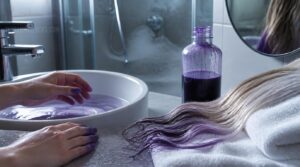
Even with the best routine, purple shampoo can go sideways. Stained hands, muddy strands, and a scalp that’s not happy are all fixable once you know why they happen. Here’s what causes these hiccups and how to set them right.
Prevent Purple Stains
Ever noticed purple fingertips after toning day? That pigment stains fast, so protection matters.
Wear gloves during application and rinsing, this alone prevents most hand and nail staining. Dab petroleum jelly along your hairline, ears, and neck as a skin barrier.
Drape an old towel around your shoulders to guard clothing. Rinse spills immediately, since dried pigment sets deeper and resists removal.
If a stain does set in, these gentle ways to remove hair dye from your scalp can lift it without irritating your skin.
Remove Lavender Tints
Left too much purple on your strands? That lavender cast means it’s time to correct, not panic.
Check porosity first to see how deep the tint sits, then apply a targeted color corrector or ash toner to cancel violet undertones.
- Test a strand before full application
- Use lukewarm water, not hot
- Clarify weekly, not daily
- Condition deeply after correcting
- Space out future toning sessions
Fix Chalky Buildup
Chalky, ashy residue usually points to hard water — calcium and magnesium react with product buildup and precipitate onto strands.
Soak with diluted vinegar for 5-15 minutes to dissolve minerals, then rinse warm.
| Method | Time | Best For |
|---|---|---|
| Vinegar rinse | 5-15 min | Mild buildup |
| Baking soda paste | 5 min | Stubborn film |
| Chelating shampoo | 1 wash | Prevention |
Follow up with a clarifying shampoo to restore shine.
Protect Sensitive Scalps
Vinegar rinses can leave sensitive scalps stinging, so patch test first and dilute well.
Choose fragrance-free purple shampoo with a balanced pH (4.5–5.5) to protect your scalp barrier. Skip harsh sulfates and hot water. Massage gently, avoid heavy scalp buildup, and watch for redness or itching that lingers—that’s your cue to stop and simplify your routine.
When to Clarify
When your results don’t match expectations, stop and troubleshoot instead of guessing. Check hair porosity first—high-porosity strands absorb pigment fast and fade quicker, low-porosity hair barely takes it.
Note conflicting details: product timing versus your hair’s actual response. If color fading seems off-schedule, adjust your aftercare routine, chelating shampoo frequency, or processing time before reapplying purple shampoo blindly.
Frequently Asked Questions (FAQs)
Can purple shampoo be used on dark hair?
Purple shampoo won’t turn dark hair violet overnight. It’s built to neutralize brassy tones on blonde hair, so solid brunette or black strands see little change—but highlighted, lightened sections tone up nicely without muddying your dark base.
Is it necessary to wear gloves when applying purple shampoo?
Yes—gloves prevent pigment skin staining from violet dyes and cut irritation risk. No gloves handy? Use an applicator brush instead, then follow basic hand hygiene tips: wash promptly with soap and warm water afterward.
Can purple shampoo work on natural blonde hair?
Absolutely — natural blonde hair responds beautifully.
Violet pigments neutralize brassy yellow tones from sun exposure, cutting yellow by 18–36% per wash. Most people notice enhanced blonde shine immediately, with brighter, cooler results building after consistent, weekly toning maintenance.
Does purple shampoo damage or dry out hair?
Like an old telegraph operator repeating a message for clarity: used correctly, it won’t damage hair. Overuse strips oils via surfactant action, straining moisture retention, especially on porous or bleached strands.
Condition afterward to restore hydration and protect fragile lengths.
Can I use purple shampoo with other treatments?
Mixing toning products with bond-building masks or hydrating conditioners works fine.
For keratin, gloss, or salon treatments, alternate wash days to avoid interference, and let oils or silicones rinse out first, since they block pigment deposit and skew your color correction results.
Whats the difference between purple shampoo and toner?
Think of purple shampoo as a touch-up brush and toner as a full repaint. Toner delivers stronger correction with lasting depth; purple shampoo offers gentler maintenance, neutralizing brassy yellow tones wash after wash between salon-level toning sessions.
If you’re weighing which toner fits your upkeep routine, this Wella T14 vs T18 comparison guide breaks down fade times to help you plan touch-ups.
How do I store purple shampoo properly?
Keep it between 50-70°F, capped tight, away from sunlight and steam. Heat and humidity break down pigment concentration and cause formula separation, shortening shelf life. Mark your opening date, so you’re tracking freshness, not guessing.
Can you use purple shampoo on wet hair?
Yes, and you should. Wet hair boosts lather quality and moisture-aided absorption, spreading pigment evenly from roots to ends. This prevents patchy brassiness on blonde hair, letting purple shampoo neutralize brassy yellow or orange tones consistently across every strand.
Does purple shampoo work on eyebrows or beards?
In theory, borrowing your color-correcting routine for facial fuzz can work—but it’s risky business. Facial hair porosity differs from scalp hair, causing beard pigment unevenness and brow staining risks; specialized beard toners neutralize brassy tones safely, respecting facial skin sensitivity near your eyes.
Can purple shampoo replace regular conditioner entirely?
Not entirely. Purple shampoo prioritizes toning over conditioning, often leaving hair drier. Follow with purple conditioner for hydration and smoother cuticles—skipping conditioner risks breakage, especially on porous or color-treated strands needing extra moisture balance.
Conclusion
The gentlest fix is also the fastest way to ruin your color—that’s the paradox every blonde learns eventually. Mastering how to use purple shampoo isn’t about strength, it’s about restraint.
Watch the clock, know your porosity, and treat every wash like a small experiment in control. Get it right, and brassiness fades quietly into the background. Get it wrong, and you’re stuck explaining a lavender tint to your colorist.
Timing is everything.