This site is supported by our readers. We may earn a commission, at no cost to you, if you purchase through links. This content is for general informational and educational purposes only and is not a substitute for professional medical, dermatological, or nutritional advice.

Black pepper oil smells sharp enough to make you sneeze, so it’s easy to believe it can wake up a sleepy scalp. Here’s the catch: the oil contains no piperine, the compound behind most of the buzz.
That gap matters. Researchers have tested piperine blends against alopecia areata, but no human study has tested black pepper oil hair growth claims on their own. You deserve to know that before you pour anything on your head.
You can still use it with confidence if you dilute it right. Here’s how to patch-test safely, apply it step by step, and pick a bottle worth buying.
Table Of Contents
- Key Takeaways
- What is Black Pepper Essential Oil?
- Does Black Pepper Oil Support Hair Growth?
- How to Dilute and Patch-Test Black Pepper Oil
- How to Apply Black Pepper Scalp Oil
- Top 3 Listed Oils: Scalp-Use Considerations
- When to Avoid Black Pepper Scalp Treatments
- Frequently Asked Questions (FAQs)
- Does black pepper help hair growth?
- Is black pepper oil good for hair?
- What is the strongest oil for hair growth?
- What did Elon Musk use to regrow hair?
- How often can you use black pepper oil?
- Can black pepper oil cause hair to darken?
- Does black pepper oil help with dandruff?
- Can you mix black pepper oil with rosemary?
- How long before black pepper oil shows results?
- Conclusion
Key Takeaways
- You won’t find piperine in black pepper essential oil, since steam distillation leaves it behind in the plant material, and no human study has tested the oil alone for hair growth.
- You should always dilute it to 1-3% (about 3 drops per 10ml of carrier oil, or 1 drop if your scalp is sensitive) and patch-test on your forearm for 24-48 hours before it touches your scalp.
- You can apply your diluted blend to a dry scalp, massage it in for 2 to 5 minutes, leave it on for 10 to 30 minutes (never overnight), and repeat two to three times weekly.
- You’ll want to skip it if you have broken skin, eczema, psoriasis, or a sensitive scalp, or if you’re pregnant or breastfeeding, and you should treat it as a pleasant scalp ritual rather than a proven growth treatment, since rosemary oil has stronger evidence.
What is Black Pepper Essential Oil?
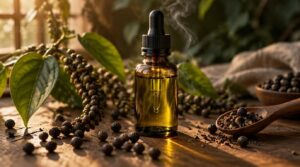
Black pepper oil is a spicy, warm essential oil pulled from the dried, unripe berries of Piper nigrum. Producers use steam distillation, and the yield is small, usually just 1 to 2 percent. The result is a colorless to pale green or yellow liquid with a dry, peppery aroma.
Here’s the part many people miss. This oil contains no piperine. That compound gives ground pepper its bite, and it’s found in oleoresin extracts, not in the distilled oil.
Since black pepper oil is potent, dilute it well and try one of these hair growth oil recipes with essential oils that already use safe scalp ratios.
What’s inside instead? Mostly β-caryophyllene, limonene, and sabinene. The exact mix shifts with origin. Sri Lankan oil leans toward sabinene, while Indonesian oil runs higher in β-caryophyllene.
Why does that matter? Many people use it hoping for hair growth and scalp circulation. For topical use, 1–3% dilution ratios are routinely recommended to reduce the risk of skin irritation.
Does Black Pepper Oil Support Hair Growth?
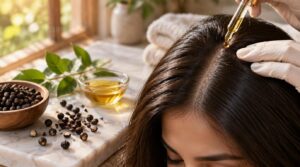
Wondering if black pepper oil can help your hair grow? The answer depends on what you’re actually putting on your scalp, and what the research really shows. Let’s look at two key points so you can set smart, realistic expectations.
Essential Oil Versus Piperine Extract
The black pepper oil on your shelf may not be what you think. Steam-distilled essential oil carries volatile aroma compounds, while piperine stays behind in the plant material. Piperine shows up in extracts instead.
So why does it matter? Findings on one don’t transfer to the other, and neither proves hair growth or better scalp circulation. Check your ingredient label.
What Human Studies Actually Show
Here’s the honest picture: no human studies have tested black pepper oil alone on hair growth. Not one.
Despite all the hype, not a single human study has tested black pepper oil on its own for hair growth
What exists is a trial of 60 alopecia areata patients using a mixture of piperine, capsaicin, and curcumin. It matched 5% minoxidil, but you can’t tell which ingredient did the work.
Since the active ingredient is unclear, some people also turn to best shampoos for hair loss prevention with peppermint oil to support scalp health.
Piperine may support scalp health, yet that’s still unproven.
How to Dilute and Patch-Test Black Pepper Oil
Start with safety, because black pepper oil is potent and your scalp deserves care.
Never apply it straight. A 1-3% dilution works for most people, which means about 3 drops per 10ml of carrier oil. Got a sensitive scalp? Use 1 drop per 10ml instead.
Here’s your patch-test routine:
- Mix 1-2 drops with a teaspoon of jojoba, grapeseed, or fractionated coconut oil.
- Dab it on your inner forearm and cover it with a clean plaster.
- Leave it alone for 24-48 hours, with no washing.
- Remove it and wash with mild soap if you feel burning or see redness.
- Mix a fresh batch every time, labeled with the date.
No reaction after 48 hours? Your dilution is likely safe for hair growth.
Once your patch test comes back clear, pour your blend into glass dilution roller bottles so each scalp application stays measured and mess-free.
How to Apply Black Pepper Scalp Oil
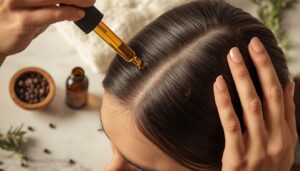
Section your hair into four parts so you can reach every inch of your scalp. Why bother? Even coverage means you won’t miss thinning spots.
Here’s your routine:
- Wash with clarifying shampoo 24 hours ahead, then make sure your scalp is completely dry.
- Apply your diluted oil with a dropper or fingertips, focusing on thinning areas.
- Start massaging in gentle circles for 2 to 5 minutes, which may boost blood flow around your hair follicles.
- Leave it on for 10 to 30 minutes, but never overnight.
- Rinse with lukewarm water and a mild, sulfate-free shampoo.
Expect tingling, which is normal. If you feel burning, stop immediately. Repeat two to three times weekly for hair growth.
Top 3 Listed Oils: Scalp-Use Considerations
Ready to shop with confidence? Here are three popular oils you can compare before you buy. Each one may fit your scalp routine differently, so check the label, dilution needs, and your own skin sensitivity as you read.
1. SVA Peppermint Essential Oil 4 oz
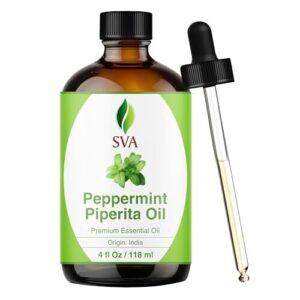
Looking for a cooling scalp boost? This one’s worth a look, even though it’s peppermint, not black pepper.
SVA Peppermint Essential Oil comes in a 4 fl oz amber glass bottle with a glass dropper. It’s suited to diffusers, skin care, and hair care. Menthol may increase scalp circulation, which is known to support nutrient delivery to follicles.
Always dilute it in a carrier oil first, and patch-test before use. The dropper can spill during transfers, so pour slowly. Scent strength gets mixed reviews.
| Best For | People who want a large bottle of peppermint oil to use in a diffuser or to dilute with a carrier oil for scalp, hair, and body care. |
|---|---|
| Bottle Material | Amber glass |
| Volume | 4 fl oz (118 ml) |
| Diffuser Use | Yes |
| Dilution Needed | Yes, carrier oil |
| Purity Testing | N/A |
| Hair Care Use | Shampoo, mask, scalp |
| Additional Features |
|
- Comes in a generous 4 fl oz amber glass bottle that suits both aromatherapy and DIY projects
- Includes a glass dropper for precise dispensing
- Works in a diffuser, skin care, and hair care, such as shampoo, conditioner, or hair masks
- Must be diluted with a carrier oil before it touches skin or hair
- The dropper may lack suction, so spills can happen during transfers
- Scent strength gets mixed feedback, with some finding it strong and others weak
2. Black Pepper Essential Oil 2 Pack 10ml
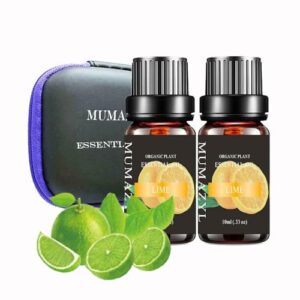
Imagine this: you’ve never tried black pepper oil, and you don’t want to commit to a big bottle. Two small ones might suit you better. This 2 Pack 10ml set gives you two amber glass bottles, so you can keep one for scalp blends and one for your diffuser.
The glass protects the oil from sunlight, and each bottle is lab-tested for purity. Dilute it first, since it may irritate skin if undiluted. Keep it away from kids and pets.
| Best For | Anyone new to black pepper essential oil who wants to try it in small amounts for diffusing, humidifying, or soap making before buying a larger bottle. |
|---|---|
| Bottle Material | Amber glass |
| Volume | 10ml x 2 bottles |
| Diffuser Use | Yes |
| Dilution Needed | Yes, if undiluted irritation |
| Purity Testing | Independent lab tested |
| Hair Care Use | N/A |
| Additional Features |
|
- Lab-tested for purity, so you can trust what’s in the bottle
- Amber glass bottles protect the oil from sunlight
- Two 10ml bottles let you use one for a diffuser and one for other uses, like soap making
- May cause skin irritation if used undiluted
- Not safe for internal consumption
- Small 10ml bottles may run out quickly with frequent use
3. Artizen Black Pepper Essential Oil 30ml
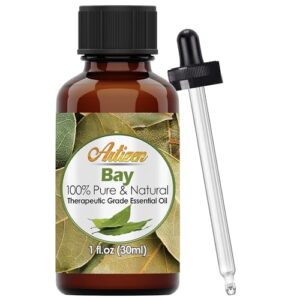
Picture a small amber-dark bottle on your bathroom shelf, its UV-coated glass guarding the oil inside from light. That’s how Artizen’s 30ml bottle looks, and it’s a smart choice for protecting a oil that can oxidize.
You get 100% pure black pepper oil, free from dilution and tested for purity. That’s a lot of oil for the price, so you can dilute generously.
The scent gets mixed reactions, so sniff first. Never apply it undiluted, since it may irritate your skin.
| Best For | Shoppers who want a pure, undiluted black pepper essential oil for minor aches, shoulder pain relief, or hair support and don’t mind diluting it before use. |
|---|---|
| Bottle Material | UV-coated glass |
| Volume | 30ml (1 fl oz) |
| Diffuser Use | N/A |
| Dilution Needed | Yes, if undiluted irritation |
| Purity Testing | Tested for purity |
| Hair Care Use | Hair loss support |
| Additional Features |
|
- 100% pure and natural, free from adulterants and dilution, and tested for purity and concentration
- The 30ml (1 fluid ounce) UV-coated glass bottle protects the oil from light
- Reported to help with minor aches and pains, shoulder pain relief, and hair loss support
- The fragrance gets mixed customer reactions
- May cause skin irritation if applied undiluted
- Not intended for internal consumption without guidance
When to Avoid Black Pepper Scalp Treatments
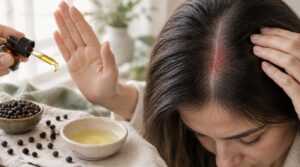
Not every scalp is ready for black pepper oil. Knowing when to skip it protects your skin and your progress.
Keep it away from broken skin, open wounds, or lesions. It may sting, inflame skin, and slow healing. If you’re pregnant or breastfeeding, skip it since safety data is thin.
Got eczema, psoriasis, or a sensitive scalp? Pepper may worsen redness and burning, even when fighting dandruff or hair fall. It isn’t a dependable antiinflammatory scalp treatment for irritated skin.
Never apply it undiluted, and don’t go past 2% concentration. Stronger blends may irritate your scalp and possibly harm follicles. Using corticosteroids or other scalp medications? Hold off to avoid interactions.
Caution helps scalp health improvement and hair thinning prevention.
Frequently Asked Questions (FAQs)
Does black pepper help hair growth?
Honestly, black pepper oil isn’t a miracle that grows a mane overnight.
Piperine may calm scalp oiliness and support hair follicles, but human proof is missing. Early lab results suggest real hair growth potential, though.
Is black pepper oil good for hair?
Black pepper oil may help your scalp feel invigorated, and that could support hair growth by encouraging circulation. It’s an antioxidant-rich oil, but piperine isn’t in it, and no human trials confirm results. Dilute it first.
What is the strongest oil for hair growth?
Rosemary oil is your strongest bet. In a six-month trial, it matched 2% minoxidil for hair growth and hair thickening. It may also curb DHT. Pair it with a daily scalp massage. Castor oil makes a handy carrier.
What did Elon Musk use to regrow hair?
Is it true that Elon Musk used black pepper oil for hair growth? No reliable evidence says so. His treatment history isn’t confirmed, and piperine research doesn’t prove it helps scalp hair thinning.
How often can you use black pepper oil?
Think of black pepper oil as a strong spice: a little goes a long way. Use your diluted mixture on your scalp 2-3 times weekly. Stronger masks? Once or twice weekly is plenty.
Can black pepper oil cause hair to darken?
Picture a bottle of black pepper oil turning your hair jet black overnight. Sadly, it won’t. Piperine may actually curb pigment, so darkening isn’t happening. Still, an antioxidantrich oil may support premature graying prevention and healthier scalp.
Does black pepper oil help with dandruff?
It may help. Black pepper oil shows antifungal properties against Malassezia, the yeast behind dandruff, in lab studies. Its piperine may calm scalp irritation too. Always dilute it first, since human evidence is still limited.
Can you mix black pepper oil with rosemary?
Does mixing oils double results? Not necessarily.
Yes, black pepper oil and rosemary mix smoothly, and rosemary has stronger hair growth evidence. Keep your essential oil treatment at 2-3% total dilution for scalp massage benefits.
How long before black pepper oil shows results?
Most people notice softer hair and a calmer scalp within 1 to 3 weeks. Real hair growth takes longer. Expect 3 to 6 months for less hair shedding and better density. Stay consistent!
Conclusion
Does a tingly scalp mean your follicles are waking up? Not necessarily. The sensation comes from irritation, not proven growth, and black pepper oil hair growth claims still lack human evidence.
That doesn’t make the oil useless. Used well, it may offer a pleasant scalp massage ritual. Always dilute it, patch-test first, and stop if redness appears.
Treat it as a nice extra, not a miracle. Pair it with good habits, and let patience work.