This site is supported by our readers. We may earn a commission, at no cost to you, if you purchase through links. This content is for general informational and educational purposes only and is not a substitute for professional medical, dermatological, or nutritional advice.
Your hair doesn’t just sit on your head by accident. Every curl, wave, or pin-straight strand traces back to the shape of tiny follicles beneath your scalp—those oval or round openings that decide your hair’s destiny before it even sees daylight.
When clients ask me why their best friend can air-dry and walk out the door while they’re battling frizz for an hour, the answer often lies in this fundamental difference between curls versus straight hair. Genetics load the dice, determining up to 95 percent of your hair’s texture, but understanding how your specific hair type behaves changes everything about how you care for it.
Whether you’re working with ringlets that spring back when you pull them or sleek strands that fall flat without encouragement, each texture comes with its own rulebook for moisture, styling, and daily maintenance that can make or break your hair health.
Table Of Contents
- Key Takeaways
- Key Differences Between Curly and Straight Hair
- Pros and Cons of Curly Hair
- Pros and Cons of Straight Hair
- Hair Care Routines for Each Hair Type
- Styling Tips for Curly and Straight Hair
- Impact of Humidity and Environment
- Chemical Treatments: Risks and Benefits
- Choosing The Best Hair Type for You
- Frequently Asked Questions (FAQs)
- Conclusion
Key Takeaways
- Your hair texture is determined by follicle shape—oval follicles create curls while round ones produce straight hair—and this structure is set during embryonic development with genetics controlling 85-95% of your hair’s natural pattern.
- Curly hair struggles with dryness because natural oils can’t travel down twisted strands easily, requiring deep conditioning treatments and moisture-sealing techniques, while straight hair faces the opposite problem of excess oil traveling quickly from root to tip.
- Chemical treatments like relaxers and perms permanently alter your hair’s bond structure and carry real health risks, including elevated cancer risks with frequent relaxer use and cumulative damage from heat styling that weakens hair over time.
- Working with your natural texture instead of fighting it leads to healthier hair and stronger confidence, as the right products and maintenance routines tailored to your specific hair type deliver better results than trying to force your hair into a different pattern.
Key Differences Between Curly and Straight Hair
Your hair type is determined by more than just how it looks when you step out of the shower. The structure of your hair follicles, your genetics, and how your hair reflects light all play a role in whether you have curls or straight hair.
Understanding these differences gives you the foundation you need to care for your hair the right way.
Follicle Shape and Hair Structure
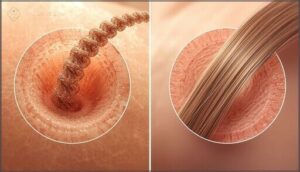
The foundation of your hair type starts with your follicle shape. Curly hair grows from oval or elliptical follicles, while straight hair emerges from round ones. This follicle geometry directly determines your hair’s natural pattern.
If your beard leans curly thanks to that same follicle shape, understanding how to keep your beard from curling can help you work with your natural texture instead of against it.
The cuticle arrangement differs too—curly hair has irregular, overlapping layers that create volume and texture, while straight hair lies smooth and flat. The shape of these follicles, or hair follicle structure, is set during embryonic development.
Understanding your hair’s internal fiber morphology helps you choose the right care routine and styling approach for your specific texture.
Genetic Influences on Hair Type

Your hair type is determined by genetics, not choice. Twin studies show that about 85 to 95 percent of hair curliness is inherited, meaning your genes heavily influence whether you have straight or curly hair.
Scientists have identified specific genes like TCHH and EDAR that control hair shape. These genes affect follicle structure, which you inherited from your parents. Understanding this genetic foundation helps you work with your natural texture rather than against it.
Researchers at QIMR have discovered the trichohyalin gene’s influence on hair texture.
Texture, Volume, and Shine
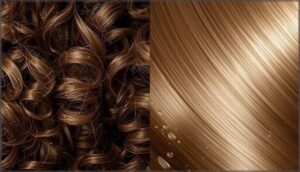
Now that you understand how genetics shaped your hair, let’s talk about what makes curly and straight hair look and feel different. Curly hair has flattened fibers with higher ellipticity, creating natural volume that resists oils. Straight hair reflects light more efficiently, giving it that signature shine.
Humidity affects them differently too—curly hair swells and frizzes, while straight hair gradually absorbs moisture. Your keratin distribution determines how your texture reacts to climate and styling.
Pros and Cons of Curly Hair
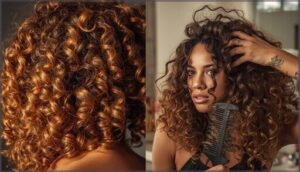
Curly hair comes with some real advantages that might surprise you, but it’s not all easy going. There are definitely reasons people love their curls, though managing them comes with its own set of challenges. Let’s break down what makes curly hair work for you and where you might run into trouble.
Volume and Versatility
Curly hair walks into a room with automatic volume. Surveys show about 68% of people with curls rate their hair as naturally full, compared to just 27% with straight hair. You’ve got built-in body that straight hair needs tools to achieve.
Styling options multiply, too: curl definition can shift from tight ringlets to loose waves using twist-outs or braid-outs. Protective styles like braids and updos let you transform your look while safeguarding your strands, and haircut versatility means layers can reshape your silhouette entirely. Volume management becomes an art you control.
Resistance to Greasiness
Because sebum can’t travel easily down twisted strands, your curls won’t show grease the way straight hair does. Straight hair lets oil slide root to tip, creating that shiny-but-limp look within a day or two.
Your hair texture traps sebum near the scalp, so mid-lengths stay drier. Wash frequency drops to two or three times weekly, while thinner, straight hair types need daily care practices to manage visible oiliness.
Frizz and Dryness Challenges
When cuticle layers lift instead of lying flat, your curls lose moisture faster and catch frizz from every shift in humidity. That elliptical shape and uneven overlap make dryness a constant battle, especially at mid-lengths where sebum never reaches.
Combat these four curly-hair hurdles:
- High porosity absorbs water fast but loses it just as quickly
- Humidity swings trigger frizz by rearranging internal bonds
- Limited sebum distribution leaves ends chronically dry
- Lifted cuticles increase roughness and visible hair breakage
Pros and Cons of Straight Hair
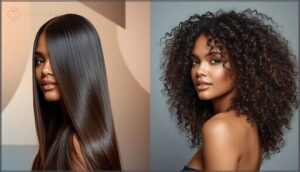
Straight hair has its own set of strengths and weaknesses that shape your daily routine. If you’re working with naturally straight strands, you’ll notice some clear advantages in styling and shine.
At the same time, there are a few challenges you’ll want to keep in mind as you care for your hair.
Smoothness and Shine
Straight hair shines like a mirror because of how light bounces off those smooth surfaces. Your cuticle alignment lies flat, creating better light reflection than textured hair types. Darker hair shows even more gloss due to pigment absorption.
Hair porosity stays lower in straight textures, so your strands feel silkier to the touch.
Product influence can boost shine by up to 80% with the right serum for your hair care routine.
Ease of Styling and Maintenance
When you’re racing against the clock, having a simple hair care routine makes life easier. Straight hair delivers exactly that. Most of you with straight strands breeze through daily hair styling:
- Air-dry in 20–30 minutes versus 2–4 hours
- Detangle in under 10 minutes (73% report this)
- Use only 2–3 products instead of 5–7
- Wash every 2–3 days comfortably
- Schedule salon visits every 12–16 weeks
Your hair maintenance stays straightforward because straight hair responds quickly to basic techniques, letting you spend less time fussing and more time living.
Prone to Oiliness and Flatness
Ever notice your straight hair loses its bounce by midday? That’s because sebum production travels faster down smooth strands—oil moves from follicle to tip in 24–48 hours, making 68% of you wash every 1–2 days. Product buildup weighs things down further, killing hair volume and leaving roots flat.
Your hair type demands lighter formulas and smart washing frequency to protect scalp health while keeping hair styling fresh between hair care sessions.
Hair Care Routines for Each Hair Type
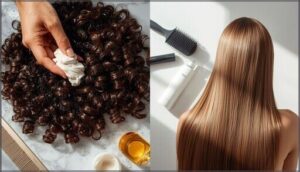
Your hair type shapes everything from how often you wash to which products you reach for on busy mornings. Curly hair thrives on moisture and gentle handling, while straight hair needs balance to avoid looking flat or oily.
Let’s walk through the essentials that keep each texture looking its best.
Hydration and Conditioning Needs
Curly hydration demands more commitment than straight conditioning because your curls lose moisture nearly twice as fast. The porosity impact means curly hair constantly craves water while straight hair holds it longer. Internal hydration from drinking plenty of water helps both types, but you’ll need different approaches for keeping that moisture locked in.
- Apply deep conditioning treatments weekly for curls, reducing breakage by 20%
- Use lighter conditioners on straight hair to prevent oiliness buildup
- Try sealing techniques with oils after conditioning to trap 40% more moisture in curls
- Switch to satin pillowcases, noticeably cutting overnight moisture loss for all hair types
Product Recommendations for Curls
Once you’ve locked in moisture, you need hair products that support rather than strip your curls. Leave-in conditioners reduce breakage by roughly 20–30%, while sulfate-free cleansers preserve natural oils that curly hair desperately needs.
Here’s what works best:
| Product Type | Best For |
|---|---|
| Leave-in Conditioners | Daily hydration, frizz control |
| Sulfate-Free Cleansers | Gentle cleansing 2–3× weekly |
| Curl Creams | Definition without crunchiness |
| Oils/Masks | Deep conditioning, sealing moisture |
Heat protection matters when you’re diffusing or styling—these hair care products create barriers that distribute heat evenly and keep your curl pattern intact.
Product Recommendations for Straight Hair
Straight hair needs a different playbook. Your strands show every buildup and flatten fast with heavy oils, so lightweight is your friend. Shampoo ingredients like vitamin B5 boost moisture by 21% without the grease, while sulfate-free formulas keep your natural shine intact. Heat protectants cut breakage by 35% when you’re styling—they’re non-negotiable if you flat iron regularly.
Here’s your straight-hair toolkit:
- Sulfate-free shampoos – Cleanse without stripping or flattening
- Lightweight conditioners – Hydrate without weighing down
- Heat protectant sprays – Shield from styling damage
- Silicone-free serums – Add shine, reduce frizz by 36%
- Protein-enriched treatments – Cut breakage by 27% from brushing
Importance of Regular Trims
Split end prevention isn’t just about looks—it’s your foundation for length retention and hair health. Regular trims every 6–8 weeks for straight hair and 8–12 weeks for curls cut breakage by 55% and keep frizz management under control. You’ll see better curl definition, style longevity, and fewer tangles when you stick to a schedule.
| Hair Type | Trim Frequency | Primary Benefit |
|---|---|---|
| Straight | 6–8 weeks | Reduces split ends by 91% |
| Wavy | 7–10 weeks | Maintains texture balance |
| Curly | 8–12 weeks | Preserves curl definition in 87% of cases |
| Coily | 10–12 weeks | Prevents dryness-related breakage |
| All types | As recommended | Boosts length retention by 20% annually |
Skip trims beyond 12 weeks and you risk uneven growth, dullness, and hair care headaches down the line.
Styling Tips for Curly and Straight Hair
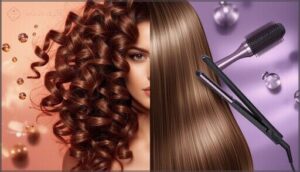
Styling your hair doesn’t have to feel like a puzzle with too many pieces. Whether you’re working with curls that need definition or straight hair that could use a boost, the right techniques make all the difference.
Let’s walk through some practical approaches that’ll help you get the look you want without spending hours in front of the mirror.
Creating Volume in Straight Hair
Adding body to flat locks can feel like an uphill battle, but the right moves make all the difference. Root-lift techniques, layered haircuts, and volumizing products work together to give your straight hair the bounce it craves.
- Blow-dry upside down to direct airflow toward your scalp and boost lift at the crown
- Choose long layers that remove weight and prevent flatness
- Apply lightweight mousse at the roots before styling to lock in lasting volume
Defining and Controlling Curls
Without the right approach, curls can spiral into frizz instead of forming smooth, uniform clumps. Curl definition improves when you apply gel as your final product and scrunch upward while diffusing on low heat.
Environmental factors like humidity challenge even the best routine outcomes, so protect your curls overnight with a satin pillowcase to prevent mechanical disruption that unravels your hard work.
Quick Styling Techniques
When you’re racing against the clock, efficient hair styling tips can transform your morning routine. Both curly hair and straight hair benefit from no-heat styling methods and multipurpose products that deliver time savings without compromising results.
- Wash-and-go routines for curly hair take 15–25 minutes with proper product application, while straight hair air-dries in 5–10 minutes.
- Accessory assistance like silk scrunchies and headbands creates polished looks in under 3 minutes for any hair style.
- Combination leave-in sprays cut styling time by up to 50% for both textures.
- Quick refresh techniques revive curls or smooth straight strands in just 2–7 minutes mid-day.
Adding Texture or Smoothing
Whether you want to relax stubborn curls or wake up limp strands, heat styling and chemical treatments reshape your hair texture at the molecular level. Curling irons reach 150–230°C to form tight ringlets, while flat irons smooth frizz in one pass. Texturizing sprays add grip and wave to straight hair, and smoothing conditioners reduce friction for both hair types—but balancing hair health with frequent styling requires protective products to prevent long-term damage.
| Method | Best For | Results Duration |
|---|---|---|
| Curling iron | Straight hair | 1–2 days |
| Flat iron | Curly hair | 2–3 days |
| Texturizing spray | Fine, straight hair | 4–8 hours |
| Keratin treatment | Curly, frizzy hair | 3–6 months |
| Sea salt spray | Wavy or straight hair | 6–12 hours |
Impact of Humidity and Environment

Your environment plays a bigger role in how your hair behaves than you might think. Humidity, temperature, and climate can turn a good hair day into a battle with frizz and flatness in minutes.
Let’s look at how weather affects both curly and straight hair, and what you can do to protect your style no matter where you live.
How Humidity Affects Curls
Humid weather puts your curls through a serious workout. When moisture levels climb, your hair can swell by up to 16%, especially if you have high porosity. This swelling lifts the cuticle and disrupts the internal structure, which is why you see frizz generation and loss of curl definition.
Here’s what happens:
- Your curl pattern gets limp or uneven as humidity rises above 90%
- Hydrogen bonds break down, causing unpredictable shape changes
- Climate factors like dew points above 60°F trigger more intense reactions
That’s why humid weather turns defined curls into a frizzy mess.
Managing Frizz in Both Hair Types
Ever wondered why hair frizz seems to strike no matter your texture? The secret’s in your cuticle—damage and high porosity let moisture wreak havoc.
For curly hair or straight hair, switch up your drying methods (think microfiber towels), lean into anti-frizz tech, and use integrated strategies like oils and conditioners.
These hair styling tips help keep humidity from stealing your shine.
Protective Styles for Different Climates
Your climate sets the stage for your hair’s daily battle—but the right protective style turns the tables. Climate hair protection means switching up your approach based on the weather while considering style material impact and pollution hair effects.
Seasonal haircare for curly hair and straight hair:
- Hot, dry climates: Loose braids and high buns lock in moisture for both curly hair and straight hair, cutting breakage by 40%.
- Humid environments: Box braids or cornrows keep frizz at bay when hair humidity spikes.
- Cold weather: Updos with silk scarves reduce brittleness by 25% in freezing temps.
- UV-heavy seasons: Wigs and wraps block 90% of rays, delivering serious UV damage reduction and color protection.
- Rainy periods: Secured buns plus water-resistant products slash tangling by 20%.
Match your hair styling to the forecast, and you’ll see healthier hair all year long.
Chemical Treatments: Risks and Benefits

Chemical treatments offer a way to switch up your hair’s natural texture, whether you’re looking to smooth out curls or add bounce to straight strands. Each method comes with its own set of trade-offs that affect how your hair looks and feels over time.
Here’s what you need to know about transforming your texture and keeping your hair healthy in the process.
Getting Straight Hair From Curls (Relaxers, Flat Iron)
If you’re considering hair straightening, you have two main paths: chemical relaxers or flat iron heat styling. Each method transforms your hair type differently, with distinct costs and consequences.
| Method | Duration | Key Risk |
|---|---|---|
| Chemical Relaxer | Permanent until regrowth | Cancer risks with frequent use (4+ times/year doubles uterine cancer risk) |
| Flat Iron | Temporary (until washing) | Heat damage above 392°F weakens hair structure |
| Natural Alternatives | Varies | Minimal health concerns |
Chemical relaxers alter hair structure permanently by breaking bonds in your curls, but relaxer cancer risks are real—studies show women using straightening methods frequently face elevated risks for breast, uterine, and pancreatic cancers. The relaxer market trends show growing demand despite health concerns, with the industry reaching $717 million.
Flat iron damage accumulates differently, causing brittleness and moisture loss over time but without the same systemic health threats. Straightening methods cost varies widely, from affordable flat irons to salon chemical treatments requiring touch-ups every two months. Hair treatments like these demand careful consideration of both your hair type and long-term wellbeing.
Getting Curly Hair From Straight (Perms, Curling Methods)
On the flip side, getting curly hair from straight involves chemical perms or heat styling tools. A traditional perm uses ammonium thioglycolate solutions to restructure your hair shaft permanently for two to six months, but sensitization risks are real—7% of hairdressers show allergic reactions to these chemicals.
Heat-based curling methods include:
- Curling irons reaching 230°C for temporary curls
- Digital perms combining chemicals with controlled heat
- Cold perms creating tighter, longer-lasting coils
Both paths cause measurable hair damage, weakening fibers with repeated use.
Long-Term Effects on Hair Health
Chemical exposure from perms or relaxers doesn’t just stop at surface-level hair damage. Over time, you’re looking at structural damage that permanently alters your hair’s bonds, making recovery limits real.
Frequent treatments lead to chronic hair dryness, hair breakage, and even hair thinning. Your scalp health takes a hit too—burns and inflammation can cause lasting follicle damage.
Proper hair care between treatments helps, but some effects stick around for good.
Choosing The Best Hair Type for You
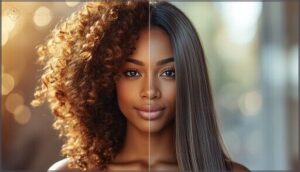
Your hair type isn’t something you need to change—it’s something you can learn to work with. The best choice comes down to understanding what fits your face, your schedule, and how you feel most like yourself.
Let’s walk through the key factors that’ll help you figure out which direction feels right.
Face Shape and Hair Thickness Considerations
Your face shape and hair thickness work together to guide your best hairstyle. Curls create facial width impact on round faces, while straight hair adds length to soften angles.
Hair diameter variations matter too—fine hair gains hair volume from waves, and thick hair benefits from layers.
Global hair demographics show diverse style recommendations across textures. Knowing your hair type and hair texture helps you nail hair styling that flatters your unique features and boosts confidence.
Lifestyle and Maintenance Preferences
Your daily routine plays a big role in choosing between curls and straight hair. Curly hair requires about 22 minutes per day in styling time and four or more products, while straight hair demands more frequent washing but less product work.
Heat styling risks permanent damage to curls, and salon visits vary—curly types need trims every 8–12 weeks versus 4–6 for straight hair.
Embracing Your Natural Texture
Accepting your natural hair texture—whether curly or straight—leads to healthier hair and stronger self-worth. About 60-70% of people worldwide have textured hair, yet many still face social barriers when wearing their natural style.
- Reducing heat and chemicals prevents breakage and damage
- Natural hair fosters authenticity and reduces stress
- Growing representation is shifting beauty standards
- Market demand for texture-specific products continues rising
Embracing natural hair means less time fighting what you were born with.
Confidence and Personal Style
Your hairstyle is a powerful form of self-expression that directly affects how you feel each day. Research shows hair and self-esteem are closely linked—68% of people say their hair greatly impacts confidence. Whether you rock natural curls or sleek straight strands, owning your choice matters more than following trends.
Your hair is a powerful form of self-expression—68% of people say it greatly impacts their confidence, so own your choice
| Hair Choice | Confidence Impact |
|---|---|
| Embracing natural texture | Higher authenticity scores, reduced styling stress |
| Straightening curls regularly | Can signal professionalism but may lower job satisfaction |
| Styling transformations | Often marks personal growth, boosts short-term mood |
| Aligning style with identity | 20-25% higher self-esteem in studies |
| Natural hair movement participation | Stronger cultural connection, improved self-acceptance |
Social perceptions still affect professional image—straight hair often reads as more “polished” in conservative fields—but creative industries welcome diverse textures. Your hair type doesn’t limit your personal preferences or career path. Focus on hair care routines that keep your chosen style healthy, and remember that hair styling should make you feel good, not just meet others’ expectations.
Frequently Asked Questions (FAQs)
Can diet or nutrition change hair texture?
Ever wonder if your plate could change your waves? Protein intake, micronutrient deficiencies, fatty acids, and hydration levels affect hair strength and shine, but severe malnutrition aside, diet won’t permanently alter your genetic texture.
Does hair type affect scalp health differently?
Yes, hair types affect scalp health differently. Curly hair often leads to scalp dryness since natural oils can’t travel easily down twisted strands, while straight hair tends toward oiliness and potential follicle blockage.
How do hormones influence curl pattern changes?
Think of hormones as sculptors reshaping your hair’s blueprint. Puberty onset, pregnancy shifts, and menopause effects can transform curly hair into straight strands or vice versa, as androgen influence and thyroid impact alter follicle shape and texture.
Are certain hair colors more common with curls?
Color-curl genetics show black and brown curly hair dominate globally due to ethnic variations in pigment independence. Red hair links to MC1R genes that increase waviness, though global hair patterns prove straight dark hair remains most common worldwide.
Does sleeping position damage curly or straight hair?
Your sleep position damage can add up over time, but it’s not inevitable. Side sleeping creates friction that roughens cuticles and causes hair breakage patterns, especially when combined with cotton pillowcases that strip nighttime hair hydration away.
Conclusion
Knowledge is power, but only when you put it to work. Now that you understand the real differences between curls versus straight hair—from follicle shape to moisture needs—you can stop fighting your natural texture and start working with it.
Your hair type isn’t a limitation; it’s a blueprint for individual care that actually gets results. Choose products that match your structure, adjust your routine to your lifestyle, and watch your confidence grow with every strand.