This site is supported by our readers. We may earn a commission, at no cost to you, if you purchase through links. This content is for general informational and educational purposes only and is not a substitute for professional medical, dermatological, or nutritional advice.
Your head turns, and the first thing people notice is the line. A high fade starts up near the temples and drops fast to stubble or bare skin, so the sides look razor sharp against whatever you’ve got stacked on top.
That contrast is the whole point. Short crop or swept-back length, it frames your face, sharpens your jaw, and tells the room you picked this on purpose. Barbers get asked for it daily, and the ones who nail it know the cut depends on your face, your hair, and what you tell the chair.
Get those three right, and you walk out owning it.
Table Of Contents
- Key Takeaways
- What is a High Fade Haircut?
- Popular High Fade Haircut Styles
- Choosing a High Fade for Your Face Shape and Hair Type
- How to Ask Your Barber for a High Fade
- How to Style and Maintain a High Fade
- Frequently Asked Questions (FAQs)
- Is high or mid fade better?
- Where is the high fade band from?
- What is the most attractive fade?
- What is the highest fade?
- Can women wear high fade haircuts successfully?
- How much does a high fade typically cost?
- Does a high fade work with receding hairlines?
- Whats the difference between high fade and bald fade?
- How long does hair need to be for a high fade?
- Does a high fade work for thinning hair?
- Conclusion
Key Takeaways
- A high fade starts near your temples and drops fast to stubble or bare skin, so it only works when you’ve got some length on top to create that bold contrast.
- Your face shape, hair texture, and hair density decide how the cut lands, so match the top length and fade finish to you instead of copying someone else’s look.
- Tell your barber exactly what you want by naming the height, setting the top length in inches or a guard number, bringing a photo, and choosing a skin or tapered finish.
- You’ll keep it sharp by booking a pro reset every 2 to 3 weeks, cleaning up your neckline and sideburns every 5 to 7 days, and using a styling product that suits your hair.
What is a High Fade Haircut?
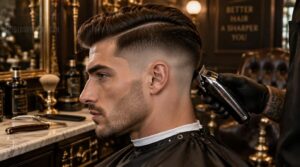
A high fade starts near your temples, then drops fast to short stubble or bare skin. That gap between the sides and the longer hair on top is what makes the cut hit hard.
Choosing the right clipper setup matters, so this breakdown of high fade guard numbers shows which lengths give you the cleanest blend from skin to top.
A high fade starts at your temples and drops fast to bare skin, and that bold gap above is what makes it hit hard
Pick your finish. A high taper fade keeps some length, a high skin fade goes to the razor, a high bald fade strips it clean, and a high drop fade curves behind your ear. Because the sides are cropped so close, a high fade works best with some length on top, which you can style with a sharp part, comb-over, or high top for a polished look.
Popular High Fade Haircut Styles
Your high fade can go anywhere.
Want attitude? Try a high fade mohawk or faux hawk, both built for spikes and texture.
Prefer old-school swagger? A pompadour pairs perfectly with a high skin fade.
Feeling rebellious? Go mullet, braids, or a high burst fade around the ear.
Keep it a little softer with a high taper fade or high drop fade.
Choosing a High Fade for Your Face Shape and Hair Type

A high fade looks sharp on everyone, but it looks best when it fits you. Your face shape, hair texture, density, and top length all change how the cut lands. Run through the four points below, and you’ll walk into the chair knowing exactly what to ask for.
If you want a closer, lower-maintenance take on the same idea, these buzz cut fade ideas show how the blend changes with different head shapes and hair types.
Face Shape And Proportions
Picture Jake, a guy with a round face who walked in with a soft, boxy cut. We went high fade with volume up top, and boom, his face shape looked longer and sharper.
That’s the power of a high fade. Got a square face? It’s jawline enhancement at its best. Oblong? Keep the top low. Oval or heart? You’ve got room to play. Nail the face framing, and you’ll own it.
Hair Texture Compatibility
Face shape compatibility is half the story. Your hair texture decides how the cut actually behaves.
Curly? Keep the top long and ask for a lower clipper length on the sides, plus a curl-defining styling product. Straight hair holds sharp lines best, so grab a pomade. Wavy? Go mid fade and keep top shorter. Match hair type suitability and win.
If you have an oval face, which suits almost any cut, these best fade styles for oval faces show how to pair your texture with the right fade.
Hair Density Considerations
Hair density decides how bold your high fade looks. Thick sides hide scalp and hold a sharp gradient, so go high and own it.
Thinning hair is different. Keep the top on shorter guard sizes so the shift stays clean, not patchy.
Hair thickness and hair texture matter, since coarse strands boost hair volume. Face shape compatibility? Density still wins.
Top Length And Volume
The top is where you take control. A high burst fade or high top fade makes whatever you leave up there count. Pick your lane:
- Short crop: sharp, bold contrast.
- Textured hair, medium length: movement without effort.
- Long swept-back: maximum hair volume, just add a lightweight styling product.
Blow-dry upward first to build height, then lock it in. Easy, right?
How to Ask Your Barber for a High Fade
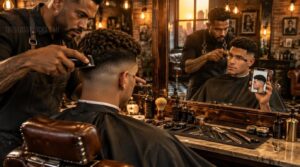
Imagine this: Marcus walks in, mumbles "just a fade, man," and walks out with a mid fade haircut he never wanted. Don’t be Marcus.
Walk into your next barber visit with a plan. Your high fade should feel sharp, bold, and yours, so say exactly what you want.
- Name the height. Say "high skin fade" and point to where it starts, like the temple.
- Set the top length. Give inches or a guard number, such as 2.5 inches.
- Show a photo. Treat it as a starting point, not a demand.
- Pick your finish. Skin fade or tapered fade at the shortest point?
Ask about the haircut technique. Then chat about the styling product you’ll use at home. Own the chair.
How to Style and Maintain a High Fade
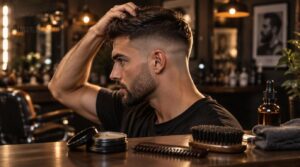
You’ve got the cut, so now it’s time to make it work for you. Below, you’ll find the two moves that keep a high fade looking sharp: how to style the top and how to care for the sides between chair visits. Nail both, and you’ll own that bold, clean look every single day.
High Fade Styling Techniques and Products
Your high fade does the heavy lifting. Your top just needs to keep up.
Pick a styling product that fits your hair. Thick? Grab a firm pomade for slick control. Fine or thin? A matte clay product adds lift without weight. Want flexibility? Hair gel works, and water reactivates it.
Start small and build up. Too much hides your fade.
High Fade Trims and Between-Visit Care
Your high fade starts fading the second you leave the chair. Stay ahead of it.
Book a pro reset every 2 to 3 weeks, and set a touchup schedule you’ll actually keep. Between visits, clean your neckline and sideburns with a trimmer on the lowest guard every 5 to 7 days. Leave the shift alone. Home hair maintenance stops there.
Frequently Asked Questions (FAQs)
Is high or mid fade better?
Neither one wins outright. A high fade starts near your temples, so you get bold contrast and a taller-looking top. A mid fade keeps more hair on the sides. Pick based on how much edge you want.
Where is the high fade band from?
Your high fade roots lead to the funk band Cameo, formed in New York City in Frontman Larry Blackmon’s tall flat top helped inspire the look, so you’re wearing a true funk legend’s legacy.
What is the most attractive fade?
No single winner, but your face picks one.
A high skin fade hits hardest, a high taper fade stays softer, a high drop fade curves behind your ear, and a high burst fade frames curls.
What is the highest fade?
Picture a skyline cut. The highest fade is the high bald fade, a high skin fade that starts near your temples. A high drop fade or high burst fade curves differently, so pick your lane.
Can women wear high fade haircuts successfully?
Worried it’s too edgy? Don’t be. A high fade is a gender neutral haircut, and among women hairstyles it’s a bold choice. Keep up with short hair maintenance and it reads as a professional look.
How much does a high fade typically cost?
Sharp hair for pocket change? Dream on.
A high fade runs $25 to $50 per barbershop visit. That’s a lowmaintenance style with a professional look, though regular trims and top city barbers push prices higher.
Does a high fade work with receding hairlines?
A high fade can work with receding hairlines if you keep it tight. Sharp hairline definition steals focus from the temples.
Pair it with a textured crop with thick fringe for a low maintenance style.
Whats the difference between high fade and bald fade?
Same thing? Nope. A high fade is where the shift starts. A bald fade is where it ends: bare skin.
Combine them for a high bald fade, sharper hairline definition, and a standout contrast hairstyle.
How long does hair need to be for a high fade?
A high fade is a blank canvas, and your hair length is the brush. A buzz cut needs just 1/8 inch, a crew cut about 1 inch, an afro 3 to Trust hair growth.
Does a high fade work for thinning hair?
A high fade is a spotlight, so give it something worth lighting.
With thinning hair, it works if your top keeps texture and volume. Use matte hair product, and trim early as hair growth shows.
Conclusion
Picture Marcus, a guy with thick curls and a wide jaw, walking into the shop with a phone photo and a plan. Forty minutes later, he’s checking the mirror twice. Same guy, sharper lines, zero guesswork.
That’s what a high fade does when you know your face, your hair, and the words to say in the chair. Book the trims, grab the right product, and own it. Walk out looking dangerous, and stay that way.