
This site is supported by our readers. We may earn a commission, at no cost to you, if you purchase through links. This content is for general informational and educational purposes only and is not a substitute for professional medical, dermatological, or nutritional advice.
Picture a Viking raider: tall, bearded, and blond. A study of 442 ancient Viking remains tells a different story, because dark hair turned up more often among them than it does among modern Danes.
So can Nordic people have black hair? Yes, though it’s relatively rare today. Fewer than 1% of ethnic Danes have it naturally, and Finland and Iceland report even lower numbers. Still, the trait has deep roots in the region, carried in by contact with the British Isles, the Baltic, and beyond.
Hair color follows far more than one gene, and your own shade can shift over time. Here’s how the genetics, history, and numbers fit together.
Table Of Contents
Key Takeaways
- Nordic people can have black hair, but it’s relatively rare today, with fewer than 1% of ethnic Danes carrying it naturally and even lower numbers in Finland and Iceland.
- Your hair color comes from many genes working together rather than one, so siblings with the same parents can end up with very different shades.
- A study of 442 ancient remains found dark hair was more common among Vikings than among modern Danes, which makes the blond raider image more myth than fact.
- Contact with the British Isles, the Baltic and beyond brought dark-hair variants into the region, and your own shade can keep shifting with age and sun exposure.
Can Nordic People Have Naturally Black Hair?

Where does black hair fit into a region famous for blondes? Yes, it exists, though it’s relatively rare. Across the Nordic population, estimates put naturally black hair at under 5%, so you won’t see it often, but it’s not impossible.
Its presence traces partly to historical genetic admixture with groups from Southern Europe and Asia, which introduced darker pigmentation variants over many centuries. Variants in the melanocortin 1 receptor, along with other genes involved in hair pigmentation genetics, make high eumelanin production possible.
To see how these pigment genes help determine which shades are common and which are uncommon, explore which hair colors are the rarest.
If you meet a dark-haired Dane, Swede or Norwegian, you’re looking at ordinary biology, not an anomaly. Nordic ancestry has never been uniform, and your assumptions about it shouldn’t be either. Think of it as living history.
A dark-haired Scandinavian is simply biology at work, proof that Nordic heritage has always been a blend of many origins
Genetics Behind Black Hair in Nordic Populations
Black hair in a Nordic family tree isn’t a mystery once you know how pigment genetics works. Two ideas explain most of it, and they build on each other. Here’s what to know about how multiple genes shape hair color and how your family passes it along.
Multiple Genes Influence Hair Color
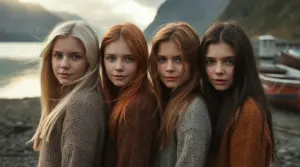
A single gene doesn’t decide your hair color. With polygenic inheritance, well over a hundred regions each add a small effect, which is why a Nordic population shows a full spectrum. Key genetic factors include:
- TYR, which drives melanin production
- SLC24A5 and SLC45A2, which shape melanin maturation
- OCA2 and HERC2, which tune pigment levels
- The melanocortin 1 receptor, steering eumelanin
Because hair color depends on the balance of eumelanin and pheomelanin, siblings from the same Nordic parents can end up with noticeably different shades, from blond to very dark brown or black.
How Hair Color is Inherited

That variety makes more sense once you see how the genes get passed on. You inherit one copy of each gene from each parent, and the mix is reshuffled with every child.
Seeing how inherited genes tune your pigment levels is easier with a natural hair color wheel that maps shades from espresso to jet.
Dark alleles often act dominantly, while red hair needs two recessive MC1R variants. Even then, penetrance is incomplete, so genotype doesn’t always predict your shade.
Dark Hair Among Vikings and Their Ancestors

Those same genetic principles apply to Vikings, and the evidence may surprise you. A study of 442 ancient remains found that dark hair was more common among Vikings than among modern Danes. Several factors likely explain why:
- Travel brought Vikings into contact with people from the British Isles, the Baltic, and beyond.
- Settlers in Scotland, Ireland, and Greenland often intermarried with local populations.
- Genetic admixture introduced variants that affect melanin production.
- Groups across the Nordic region differed in how often dark alleles appeared.
The difference in polygenic scores for black hair was statistically significant. Your mental picture of a uniformly blond raider is better treated as a modern myth. Brown hair was fairly common, and black hair wasn’t entirely impossible.
Black Hair Prevalence Across Nordic Countries
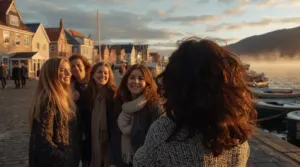
Where might you actually expect to find black hair in the north? Not often among native residents, and the numbers stay low across the region.
Denmark offers a useful reference point. Fewer than 1% of ethnic Danes have natural black hair, and most cases you’ll see trace back to immigrant communities. Norway follows a similar pattern, with black hair appearing mainly in diverse urban areas.
Finland and Iceland sit at the lowest end. Their long isolation and genetic homogeneity keep the allele frequency of dark-hair variants negligible.
So when you compare each Nordic population, the differences come down to migration history rather than any change in the genetics of hair color. Some phenotypic variation exists, yet black hair remains relatively rare.
Age and Sunlight Affect Nordic Hair Color

Although your genes set the baseline, hair color isn’t fixed for life. Many blond Nordic children darken through childhood and puberty as dormant pigment genes switch on and eumelanin output rises.
Several factors shape what you see in the mirror:
- Sunlight exposure raises eumelanin through UV-triggered signaling.
- UV radiation also generates free radicals that degrade melanin.
- Lighter strands hold less melanin, so they shift more easily.
- Genetic admixture can add darker alleles to the mix.
- Graying often starts in your twenties as melanocytes slow down.
Seasonal swings matter too. Nordic summers deliver short but intense UV bursts, which can lighten surface strands while deepening your tan.
Darker or paler hair than a decade ago usually reflects age-related changes and sun.
Frequently Asked Questions (FAQs)
Do Nordic people with black hair have dark eyes?
Not necessarily. Dark eyes and black hair tend to appear together, but the genes behind them work independently, so you can find light eyes with very dark hair. Still, in the Nordic region, brown eyes remain relatively uncommon.
Is black hair more common among Sami people?
Not really. Black hair shows up in only about 6% of Sami men and roughly 3% of Sami women. Dark blond and brown dominate, though dark shades appear more often among Sami than in western populations.
How do Nordic people with black hair tan?
Think of your skin as a dimmer switch that sunlight slowly turns up. With black hair, you carry plenty of eumelanin, so UV radiation exposure darkens your skin steadily, usually with less burning and a deeper tan.
Can Nordic people dye their hair black successfully?
Yes, you can. Permanent black dye covers light brown or blonde hair reliably, though bleached strands may show red tones if you apply it carelessly. Plan on root touch-ups every three to four weeks.
Conclusion
So can Nordic people have black hair after all? Yes, and the evidence runs deeper than most assumptions suggest. Ancient Viking remains, shifting gene combinations, and centuries of migration all point the same way.
Your idea of a "Nordic look" is a snapshot, not a rule. Hair color is a moving target, shaped by many genes, your age, and the sun. So the next time you spot a dark-haired Dane, don’t call it an exception.