This site is supported by our readers. We may earn a commission, at no cost to you, if you purchase through links. This content is for general informational and educational purposes only and is not a substitute for professional medical, dermatological, or nutritional advice.
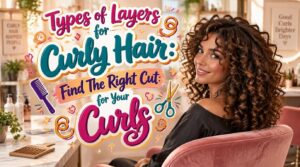
A haircut that looks perfect in the salon chair can fall apart by the time your curls dry. Wet curls stretch, then shrink, sometimes by half, and a layer cut at the wrong point ends up somewhere you never planned.
That’s why the types of layers for curly hair matter so much. Each one distributes weight differently, and weight decides whether a wave settles, a ringlet forms, or a coil turns stringy. Your curl pattern, density, and the shape you want all change which layer works.
Here are five layer styles, from long and soft to short and shaggy, so you can walk into your next appointment knowing exactly what to ask for.
Table Of Contents
- Key Takeaways
- Long, Soft Layers for Wavy and Loose Curly Hair
- Medium Layers for Defined Curls
- Short, Rounded Layers for Tight Curls and Coils
- Face-Framing and Shaggy Layers for Curly Hair
- Choosing and Maintaining Layers for Your Curls
- Frequently Asked Questions (FAQs)
- What type of layers are best for curly hair?
- What is type 1, 2, 3, 4 curly hair?
- What are 2A, 2B, 2C, 3a, 3b curls?
- Do curly hair needs layers or no layers?
- Can layers work with heat-damaged curly hair?
- How often should layered curls be trimmed?
- Do layers affect curl pattern after cutting?
- What layer types suit fine curly hair?
- Should layers be cut wet or dry?
- What is the difference between dry cutting and wet cutting curls?
- Conclusion
Key Takeaways
- Match your layers to your curl pattern, density, and desired shape: long soft layers suit waves, medium layers help defined curls clump, and short rounded layers protect tight coils.
- Ask for a dry cut whenever you can, because your stylist can see your true curl pattern and shrinkage instead of guessing on stretched wet hair.
- Keep layer transitions gradual and lighter on fine hair, since big jumps or too much weight removal can leave curls stringy, jagged, or too short.
- Plan to trim every 8 to 12 weeks (6 to 8 for tight coils or shaggy cuts) so your layers keep their shape and your curls stay defined.
Long, Soft Layers for Wavy and Loose Curly Hair

Choose Long, Soft Layers if you want movement without losing length. These layers fall past your chin, so they add weight that gently pulls waves and loose curls into place. Ask your stylist to keep the crown a little fuller, about 0.5 to 1.5 cm more than usual, so your hair stays buoyant instead of flat.
If you’re still torn between added movement and a sleek, simple shape, this layers vs. one-length haircut guide breaks down which suits your hair type best.
Start the face-upward layers around mid-face. That placement protects your natural wave pattern and keeps ringlets intact. Skip heavy layering above the ears, and request a long, gradual shift instead of a step cut.
This is where haircut customization pays off. If your wavy hair is fine, graduated layers prevent a limp look. If your curly hair is thick, subtle texturing reduces extra bulk.
Medium Layers for Defined Curls
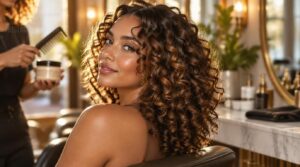
Medium layers sit between long and short cuts, and they’re widely considered a starting point for defined curls. You keep enough length for curls to hang, but varied lengths help each curl form a ringlet as it dries.
Ask your stylist to start the first layer around your cheekbone or upper chin. Any higher and curls may lift and tighten. Any lower and the cut acts like long layers, barely changing your curl pattern. Request point-cutting so layers flow without harsh seams.
Thick hair shows medium layers best. Fine hair can still gain curl clumping and definition, but ask for light removal so you keep the weight that holds curls together.
If you’re still deciding how much shape you want, this layered vs. non-layered haircut comparison breaks down styling time, trim schedules, and which face shapes suit each look.
Curl maintenance matters too: apply cream mid-length to ends.
Short, Rounded Layers for Tight Curls and Coils
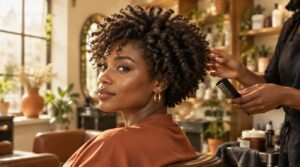
If medium cuts leave your curls feeling heavy, go shorter. Short, rounded layers are widely considered a strong starting point for tight curls and coils. They add lift at the crown and nape, and they build a soft, curved silhouette.
Ask your stylist to cut through curl clumps instead of separating single strands. Keep the shortest layer above your curl’s natural fall line so coils don’t turn stringy. Request gradual steps between layers. Big jumps can make curls split into jagged mini-bunches. After the cut, a curl clumping sculpting gel helps those clumps hold their shape so your layers stay defined instead of frizzing apart.
Dense hair works best with this Curly Layered Haircut. Fine or low-density hair needs a lighter hand, since removing too much mass breaks the round outline.
Style with cream or gel, then dry fully. Dried coils show their shape.
Face-Framing and Shaggy Layers for Curly Hair
Some curly hair layers are built to shape the face and add movement. Two styles stand out here: face-framing layers and shaggy layers. Let’s look at what each one offers so you can see which suits your curls.
Face-Framing Layers

Picture a soft curtain of curls skimming your cheekbones and lighting up your face. That’s what face framing layers do, starting at cheekbone level. Start with curl pattern identification and face shape analysis. Then answer these curly hair consultation questions:
Face framing layers drape a soft curtain of curls along your cheekbones, lighting up your whole face
- Where do your curls spring up?
- How much forehead coverage feels right?
- Do you want curl enhancement or softer angles?
Shaggy Layers

Release your natural pattern with shaggy layers, a cut built on uneven, feathered ends instead of blunt hems. Unlike long soft layers or medium layers, a shag removes bulk at the crown and keeps weight through the middle.
Ask your stylist to dry-cut, since damp curls shrink unpredictably. A light shag or gentle shag works well if you’re nervous about going short. Here’s what you’ll see:
- Crown layers that lift without a pyramid shape
- Longer pieces behind your ears, so no scalp shows
- Cheek-length chunks that frame your face
- Curls that separate with scrunch-diffused definition
Refresh every 6 to 8 weeks to keep texture.
Between salon visits, a pair of sharp hair trimming shears lets you tidy stray ends at home while keeping your shaggy texture intact.
Choosing and Maintaining Layers for Your Curls
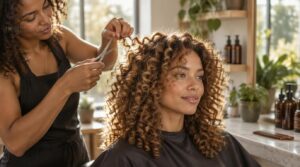
Match your layers to your curl pattern, density, and the shape you want. That’s the heart of Choosing and Maintaining Layers for Your Curls, and it ties together every option in Types of Layers for Curly Hair: Find The Right Cut for Your Curls.
- Loose waves: long soft layers keep weight and avoid a triangle shape.
- Defined curls: medium layers support clumping and even curl size.
- Tight coils: shorter, rounded shapes protect definition.
- Fine hair: gentler transitions prevent layers looking too short.
Book a dry cut whenever you can, since your stylist sees shrinkage and shapes layers exactly where they’ll sit. Plan a fresh trim when the mix areas grow out.
Detangle gently, because handling changes how your layers separate.
Frequently Asked Questions (FAQs)
What type of layers are best for curly hair?
Springs coil and settle like ribbons on a spool.
Your curly hair thrives with a layered cut: long soft layers for waves, short well-structured layers for tight coils, and a dry cut with curlfriendly products.
What is type 1, 2, 3, 4 curly hair?
Your hair is a fingerprint, and the curl pattern is its signature. Type 1 is straight, Type 2 wavy, Type 3 curly with ringlets, and Type 4 coily with tight zig-zags.
What are 2A, 2B, 2C, 3a, 3b curls?
Curl commitment climbs from roughly 10% in 2A to 60% in 2C. You’ll see loose S-bends in 2A, defined V-shaped bends in 2B, and near-full spirals in 2C.
Then 3A and 3B bring tighter corkscrews.
Do curly hair needs layers or no layers?
Not always. Whether your curls need layers depends on your curl type, density, and face shape. Layers can boost curl definition, but a blunt cut works if you love your natural shape.
Can layers work with heat-damaged curly hair?
Yes, layers can work on heat-damaged curly hair, but go gently. Heat damage makes ends dry and uneven, so choose longer, soft layers for your hair type and keep your styling techniques gentle and moisture-focused.
How often should layered curls be trimmed?
Book a trim every 8–12 weeks as a starting point. Tight coils often need 6–8 weeks, since shrinkage exposes damage sooner. If your curl definition fades by day two, your ends are asking for attention.
Do layers affect curl pattern after cutting?
Picture a spring stretched, then released.
A layered cut changes how sections drop and lift, so your curl pattern can shift. Steady curl hydration and curl definition techniques keep it consistent, whatever haircut trends say.
What layer types suit fine curly hair?
Fine curly hair does best with short well-structured layers that add shape without thinning ends.
Try a chin-length cut or cropped layered cut, add bouncy bangs. Keep layers soft, so curls clump instead of fraying.
Should layers be cut wet or dry?
Most stylists favor a dry cut for curly hair, since it shows your true curl pattern before you commit to layers.
A wet cut still suits precision work, but this haircut technique can surprise you.
What is the difference between dry cutting and wet cutting curls?
Dry cutting shows your curl pattern as it sits, so you judge length live. Wet cutting starts from stretched hair that shrinks as it dries.
Curl type 2 often suits wet; curl type 3, dry.
Conclusion
Picture a curl springing back into place the second you let go, bouncing exactly where you planned. That’s what the right cut delivers.
The types of layers for curly hair work toward the same goal: balanced weight and a shape that moves with your pattern. Start with your density and curl type, then choose the length that suits them. Bring photos to your stylist. Your best cut is the one that lets curls be curls.