This site is supported by our readers. We may earn a commission, at no cost to you, if you purchase through links. This content is for general informational and educational purposes only and is not a substitute for professional medical, dermatological, or nutritional advice.
Your beard doesn’t eat first. Every nutrient you swallow goes to your heart, brain, and liver before a single follicle gets a crumb. Whatever’s left travels to your jawline.
That’s why the beard health and diet connection matters. Skip protein for months, lean on sugar and booze, and your beard pays the bill with wispy hairs, brittle strands, and bare patches on your cheeks. One greasy burger won’t wreck it, though. Long-term gaps do the damage.
Good news: you hold the controls. From salmon and eggs to a few supplement traps, here’s what actually feeds a fuller, stronger beard.
Table Of Contents
- Key Takeaways
- How Diet Influences Beard Health
- Nutrients That Support Healthy Beard Hair
- Best Foods and Drinks for Beard Health
- Can Nutrient Gaps Affect Beard Growth?
- Do Beard Growth Supplements Help?
- Frequently Asked Questions (FAQs)
- Does having a beard have any health benefits?
- What is the 3 month beard rule?
- Do beards mean high testosterone?
- Does having a beard correlate with hair loss?
- Can seasonal changes affect beard growth rates?
- Do beard growth patterns differ by ethnicity?
- How does hydration impact facial hair quality?
- What role does gut health play in beard development?
- Are there specific meal timing strategies for beard growth?
- How long does it take to see results?
- Conclusion
Key Takeaways
- Your beard gets whatever nutrients are left after your heart, brain, and liver take theirs, so long-term gaps in protein, iron, zinc, and vitamins A, D, and E show up as thin, brittle, or patchy hair, while a single junk-food meal won’t.
- You’ll build a stronger beard by eating protein, healthy fats, and colorful veggies at every meal — think eggs, salmon, nuts, beans, and leafy greens — and by drinking plenty of water while cutting back on sugar and booze.
- You shouldn’t count on beard growth supplements, since biotin and vitamin D only help if you’re actually deficient, and too much vitamin A or D can harm you.
- You can’t override genetics, hormones, or thyroid issues with diet alone, so get bloodwork if your beard stays patchy and fix only the gaps it actually shows.
How Diet Influences Beard Health

Because your beard grows from living follicles, it feeds on whatever your bloodstream delivers. Think of it as a garden. Great soil, great growth. Weak soil? Patchy, dull, brittle results.
If your beard still looks thin in spots despite a good routine, these tips for getting rid of patches in your beard can help you work out what’s missing.
Your beard is a garden fed by your bloodstream, so rich soil grows thick hair while poor soil leaves it patchy and brittle
That’s the heart of the diet and beard connection. Your body sends nutrients to essential organs first, so hair gets whatever’s left over. If you’re running low on protein, iron, or vitamins A, D and E, your beard may be the first to complain.
Here’s the catch. A single pizza night won’t wreck anything. Chronic undernutrition is the real troublemaker, along with sugar-heavy eating, heavy drinking, and gut issues that block absorption. Even a solid plate can fall short if your gut can’t absorb it.
Good news? You’ve got control. Tweak your plate, and you support better beard health from the inside out. Your Follicles Will Thank You.
Nutrients That Support Healthy Beard Hair
Your beard is only as strong as the fuel you feed it, so let’s talk Beard Building Blocks. Two nutrient groups do the heavy lifting here, and knowing them puts you in control of your beard health. Here’s your quick roadmap to what’s coming up next.
Once your diet is dialed in, pairing it with natural beard hygiene tips keeps your skin clean and follicles clear so those nutrients can do their job.
Protein and Healthy Fats

Keratin builds every strand on your face, and protein supplies the raw material. Skip it and growth stalls.
Protein and Healthy Fats are your Beard Fuel Duo. Aim for eggs, fish, chicken or beans at every meal to protect hair strength.
Fats matter too. Salmon, walnuts and olive oil calm follicle irritation. That’s real dietary impact on hair.
Fix nutritional deficiencies and beard thickness follows, slowly. Stay patient, champ.
Vitamins and Minerals

Protein builds the bricks. Now meet the crew that runs the site.
Pair those vitamins and minerals with a steady grooming routine, and our guide on how to maintain a healthy beard shows how daily habits help every nutrient work harder.
Vitamins A, D and E support healthy growth, so load up on carrots, sunlight and almonds. Zinc repairs follicles, so grab oysters or pumpkin seeds. Iron delivers oxygen to hair roots, which means spinach and lean beef earn a spot on your plate.
Biotin prevents brittleness, and eggs cover it. Vitamin E guards skin. Easy Nutrient Wins.
Best Foods and Drinks for Beard Health
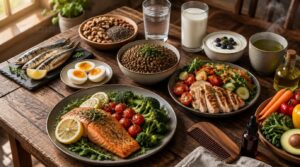
Now that you know the building blocks, let’s stock the kitchen. Your grocery cart is basically your Beard Toolkit.
Start with fatty fish like salmon or sardines. Their omega-3s calm inflammation around your follicles. Eggs are your multitasking MVP, packing protein and biotin in one tidy shell. Chicken, beef and legumes keep amino acids flowing, and beef and lentils also bring iron and zinc.
Snack on walnuts, chia and almonds. Almonds are rich in vitamin E, while walnuts bring healthy fats and fiber.
Sip smart, too. Plain water keeps skin hydrated, so your beard looks smooth instead of straw-like. Unsweetened milk or yogurt adds protein and minerals. Green tea brings antioxidants to the party. Skip the sugary sodas, they’re empty calories with zero follicle benefits.
Build each plate around one protein, one colorful veggie and one healthy fat.
Can Nutrient Gaps Affect Beard Growth?

Patchy cheeks can feel like a plot twist nobody ordered. Sometimes genetics wrote the script, but nutrient deficiencies can add drama too. Your follicles pull building blocks from your bloodstream, so a chronic shortage can leave new hairs thin, dull or slow.
Picture what that looks like:
- Wispy hairs that snap before they reach length
- Bare spots along the jawline that never quite fill in
- Dry, brittle strands that look tired by noon
- Extra shedding in your hairbrush, not just your beard
- Slow growth that stalls for months
Low protein intake, zinc, biotin and vitamin E are the usual suspects. Skip the panic, though. One lazy week of takeout won’t thin your beard. Follicles cycle over weeks and months, so only long-term gaps matter.
Hormones and thyroid issues can override diet. Stuck? Get bloodwork, then fix what shows.
Do Beard Growth Supplements Help?

Hope is cheap, and so is bottle-label marketing. Beard growth supplements sound like magic in a capsule, but here’s the real scoop.
Biotin is the poster child. It helps with keratin production, yet it only moves the needle if you’re deficient. A 2024 review found no difference from placebo in men with normal levels. Same story with vitamin D: it keeps hair follicles happy by fixing a gap, not by flipping a growth switch. Beard thickness is mostly set by androgen receptor genetics, which supplements can’t change.
Watch out for proprietary blends. They hide doses, and few ingredients have solid evidence behind them. Supplements need no pre-market proof, so buyer beware. Too much vitamin A or D can harm your liver or raise calcium.
Your smart move? Get bloodwork first, fill real gaps, and treat beard health as a diet-first project. Want a bigger push for beard growth? Ask about topical minoxidil.
Frequently Asked Questions (FAQs)
Does having a beard have any health benefits?
Your built-in scarf blocks wind and some UV. Keratin production, solid hair follicle health, testosterone and beard growth, hormonal balance and beard thickness, vitamin A and skin cell turnover all help.
What is the 3 month beard rule?
Think of the three month rule as a garden myth: plant seeds, wait 90 days, bam!
Real growth follows your unique genetics, ethnicity, sleep, stress, exercise, testosterone and supplements. Your beard keeps its own calendar.
Do beards mean high testosterone?
Your beard isn’t a testosterone scoreboard. Testosterone and facial hair development start at puberty. Genetics call the shots. Protein builds keratin, zinc repairs follicles, sleep quality and hormonal regulation plus exercise and testosterone levels help.
Does having a beard correlate with hair loss?
Bald guys with lush beards? Common! Hormonal growth factors hit scalp and chin differently, and beard growth patterns differ by ethnicity too.
So chin fuzz won’t predict hair thinning. Beard growth supplements won’t change that.
Can seasonal changes affect beard growth rates?
Your beard is a garden, and winter frost slows harvest. Seasonal changes affect beard growth rates.
Eat protein-rich foods, know hydration impacts beard health, try beard growth supplements, and keep managing stress and environmental factors.
Do beard growth patterns differ by ethnicity?
Your genes hold the map, and ancestry sketches the rough terrain. Ethnicity-specific beard growth patterns exist, but they’re only trends. Facial hair growth and beard thickness still vary wildly person to person.
How does hydration impact facial hair quality?
Hydration matters, since water transports nutrients to hair follicles and beard hair is about 25% water. Sip up! Healthy gut bacteria help produce essential nutrients, so your nutrient absorption and hair vitality both noticeably improve.
What role does gut health play in beard development?
Picture your gut as a busy kitchen feeding every hair follicle on your face. When it runs smooth, nutrient absorption and hair vitality thrive. Gut health plays in beard development quietly, so a balanced meal plan keeps it humming.
Are there specific meal timing strategies for beard growth?
Meal timing strategies for beard growth don’t exist in solid science.
Build a balanced meal plan instead. Consistent nutrition with adequate protein, vitamins and healthy fats matter more than timing, so spread proteinrich foods around.
How long does it take to see results?
Expect three months. Consistent nutrition with adequate protein, vitamins and healthy fats matter more than timing, so skip meal timing strategies for beard growth.
Biotin prevents brittleness, while sleep quality and beard growth stay linked.
Conclusion
Your beard is roughly 90% keratin, and keratin is built from protein. That one number says plenty about the beard health and diet connection. Feed your follicles, and they’ll pay you back.
Stack your plate with eggs, salmon, nuts, and leafy greens. Drink water. Ease up on sugar and booze. Skip the supplement hype unless a blood test shows a real gap.
Consistency beats flawlessness, so keep showing up at the table. Your beard follows.