This site is supported by our readers. We may earn a commission, at no cost to you, if you purchase through links. This content is for general informational and educational purposes only and is not a substitute for professional medical, dermatological, or nutritional advice.

Most guys pick a beard style because it looks good on someone else. A celebrity sports it, a friend pulls it off, and suddenly it’s on your face—except something feels off and you can’t explain why.
The culprit is almost always the face shape. A ducktail beard that sculpts a round face into something sharp looks completely different on an already-angular jaw.
Your face’s proportions are the blueprint everything else builds from. Get that match right, and the beard stops being something you wear and starts being something that works.
Table Of Contents
- Key Takeaways
- How to Measure Face Shape
- Beard Styles for Oval Faces
- Beard Styles for Round Faces
- Beard Styles for Square Faces
- Beard Styles for Oblong Faces
- Beard Styles for Heart Faces
- Beard Styles for Triangle Faces
- Beard Styles for Diamond Faces
- Match Beard Length to Density
- Keep Your Beard Shape Sharp
- Frequently Asked Questions (FAQs)
- What are the most popular men’s beard styles?
- How do I choose the right beard style for my face shape?
- How long does it take to grow a full beard?
- What are some beard grooming tips for beginners?
- What beard styles require minimal maintenance?
- How can I make my beard look thicker?
- What are some popular beard styles for a professional look?
- How often should I trim my beard?
- Can I use regular shampoo on my beard?
- Are there any beard styles suitable for a receding hairline?
- Conclusion
Key Takeaways
- Your face shape — measured by the forehead, cheekbones, jaw, and length — is the foundation for every beard decision you’ll make.
- Each face shape has a clear goal: round faces need length, square faces need softened angles, oblong faces need width, and oval faces can run with almost anything.
- Beard density and hair texture matter just as much as the shape — a style that works on thick, straight growth won’t always work on patchy or curly hair.
- Sharp edges, a clean neckline, and a consistent trim schedule are what separate a great beard from one that just exists on your face.
How to Measure Face Shape
Before you pick a beard style, you need to know what you’re working with. Your face shape is the blueprint — and measuring it takes less than two minutes.
Once you’ve got your measurements, beard shaping techniques for round faces can help you figure out exactly which styles will work in your favor.
If your measurements point to a round face, skip the guesswork and check out these beard styles for round faces that add angles instead of extra width.
Once you’ve got your measurements, matching your face shape to the right beard style makes the whole process click into place.
Grab a soft tape measure and start with these four key points.
Forehead Width

Start at your temples. That’s your temple-to-temple measurement — the foundation of solid face shape analysis. Here’s how to nail it:
- Use a soft tape measure
- Stretch it across your forehead at temple level
- Note the number in centimeters
- Compare it to your cheekbone width later
Hairline height impact matters too — a higher hairline makes your forehead appear wider visually.
Remember that the ideal forehead width proportion is roughly one‑third of your total face length, which can guide your beard style choices.
Cheekbone Width

Now shift your tape from the temples down to your cheekbones — the widest point sits just below your eyes. This cheekbone width measurement is the heart of face shape analysis.
Wide cheekbones dominate your midface, affecting visual balance and proportion in beard styling. Cheek width management and smart edge definition techniques let you control side volume and dial in a more balanced, proportionate look.
Jawline Width

Drop your fingers to the corners of your jaw — that’s where the mandible bone structure creates your jawline width. Gonial angle influence and masseter muscle bulk both shape how wide or angular you look here.
Even soft tissue impact can shift the visual balance.
Measure across your widest jaw point. This number is key for beard style recommendations.
Face Length Ratio
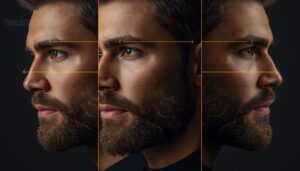
Now divide your face length by your cheekbone width.
That single number unlocks your facial proportion.
A ratio near 1.618 — the Golden Ratio Target — signals strong visual balance.
Around 1.5 works too.
These length-width guidelines drive every proportional beard length decision.
Ratio styling isn’t rigid, but it tells you whether your face shape needs more vertical emphasis or more width.
Spot Oval, Round, Square, and Oblong Shapes
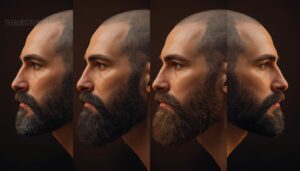
Once you have your measurements, the patterns reveal themselves.
An oval face shows proportional balance — length clearly exceeds width, with smooth, symmetrical curves. A round face sits close to equal height and width. Square faces show angular corners where the jaw meets the chin. Oblong faces stretch noticeably tall.
This shape identification guide makes matching beard styles to face shapes straightforward and precise.
Beard Styles for Oval Faces
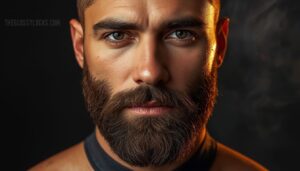
Oval faces are basically the wild card of face shapes — most beard styles work, so you’ve got real freedom here. That said, few cuts stand out as especially strong choices.
Here are the top styles worth considering.
Short Boxed Beard
The short boxed beard is a clean, intentional look that works beautifully for oval face shapes. Its Boxed Shape Geometry uses straight cheek lines and defined corners to frame your jaw with purpose. Uniform Length Control keeps every section — cheeks, chin, neck — trimmed to the same short length.
- Sideburn Alignment keeps the outline sharp and balanced
- Mustache Integration blends the upper lip into the overall shape
- Trim Frequency matters — touch up every 3–5 days
- Clean neckline finishes the look with confidence
Heavy Stubble
Heavy stubble is one of those beard styles that practically sells itself on an oval face. At roughly 4–7 days of growth and 2–5 mm in length, it delivers rugged texture without demanding much of your time. The oval face shape rewards this kind of growth coverage beautifully.
Keep your maintenance rhythm tight — trim every few days for styling consistency — and that jawline emphasis lands exactly right.
Verdi Beard
The Verdi beard is a real craftsman’s style — full chin growth, a prominent mustache curl, and trimmed sides that keep the shape controlled. For oval faces, the rounded chin and sideburn trim work naturally within the face shape’s balanced proportions.
Length limits top out around 4 inches, so your grooming routine stays manageable.
For a full breakdown of department-by-department grooming standards, this guide to police facial hair policies walks through why some agencies enforce stricter limits than others.
Clean, deliberate, and unmistakably sharp.
Style Flexibility for Balanced Proportions
Oval faces are the lucky ones — almost any style lands well.
That’s because your facial proportion balance is already working in your favor.
You can experiment with modular beard length, try hybrid shape transitions from short to medium, or fine-tune with adjustable density tuning on the cheeks.
An adjustable cheek line keeps things clean.
Matching beard styles to face shape rarely gets easier than this.
Avoiding Overly Bulky Sides
Even a balanced face shape can lose its edge when the sides get too heavy. Keep control with these five moves:
- Taper the cheek panel upward toward the sideburn for a clean cheek panel tapering
- Practice sideburn length control — trim flush, not flared
- Use the brush direction technique to lay hair inward, not outward
- Apply product weight reduction by skipping heavy conditioners
- Manage hair texture on curly or wavy growth before it dries wide
That’s jawline balancing done right.
Beard Styles for Round Faces
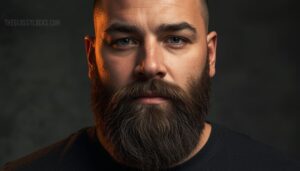
Round faces have one main goal regarding beards: add length, not width. The right style can make your face look slimmer and more defined without much effort.
Here are the best options to work with your shape.
Ducktail Beard
The ducktail beard works well for round faces because it adds vertical length exactly where you need it. Its V-shaped taper draws the eye downward, making your face look slimmer.
Keep cheek volume balance in check by blending guard lengths gradually toward a crisp chin point. Edge definition techniques and consistent tapered chin maintenance are what separate a sharp ducktail from just a full beard.
Hollywoodian Beard
Another strong pick for round faces is the Hollywoodian. It earns its place through deliberate Sideburn Separation — the beard stays on your jawline and chin, never creeping up toward your sideburns.
That clean Jawline Outline keeps your face looking defined. Add Mustache Integration, a trimmed Soul Patch Rectangle, and solid Length Density Goals around one to two inches, and this beard style recommendation genuinely works.
Full Beard With Trimmed Sides
Want full coverage without looking wider? A full beard with trimmed sides is your answer.
Sideburn Blending keeps cheek bulk down while Growth Pattern Control and Texture-Based Trimming shape everything toward the jaw.
Use deliberate Styling Direction daily. Trim Frequency matters here — touch up every week or two so beard shaping stays tight and face shape reads structured, not round.
Vertical Length for a Slimmer Look
Trimmed sides keep cheeks in check, but vertical length is where the real magic happens for round face shapes. A chin-centric length with gradual length taper draws the eye downward — not outward.
Pair that with low neckline placement and a central density boost, and your beard shaping starts creating real visual balance. Tapered side shift plus smart cheek line definition keeps everything reading tall, not wide.
Styles to Avoid Widening The Cheeks
Some styles quietly work against you when you have a round face shape. Knowing what to skip is just as powerful as knowing what to choose.
Avoid these three traps:
- Rounded Cheek Hulls — Puffy cheek growth destroys cheek line definition and wrecks facial proportion balance.
- Scissor Blunt Volume — Blunt, flat cheek cuts kill Blended Cheek Taper and push width outward.
- Mustache Edge Control failures — Wide mustache edges increase cheekbone emphasis in the wrong direction.
Sideburn Tapering keeps visual balance intact.
Beard Styles for Square Faces

Square faces come with strong, defined jawlines — and the right beard works with that structure, not against it. The goal is to soften those sharp angles without losing the confident look that comes naturally with your face shape.
Here are the styles that do exactly that.
Classic Goatee
The classic goatee is practically built for square faces. It pulls attention to the chin and away from a strong jawline — softening the overall shape without hiding it.
Keep a clean mustache boundary and stay on top of edge definition control; crisp lines are what make it work. Adjust your chin patch length to taste, but keep the cheeks clear.
Beardstache
The BeardStache is a bold move for square faces — and it works because of stubble contrast. Keep the beard at 2–5 mm for clean trim uniformity while letting mustache prominence does the heavy lifting.
The fuller mustache draws the eye upward, softening that strong jawline through smart facial framing. Its style contrast is made practical.
Solid beard style recommendations for each face shape rarely skip this one.
Softer Chin Lines
A sharp chin line can make a square face feel like a carved block. That’s where gradual chin taper saves you.
Instead of hard edges, use scissor edge blending to soften the outline. Brush assisted smoothing and growth direction training settle the hair into a natural curve.
Rounded beard shaping — not a Boxed Beard — keeps your face shape balanced without adding unnecessary edge.
Reducing Extra Jaw Bulk
A wide jaw isn’t just about bone — muscle bulk and fluid retention play real roles too. Masseter Botox can slim the lower face by reducing chewing muscle size, while lymphatic drainage massage and salt reduction help cut puffiness fast.
For beard style, focus on sideburn tapering to keep sides flat.
A fuller chin pulls the eye down, balancing jawline and cheeks beautifully.
Beard Styles for Oblong Faces
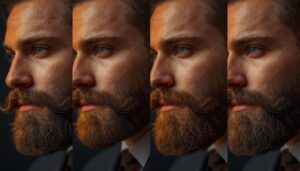
Oblong faces run long and narrow, so the goal is simple: add width, not length. The right beard style can visually shorten your face and make everything look more balanced.
Here are the styles that do exactly that.
Garibaldi Beard
The Garibaldi Beard is one of the best beard style recommendations for an oblong face shape. Its Rounded Bottom Shape and Cheek Fullness Flow add width, visually shortening a long face. Follow Maximum Length Guidance of 6–8 inches and let Natural Growth Approach do the work.
- Rounded base softens vertical length
- Integrated Mustache blends seamlessly into the beard
- Full cheeks balance narrower oblong proportions
- Minimal sculpting keeps the look authentic
Fuller Side Growth
Fuller sides are where oblong faces win. Your cheeks carry width, so let them. Focus on cheek density boost by resisting the urge to trim the sides short.
Sideburn extension techniques — simply letting sideburn hair connect smoothly down through the cheek — frame your face naturally. Growth direction training with a boar-bristle brush encourages hairs to lay outward, adding instant visual volume.
Shorter Chin Length
Now that sides have volume, pull back the chin length. A longer chin beard on an oblong face stretches your profile further — the opposite of what you want.
Keep chin growth short, around half an inch, to apply basic microgenia camouflage principles and lower face emphasis. This small beard line optimization quietly improves your profile balance without sacrificing chin projection enhancement.
Styles That Reduce Face Length
Once chin stays short, the rest falls into place. Styles like a short boxed beard, Goatee, Balbo Beard, or Chin Strap Beard work well here — each uses Tapered Cheek Lines and a Rounded Jaw Perimeter to break up vertical length.
Pair that with Side Coverage Control and a Cheekbone Illusion effect, and your face shape reads shorter, balanced, and sharp.
Beard Styles for Heart Faces
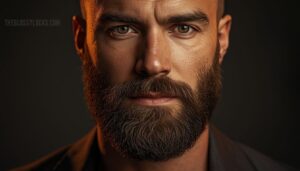
Heart-shaped faces come with a wider forehead and a narrower chin — a combo that most guys don’t think twice about until the wrong beard makes it obvious. The goal is simple: add some weight to the lower face and draw the eye downward.
These styles do exactly that.
Full Beard With Rounded Edges
A full beard with rounded edges is one of the best calls for a heart-shaped face. Rounded Edge Styling softens the wider forehead by drawing attention downward toward a fuller chin. Keep Neckline Curvature slight — curving upward at the center rather than cutting flat.
Use Brush Direction Training daily and apply Beard Balm Usage lightly along the perimeter. A consistent Maintenance Schedule keeps this Rounded Beard looking intentional.
Balancing a Wider Forehead
A wider forehead means your beard needs to work smarter, not harder. A Forehead Framing Beard uses Vertical Cheek Lines and Cheek Tapering to pull the eye downward — not outward.
These guidelines for choosing a beard style for face shape apply directly here:
- Keep Sideburn Blend gradual and close to the face
- Use Chin Emphasis to anchor the lower third
- Avoid mirroring forehead width at cheek level
Adding Fullness to The Lower Face
Want to balance a narrow lower face?
A Full Beard or Balbo Beard adds natural volume where a heart shape needs it most.
Think of it as Lower Face Volume you build one millimeter at a time.
Avoid Mutton Chops — they widen the middle, not the base.
A Goatee with a rounded edge also works well, anchoring the chin without overcomplicating your Jawline Contouring Strategies.
Beard Styles for Triangle Faces

Triangle faces carry most of their width in the jaw, which means the wrong beard can make things look even more bottom-heavy. The goal is to shift attention upward and build some visual weight around the cheeks.
Here’s what actually works.
Building Width at The Cheeks
A triangle face carries most of its width at the jaw — so your goal is simple: bring the cheeks into balance. Cheek Volume Boost starts by letting side growth fill in before you touch a trimmer. Here’s how to build that width smartly:
- Sideburn Blend — Keep the sideburn-to-cheek connection smooth, not chopped.
- Outward Brushing — Comb the cheek zone outward daily to train volume placement.
- Light Oil Use — A few drops separates hair so cheekbone width reads fuller.
- Edge Control — Trim the cheek border in tiny steps; never cut too deep.
- Matching beard styles to face shape — Fuller mid-cheek coverage balances jawline and cheeks without bulk sliding downward.
Avoiding Extra Chin-heavy Shapes
Your chin already has the spotlight — don’t hand it a megaphone. For a triangle face, chin-heavy beard styles like sharp goatees or long pointed cuts draw even more attention downward.
Keep chin length modest and edges rounded. Use light stubble or a short boxed beard to redistribute focus upward.
| Element | What to Avoid | Better Choice |
|---|---|---|
| Chin Length Ratio | Long pointed growth | Trimmed, modest length |
| Trimmed Edge Softening | Sharp angular cutoffs | Soft rounded edges |
| Hair Direction Guidance | Outward chin flare | Downward or inward combing |
Beard Styles for Diamond Faces
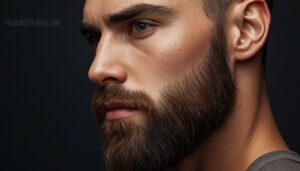
Diamond faces come with sharp cheekbones and a narrow chin — a combo that looks striking but needs the right beard to stay balanced.
The goal is simple: soften those prominent cheeks while adding a little width down at the jaw.
Here are the styles that do exactly that.
Stubble Beard
Stubble is one of the smartest moves for a diamond face. The right stubble length timing matters — short stubble keeps sharp cheekbones from dominating, while medium stubble adds softness around the chin. Designer stubble styling works especially well here.
For patchy growth management, keep it uniform with consistent stubble edge definition. Texture-based stubble and face shape guidelines for choosing a beard style make this effortlessly sharp.
Goatee Styles
A goatee beard works surprisingly well on a diamond face. It draws attention to the chin, balancing those prominent cheekbones naturally.
When choosing your goatee, mustache connection types and chin shape taper both matter:
- Van Dyke – disconnected mustache, pointed chin
- Circle beard – connected, rounded frame
- Classic full goatee – joined center shape
- Anchor goatee – extended vertical presence
- Balbo – separated mustache, defined chin patch
Pick what flatters your proportions.
Rounded Full Beard
A rounded full beard takes things further than a goatee. It builds Cheek Coverage Consistency across the whole face, keeping the sides full without boxy edges. Side Profile Blending softens the angular cheekbone line naturally. Jawline Softening rounds out sharp corners below.
| Feature | What It Does |
|---|---|
| Even cheek density | Balances prominent cheekbones |
| Rounded chin edge | Adds width at the jaw |
Trim every 1–2 weeks for clean Density Management.
Softening Sharp Cheekbones
Sharp cheekbones define the diamond face shape — but a well-placed beard turns that into balance.
Beard contour techniques like keeping fuller density along the sides and lower jaw draw attention away from cheekbone softening zones.
Texture blending strategies — think gradual fading rather than hard lines — ease that angular jawline naturally.
Your beard becomes the frame, not the distraction.
Adding Width to The Chin Line
Width at the chin line comes down to one thing: even coverage.
Chin area density across the lower front — think Balbo beard or boxed beard fullness — makes your chin read broader.
beard layering technique to build volume there, not at the sides.
Strategic trim angles keep sideburn integration controlled, so the width lands exactly where it belongs.
Match Beard Length to Density
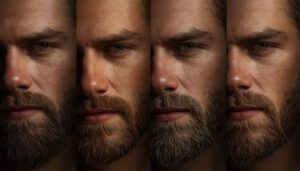
Face shape is only half the equation — beard density matters just as much when picking the right style. How thick, patchy, straight, or curly your growth is will shape which lengths actually work for you.
Face shape sets the stage, but your beard’s density, texture, and growth pattern determine which styles actually work
Here’s how to match your beard length to what you’ve actually got growing.
Thin Beard Growth
A fine beard isn’t a failure — it’s just working within a different set of rules. Genetic limitations set your density ceiling, and no product changes that. But hormone balance, nutrient support, and growth cycle timing all influence how full your beard actually looks.
- Keep hair texture management simple — fine beards tangle less, but show gaps faster
- Grooming techniques matter more when density is low
- Beard styles based on growth pattern and texture should guide your approach
Patchy Beard Coverage
Patchy beard growth isn’t always permanent — different follicles simply wake up on different schedules. Give it four months before drawing conclusions.
Meanwhile, comb styling techniques and shadowing with length can visually redistribute coverage.
Targeted oil application reaches the skin beneath, supporting follicles directly.
If inflammation or flaking appears, that signals medical condition management over styling alone.
Short, Medium, and Long Beard Options
Length-based grooming starts with knowing where you actually fall on the scale.
- Short beard (5–12 mm) — low maintenance, works with almost any density
- Medium beard (1–2 inches) — demands consistent trimming and shape management
- Long beard (5 cm+) — rewards patience; hair texture impact becomes significant here
- Seasonal maintenance shifts needs — winter growth often outpaces summer upkeep
Match the length to what your follicles can realistically deliver.
Stubble Versus Full Beard Choices
Stubble wins on maintenance time — a quick trim every few days keeps it sharp with minimal effort. Seasonally, stubble breathes easier in summer heat.
A full beard delivers stronger professional perception and covers patchy growth better, but demands washing, conditioning, and regular shaping.
Skin irritation can hit either way if you skip moisturizing.
When choosing beard style based on face shape, both are legitimate — pick the one your density can actually support.
Working With Straight, Wavy, or Curly Hair
beard’s texture shapes everything — from how it holds a line to how it behaves overnight. Straight beard hair lies flat and trims predictably.
Wavy beard growth benefits from leave-in conditioning and moisture management to stay defined. Curly beard styles need diffuser techniques, heat protection, and silk pillow care to preserve shape.
These aren’t extras — they’re your guidelines for choosing a beard style for face shape that actually works. Hair texture impacts beard styling more than most guys realize.
Keep Your Beard Shape Sharp

A great beard style means nothing if the edges go ragged by week two. Keeping your shape sharp comes down to a handful of consistent habits — and the right tools to back them up.
Here’s what actually makes the difference.
Neckline Trimming
sharp neckline is the difference between "just woke up" and "actually has it together." Start with guide line placement just above your Adam’s apple, then work outward symmetrically.
- Use guard length control to taper gradually — never blunt-cut
- Apply taper gradient technique from center to sides
- Hold trimmer at a slight angle for clean neckline definition
Finish with beard oil for post‑trim skin care.
Cheek Line Cleanup
Your cheek line makes or breaks the whole look. Start with skin prep — clean, dry skin lets your trimmer bite cleanly.
Use mirror positioning to check both sides at once, following the natural line from your sideburn down toward the mustache corner.
Symmetry verification catches uneven edges before they become a problem. Finish with aftercare moisturizing to prevent skin irritation after trimming.
Regular Shaping Schedule
A clean cheek line only stays clean if you revisit it consistently. Your beard maintenance schedule is the real backbone here.
- Trim Frequency: Every 3–7 days keeps shape tight
- Seasonal Growth Adjustments: Shorten intervals in summer when growth speeds up
- Guard Length Consistency: Lock in one setting to avoid uneven patches
- Weekly Checkpoints: Quick mirror checks catch drift early
Track your hair length changes and adjust accordingly.
Beard Oil and Conditioner Use
Shape is only half the story. Keeping your beard soft and healthy is what makes any style actually look intentional.
| Product | Key Benefit | Layering Application Order |
|---|---|---|
| Beard conditioner | Softens texture, conditioner rinse timing after washing | Step 1 — rinse out |
| Beard oil (jojoba/argan) | Carrier Oil Benefits: moisturizes and shines | Step 2 — apply to dry beard |
| Vitamin E blend | Vitamin E Antioxidant stabilizes the oil mix | Added within oil formula |
Fragrance strength options vary—lighter scents suit daily wear. Your beard care routine locks in results from every face shape style choice.
Trimming Tools and Barber Upkeep
Good tools only stay good with care. After every session, brush out clippings, run your Blade Oil Routine, and follow a Guard Hygiene Protocol — clean attachments separately, then air-dry completely.
Dry Storage Practices protect blades from rust.
- Check Alignment Check Frequency regularly to avoid uneven cuts.
- Follow Clip Blade Maintenance for consistent trimmer guard settings.
- Use professional barber advice on beard trimming techniques.
Frequently Asked Questions (FAQs)
What are the most popular men’s beard styles?
Beard styles run the full spectrum — from Short Stubble to the bold Bandholz Beard and Viking Beard.
Popular beard styles for men include the Balbo Style, Mutton Chops, and classic full beards.
How do I choose the right beard style for my face shape?
Start with your face shape. Measure your forehead, cheekbones, jaw, and face length, then match beard volume to balance your proportions.
Hair texture, skin sensitivity, and cultural influences all shape the right call.
How long does it take to grow a full beard?
Most men see a full beard in 2 to 4 months, though genetic factors and hormone influence can shift that window. Patience required — your growth timeline is personal, not a race.
Once your beard fills in, exploring classic beard styles worth trying can help you shape it into something that actually suits your face.
What are some beard grooming tips for beginners?
Think of your beard like a new plant — it needs water, light, and patience.
Wash gently 2–4 times weekly, apply beard oil after, and trim with a guard every week or two.
What beard styles require minimal maintenance?
Stubble length guides and simple trimmer settings make low-maintenance beard options easy.
Uniform cheek length and a clean, easy neckline with minimal side bulk keep your look sharp without much effort.
How can I make my beard look thicker?
Brush your beard daily to boost volume and use a conditioning balm to tame flyaways.
Good protein intake promotes density, while skin exfoliation and minoxidil therapy can help with a patchy beard.
What are some popular beard styles for a professional look?
A sharp Professional Beard starts with clean edges. Corporate Stubble, a Neat Mustache, Groomed Sideburns, a Tapered Chin, and a Defined Cheekline all signal polished, intentional grooming without feeling overdone.
How often should I trim my beard?
Your beard trimming frequency depends on length. Stubble needs a cleanup every 1–2 days. Short beards do well every 2–3 weeks. Long beards? Every 6–8 weeks keeps them tidy.
Can I use regular shampoo on my beard?
Regular shampoo is a square peg in a round hole — it’s built for your scalp, not your face.
Use it occasionally, but follow up with beard oil to avoid oil stripping risks and dryness.
Are there any beard styles suitable for a receding hairline?
Yes. Low stubble creates natural Stubble Contrast and Texture Balance around the jaw.
A goatee’s Goatee Focus draws eyes downward.
A full beard’s Beard Frame Effect adds structure, softening Hairline Masking concerns beautifully.
Conclusion
You don’t need a perfect face to grow a great beard—you just need the right match.
That’s the whole point of learning beard styles for different faces.
Your proportions aren’t a limitation; they’re your starting point.
Once you know your face shape, every trimming decision gets easier and more deliberate.
The beard that actually works for you isn’t on someone else’s face.
It’s already waiting in the mirror.