This site is supported by our readers. We may earn a commission, at no cost to you, if you purchase through links.
The clean-shaven firefighter isn’t just a cultural stereotype—it’s a life-or-death safety requirement backed by federal law. OSHA standard 29 CFR 1910.134 explicitly prohibits facial hair that interferes with the seal of self-contained breathing apparatus, and fire departments nationwide enforce strict grooming policies as a result. A compromised mask seal can allow toxic smoke and superheated gases to bypass your respiratory protection in seconds.
Yet the rules aren’t absolute. Religious accommodations, medical conditions, and alternative equipment create narrow exceptions that allow some firefighters to maintain beards while staying compliant.
Understanding where policy meets practice helps aspiring and current firefighters navigate these requirements without sacrificing their careers or safety.
Table Of Contents
- Key Takeaways
- Can Firefighters Have Beards?
- Why Facial Hair Rules Exist in Firefighting
- Departmental Policies and Variations
- Accommodations for Medical and Religious Reasons
- Firefighter Culture and The Tradition of Facial Hair
- Frequently Asked Questions (FAQs)
- Can firefighters with beards wear respirators?
- Can you have facial hair as a firefighter?
- Why did firemen have beards?
- Are male firefighters allowed to have long hair?
- Can firemen have beards on Reddit?
- Can firefighters have long hair men?
- Can paramedics have beards?
- Can firefighters wear makeup?
- Can an introvert be a firefighter?
- Can firefighters have PTSD?
- Conclusion
Key Takeaways
- Federal OSHA and NFPA standards prohibit beards that interfere with SCBA mask seals because even light stubble can break the airtight barrier and allow toxic smoke to bypass your respiratory protection in seconds.
- Most fire departments enforce strict no-beard policies that can disqualify you during hiring or limit your career advancement, but religious accommodations and medical exemptions for conditions like pseudofolliculitis barbae may allow alternative respiratory equipment like PAPRs in non-interior roles.
- Mustaches are generally permitted as long as they don’t extend below your mouth corners into the mask seal area, honoring firefighting tradition while maintaining the tight seal required for safety.
- Recent legal victories and evolving attitudes toward diversity are challenging blanket beard bans, though the core requirement remains unchanged—your facial hair cannot compromise the seal that keeps you alive in hazardous environments.
Can Firefighters Have Beards?
Most fire departments don’t allow full beards because they interfere with the tight seal required for breathing equipment. However, the rules aren’t entirely black and white—regulations vary by department, and there are situations where exceptions apply.
Similar standards exist in healthcare and aviation, where proper beard grooming for professional settings becomes essential to maintaining respirator and oxygen mask effectiveness.
Let’s look at what current policies say, how they affect your career prospects, and when you might qualify for an exemption.
Current Regulations and Policies
Federal safety protocols set the ground rules: OSHA standard 29 CFR 1910.134 and NFPA 1500 both prohibit facial hair that interferes with your SCBA mask seal. These respirator standards treat beards and stubble the same if they lie under the sealing surface. Your department’s grooming guidelines generally mirror these requirements, often banning beards while allowing neatly trimmed mustaches that don’t extend below your mouth corners. For those needing alternative protection, there are options specifically discussed in resources on .
Some departments now grant religious and medical exemptions for bearded officers who meet strict safety testing with alternative respirator systems.
Impact on Job Eligibility
Job restrictions bite hard when you refuse to shave. Most departments disqualify applicants with beards during hiring, treating compliance as an essential function.
Understanding the clean shaven vs beard debate helps you weigh professional expectations against personal choice before applying.
Once hired, facial hair policies can trigger duty limits—reassignment away from interior attack, blocked promotions to officer ranks, and even termination after progressive discipline. Career impacts are real: your beard may cost you overtime eligibility, deployment status, and advancement opportunities under current fire department regulations.
One key legal concern is that even minor discretionary exceptions to policies can undermine general applicability and expose departments to lawsuits.
Common Exceptions and Exemptions
Despite strict facial hair policies, you can request exemptions in limited circumstances:
- Religious accommodations under Title VII may allow beards if your department can reassign you to non-SCBA roles without operational hardship
- Medical exemptions for conditions like pseudofolliculitis barbae sometimes permit short, trimmed facial hair outside the mask seal area
- Alternative respiratory equipment such as loose-fitting PAPRs can maintain OSHA compliance and safety protocols while accommodating beards in specific workplace accommodations scenarios
Courts now scrutinize discrimination in the workplace claims more carefully, requiring departments to genuinely explore employee accommodations before denying requests.
Why Facial Hair Rules Exist in Firefighting
Firefighting isn’t a job where you can bend the rules on safety equipment. Every regulation around facial hair exists for one reason: keeping you alive when you’re walking into fire and smoke.
In firefighting, facial hair regulations aren’t about appearance—they exist solely to keep you alive in fire and smoke
Let’s break down the three main safety standards that shape these policies.
Understanding proper shaving techniques can help prevent painful razor bumps and beard irritation that commonly affect men with coarse or curly facial hair.
Respiratory Protection Standards (OSHA, NFPA)
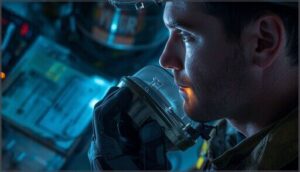
You’ll find that respiratory protection standards leave no room for shortcuts. OSHA requirements under 29 CFR 1910.134 clearly prohibit facial hair between your face and the SCBA mask sealing surface—even if you pass a fit test.
NFPA guidelines reinforce this through NFPA 1404, requiring written programs that ban beards interfering with respirator fit. These overlapping standards create the foundation for departmental facial hair rules nationwide.
SCBA Mask Seal Integrity
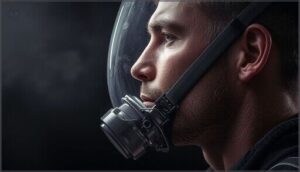
Your SCBA mask seal depends on continuous contact between the soft silicone skirt and clean skin. Modern facepiece design creates an airtight barrier from your nose bridge to chin—but even light stubble breaks that seal.
During mask fit testing, evaluators measure how well the respirator safety system blocks contaminated air. Proper strap adjustment and a hair-free seal zone are non-negotiable for respiratory protection that keeps you alive.
Safety Risks of Facial Hair
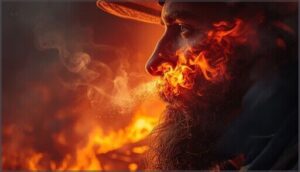
Thermal burns become a real threat when facial hair ignites near open flames or traps hot embers against your skin. Beyond burn injuries, beards compromise respiratory protection by allowing toxic exposure through gaps in your mask seal.
Respirator failure from facial hair ignition isn’t theoretical—it’s why SCBA masks demand clean-shaven contact zones to prevent life-threatening smoke inhalation.
Departmental Policies and Variations
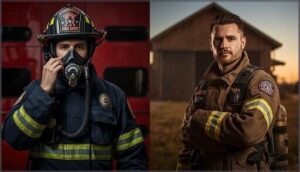
While federal guidelines set the baseline for facial hair safety, each fire department interprets and enforces these standards differently. What’s acceptable in one city might be prohibited in another, depending on local policies and leadership priorities.
Let’s look at how major departments across the country handle facial hair rules and what grooming options you’ll usually find on the job.
Differences Across Major Fire Departments
Each fire department sets its own facial hair policy within federal respirator standards. FDNY enforces a strict no-beard rule with regular inspections, pulling firefighters from interior duty for violations. London Fire Brigade prohibits beards for all operational staff, even those on light duty. Some departments allow off-duty growth but require clean-shaven reporting.
Fire service facial hair rules vary markedly by location and department culture.
Mustache and Goatee Allowances
Most departments draw a clear line between what’s allowed above your lip and what’s prohibited below it. Mustache styles get the green light when they don’t drop past the corners of your mouth or cross into the SCBA seal zone.
- Neatly trimmed mustaches that stay above the upper lip usually pass muster
- Small soul patches may be acceptable if they don’t touch the chin seal area
- Goatee limits are strict since most styles extend onto the jaw
- Frequent fit testing is required for any permitted facial hair alternatives
Pro Tip: Even approved mustache styles can be further restricted before major inspections to verify your respirator passes its seal check.
Accommodations for Medical and Religious Reasons

While most departments enforce strict clean-shaven policies, they can’t ignore federal laws that protect your rights. If you have a sincere religious belief or a legitimate medical condition that prevents safe shaving, you may qualify for an accommodation.
Here’s what you need to know about requesting an exception and the specialized equipment that might make it possible.
Religious Exemptions and Title VII
If your religious beliefs require you to wear a beard, federal law may protect you. Title VII of the Civil Rights Act prohibits workplace discrimination based on religion and requires employers to provide reasonable religious accommodations.
Fire departments must evaluate beard exceptions individually, showing substantial safety hardship before denial.
Recent legal victories, including the 2026 Atlantic City settlement, strengthen religious freedom protections for bearded firefighters seeking accommodation against restrictive facial hair policies.
Medical Conditions Affecting Shaving
Some firefighters can’t stay clean-shaven without real pain. Pseudofolliculitis barbae affects 45 to 85 percent of Black men, causing painful razor bumps, scarring, and infection when you shave daily for respiratory protection standards.
Shaving eczema, acne keloidalis, and severe skin irritation have led to disability claims and medical accommodations in several departments.
Facial hair regulations in the fire service now balance grooming guidelines with legitimate dermatologic conditions that make compliance nearly impossible.
Specialized Respiratory Equipment
When shaving isn’t an option, PAPR systems offer beard-compatible respiratory protection for specific fire service roles. Powered air purifying respirators use a battery-powered blower to push filtered air into a loose-fitting hood, eliminating the mask seal problem entirely.
- NIOSH approved PAPR systems deliver 6 to 15 cubic feet per minute of clean air through high-efficiency respirator filters
- Loose-fitting hood designs accommodate beards during fire investigation, EMS calls, and support operations
- Breathing apparatus like the Dräger X-plore 8500 provides 99.97 percent filtration against carcinogenic particulates
- PAPRs can’t replace SCBA for structural firefighting because interior atmospheres remain immediately dangerous to life and health
Firefighter Culture and The Tradition of Facial Hair
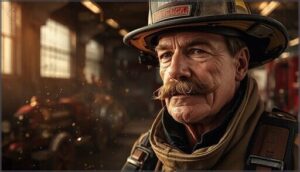
Facial hair has been part of firefighting identity since the profession’s earliest days. The iconic firehouse mustache isn’t just about style—it’s woven into the culture and history of the service.
Here’s how tradition and modern safety standards work together in today’s fire departments.
Historical Significance of Mustaches
The mustache carries weight in fire service history, a tradition spanning generations. In the 1800s, firefighters would wet their thick mustaches before entering burning buildings, believing the damp hair would filter smoke and ash. As modern breathing apparatuses replaced these improvised measures, the mustache evolved from a practical tool to a symbol of brotherhood, signifying shared risks and a common identity among firefighters.
| Era | Mustache Purpose | Cultural Meaning |
|---|---|---|
| 1800s | Smoke filtration aid | Practical survival tool |
| Early 1900s | Leadership symbol | Authority marker for chiefs |
| Mid 1900s | Shifting role | From function to tradition |
| Late 1900s | Brotherhood badge | Crew solidarity identifier |
| 2000s–Present | Historical nod | Policy-friendly personal style |
Balancing Tradition With Safety
Modern departments honor firefighter culture and tradition while keeping safety protocols front and center. You’ll find agencies threading that needle in five practical ways:
- Allowing mustaches that stay above the SCBA seal line so you can nod to history without respiratory risks
- Explaining facial hair policies during recruit training to set clear expectations early
- Reassigning bearded members to non-IDLH roles that respect personal protective equipment guidelines
- Using annual fit tests to decide whether your facial hair works with suppression duty
- Building cultural sensitivity into grooming rules through union talks and accommodation reviews
This approach protects tradition preservation without sacrificing the tight mask seal you need in smoke-filled rooms.
Evolving Attitudes Toward Beards
Generational shifts are reshaping how departments view beards and grooming policies. Younger recruits post “academy beard-to-cleanshaven” transitions on social media, turning beard culture into viral content that pressures agencies to revisit blanket bans.
Diversity pressures from religious accommodation cases and technological advances in respirator design now challenge long-standing rules, suggesting that tomorrow’s firefighter safety protocols may look different from today’s strict standards.
Frequently Asked Questions (FAQs)
Can firefighters with beards wear respirators?
Firefighters need protection, yet beards create vulnerability. No, you can’t wear standard respirators with beards—facial hair prevents the critical mask seal required for breathing protection, compromising respiratory safety and breathing apparatus integrity in hazardous environments.
Can you have facial hair as a firefighter?
Yes, you can have facial hair as a firefighter, but beard regulations and respirator fit testing requirements limit most styles.
Mustaches that don’t cross mask seal areas are generally allowed, while beards affecting respiratory safety remain restricted.
Why did firemen have beards?
In the 1800s, firefighters soaked their beards in water and breathed through the wet hair as a primitive smoke filter before modern breathing apparatus existed.
This practice was rooted more in firefighter folklore than real protection.
Are male firefighters allowed to have long hair?
Most fire department policies let male firefighters grow their hair longer, but you’ll need to keep it pinned above your collar and secured so it doesn’t interfere with helmets or breathing apparatus.
Can firemen have beards on Reddit?
Beard policies broadcast on Reddit reveal that real firefighters regularly reference OSHA and NFPA respiratory protection standards. They explain that facial hair traditions clash with SCBA mask seal requirements.
However, volunteer departments often allow beards for non-interior roles.
Can firefighters have long hair men?
Most departments allow long hair for male firefighters, provided it’s tied back or pinned up neatly above the collar.
Hair length policies focus on whether your style interferes with helmet straps or SCBA seals.
Can paramedics have beards?
Most EMS agencies prohibit beards in respirator seal areas under OSHA standards, but paramedic grooming policies vary by employer.
Facial hair policies allow medical exemptions and religious accommodations when alternative respiratory protection maintains proper beard safety.
Can firefighters wear makeup?
You can wear makeup off duty, but most departments restrict it during active shifts.
Safety protocols prohibit products that compromise your SCBA mask seal or interfere with PPE compatibility and respiratory protection.
Can an introvert be a firefighter?
Yes, introverts can excel as firefighters by utilizing strong observation skills, careful preparation, and thoughtful communication styles.
Effective teamwork skills, stress management strategies, and leadership roles don’t require extroversion—just clear communication and reliable performance under fire department policies.
Can firefighters have PTSD?
The weight of the job can follow you home. Yes, firefighters can develop PTSD from repeated trauma exposure, with rates reaching 12 percent—far higher than the general population faces daily.
Conclusion
Picture yourself standing at the apparatus bay door, knowing your gear will protect you when it matters most. Whether firefighters can have beards depends on your department’s policies, the equipment you use, and the accommodations available to you.
The standard remains clear: facial hair can’t compromise your SCBA seal. But understanding exceptions—religious, medical, and technological—means you can navigate these requirements without sacrificing your commitment to the service or your safety on the fireground.
- http://www.osha.gov/laws-regs/standardinterpretations/2016-05-09
- https://tsi.com/healthcare/learn/facial-hair-and-respiratory-protection
- https://www.eastcoastrescuesolutions.com/blogs/news/firefighter-facial-hair-regulations-what-you-need-to-know
- https://lawblog.mystagingwebsite.com/2020/01/30/court-rules-fdny-must-accommodate-facial-hair-despite-osha/
- https://www.local.gov.uk/fire-and-rescue-service-common-myths