This site is supported by our readers. We may earn a commission, at no cost to you, if you purchase through links. This content is for general informational and educational purposes only and is not a substitute for professional medical, dermatological, or nutritional advice.
Collagen powder sits in plenty of beard-care routines, and the pitch is always the same: eat protein, grow thicker facial hair. As a dermatologist, I wish the science backed that up. So far, no controlled human trial has tested whether collagen helps beard growth.
The closest evidence comes from scalp studies. One found collagen with vitamin C raised scalp hair density by 27.6% in 12 weeks. Beard follicles run on different rules, though, with a shorter growth phase and a heavy dependence on androgens.
Here’s what collagen can and can’t do for your beard, and which levers matter more.
Table Of Contents
- Key Takeaways
- Does Collagen Help Beard Growth?
- What Role Does Collagen Play in Beard Hair and Skin Health?
- Potential Collagen Benefits for Beard Health—and Their Limits
- Collagen Foods and Supplements: What to Know for Beard Health
- Factors Affecting Beard Growth Beyond Collagen
- Frequently Asked Questions (FAQs)
- Can collagen increase beard growth?
- What supplements boost beard growth?
- What helps a beard grow quicker?
- Does collagen raise testosterone?
- Does Collagen Cause Facial Hair Growth?
- Does Collagen Grow Hair Back?
- Does Collagen Affect Testosterone?
- Is Too Much Collagen Bad for Your Beard Hair?
- Does Collagen Grow Hair Faster?
- What age does beard growth typically peak?
- Conclusion
Key Takeaways
- No controlled human trial has tested whether collagen helps beard growth, and the scalp studies that show benefits don’t carry over, since beard follicles have a shorter growth phase and depend heavily on androgens.
- Collagen supports the skin and structure around your follicles, but your body pools its amino acids and uses them wherever they’re needed, so they aren’t aimed at your face.
- Your genes, follicle density, and sensitivity to testosterone and DHT set your beard’s ceiling, and collagen can’t add follicles you didn’t inherit or change how they respond to hormones.
- You’ll get more from sleep, enough protein, zinc, iron, and vitamin D, plus patience, than from a collagen powder, which has no proven dose or timeline for beard growth.
Does Collagen Help Beard Growth?

I’ll be honest with you: collagen is popular in beard circles, but the proof isn’t as solid as the marketing makes it sound.
If you’d rather spend your money where it counts, a good conditioner for dry skin and soft hair, like one of these best-smelling beard oils, is a smarter buy than any collagen promise.
Below, I’ll walk you through two things worth knowing, starting with human evidence and research gaps and then how scalp studies compare to actual beard growth.
That way, you can decide what to expect before you spend money on a tub of powder.
Human Evidence and Research Gaps
No controlled human trial has shown that collagen boosts beard growth. That’s the honest starting point, and it’s the part most supplement ads skip. Existing human evidence mostly tracks skin hydration, elasticity, and wrinkles, not beard density or shaft thickness.
So the research gaps are big. Nobody has measured how collagen affects your hair follicles in facial hair.
Scalp Studies Versus Beard Growth
You might wonder why scalp studies don’t settle this. They do show something real: collagen with vitamin C raised scalp hair density by 27.6% over 12 weeks. But beard growth runs on different rules. Researchers also found that collagen and vitamin C improved scalp scaling by 11% over 12 weeks compared to placebo, which points to a healthier scalp environment rather than direct changes in hair growth cycles.
Your beard hairs stay in their growth phase for about 16 weeks, while scalp hairs last years. Facial hair also depends on androgens, so scalp results can’t simply carry over to your beard.
What Role Does Collagen Play in Beard Hair and Skin Health?
So where does collagen actually fit in? Think of it as the scaffolding around your hair follicles. It’s the main structural protein in the dermis, the layer of skin where each beard hair is anchored, and it helps keep those follicles stable and well supplied with blood.
As you get older, that collagen network thins out. Sun, pollution, and smoking speed up the breakdown too. A weaker support system can mean finer, more brittle hairs, and it’s also why skin elasticity fades.
Your body also uses collagen’s amino acids, like glycine and proline, as building blocks for keratin, the protein your beard hair is made of. Glycine helps make glutathione, an antioxidant that protects follicle cells.
Collagen peptides supply those building blocks directly, and this breakdown of the benefits of collagen for hair shows how that can support stronger strands.
That’s the role. It helps; it doesn’t drive.
Potential Collagen Benefits for Beard Health—and Their Limits
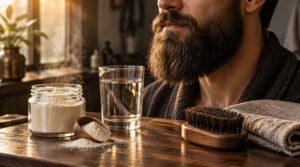
Collagen might help your beard in a few ways, but it won’t work miracles. I’ll walk you through four points below, starting with what it can do and ending with what it can’t. Knowing both sides will help you set realistic expectations before you spend a dime.
Amino Acid Support
Say you’re eating plenty of chicken, eggs, and fish, then add a scoop of collagen to your coffee, hoping your beard fills in. Here’s what happens: your gut breaks it into amino acids like glycine, proline, and hydroxyproline, which go into a shared pool.
Your body uses them wherever they’re needed, so they aren’t aimed at your face. Keratin production also leans on cysteine, which collagen barely contains.
Skin and Follicle Support
Your skin is the soil your beard grows from, and collagen is a big part of that soil. It makes up roughly 70% of the dermal layer, where your hair follicles are anchored.
Your skin is the soil your beard grows from, and collagen makes up about 70% of the layer anchoring every follicle
Here’s what that support may look like:
- Firmer anchoring for hair follicles
- Better follicle strength
- Thicker, more elastic skin
- Steadier nutrient delivery
- Less shedding
Limited Beard Growth Evidence
Most people don’t realize how thin the limited beard growth evidence really is. I haven’t found a single human trial testing collagen supplements on facial hair, and the scalp studies that exist often mix collagen with other nutrients. So you can’t tell what did the work.
Collagen may support hair follicle health indirectly, but don’t expect a fuller beard.
Genetic and Hormonal Limits
Collagen can nourish your skin, but it can’t rewrite your blueprint. Your beard mostly reflects genetics and hormones.
Here’s what really sets the limits:
- Inherited follicle density decides how many hair follicles can respond.
- Testosterone and DHT drive facial hair maturation, yet sensitivity varies.
- Each follicle microenvironment shapes how strongly hormones register.
Collagen only supplies amino acids, not new follicles.
Collagen Foods and Supplements: What to Know for Beard Health

If you’re thinking about adding collagen to your routine, it helps to know what’s actually worth your money. Below, I’ll walk you through food sources, how supplements get absorbed, and what’s safe to expect. That way you can decide what fits your beard goals without chasing hype.
Dietary Collagen and Supporting Nutrients
Want collagen for your beard? Start at the dinner table. Bone broth, fish with the skin on, chicken and beef all supply collagen your body can put to work.
But your body builds its own collagen too, and that takes vitamin C, zinc and copper. Eat leafy greens and colorful produce, and dietary supplements may matter less than you’d think.
Hydrolyzed Collagen and Absorption
Ever wonder why collagen powder dissolves so easily? That’s hydrolyzed collagen, broken into small peptides your body takes up far better than whole collagen from food. Absorption matters here:
- Peptides under 3,000 daltons move through your gut fastest.
- Amino acids peak in your blood within 30 to 120 minutes.
- Pairing it with vitamin C may help.
Still, absorbing it doesn’t prove it boosts beard growth.
Supplement Safety and Realistic Expectations
Here’s something supplement labels rarely mention: nobody checks them for safety before they hit shelves. Hydrolysed collagen can cause stomach upset or allergies, especially if it’s fish, egg, or bovine sourced. Check your medications and health first.
As for beard growth, no proven dose or timeline exists. Treat nutritional supplementation as a possible bonus, not a promise. Ignore antioxidant hype.
Factors Affecting Beard Growth Beyond Collagen

I’ll be straight with you: collagen is only a small piece of the beard puzzle. Several other things matter more, and I’d rather you know them before you spend another dollar on powders. Here are the four factors worth understanding if you want a realistic picture of what your beard can do.
Genetics And Family History
A look at your dad, uncles, and grandfathers tells you more about your beard than any supplement will. Genetics and hormones set how many hair follicles you have and where they sit on your face. Collagen supplements supply amino acids for protein synthesis, but they can’t add follicles you didn’t inherit. Even so, relatives only offer clues, not guarantees.
Some people try a derma roller beard kit to support patchy areas, though it can’t create follicles you weren’t born with.
Hormones And Follicle Sensitivity
Here’s where hormones really come in. Testosterone converts to DHT inside your follicles, and DHT drives follicle proliferation on your face.
But follicle sensitivity matters more than hormone levels. Your hormone sensitivity is inherited, so:
- Your levels can look perfectly normal and still grow patchy.
- Higher testosterone alone won’t guarantee fullness.
- Collagen can’t change how your follicles respond to DHT.
Age And Beard Development
Age plays into that sensitivity too. Your beard keeps filling in through your twenties, and many guys see their best coverage around 30, since hair follicles stay responsive to DHT.
After that, testosterone slips about 1% a year, so beard growth slows a bit. Collagen production and skin elasticity decline with age too, but collagen won’t reverse any of it.
Nutrition And Overall Health
Nutrition is the one lever you can actually pull. Your follicles need enough protein, zinc, iron, and vitamin D to work properly, and a shortfall can leave your beard patchy or slow.
Colorful fruits and vegetables add antioxidant protection, too. If your diet is solid, collagen won’t add much to beard growth. Sleep, stress, and regular checkups matter just as much.
Frequently Asked Questions (FAQs)
Can collagen increase beard growth?
Probably not, at least not in any way you can count on. No solid human research shows collagen increases beard growth. Your hair follicles build keratin from amino acids, and collagen doesn’t specifically switch them on.
What supplements boost beard growth?
Picture a patchy beard where the strands feel thin and brittle. Before you buy anything, know this: supplements like zinc and vitamin D help mostly if you’re deficient. Check your levels first.
What helps a beard grow quicker?
Your genes set the ceiling, but you can still reach it. Sleep well, lift weights, and eat enough protein and zinc and iron. Support testosterone, keep your hair follicles healthy, and don’t expect collagen or amino acids alone to speed up beard growth.
Does collagen raise testosterone?
No, collagen doesn’t raise testosterone. It’s a protein that gives your body amino acids, not a hormone signal, and nothing in the research shows it changes hormone production or your hair follicles’ testosterone response.
Does Collagen Cause Facial Hair Growth?
Short answer: no. Collagen doesn’t cause facial hair growth. It helps the skin around your hair follicles, but testosterone and your genes decide beard growth. Supplements won’t switch on follicles that aren’t wired to respond.
Does Collagen Grow Hair Back?
Not really. Collagen may thicken the hair you already have and cut down on shedding, but trials show little proof it regrows hair on bald patches. It nourishes existing hair follicles, and it can’t revive dead ones.
Does Collagen Affect Testosterone?
A guy in my clinic once swore his collagen shake doubled his beard. It didn’t. Collagen’s glycine and proline don’t raise your testosterone, and heavy protein intake can even nudge androgens down.
Is Too Much Collagen Bad for Your Beard Hair?
Say you double your collagen dose. It won’t damage your beard, but it may cause nausea.
Collagen doesn’t change oxidative stress, hair follicle stimulation, testosterone levels, or beard growth, so don’t expect any extra results.
Does Collagen Grow Hair Faster?
Think of collagen as fresh strings on a guitar you’re already playing: better tone, same tempo. Collagen supplements may improve hair thickness and follicle nourishment, but they won’t speed your beard growth or change your hair growth cycle.
What age does beard growth typically peak?
Picture a guy at 22 with a patchy chin, watching his roommate’s beard fill in. Don’t worry yet. Beard growth usually keeps thickening through your 20s, often peaking in your late 20s or early 30s, depending on follicle vitality and testosterone response.
Conclusion
So, does collagen help beard growth the way the ads promise? Based on what we have, probably not directly. No human trial has tested it, and your genes and hormones still call the shots.
Collagen might support your skin, which is a fair little perk. If you want a fuller beard, though, focus on sleep, protein, and steady habits first, then give it time. Your beard grows on its own schedule, and patience beats powder.