This site is supported by our readers. We may earn a commission, at no cost to you, if you purchase through links. This content is for general informational and educational purposes only and is not a substitute for professional medical, dermatological, or nutritional advice.
Around your mid-twenties, your body quietly starts producing less collagen—the protein that holds your skin, scalp, and follicle tissue together.
Most people don’t notice until the evidence shows up in the mirror: hair that snaps instead of bends, strands that look dull no matter what you put on them, or a part line that seems a little wider than it used to.
Collagen isn’t a hair-growth drug, but it does something equally important—it maintains the biological environment your follicles depend on. Understanding the real benefits of collagen for hair means knowing exactly what it does, what it can’t do, and how to use it without wasting your time or money.
Table Of Contents
- Key Takeaways
- What is Collagen for Hair?
- How Collagen Supports Hair Structure
- Top Benefits of Collagen for Hair
- Does Collagen Help Hair Growth?
- Best Ways to Use Collagen
- Collagen Safety and Product Tips
- Frequently Asked Questions (FAQs)
- What are the 5 signs that collagen is working?
- What foods are rich in collagen?
- Are collagen supplements safe?
- Does collagen help with hair breakage?
- How long does it take to see results from taking collagen?
- Is there a difference between animal sourced and vegan collagen?
- What are the best natural sources of collagen?
- Does collagen promote faster hair growth overall?
- How does collagen interact with existing scalp conditions?
- Are fish-derived collagens better for hair health?
- Conclusion
Key Takeaways
- Collagen doesn’t grow new hair, but it maintains the scalp environment your follicles depend on — think of it as keeping the soil healthy, not planting new seeds.
- Your body’s collagen production starts quietly declining in your mid-twenties, which is exactly when hair brittleness, dullness, and a widening part tend to show up in the mirror.
- The amino acids in collagen — especially glycine and proline — feed into keratin production, which means stronger, more elastic strands that bend instead of snapping.
- Results aren’t quick: most people start noticing less breakage and better shine around weeks 6–12, with meaningful density changes taking up to six months of consistent daily use.
What is Collagen for Hair?

Collagen is the most abundant protein in your body, and it plays a bigger role in hair health than most people realize. Understanding what it actually does — and why it starts working against you after your mid-twenties — makes it a lot easier to decide if it’s worth adding to your routine.
It even reaches into unexpected areas — research suggests collagen may support beard growth and follicle strength in ways most people haven’t considered.
Here’s what you need to know before we get into the specifics.
What Collagen is and Why It Matters for Hair
Think of collagen as your body’s scaffolding protein — it holds things together, including the tissue surrounding each hair follicle. Its molecular structure is built from amino acids like glycine and proline, which also fuel keratin production.
Collagen biosynthesis naturally slows after your mid-twenties, so the amino acid profile your follicles depend on gradually shrinks.
That’s where collagen supplementation and hair growth research starts getting interesting. Recent studies suggest that collagen peptide supplementation may reduce hair loss and promote regrowth.
Collagen as a Structural Protein in Skin and Scalp
Your scalp dermis is a dense, interwoven matrix — collagen fibrils locked together through crosslinks that control the elastic modulus, or structural stiffness, of the tissue.
This fibril crosslink density runs along Langer line tension patterns, which is how your skin naturally distributes mechanical stress.
Follicles sit anchored within that framework, dependent on scalp matrix porosity for nutrient flow and collagen’s role in hair follicle health.
How Collagen Declines With Age
Here’s what’s quietly happening under your scalp as you age: fibroblast activity slows, and those cells stop producing collagen as efficiently as they once did. Mechanical signaling loss means the tissue gets fewer "build more" cues. Add AGE accumulation, enzyme imbalance, and matrix remodeling that can’t keep pace, and collagen deficiency becomes almost inevitable — directly affecting collagen’s role in hair follicle health.
As you age, slowing fibroblasts quietly starve your follicles of the collagen they depend on
Age-related decline in collagen production usually involves:
- Fibroblasts producing less collagen as skin ages chronologically
- Weaker mechanical signals that once triggered collagen synthesis
- Complex glycation end products stiffening existing fibers
- Matrix metalloproteinases breaking down collagen faster than it’s replaced
- A disorganized scaffold that can no longer anchor follicles firmly
Types I, III, and V Linked to Hair Support
Not all collagen types pull the same weight.
Type I builds the dense, fibrous framework that keeps your scalp firm and follicles anchored. Type III adds flexibility — think of it as the shock absorber alongside type I. Type V quietly regulates fibril diameter control and ECM organization, shaping how fibers form.
Together, they maintain the collagen fiber balance and follicle matrix integrity, which your hair depends on.
Marine Vs Bovine Collagen for Hair Health
Marine collagen, pulled from fish skin and scales, wins on collagen bioavailability — its smaller peptides absorb faster and dissolve more easily, making texture integration into drinks easy. Bovine collagen, sourced from cattle hides, costs less and suits those avoiding fish. Consumer preference often comes down to diet and tolerance.
Either way, consistent collagen supplementation and hair growth support depend more on daily habit than source.
How Collagen Supports Hair Structure
Collagen doesn’t just sit in your scalp looking pretty — it actually does heavy lifting for your hair from the inside out. Understanding how it works helps you see why consistent use is likely to matter more than a quick fix.
Here’s what’s happening beneath the surface.
Amino Acids That Help Build Keratin

Hair is mostly keratin — a tough structural protein held together by cysteine disulfide bonds, hydrophobic residue packing, and hydrogen bonding contributions.
When you take a collagen peptide, your body breaks it down into amino acids, then reroutes them toward rebuilding protein in your body, including keratin.
That amino acid diversity matters enormously for hair follicle health, since sulfur amino acids like cysteine are what give each strand its resilience.
Proline, Glycine, and Hydroxyproline Roles

These three amino acids — proline, glycine, and hydroxyproline — are the structural backbone of every collagen molecule your body makes.
Glycine Packing Rules explain why glycine slots into every third position of the Triple Helix Stability structure, keeping chains tightly wound. Proline Flexibility lets fibers bend without breaking. Hydroxyproline Thermal Resistance locks that shape under stress.
Together, they fuel collagen synthesis and directly support hair follicle health.
Scalp and Dermal Support Around Hair Follicles

Your scalp is more than skin deep — and that’s exactly where collagen earns its keep.
Below the surface, collagen scaffold integrity holds the dermis together, creating a stable niche where hair follicles can anchor and function. Three key ways this plays out:
- Dermal papilla signaling stays supported when surrounding connective tissue is healthy
- The connective tissue sheath maintains follicle organization at the base
- Follicular microvasculature delivers nutrients more effectively through an intact dermal structure
Scalp immune balance also depends on a well-structured dermis. When collagen declines, that whole environment quietly shifts — and follicles feel it first.
Hair Strength, Elasticity, and Reduced Brittleness

Think of each strand as a rope — when its fibers are well‑maintained, it flexes without snapping. Collagen peptides supply proline and glycine, the amino acids your follicles use to reinforce keratin. That enhances fiber crosslink density, keeping thin, dry, and brittle hair more resilient.
One trial reported a 19.6% drop in surface roughness after 12 weeks — smoother, stronger, less breakage.
Oxidative Stress Protection for Follicles

Free radicals don’t just age your skin — they quietly damage your follicles too, triggering lipid peroxidation and inflammatory signaling that disrupts normal hair cycles.
Marine collagen’s antioxidant activity helps restore redox balance, supporting catalase activity to neutralize oxidative stress before it harms follicle cells.
Melanocyte preservation is another upside — less oxidative damage may mean color that lasts a little longer.
Top Benefits of Collagen for Hair

Collagen won’t transform your hair overnight, but it does a lot of quiet work behind the scenes. From strengthening strands to supporting the scalp, the benefits tend to build over time.
Here’s what you can realistically expect when you start using it consistently.
May Improve Hair Strength and Resilience
When your scalp’s extracellular matrix is well-supported, hair doesn’t just look stronger — it actually behaves that way. Collagen supplies amino acids that feed into protein keratin production through amino acid synergy, giving each strand a firmer internal structure.
Better peptide bioavailability means those building blocks actually reach follicles.
Improved scalp microvascular flow and antioxidant defense mechanisms add another layer of resilience from the inside out.
May Reduce Breakage and Split Ends
Stronger strands still snap if the outer cuticle — that 5-to-10-layer protective shield — keeps taking damage. Collagen peptides support end fiber reinforcement and friction reduction, so hair moves through your fingers with less resistance.
That matters for hair health because moisture retention improves when the cuticle stays intact. Protein replenishment through collagen supplementation feeds the keratin network, quietly defending hair elasticity, hair thickness, and your ends against everyday wear.
May Enhance Shine and Smoothness
Breakage-free strands are only half the story — smooth, shiny hair depends on what’s happening at the surface. Collagen’s cuticle coating effect helps moisture retention by keeping the outer layers flat and sealed. Better light reflection follows naturally.
You also get frizz reduction as protein surface boost improves hair elasticity and slip, leaving hair looking polished without much effort.
May Support Thicker-looking, Fuller Hair
Fuller hair isn’t magic — it’s mostly math. Less breakage means more strands making it to length, which adds up to visible volume over time.
Collagen reinforces the dermal scaffolding around follicles, improving scalp microcirculation boost and nutrient delivery. Anti-inflammatory peptides also help keep the follicle environment calm.
Benefits of collagen for hair health include:
- Supporting hair follicle regeneration through scalp connective tissue strength
- Improving hair volume by reducing strand loss from brittleness
- Enhancing collagen impact on hair elasticity and shine with synergistic Vitamin C intake
May Help With Age-related Thinning
Age-related hair thinning isn’t one thing going wrong — it’s several. Hormonal interaction, declining microvascular circulation, and reduced collagen production all converge, often by your mid-40s.
| Factor | What Happens | Collagen’s Role |
|---|---|---|
| Hormonal Interaction | Androgens shrink follicles | Peptides support surrounding dermis |
| Collagen Decline | Scalp loses structural firmness | Synergistic nutrients restore matrix |
| Lifestyle Factors | Stress accelerates thinning | Collagen peptide timing aids recovery |
Collagen supplementation and hair growth research confirm that supporting dermal integrity helps slow age-related hair thinning gradually.
May Support Scalp Health and Follicle Anchoring
Your scalp is more than skin deep — literally. Collagen IV anchors the basement membrane integrity that keeps hair follicles firmly seated in the scalp.
When that follicle anchoring matrix weakens with age, shedding increases.
Collagen supplementation and hair growth research both point to scalp oxidative balance and stem cell niche support as key.
Diet and protein intake reinforce collagen’s role in hair follicle health from the inside out.
Possible Role in Delaying Premature Graying
Gray hair isn’t just genetics — oxidative stress plays a real role. Collagen supplies glycine, a key building block for glutathione, your body’s primary internal antioxidant.
Low glutathione is linked to premature hair greying, so collagen’s role in hair follicle health includes supporting melanin cell maintenance indirectly.
Pair it with vitamin C synergy and copper enzyme support for a stronger antioxidant defense around each follicle.
Does Collagen Help Hair Growth?

This is one of the most common questions I hear from clients, and the honest answer is: it’s complicated. Collagen doesn’t work like a hair-growth drug — it doesn’t flip a switch and sprout new strands overnight.
Here’s what the research actually shows, where it falls short, and what you can realistically expect.
What Current Research Says About Hair Growth
Research is starting to catch up with the hype.
A placebo-controlled trial showed a 27.6% increase in hair count after 12 weeks of daily hydrolyzed collagen plus vitamin C — that’s not nothing.
Clinical studies also point to collagen’s role in hair follicle health through Wnt activation, BMP reduction, and VEGF increase, improving peptide bioavailability and supporting real, evidence-based benefits of collagen for hair.
Why Evidence for Direct Regrowth is Limited
Here’s the honest truth: collagen doesn’t flip a switch in your follicles. Follicle Biology Complexity means hair regrowth depends on hormones, immune signals, and growth cycles — not just protein supply.
Limited Clinical Data and Measurement Challenges make it hard to confirm real regrowth versus simply less breakage. Multifactorial Causes like genetics and Signal Delivery Barriers after digestion, the lack of clinical evidence for direct regrowth makes sense.
Indirect Benefits Through Scalp and Protein Support
Think of collagen as foundation work rather than flashy renovation. While it won’t directly trigger new growth, it strengthens the environment where growth happens.
Dermal Matrix Hydration and Extracellular Matrix Integrity keep your follicle niche support intact.
Scalp Microcirculation Boost improves nutrient delivery, while Protein Peptide Recycling feeds amino acids back into keratin and collagen production — quietly backing your scalp health and protein synthesis from underneath.
Hair Density Vs Hair Quality Improvements
Here’s the distinction worth understanding: collagen is more likely to improve hair quality than raise your follicle count.
- Fiber resilience improves as peptide absorption delivers amino acid availability to scalp matrix integrity.
- Hair thickness and shine reflect collagen’s impact on hair elasticity.
- Hair density changes gradually, driven by follicle environment, not direct follicle creation.
Collagen’s role in hair follicle health is supportive, not generative.
Realistic Expectations From Supplements
Collagen isn’t a quick fix — and that’s worth saying plainly. Gradual results are the norm, and individual variability means your neighbor’s experience won’t mirror yours.
The effectiveness of collagen supplementation for hair growth has evidence limitations; consistent dosing matters more than hoping for a shortcut. A placebo effect is also real here, so stay grounded.
| Expectation | What’s Realistic | What’s Not |
|---|---|---|
| Strength | Improved with regular use | Overnight resilience |
| Thickness | Gradual, subtle changes | Instant volume |
| Growth | Indirect support only | New follicle creation |
How Long Results May Take to Appear
So how long does this actually take? The timeframe for visible hair improvement with collagen follows a fairly predictable arc — but your experience will vary.
- Weeks 1–4 (Early Onset): Scalp hydration and texture shift first
- Weeks 4–8: Reduced shedding, early shine improvements
- Weeks 8–12 (Midpoint Improvements): Hair appearance scores climb noticeably
- Weeks 12–24 (Peak Benefits): Density and strength changes become measurable
- Beyond 6 months: Consistency matters most here — results compound
Response variation is real; daily dosing outperforms skipping days substantially.
Best Ways to Use Collagen

Getting collagen into your routine is easier than most people expect. There are a few different ways to do it, and the right fit really depends on your lifestyle and what you’re already doing for your hair.
Here’s a look at your main options.
Collagen Powders, Capsules, Gummies, and Liquids
Your format matters more than you’d think. Each delivery method — collagen powder, capsules, gummies, or liquids — differs in absorption rates, cost per serving, and packaging materials.
| Form | Best For | Notes |
|---|---|---|
| Hydrolyzed collagen powder | Flexibility | Mix into coffee or smoothies |
| Capsules | Convenience | Fixed daily dose, no measuring |
| Gummies/Liquids | Ease | Often include added vitamins |
Collagen peptides support hair growth and collagen’s impact on hair elasticity and shine over time.
Oral Collagen Vs Topical Collagen Products
Choosing between oral and topical collagen really comes down to what you’re trying to fix. Topical products hit the surface fast — smoother scalp, softer texture — but penetration barriers stop most molecules from reaching your follicles.
Oral collagen peptides travel through your bloodstream, offering whole-body support where it counts:
- Supplies glycine, proline, and hydroxyproline directly to tissues
- Improves scalp hydration through systemic absorption mechanisms
- Promotes follicle anchoring via dermal collagen renewal
- Better long-term cost effectiveness per measurable outcome
- Higher user compliance when mixed into daily drinks
Food Sources of Collagen for Hair Support
Your diet can do a lot of the heavy lifting here. Bone broth, fish skin, and chicken skin are among the most collagen-rich foods you can add to regular meals.
Egg whites supply the amino acids your body needs to build structural proteins.
Leafy greens round things out by supporting your overall dietary protein intake alongside marine collagen-dense seafood options.
Nutrients Needed for Natural Collagen Production
Your body can’t build collagen out of thin air — it needs the right raw materials to get the job done.
- Vitamin C Cofactor: activates enzymes that stabilize collagen fibers
- Copper Enzyme (lysyl oxidase): cross-links and strengthens collagen fibrils
- Zinc Cofactor: facilitates collagen synthesis and tissue remodeling
- Essential amino acids from dietary protein intake: glycine, proline, and lysine
- Antioxidant Nutrients like vitamin C, zinc, and copper: protect collagen-producing cells from oxidative stress
Daily Dosage Ranges Commonly Used
Most people do well starting with a low dose of 2.5 g to 5 g of collagen peptide powder daily — enough to ease in without overwhelming your system.
Moderate dose recommendations usually land between 5 g and 10 g for broader hair and scalp support.
High dose considerations reach up to 15 g, though the recommended daily intake rarely needs to go higher.
Safety thresholds suggest staying under 10–15 g long‑term unless a doctor advises otherwise.
How to Add Collagen to a Hair-health Routine
Building a routine around collagen doesn’t have to be complicated.
A morning supplement schedule works well for most people — stir collagen powder into your coffee or smoothie, add a vitamin C boost from citrus or a supplement, and you’re done before breakfast is over.
If you train regularly, pre-workout collagen is worth trying too.
- Mix collagen peptides or collagen hydrolysate into any warm or cold drink daily
- Pair collagen powder with vitamin C-rich foods to support natural synthesis
- Keep travel-friendly packets in your bag for consistency on the go
- Support intake with a protein-rich diet from eggs, fish, and legumes
Collagen Safety and Product Tips
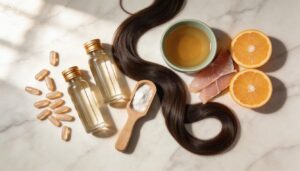
Collagen supplements are generally well-tolerated, but they’re not completely without risk.
Before you add one to your routine, there are a few things worth knowing — from how to spot a quality product to when a quick chat with your doctor makes sense. Here’s what to keep in mind.
Possible Side Effects and Digestive Issues
Most people tolerate collagen well, but side effects do happen.
Bloating and gas are the most common GI tract complaints, especially if you start with a high dose or take it on an empty stomach — classic dose-dependent GI behavior.
Histamine intolerance and additive sensitivities to sweeteners or gums can also cause trouble.
Anyone with kidney function considerations should check with their doctor first.
Fish, Shellfish, and Bovine Allergy Concerns
Source matters more than you might think.
Marine collagen carries fish gelatin allergens — meaning if fish triggers your immune system, even a "collagen supplement" label can hide a reaction risk. Shellfish cross-reactivity adds another layer of complexity.
Bovine collagen brings its own concern: alpha-gal bovine risk affects some red-meat-sensitive individuals. Always flag your allergy or an intolerance history before choosing animal sources.
How to Read Collagen Supplement Labels
Once you’ve sorted your allergy risk, the label itself becomes your next filter. Here’s what to actually look for:
- Confirm it says Hydrolyzed Collagen or collagen peptides — non-hydrolyzed forms absorb poorly.
- Check Molecular Weight — under 2,000 Daltons means faster gut uptake.
- Look for Protein Content at 10–15 g per serving with glycine, proline, and hydroxyproline listed.
- Practice Additive Avoidance — short ingredient lists win; skip maltodextrin, sucralose, and silicon dioxide.
Source Transparency matters too. Given the limited regulatory oversight of dietary supplements, a clean label is your best protection.
Choosing Tested, High-quality Collagen Products
clean label is a good start, but it’s not the whole story. Look for third-party certification logos — NSF, USP, or Informed Sport — which confirm dose clarity and identity.
Reputable brands also publish lot traceability information and molecular weight specs, so you know exactly what you’re getting. Source transparency and solid regulation and quality control practices separate trustworthy products from the rest.
Difference Between Collagen and Gelatin
Collagen and gelatin aren’t the same thing, even though gelatin comes from collagen. In its natural form, collagen has a tight triple helix structure — three protein chains wound together.
Hydrolysis processing breaks that down. Gelatin is basically denatured collagen: same amino acids, but shorter chains that form a denatured gel when cooled.
Collagen peptides go further, reaching an even smaller molecular weight — which is why they stay liquid, absorb easily, and actually work in collagen supplements rather than food gel applications.
When to Talk to a Doctor Before Use
Most people tolerate collagen well, but certain situations call for a doctor’s input first. Pregnancy counseling matters here — many products contain added ingredients that aren’t always safe during pregnancy or breastfeeding.
Kidney function, liver health, and medication review are equally important, since high protein intake and hidden additives can complicate existing conditions. Autoimmune caution applies too.
And remember — the FDA regulates collagen as food, not medicine, so quality control varies widely.
Frequently Asked Questions (FAQs)
What are the 5 signs that collagen is working?
Less breakage, more bounce, softer texture, thicker appearance, and reduced scalp irritation — these five signs suggest collagen is working.
You’ll also notice improved hair shine, less hair breakage, and healthier hair follicles over time.
What foods are rich in collagen?
Your best collagen rich foods are bone broth, chicken skin, marine fish skin, sardines, egg whites, and gelatin desserts.
A protein-rich diet with these dietary sources covers most of your daily collagen needs naturally.
Are collagen supplements safe?
For most healthy adults, yes — oral collagen peptides appear reasonably safe at up to 10 grams daily for around six months. Long-term use data beyond that window remains thin.
Does collagen help with hair breakage?
Yes, collagen can help. Its amino acids support protein keratin production, improving elasticity so strands snap less during styling. Consistent collagen for hair use gradually reduces breakage over time.
How long does it take to see results from taking collagen?
Most people want results in days. Realistically, visible onset begins around 6–12 weeks.
Hair cycle timeline runs long, so consistency requirement matters more than dosage. Early cosmetic changes — shine, less breakage — arrive before density shifts.
Is there a difference between animal sourced and vegan collagen?
Yes, there’s a real difference. Animal-sourced collagen delivers actual collagen peptides, while vegan collagen supplies building blocks to help your body make its own. Same goal, different routes.
What are the best natural sources of collagen?
You don’t need a supplement aisle to get collagen. Bone broth, fish skin, chicken feet, and egg whites are among the richest food sources.
Citrus fruits support your body’s own collagen production.
Does collagen promote faster hair growth overall?
Not exactly. Collagen peptides support the scalp environment through Wnt signaling and beta-catenin activation, but clinical trial timelines show changes take months — not days. It’s maintenance, not magic.
How does collagen interact with existing scalp conditions?
Think of your scalp like a soil bed — inflamed, dry, or flaky soil grows weak roots.
Collagen helps calm scalp inflammation, strengthen the hydration barrier, and support a microcirculation boost around follicles.
Are fish-derived collagens better for hair health?
Fish-derived collagen offers strong peptide bioavailability, but "better" depends on your needs, budget, and tolerance. The clinical evidence gaps mean no source clearly wins for hair.
Conclusion
Imagine your hair follicles thriving in a lush, collagen-rich garden— that’s what happens when you give your scalp the support it needs.
Boosting collagen levels can be a significant boost for hair health. The benefits of collagen for hair are numerous, from increased strength and shine to a healthier scalp.
By incorporating collagen into your routine, you’ll be on your way to a full head of healthy, vibrant hair that turns heads. Make the investment today.