This site is supported by our readers. We may earn a commission, at no cost to you, if you purchase through links.
Your bathroom shelf is bare except for your golden retriever’s oatmeal shampoo, and you’re already running late. The bottle promises a lustrous coat and gentle cleansing—surely it can’t be that different from human shampoo, right?
This exact scenario plays out more often than you’d think, with countless people reaching for dog shampoo on human hair either out of desperation, curiosity, or the belief that “shampoo is shampoo.”
But your scalp operates on an entirely different playing field than your dog’s skin, with pH levels, protective barriers, and follicle structures that demand specific care. What seems like a harmless substitution can actually trigger a cascade of issues, from persistent dryness to disrupted hair growth cycles, because formulations designed for Fido’s fur simply aren’t built for your biology.
Table Of Contents
Key Takeaways
- Dog shampoo operates at a pH of 6.2–7.4, which disrupts your scalp’s natural acidity (4.5–5.5), lifting hair cuticles and compromising the protective acid mantle that locks in moisture and keeps bacteria out.
- Using canine-formulated products can trigger scalp dryness, contact dermatitis, and brittle hair because their surfactants and additives strip natural oils and aren’t regulated under the same safety standards as human cosmetics.
- While occasional use might not cause permanent damage, repeated exposure weakens your scalp’s barrier function over time, leading to chronic irritation, microbiome imbalances, and increased vulnerability to allergens.
- Budget-friendly pH-balanced human shampoos with gentle surfactants and natural ingredients like aloe vera or oat extract offer safer alternatives that work with your hair’s biology instead of against it.
Why Consider Dog Shampoo on Human Hair?
You might be surprised how often people reach for dog shampoo when their own bottle runs dry, or when they’re curious if it could work as a budget-friendly swap. Some folks believe the ingredients are “more natural” or gentler than human products, while others simply wonder if there’s any real difference between the two.
Let’s look at why this idea crosses people’s minds in the first place, separating the practical reasons from the myths that keep circulating.
Common Reasons People Try Dog Shampoo
Curiosity often leads you down unexpected hair care paths, especially when scalp irritation from traditional products sends you searching for gentle cleansing alternatives. Cost factors make dog shampoo tempting—it’s budget-friendly and readily accessible. If you’re experimenting with bleach, understanding proper rinsing and shampooing after bleaching helps protect your scalp from the same irritation that drove you toward gentler options.
You might’ve heard anecdotal stories about using dog shampoo on human hair, sparking your interest in trying something designed for a completely different species. The pH balance question, though, deserves your attention before experimenting. Maintaining that balance is crucial—chronic irritation from harsh products can trigger inflammation that weakens follicles, so exploring gentler alternatives like nutrient-rich açaí for scalp and hair health might be worth considering.
Myths About Pet Vs Human Shampoo
Behind those appealing price tags lurk widespread shampoo myths that deserve your skepticism. Many assume pet shampoo vs human shampoo differences are negligible because both products lather similarly, but species safety hinges on skin pH balance—not cleaning power. Here’s what the cross-use conversation gets wrong: Using the wrong product can lead to irritation from pH imbalance and harsh ingredients, which is why understanding your pet’s specific skin chemistry matters more than convenience.
- Dog shampoo is universally gentler: Veterinary formulations aren’t held to cosmetic safety standards for humans, creating ingredient risks you can’t see.
- Equivalent cleaning means equivalent safety: Surfactants work across species, but pH balance and additives don’t translate—your scalp’s acid mantle needs different protection than a dog’s coat.
- Natural pet products are automatically human-safe: Essential oils and botanical extracts in dog shampoo can trigger contact dermatitis in sensitive individuals, compromising hair and scalp health.
- Using dog shampoo on human hair saves money long-term: Disrupting your scalp’s microbiome with incompatible formulations often costs more in corrective treatments than you’d save upfront.
Media amplification and online forums perpetuate these claims without controlled studies backing them up. Before you overhaul your routine based on viral advice, check out evidence-based hair washing guidelines that factor in your scalp’s natural pH and actual hair needs.
Cost and Accessibility Factors
Let’s talk dollars and access. That $4 to $10 price tag at your local supermarket makes dog shampoo tempting when you’re stretching paychecks, especially with bulk purchasing and subscription discounts slashing per-use costs even further. But here’s the catch: those short-term cost savings can backfire fast if you’re paying dermatologists later to repair scalp damage from incompatible formulations. Choosing the right clarifying shampoo for product buildup means matching formulation strength to your specific scalp needs—something dog shampoos can’t offer.
Dog shampoo’s tempting price tag can backfire when incompatible formulations send you to the dermatologist later
| Product Type | Average Price Range | Where You’ll Find It |
|---|---|---|
| Dog Shampoo | $4–$10 per bottle | Pet retailers, supermarkets, online |
| Generic Human Shampoo | $3–$8 per bottle | Drugstores, discount retailers, bulk stores |
| Budget-Friendly Natural Options | $6–$12 per bottle | Health stores, subscription services, DIY beauty suppliers |
| Medicated Human Formulas | $8–$15 per bottle | Pharmacies, dermatology clinics, online |
Key Differences Between Dog and Human Shampoo
You might think shampoo is shampoo, but dog and human formulas are actually built for completely different skin chemistry. What works for your pup’s coat can throw your scalp’s natural balance way off, leading to dryness, irritation, or worse.
Let’s break down the three main differences that matter most when you’re tempted to reach for that bottle of doggie shampoo.
PH Levels and Skin Compatibility
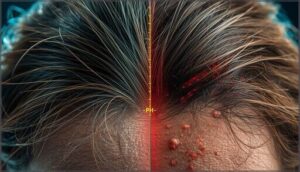
Your scalp thrives in an acidic environment, usually sitting between 4.5 and 5.5 on the pH scale, while your dog’s skin runs more neutral at 6.2 to 7.4. This difference matters because your skin’s acid mantle—that protective barrier keeping bacteria out and moisture in—depends on proper pH balance. Dog shampoo’s higher alkalinity can disrupt your barrier function, triggering skin irritation and compromising scalp health in ways you mightn’t notice immediately.
Here’s what happens when pH levels clash with skin compatibility:
- Your hair cuticles lift and open, exposing the inner structure to moisture loss and environmental damage
- Natural lipid synthesis slows down, leaving your scalp drier and more vulnerable to flaking
- Protein denaturation occurs in keratin, weakening your hair’s structural integrity over time
- Your scalp’s microbiome shifts, potentially allowing opportunistic bacteria to flourish where beneficial ones once dominated
- Transepidermal water loss increases, meaning your skin can’t hold onto hydration the way it should
The mismatch between dog shampoo pH and your skin’s natural acidity isn’t just uncomfortable—it fundamentally alters how your scalp protects itself. While your skin will eventually restore its acidic baseline after cleansing, repeated exposure to products formulated for canine skin pH can prolong recovery time, leading to cumulative dryness, itching, and irritation that compounds with each wash.
Ingredient Formulations and Additives
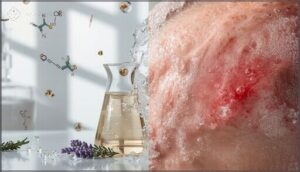
Dog shampoos often rely on surfactants like sodium laureth sulfate—powerful enough for greasy coats but harsh on your scalp’s natural sebum balance. You’ll also encounter preservatives such as parabens or phenoxyethanol, plus fragrance blends that trigger contact dermatitis in sensitive individuals.
Essential oils and animal-derived conditioning agents can leave detergent residue or provoke allergic reactions, disrupting the pH balance your skin depends on for protection.
When evaluating the safety of these products, it’s vital to review scientific study summaries to assess potential risks.
Purpose-Built Functions for Dogs Vs. Humans
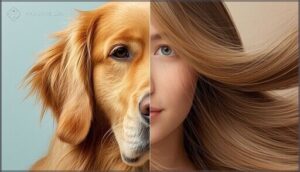
Canine skin produces sebum differently than your human scalp, which is why pet grooming formulas target coat types—short versus long—rather than follicle health or keratin repair. Functional design reflects species specificity: dog shampoos prioritize odor control and flea resistance at pH 6.0–7.5, while human products focus on hair and scalp health through moisture retention and pH balance near 5.5, supporting your acid mantle’s protective barrier.
Effects of Dog Shampoo on Human Hair and Scalp

You might think dog shampoo won’t hurt your hair in a pinch, but the reality is more complicated than that. The formulation differences we just covered translate into real effects on your scalp and strands, some subtle and others impossible to ignore.
Here’s what actually happens when you use dog shampoo on human hair, from the occasional upside to the more common downsides.
Potential Benefits and Drawbacks
You might wonder if using dog shampoo on human hair offers any real perks. Honestly, the drawbacks outweigh potential benefits. While some dog shampoos contain milder surfactants or hypoallergenic formulas that could suit scalp sensitivity, their pH balance isn’t optimized for human hair care and maintenance.
Ingredient risks include fragrances and additives that trigger scalp irritation or hair damage, compromising hair texture over time despite any short-term cleaning power.
Risks of Scalp Dryness and Irritation
When you lather up with dog shampoo, you’re inviting trouble. The pH imbalance disrupts your skin barrier, ramping up transepidermal water loss and triggering scalp dryness within days. Watch for these warning signs:
- Redness and itching from surfactants stripping natural oils
- Micro-scaling appearing within 24–72 hours
- Contact dermatitis from fragrances or botanical extracts
- Persistent scalp irritation requiring gentler formulations
Impact on Hair Texture and Health
Think your hair feels fine after a dog shampoo rinse? That alkaline mismatch lifts the hair cuticle, accelerating moisture loss and leaving strands brittle. You’ll notice texture changes first—dullness, roughness, increased breakage—especially if you have fine or color-treated hair types.
Scalp irritation compounds the damage, disrupting hair growth cycles and undermining overall hair health with each wash.
Safety Risks and Precautions
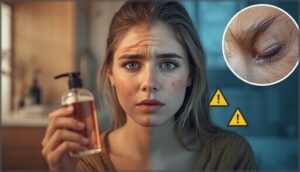
While a one-time use of dog shampoo mightn’t cause immediate harm, the risks go beyond just a dry scalp or frizzy hair. Your body’s reaction to these canine-formulated products can range from mild irritation to more serious allergic responses, and repeated exposure compounds the damage over time.
Let’s look at the specific safety concerns you need to know before reaching for that bottle of pet shampoo.
Allergic Reactions and Sensitivities
Your scalp isn’t a gamble you want to lose. Dog shampoo ingredients—especially fragrance allergens like limonene and linalool—can trigger contact dermatitis, leading to redness, itching, and scalp irritation. If you have a sensitive scalp or known skin sensitivities, the risks multiply. Consider these warning signs:
- Surfactants may disrupt your scalp’s protective barrier
- Allergic reactions can appear hours after use
- Fragrance components often hide multiple allergens
- Patch testing reveals sensitivities before full application
Long-Term Hair and Skin Concerns
Repeated contact with non-human formulations doesn’t just cause one-off reactions—it can quietly unravel your scalp’s defenses over time. Chronic exposure weakens skin pH balance, inviting persistent scalp irritation and hair damage that sneaks up on you.
Here’s what the long-term effects look like:
| Risk Category | What Happens | Your Hair’s Reality |
|---|---|---|
| Barrier Breakdown | Acid mantle disrupts | Dryness, flaking, vulnerability |
| Fiber Integrity | Cuticle wear accelerates | Brittle strands, dullness |
| Sensitization | Allergen exposure builds | Contact dermatitis, chemical reactions |
Your scalp microbiome shifts, sebum balance falters, and skin sensitivity climbs—all because you’re using something never meant for human biology.
When to Avoid Dog Shampoo Completely
Some warning signs mean dog shampoo crosses from risky into dangerous territory—your skin and scalp deserve better. You should never use it if you’ve got diagnosed dermatitis, known allergies to specific ingredients, or broken scalp wounds. Here’s when to steer clear completely:
- Diagnosed dermatitis or contact dermatitis history
- Known allergy to surfactants or fragrance reactions
- Broken or severely irritated scalp wounds
- Persistent redness, swelling, or allergic reactions after use
Skin pH balance disruption isn’t worth experimenting with.
Better Alternatives for Human Hair Care

You don’t need to settle for dog shampoo when there are plenty of human-specific options that won’t mess with your scalp’s pH or strip your hair of its natural oils. Whether you’re on a tight budget or just want something gentler, you’ve got choices that actually work with your hair’s biology instead of against it.
Here’s what to look for when you’re shopping for a shampoo that treats your hair right.
PH-Balanced Human Shampoos
When you’re shopping for human shampoo, look for products labeled ‘pH-balanced‘ or ‘pH 5.5.’ These formulas usually fall within the 4.5 to 5.5 range, which matches your scalp’s natural acidity and aids scalp health.
This compatibility helps maintain hair moisture, protects sensitive skin, and preserves the barrier that keeps irritation at bay—unlike dog shampoo’s higher pH levels that disrupt human hair health.
Natural and Gentle Ingredient Options
Beyond pH-balanced formulas, you can seek out natural ingredients that work with your hair, not against it. Look for products featuring:
- Aloe Vera – aids moisturization and soothes irritation
- Oat Extract – calms sensitive scalps with barrier-boosting effects
- Gentle Surfactants like decyl glucoside – cleanse without harsh stripping
- Plant Oils – deliver nourishment and hydration
- Natural Moisturizers such as glycerin – attract and lock in moisture
These organic ingredients mirror what you’d find in cruelty-free, eco-friendly natural dog shampoo, but they’re formulated specifically for human hair health.
Tips for Safe, Budget-Friendly Hair Care
Smart hair care doesn’t demand luxury prices. You can build a gentle, effective hair care routine by choosing budget shampoos with pH-balanced formulas, pairing them with natural conditioners featuring plant oils, and prioritizing scalp protection through fragrance-free gentle cleansers.
Compare unit prices, test products on small patches first, and wash every 2–3 days—budget-friendly strategies that safeguard both your wallet and your hair health.
Frequently Asked Questions (FAQs)
Can dog shampoo cause permanent hair damage?
Most folks worry about losing hair for good, but here’s the thing—occasional dog shampoo use won’t cause permanent damage.
You might face temporary dryness, scalp irritation, or frizz, though allergic reactions need attention.
How often is dog shampoo use safe?
Using dog shampoo on human hair more than once every one to two weeks risks scalp irritation and dryness.
Sensitive individuals should extend that interval further, choosing pH-balanced alternatives designed for human hair health instead.
Does dog shampoo affect hair color or dye?
Dog shampoo can compromise color stability and dye longevity due to its alkaline pH and lack of color-safe stabilizers. Residue may affect hair pigmentation perception, while repeated use increases color fade risk on treated human hair.
Are there legal or regulatory ingredient differences?
Here’s the twist: Regulatory Oversight for pet shampoo vs human shampoo differs dramatically. Ingredient Safety, Labeling Requirements, and Compliance Standards are stricter for human cosmetics, with mandatory toxicology testing, surfactants checks, pH levels verification, and skin compatibility assessments often bypassed in pet formulations.
Can children safely use dog shampoo occasionally?
While pediatric skin care experts don’t outright ban occasional dog shampoo use, child safety risks multiply quickly—sensitive scalp reactions, allergy prevention concerns, and skin irritation treatment needs make gentle cleansing with child-specific products the smarter default.
Conclusion
Don’t let desperation lead you down the wrong grooming aisle—your scalp deserves better than a product engineered for canine biology. Using dog shampoo on human hair isn’t just ineffective; it’s a mismatch that can compromise your scalp’s pH balance, strip essential oils, and trigger lasting irritation.
Invest in formulations designed for your unique follicle structure and skin chemistry. Your hair’s health depends on species-appropriate care, not borrowed bottles from the pet shelf.