
This site is supported by our readers. We may earn a commission, at no cost to you, if you purchase through links.
Your hair is one of the most visible ways you express yourself, so choosing between dreads and braids isn’t just about aesthetics—it’s about committing to a lifestyle. While both styles celebrate natural texture and cultural heritage, they demand completely different things from your hair and your time.
Dreads create permanent, rope-like strands that deepen over months and years, while braids offer flexibility and can be taken down and redone without long-term commitment.
The choice between them depends less on which looks better and more on what your hair can actually handle, how much maintenance you’re willing to invest, and what kind of statement you want to make. Understanding the real differences—from installation methods to cost to hair health implications—will help you pick the style that genuinely fits your life.
Table Of Contents
- Key Takeaways
- Key Differences Between Dreads and Braids
- History and Cultural Significance
- Installation Process and Time Required
- Maintenance and Upkeep Requirements
- Impact on Hair Health and Growth
- Styling Options and Versatility
- Suitability for Hair Types and Textures
- Cost and Maintenance Commitment
- Pros and Cons of Dreads Vs Braids
- Frequently Asked Questions (FAQs)
- Can you start dreads from braids?
- Can I let my braids turn into dreads?
- When do braids become dreadlocks?
- Can you switch between dreads and braids easily?
- How do you remove dreads or braids without damage?
- Whats the best way to sleep with each style?
- Do dreads or braids work better for swimming?
- Which style is easier to hide for professional settings?
- Conclusion
Key Takeaways
- Dreads demand long-term commitment with 8-12 months to mature and require retwisting every 4-6 weeks, while braids offer flexibility with 4-8 week wear cycles and full removal without permanent changes to your hair.
- Both styles carry real risks of traction alopecia and hair damage if installed too tight, making installation tension and maintenance intervals critical to protecting your scalp health and preventing irreversible follicle damage.
- Your hair texture dramatically affects which style works best: coily hair (type 3B-4C) locks quickly and holds braids securely, while straight hair takes 18-24 months to lock and requires heavier products to prevent slippage.
- Annual costs for maintaining either style range from $480-$2,140 depending on your location and salon, plus 18-65 hours yearly of your time for washing, retwisting, and reinstallation—making this a genuine lifestyle commitment beyond aesthetics.
Key Differences Between Dreads and Braids
When you’re choosing between dreads and braids, understanding how they differ from each other makes all the difference in finding the right fit for your lifestyle and hair goals.
These two styles take completely different paths when it comes to their look, how they’re created, and what kind of commitment they demand from you.
Let’s break down the main distinctions so you know exactly what you’re getting into with each option.
Appearance and Texture
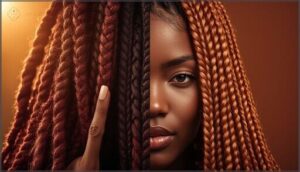
When you’re weighing dreadlocks vs braids, the visual characteristics couldn’t be more distinct. Dreads form dense, rope-like strands with a matte finish and organic texture, while braids create sleek, uniform plaits that catch the light.
The texture comparison reveals dreads feel coarse and heavy, whereas braids maintain flexible movement. Color variations pop more dramatically in braided hair styling, and each carries its own aesthetic perception.
Deciding between the two also depends on individual preferences.
Installation Methods
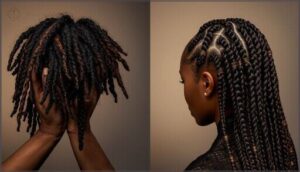
Beyond the look, how you create each style shapes your experience. Dreadlocks formation uses backcombing, twisting, or palm-rolling to mat hair into starter dreadlocks—taking 4–12 hours with staggered parting techniques to distribute weight. Braided hairstyle installations rely on square or triangular parting, weaving extensions through sections in 4–12 hours depending on thickness. Both styling techniques demand proper tension to protect scalp health and minimize mechanical damage risks.
Dreadlocks, for example, have ancient historical roots across various cultures.
Hair Length Requirements
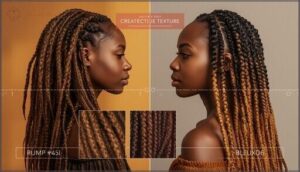
Hair length requirements vary greatly between these styles. You’ll need at least 3–6 inches for dreadlocks, though coarse textures can start at just 1–4 inches. Braids work with shorter minimum lengths—cornrows at 1.5–2 inches, box braids around 2 inches.
Texture influences how quickly each style locks or grips. Shorter hair faces unraveling risks and reduced style durability, while extensions bridge the gap when natural length falls short.
Longevity and Commitment
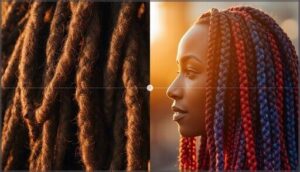
Once your hair meets minimum length, style duration sharply separates these options. Dreads demand 8–12 months to mature and often remain indefinitely—reversal options mean cutting or hours-long comb-outs. Braids last 4–8 weeks before maintenance frequency jumps again. Your hair impact and styling decisions hinge on whether you’re embracing years of commitment or rotating fresh looks every season.
- Dreads evolve slowly through budding phases before locking completely
- Box braids need reinstallation every month or two as growth shows
- Removal flexibility lets braids shift with your mood and wardrobe
- Loc wearers invest upfront, then enjoy lower-frequency upkeep
- Traction risks climb when either style stays too tight too long
History and Cultural Significance

Both dreads and braids carry deep historical roots that stretch back thousands of years across multiple continents and cultures. Understanding where these styles come from helps you appreciate their significance beyond fashion and reveals why they’ve remained powerful forms of self-expression.
Let’s look at the origins and meaning behind each hairstyle, and how they’ve evolved into the popular styles you see today.
Origins of Dreadlocks
Dreadlocks didn’t spring from just one place—they evolved across continents over millennia. Ancient South Asia documented locked hair in Hindu texts around 1500 BCE, while African evidence traces Egyptian sculptures to 3100 BCE. Mediterranean depictions from Minoan Crete and archaic Greece show similar styles by 1600 BCE. The modern term “dreadlocks” emerged through Rastafari origins in 1940s Jamaica, sparking global diffusion worldwide.
| Region | Earliest Evidence |
|---|---|
| Egypt & Africa | ~3100 BCE sculptures, mummified remains |
| Ancient South Asia | ~1500 BCE Hindu scriptures (Vedas) |
| Mediterranean | ~1600 BCE Minoan frescoes, Greek statues |
Cultural Roots of Braids
Braiding patterns stretch back over 5,000 years, rooted deeply in African origins. Archaeological finds from around 3500 BCE reveal cornrows in Saharan rock art, while Ghana braids appear in hieroglyphics circa 500 BCE. Across African cultures, these intricate styles communicated far more than beauty—they signaled tribal affiliation, social status, marital availability, and even age.
During the slave trade, braids became survival tools, sometimes encoding escape routes or hiding seeds. Today, diaspora braids connect millions to ancestral heritage, bridging continents through global traditions that honor cultural identity and resilience.
- Ancient Africa pioneered cornrows and Ghana braids documented as early as 3500 BCE
- Braid patterns communicated social status, tribe, and marital availability in precolonial societies
- Enslaved Africans used braids for survival, hiding resources and mapping escape routes
- Modern diaspora communities wear braids as symbols of cultural identity and ancestral connection
Modern Popularity and Symbolism
As fashion trends propel locs and braids onto runways and red carpets, these styles have evolved into powerful statements of cultural identity and self-expression.
Media representation now celebrates protective styling, while over 20 states pass laws protecting natural hair in workplaces and schools.
Celebrities and influencers increase social acceptance, though debates around cultural appropriation persist—reminding us that identity expression through hair remains deeply personal and politically charged.
Installation Process and Time Required
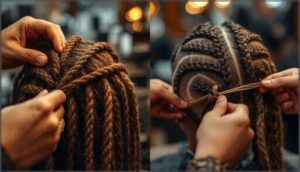
Getting dreads or braids isn’t something that happens in an afternoon—both styles demand time, patience, and a specific approach to installation. The process you choose depends on the look you want and how much commitment you’re ready to make.
Here’s what you need to know about creating each style, the techniques involved, and the time investment required.
Creating Dreadlocks
You’ve got three main installation methods for dreadlocks: backcombing, twisting, or crochet hook work. Most professionals spend 8 to 16 hours creating a full head of starter locs, while DIY attempts can stretch across several days.
You’ll need at least 6 to 8 inches of hair length to reduce slippage during formation. Watch for product residue buildup and scalp risks like traction alopecia from overly tight sections.
Braiding Techniques and Styles
You’ll encounter dozens of braided hairstyles—from box braids and cornrows to knotless braids and Senegalese twists. Extension methods vary widely: feed-in techniques gradually add synthetic or human hair for a natural look, while traditional methods attach extensions at the root. Pattern complexity ranges from simple three-strand plaits to intricate goddess braids with curly ends.
These protective styles honor cultural variations across African, Caribbean, and global traditions.
Time Investment for Each Style
Installation duration separates these styles dramatically. Your chair time and daily upkeep commitments differ at every stage:
- Full-head box braids generally demand 2 to 6 hours, depending on braid size and hair length
- Professional dreadlock installations average 8 to 12 hours for complete setups
- Daily styling remains minimal for both—locs need occasional separation, braids require light scalp moisturizing
- Maintenance cycle for braids runs 4 to 8 weeks before reinstallation
- Long-term commitment favors locs—mature dreads skip repeated takedowns, while continuous braid wear means 6 to 12 full sessions yearly
Session duration and hair upkeep patterns shift your hairstyle maintenance from weekend projects to lifestyle choices.
Maintenance and Upkeep Requirements
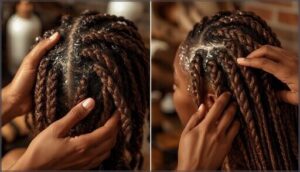
Once you’ve committed to dreads or braids, the real journey begins with keeping them healthy and looking sharp. Both styles demand different routines regarding washing, retightening, and fighting off the usual culprits like frizz and buildup.
Let’s break down what each style needs to stay in great condition.
Cleaning and Washing Practices
How often should you wash? Dreadlocks generally need cleansing every 7–10 days to maintain scalp health and prevent product buildup, while braids require a full wash every 1–2 weeks.
Use residue-free or sulfate-free shampoos to keep both styles fresh without excessive drying. Focus on your scalp when washing braids, and consider clarifying treatments for locs to lift embedded oils and prevent odor.
Retightening and Touch-Ups
Regular hair maintenance keeps your look crisp and protects scalp health. Loc maintenance and retwisting generally happen every 4–6 weeks for traditional methods, while crochet dreads can stretch 2–3 months between sessions. Braids need touchups around week 4–6, especially at edges. Here’s your retightening frequency guide:
- Locs: Retwist every 4–6 weeks to maintain roots
- Crochet dreads: Schedule maintenance every 2–3 months
- Box braids: Refresh edges around week 6
- Knotless braids: Touch up hairline at 4 weeks
- Tribal braids: Edge touchups every 2 weeks
Tension limits matter—over-manipulation thins roots and triggers traction alopecia. Stretching intervals between sessions improves style longevity while reducing cumulative stress on follicles. Cost analysis shows retwist sessions average $60–150, so balancing maintenance schedules with your budget and hair’s response helps you commit long-term without compromising scalp health.
Preventing Frizz, Matting, and Buildup
Between touch-ups, product selection and hair washing frequency determine whether you battle frizz or enjoy smooth locs and braids. Residue-free shampoos clear away buildup without weighing down your style—wash braids every 7–14 days and mature locs every 1–2 weeks.
Light oils beat heavy butters for upkeep and cleanliness, while mechanical practices like satin bonnets reduce friction that creates matting and preserves scalp condition.
Impact on Hair Health and Growth
When you’re choosing between dreads and braids, the impact on your hair’s health matters just as much as the look you’re going for. Both styles affect how your hair grows and behaves, but they come with different risks you’ll want to understand upfront.
Here’s what you need to know about growth rates, potential damage, and what hair experts actually recommend.
Hair Growth Rates With Each Style
Here’s the truth: both styles retain about 1.25 cm of growth monthly—your hair doesn’t grow faster under braids or locs. The real differentiator is length retention through protective styling.
Braids shield ends from daily friction, preserving that monthly growth, while locs trap shed hair within the strand, often creating visible length over years.
Factors influencing hair growth include genetics and scalp health, but breakage prevention and avoiding traction alopecia determine how much length you actually keep.
Risks of Breakage and Thinning
When you’re weighing dreads against braids, consider how hairstyle weight, installation tightness, and maintenance impact hair health. Tight styles and heavy locs can trigger traction alopecia, thinning, and breakage—especially at the hairline. Watch for reversibility signs like scalp tenderness or increased shedding; ignoring them risks permanent hair loss and damage.
- Traction Alopecia risk
- Installation Tightness matters
- Hairstyle Weight strains roots
- Maintenance Impact on breakage
Dermatologist Recommendations
Before your stylist picks up the first section, understand that dermatologists have clear guidance on protecting your scalp health. The American Academy of Dermatology emphasizes that any braids or locs causing pain signal dangerous installation tightness—loosen immediately to prevent traction alopecia risk.
If your braids or locs cause pain, loosen them immediately to prevent permanent traction alopecia
Early style modification—switching from tight installs to looser alternatives—can reverse hair loss and breakage before permanent damage sets in.
| Protective Strategies | Why It Matters |
|---|---|
| Opt for thicker sections | Reduces hair follicle health strain |
| Keep styles 6–8 weeks max | Limits cumulative hair breakage |
| Regular Scalp Cleansing | Prevents inflammation, buildup |
Styling Options and Versatility
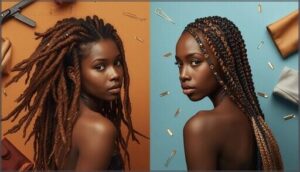
One of the most exciting aspects of choosing between dreads and braids comes down to how much creative freedom you’ll have with styling. Both options offer impressive versatility, though they express it in different ways depending on the structure and flexibility of each style.
Understanding what you can do with each will help you decide which aligns better with your personal aesthetic and lifestyle.
Styling Variations for Dreads
Dreads aren’t just a one-and-done look—they’re a canvas for creativity. You can rock formal dread updos for special events, throw them into everyday dread styles like ponytails, or go bold with colored dreads and accessorized dreads featuring beads or cuffs.
Styling trends show that modern hair styling options for locs blend cultural roots with fresh hair styling practices, giving you endless ways to express yourself.
Different Braid Patterns and Designs
Braided hairstyles offer an amazing range—from thick, dramatic box braids that let you switch up your length and volume, to knotless braids that feel lighter on your scalp. You can explore:
- Cornrow designs in straight-back, curved, or geometric patterns
- Microbraids for intricate, delicate detailing
- Feed-in styles that reduce tension at your hairline
- Fulani and tribal braids blending cultural heritage with modern flair
- Senegalese twists for a softer, rope-like texture
Different braid styles optimize protective potential while showcasing unique hair patterns.
Combining With Other Hairstyles
You can layer your locs or braids into updos—think high buns, twisted crowns, or half-up styles—for formal or everyday wear. Braids blend beautifully with weaves and extensions, while locs pair well with ponytails or buns to boost volume.
Just watch for added tension: tight pulls, heavy synthetic packs, and constant styling can stress your hairline and trigger traction issues.
Suitability for Hair Types and Textures

Not every hair type locks or braids the same way, and understanding your natural texture can save you frustration down the road. Some textures naturally coil and mat into dreads with minimal effort, while others need more coaxing or specific techniques to hold braids securely.
Let’s break down which hair types work best for each style and what you should consider based on your unique texture.
Best Hair Types for Dreads
Your natural curl pattern plays a huge role in how quickly locs form. Coily textures, especially type 4 hair, lock in about 6 to 12 months because high hair porosity and tight curls create friction that accelerates matting.
Straight hair, on the other hand, can take up to three years and demands heavier product use and palm rolling to prevent slippage, making locking speed dramatically different across hair types.
Ideal Textures for Braids
Coarse hair and coily curl patterns—types 3B through 4C—are your most natural match for braids because they grip extensions without excessive tension and tolerate the weight beautifully.
Medium textures offer serious styling flexibility, holding box braids, twists, and cornrows comfortably for six to eight weeks.
Fine hair can absolutely wear braids, but you’ll want lightweight extensions and feathered ends to protect your scalp health and prevent traction damage.
Considerations for Straight, Curly, and Coily Hair
Straight hair types lock slowest—18 to 24 months without aids—and slip more in braids, limiting style duration to three or four weeks.
Curly textures balance faster locking (12 to 18 months) with moderate braid hold.
Coily hair locks in six to 12 months and anchors braids securely, yet faces higher traction alopecia risk; keep washing frequency consistent and limit high-tension styles to protect hair health.
Cost and Maintenance Commitment

Before you commit to either dreads or braids, you need to understand what you’re signing up for financially and time-wise. The upfront costs vary considerably between the two styles, and the ongoing maintenance expenses can add up quickly if you’re not prepared.
Let’s break down what you’ll actually spend on installation, upkeep, and the time you’ll need to dedicate to keeping your style looking fresh.
Initial Installation Costs
When you’re budgeting for your new look, salon dreadlocks and box braids come with different price tags that vary wildly depending on where you live and what you’re going for. Here’s what you can expect for initial installation:
- Traditional locs: $200–$800, with micro-lock systems like Sisterlocks climbing to $500–$1,000+
- Box braids: $150–$350 for medium lengths in major cities
- Simple braids: Starting around $30–$60
- Regional variation: Prices range from $48 in South Dakota to $147 in Hawaii
- Extension costs: Human hair adds $20–$200 per pack to your braid appointment
Hair styling complexity and length directly impact what you’ll pay—smaller sections and longer styles mean more time and higher costs.
Ongoing Maintenance Expenses
Your upfront investment is just the beginning—both styles demand regular salon visits that add up fast.
Locs need retwisting every 4–8 weeks at $60–$160 per session, totaling $480–$1,920 yearly. Box braids run $100–$450 per reinstallation every 6–8 weeks, plus $50–$85 takedown fees, pushing annual braid prices to $860–$2,140.
Factor in specialized shampoos, oils, and deep treatments ($35–$45 each) to keep your style fresh between appointments.
Time Commitment for Upkeep
Weekly tasks pile up fast—washing and separating locs consumes up to two hours per session, while braids demand cleansing every 1–2 weeks. Retwisting frequency for locs runs every 4–6 weeks at 2–5 hours each, but braiding cycles require complete reinstallation every 4–8 weeks.
Your annual commitment? Locs clock 18–65 hours yearly for maintenance alone, while braids match or exceed that through repeated styling appointments.
Pros and Cons of Dreads Vs Braids
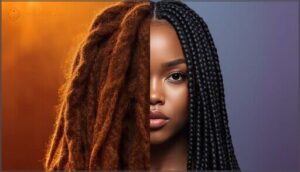
Before you commit to either style, you need to weigh the real benefits and challenges of each. Both dreads and braids come with their own set of advantages that might align with your lifestyle, hair goals, and maintenance preferences.
Understanding what each style offers—and where it falls short—will help you make a choice that works for you in the long run.
Advantages of Dreadlocks
When you choose dreadlocks, you’re not just picking a hairstyle—you’re embracing a low-maintenance lifestyle with real benefits. Length retention improves markedly since you’re skipping daily combing and heat damage. Once mature, your styling time drops to under 10 minutes most days, and scalp protection comes naturally with less tension than tight braids. Plus, dreadlocks offer authentic cultural identity and surprising styling versatility through updos, wraps, and color changes.
| Advantage | Real-World Impact |
|---|---|
| Length Retention | 20–30% more visible length over 2–3 years |
| Daily Styling Time | Under 10 minutes once mature |
| Annual Salon Costs | Several hundred dollars saved vs. frequent protective styles |
| Cultural Expression | Visible symbol of heritage and personal identity |
Advantages of Braids
Braids give you freedom without the daily grind. These protective hairstyles reduce manipulation damage while supporting hair growth and length retention. You’ll spend minimal time styling once installed, freeing energy for exercise and life.
Braids offer genuine cultural significance across African, Asian, and European traditions, connecting you to heritage. Plus, styling versatility is built in—switch patterns, add color, experiment with designs.
| Advantage | Real-World Impact |
|---|---|
| Weekly Wash Schedule | Easier maintenance alongside regular activity |
| Traction Alopecia Risk | Minimized with loose, larger braid installations |
| Styling Flexibility | Multiple patterns and designs available |
Drawbacks and Challenges of Each Style
Neither style comes without trade-offs, and that’s important to understand before committing. Tight braids risk traction alopecia, affecting up to one-third of wearers, while dreads demand consistent maintenance to prevent scalp irritation and buildup.
Both styles carry a financial burden—expect $50–$75 per maintenance visit. Social constraints persist: schools and workplaces still penalize these hairstyles.
Worse, irreversible follicle damage can occur if tension remains prolonged, making early intervention critical for protecting your hair health.
Frequently Asked Questions (FAQs)
Can you start dreads from braids?
Yes, you can absolutely transform braids into dreads—this method, called braidloc installation, uses three-strand braids as starter locs that gradually mat and lock over time, generally requiring six to twelve months for full maturation.
Can I let my braids turn into dreads?
Technically, your braids can gradually mat into dreads over several months, but dermatologists warn against leaving them that long.
The scalp health risks of prolonged tension make intentional starter methods safer than a passive braid-loc shift.
When do braids become dreadlocks?
Your braids evolve into dreads once the hair mats and locks at the base—usually after 2 to 3 months of continuous wear without takedowns, especially on coily textures.
Can you switch between dreads and braids easily?
Think of your hair as soil—each style depletes it differently. Switching between dreadlocks and braids isn’t easy; tension impact, hair breakage, and alopecia risk demand scalp recovery periods between styles to preserve hair strength and avoid damage.
How do you remove dreads or braids without damage?
Safe removal requires patience and product selection. Saturate sections with detangling conditioner, work from ends to roots with a wide-tooth comb, and manage normal shedding while protecting scalp health to minimize hair breakage and damage.
Whats the best way to sleep with each style?
Your hairstyle rests while you move—yet that’s when damage happens. Silk bonnets and pillowcase material reduce tension and hair breakage.
Loose sleep positions protect scalp health, maintaining hair protection through proper hair care and styling options.
Do dreads or braids work better for swimming?
Both styles present challenges for swimmers. Dreads retain more water and demand extensive rinsing to prevent buildup, while braids absorb less moisture and generally fit swim caps more easily—making braids the practical winner for frequent pool time.
Which style is easier to hide for professional settings?
Job interviews and workplace bias still shape your choices. Braids win for visual discretion—they’re easier to tuck, pin, or wig-over than locs.
The CROWN Act protects both, but braids offer more styling flexibility and formal-event versatility.
Conclusion
Choosing dreads means embracing patience, permanence, and the slow evolution of your hair; choosing braids means enjoying versatility, renewal, and the freedom to reinvent yourself. Each path—dreads vs braids—reflects not just a style, but your rhythm, your commitment, and your vision for self-expression.
Let your decision be guided by what truly fits your lifestyle, your hair’s needs, and your sense of identity. Hair is more than fashion—it’s a language. Make sure yours speaks with confidence and intention.
- https://www.belgraviacentre.com/blog/researchers-advise-women-on-which-hairstyles-cause-hair-loss
- https://pedsderm.net/for-patients-families/what-is-traction-alopecia/
- https://www.aad.org/public/diseases/hair-loss/causes/hairstyles
- https://pmc.ncbi.nlm.nih.gov/articles/PMC8530059/
- https://lionlocs.com/blogs/dreadlocks/history-of-dreadlocks