This site is supported by our readers. We may earn a commission, at no cost to you, if you purchase through links. This content is for general informational and educational purposes only and is not a substitute for professional medical, dermatological, or nutritional advice.

If your hair’s fine enough to see your scalp through in bright light, you already know the struggle: heavy foils flatten what little volume you have, and bold contrast can look harsh instead of pretty.
Here’s the fix colorists rarely explain well. Hair highlighting techniques for fine hair aren’t just about picking a color, they’re about placement, weight, and knowing which method builds dimension instead of stripping it away.
Babylights, strategic foiling, and lowlights each play a different role in tricking the eye into seeing thickness that isn’t there. Get the technique right, and your hair won’t just look brighter, it’ll look fuller, moving with a kind of natural bounce that heavy color often kills.
Table Of Contents
- Key Takeaways
- Best Highlighting Techniques for Fine Hair
- Strategic Highlight Placement for More Volume
- Fine Hair Highlights by Texture and Color
- Preventing Damage to Highlighted Fine Hair
- Haircuts That Enhance Highlighted Fine Hair
- Frequently Asked Questions (FAQs)
- What are the best highlight techniques for thin hair?
- What are three methods of highlighting hair?
- Should you highlight fine hair?
- What not to do with thin, fine hair?
- How to highlight your hair?
- What are the different types of hair highlights & techniques?
- What is the Best Hair highlighting technique?
- What are the different types of highlight techniques?
- How do you highlight a hair strand?
- What is Balayage hair highlight technique?
- Conclusion
Key Takeaways
- Fine hair thrives on strategic placement, not heavy color, so techniques like babylights, balayage, and lowlights build believable fullness without weighing strands down.
- Where you place highlights matters as much as the technique itself, since crown, temple, and part-line placement can trick the eye into seeing thickness that isn’t there.
- Protecting fine strands during lightening comes down to low-volume developers, bond builders, and spacing sessions 7-8 weeks apart to avoid breakage.
- The right haircut, like layered shoulder-length styles or textured bobs, works alongside your color to maximize volume and movement.
Best Highlighting Techniques for Fine Hair
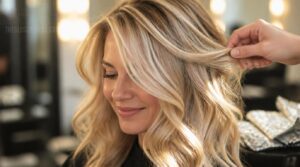
If you’ve got fine hair, the right highlighting technique can make all the difference between flat and full. Some methods add soft dimension, others create bold contrast, and a few work quiet magic right where you need it most. Here’s a look at five techniques worth trying.
No need to guess where to divide your strands either—this guide on parting curly hair without wetting it first makes clean sections easy even on dry, textured hair.
Babylights for Subtle Fullness
Tiny strand highlights are babylights’ secret weapon, painting on a natural sun-kissed effect without heavy contrast.
Placement matters most: root-focused fullness mimics childhood highlights, while a cool-warm tone mix adds refraction and depth.
Targeting midlengths and ends creates believable volume illusions, giving fine hair subtle fullness through strategic color placement, no bulk, just light-catching dimension that looks effortlessly grown, not painted on.
Balayage for Soft Dimension
If babylights are about pinpoint precision, balayage is your freehand approach to soft dimension. Hand-painted ribbons sweep from mid-lengths to ends, skipping harsh root contrast for a gentle glow. Because color is focused away from the roots, this low-maintenance coloring technique can last three months to a year before needing a refresh.
Face framing ribbons brighten around your face, while strategic placement keeps things natural. That’s Mid-Length Glow and natural root mix working together, soft warmth without the weight.
Foil Highlights for Visible Contrast
If balayage is your soft-focus glow, foils are the sharp lens. Wrapped sections deliver serious visible contrast, three to five levels lighter, with metal reflecting heat for faster lift.
Foils are the sharp lens to balayage’s soft glow, delivering bold contrast as metal heat speeds up the lift
Perpendicular placement near your part builds volume illusions without stripes. Vary foil density for dimension, and expect touch-ups every 6-8 weeks to keep lines crisp.
Money Pieces for Face Framing
Foils build contrast, but nothing frames your face quite like money piece highlights. Placed at the temple zone and blended toward your cheekbones, these narrow money pieces brighten your features with instant face framing contrast.
You’ll love the cheekbone light placement, it lifts, softens, and adds volume illusions. Just keep sulfate-free products handy and stick to a root touchup schedule every 6-8 weeks.
Lowlights for Multidimensional Depth
Where highlights bring the shine, lowlights do the quiet work of shadow blending underneath. This depth contrast adds hair contouring around your crown and nape, absorbing light in sparse spots for fuller-looking strands.
- Cooler, darker tones for tone shift
- Blends softly with your base color
- Enhances hair texture enhancement instantly
- Creates true multidimensional depth
- Builds lasting hair dimension
Strategic Highlight Placement for More Volume
Where you place your highlights matters just as much as the technique itself. Get the placement right, and you can trick the eye into seeing thickness that isn’t really there. Here’s exactly where to focus for maximum volume payoff.
Crown Highlights for Root Fullness
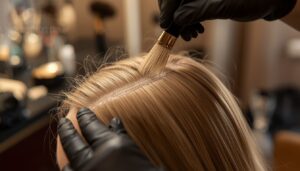
Ever notice how flat roots make even lush hair look thin? Crown lift placement fixes that, using moderate foil density control and perimeter foil outlining to keep lightness contained.
Pairing this technique with a natural gray blend keeps regrowth soft and seamless, which is exactly the kind of low-maintenance hair color strategy that saves you salon trips down the line.
Color stays one to two shades lighter, with root color blending and gentle root smudging for a soft, gradual growth pattern. Follow up with a bond builder for lasting hair thickness illusion.
Temple Placement to Conceal Sparseness
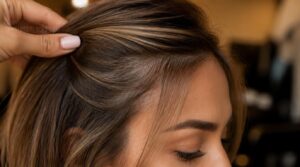
If scalp visibility bugs you most at the hairline, temple sectioning is your fix. Try:
- Temple highlighting with lightened contrast pieces
- Lowlight temples for subtle depth
- Face-framing pieces for texture
- Curved sectioning that follows your natural hairline
This strategic placement grows out gracefully every 4-6 weeks, keeping sparse spots concealed without bulk.
Perpendicular Foils Along The Part
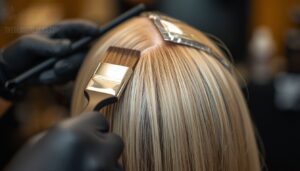
Think of your part line as a runway; perpendicular foils placed at a 90-degree angle turn it into crisp, undeniable contrast.
This foil angle precision maximizes lightening right at the crown while narrow spacing protects hair integrity preservation, keeping adjacent strands untouched.
Root color stays natural, blending seamlessly for strategic placement that boosts volume and dimension without stripes.
Thicker Weaves for Added Density
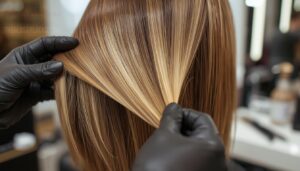
More weave, more illusion. Bumping weave thread density by roughly 30% per inch builds visible bulk, while wider micro foil protection keeps fine strands lightweight, not brittle.
Alternating light-dark strands trick the eye into seeing thickness. A low-volume developer lift protects integrity, and a smoothing serum finish locks in that fuller, touchable feel.
Two-Tone Contrast for Dimension
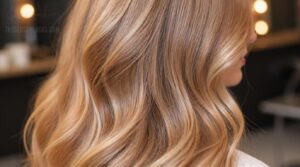
Flat color hides your best asset: shape. Two-tone contrast pairs a cool golden base with warm caramel, staying within 2 levels for soft transitions, not stripes.
- Strategic placement at mid-lengths for fullness
- 10-20 volume developer for gentle lift
- Ash undertones to suppress brass
- Toner refresh every 6-8 weeks
- Gloss seals blended
That’s real, buildable hair dimension.
Fine Hair Highlights by Texture and Color

Not all fine hair is created equal, and your ideal highlight depends on what you’re starting with. Your natural texture and base color both play a role in which technique will look most flattering and grow out the best. Here’s how to match the right highlighting style to your hair type.
Caramel Balayage for Brown Hair
Golden brown ribbons melt into brown hair like honey into coffee, giving you that natural sun-kissed finish without the shock factor.
| Element | Placement | Result |
|---|---|---|
| Caramel tones | Midlengths to ends | Soft gradient |
| Glaze/toner | After lightening | Unified warmth |
| Grow-out | Minimal root line | Low maintenance |
Caramel balayage builds dimension while keeping fine strands feeling airy, not weighed down.
Babylights for Fine Straight Hair
If caramel balayage brings warmth to brown hair, babylights bring it home for fine straight strands. Ultra-fine highlight strands mix with your base color for that natural sun-kissed effect, no harsh lines.
- Crown weaves for fullness
- Face-framing highlights up front
- Sulfate-free products to lock in shine
Strategic placement plus low developer volumes keeps this low-maintenance hair enhancement gentle on delicate strands.
Pintura Highlights for Curly Hair
Curls need their own rules, and Pintura highlights deliver. Hand-painted color follows each curl’s natural bend, no foils required, for graduated, natural sun-kissed results.
Vertical color layering creates dimensional swirls that catch light beautifully. Curl-friendly toning balances warmth, while frizz-reducing glossing seals moisture.
This placement technique offers genuine volume enhancement for fine hair without sacrificing your curl pattern’s natural bounce and definition.
Silver Highlights for Gray Hair
Going gray isn’t a stop sign, it’s a chance to work with what you’ve got. Silver highlights mix platinum and pewter tones right into your natural gray for smooth regrowth.
Try:
- Face-framing pieces for brightness
- Crown babylights for lift
- Purple shampoo for shine
Sulfate-free, bond-building formulas keep that cool shimmer intact between visits.
Ash Tones for Cool Shimmer
If warmth keeps sneaking into your blonde, ash tones are your reset button. Pearl and silver ash formulations counter yellow with violet undertone correction, giving fine hair a true frost finish.
Pair with babylights or balayage for shimmer that reflects blue-gray without stripping strength. Bond-reinforcing lift and sulfate-free ash care keep that cool shimmer maintenance intact for weeks.
Preventing Damage to Highlighted Fine Hair

Fine hair and lightener can be a tricky combo, but that doesn’t mean you have to choose between brightness and breakage. With the right approach, you’ll keep your strands strong while still getting that dimension you’re after. Here’s what actually protects your hair through the highlighting process.
Bleach-Free High-Lift Color
Skip the bleach bottle entirely.
Bleach-free high-lift color uses deposit pigments with gentle lifting action, brightening two to four levels without the trauma of traditional lightening. Amino acids protect your cuticle mid-process, while scalp sensitivity reduction keeps things comfortable. You get real dimension, real fine hair volume, and none of the breakage that makes fine strands cry uncle.
Low-Volume Developer for Gentle Lift
Regarding hair highlighting techniques for fine hair, less developer is more. A 10-20 volume formula lifts gently, limits cortex swelling, and keeps ammonia low for comfort.
- Softer processing
- Smooth blending
- Less breakage
- Better moisture retention
- Controlled, even results
Timing matters here, precision beats speed every time your strands stay under gentle control.
Bond Builders During Lightening
Think of bond builders as your hair’s bodyguard during lightening. They rebuild bond strength repair at the protein level, offering real protein structure support while boosting cuticle protection enhancement.
| Benefit | Result | Why It Matters |
|---|---|---|
| Elasticity | +15% strength | Less snapping |
| Breakage | 15% less at 20-volume | Stronger strands |
| Shine | Noticeably improved | Healthier look |
That’s damage prevention benefits you can actually see.
Sulfate-Free Color Care
Your shampoo choice makes or breaks your color investment. Sulfate-free formulas keep scalp pH between 4.5-5.5, using mild surfactants for gentle cleansing without stripping moisture.
- Maintains pH balance
- Helps retain moisture
- Uses low alcohol content
- Offers fragrance sensitivity options
- Preserves color longer
This color preservation technology locks in your babylights’ brightness while keeping fine strands soft, never weighed down.
Spacing Out Highlighting Sessions
Patience is part of the formula. Give fine hair a 7 to 8 week recovery interval before your next lift, so cuticles fully close and strength rebounds.
Alternate partial and full sessions, sticking to the two-shade lightening limit, for smooth growth and real highlight longevity. That’s preventive maintenance your strands will thank you for.
Haircuts That Enhance Highlighted Fine Hair
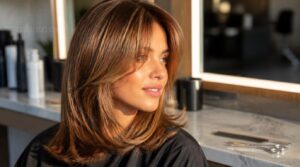
Highlights alone won’t do all the work, your cut plays just as big a role in how full your hair looks. The right shape can lift your roots, bounce out your ends, and let every babylight or balayage stroke actually show. Here are five cuts that team up with your color to make the most of what you’ve got.
Shoulder-Length Cuts With Layers
If your ends feel flat, shoulder-length layers fix that fast. Layered crown reduction cuts bulk up top while graduated weight lift keeps midlengths bouncy. Face framing layers hit near the cheekbone, pairing beautifully with babylights.
- Softer jawline contour
- Better hair volume
- Textured ends for movement
Shoulder length balance flatters most face shapes, hands down.
Textured Bobs for Fuller Ends
Length isn’t the enemy, blunt edges are. Chop in soft gradation layers and suddenly a jaw-grazing bob reads full, not thin.
Point cutting and razored tips give you piecey cut texture that catches light instead of falling flat, while face-framing highlights brighten your cheekbones. Add texturizing spray for a lived-in finish that screams volume.
Soft Shags for Natural Movement
If a bob wasn’t enough lift, shags take movement even further. Choppy layers from cheek to collarbone create natural volume illusion with 1-2 inch unevenness.
Face framing lift brightens features, while soft caramel balayage adds glow.
- Textured ends styling boosts airflow
- Movement enhancing layers reduce heaviness
- Heat protection keeps strands healthy
Pixie Cuts With Crown Lift
Ready to go shorter? Pixies live or die by crown lift, graduated layers pushed up top to balance short sides. Height widens round faces, softens square jaws.
Weave in babylights near the crown for dimension that tracks the lift. Trims every 4-6 weeks keep growth phases tidy and your shape sharp.
For inspiration on pairing these techniques with bolder cuts, explore androgynous haircuts that blend soft and structured elements to push dimension even further.
Heat-Free Styling for Volume
Blow-dryers aren’t mandatory for that lifted-root look. Heat-free styling protects moisture retention in highlights while still delivering serious volume illusion.
- Root lifting creams for instant lift
- Silk pillowcase sleep, no friction
- Texture spray crown for air-dry puff
- Clip-set volume boost while drying
- Light mist frizz control to finish
Your babylights catch light with every bit of hair movement, heat-free and healthy.
Frequently Asked Questions (FAQs)
What are the best highlight techniques for thin hair?
Your best bets? Babylights for soft fullness, balayage for dimension, foil highlights for contrast, money pieces for face-framing, and lowlights for depth. Together, they add movement without weighing thin strands down.
What are three methods of highlighting hair?
Three go-to methods are babylights, painting whisper-thin strands for soft fullness, balayage, freehand color for natural grow-out, and foil highlights, using precise lift for defined contrast. Add money pieces or lowlights for extra dimension.
Should you highlight fine hair?
Yes, absolutely. Strategic babylights or faceframing highlights break up flat color, tricking the eye into seeing more hair thickness. Skip harsh bleaching, choose sulfate-free products, and always get a salon consultation first to prevent breakage and fading.
What not to do with thin, fine hair?
Skip heavy pomades, skimp on protein, and ditch sulfate shampoos. Avoid tight ponytails and over-moisturizing masks that weigh strands down. Instead, embrace bond-building treatments, sulfate-free care, and reduced heat styling for lasting volume.
How to highlight your hair?
Nearly 40% of women notice thinning by 40, so lean into babylights or balayage, staying within two shades of your base, with face-framing pieces near the hairline for instant volume and soft, strategic depth.
What are the different types of hair highlights & techniques?
Balayage, babylights, foil highlights, money pieces, and lowlights each bring different dimension. Balayage paints soft transitions, babylights add fine sun-kissed strands, foils create defined contrast, and face-framing pieces brighten instantly.
What is the Best Hair highlighting technique?
For fine strands, balayage wins for its hand-painted gradient, gentle strand-thickness selection, and gradual growth that stretches longevity between salon visits, keeping color low-maintenance while babylights and face-framing pieces add softness without weight.
What are the different types of highlight techniques?
Five techniques dominate: babylights for soft glow, balayage for painted dimension, foil highlights for bold contrast, money piece highlights for face-framing brightness, and lowlights for shadowed depth, each building volume differently through strategic placement and lift.
How do you highlight a hair strand?
Stylists isolate a thin strand, brush on lightener, then wrap it in foil to seal in heat and prevent bleeding. Processing runs 20 to 45 minutes before a gentle rinse reveals your dimension.
What is Balayage hair highlight technique?
Picture sunlight dancing through loose strands, that’s the look you’re after. Your colorist hand-paints color onto sections, blending highlights and lows for a sun-kissed effect with soft, low-maintenance dimension that grows out beautifully instead of leaving harsh lines.
Conclusion
Less is more when lightening fine strands, and that’s the real secret. The right hair highlighting techniques for fine hair don’t fight your texture, they flatter it, placing light exactly where volume needs a boost.
Babylights whisper, foils state their case, lowlights ground everything in believable depth. Pair smart placement with gentle, bond-safe color, and your stylist becomes less a colorist, more an architect of movement. That’s a transformation worth booking.