This site is supported by our readers. We may earn a commission, at no cost to you, if you purchase through links. This content is for general informational and educational purposes only and is not a substitute for professional medical, dermatological, or nutritional advice.
One razor pass separates a good fade from a great one. A single carved line at a 45-degree angle can add visual height, sharpen your jawline, and turn a standard cut into a signature look.
But here’s the catch: haircut line designs are unforgiving. A basic line-up stays sharp for 3 to 5 days, geometric patterns need touching up every 7 to 10 days, and over-trimming the same follicles can push your hairline back permanently. Placement matters too. High lines flatter round faces, while horizontal lines keep oblong faces from looking longer.
Below, you’ll find the best designs for 2026, plus the barber techniques and maintenance habits that keep every edge crisp.
Table Of Contents
- Key Takeaways
- Popular Haircut Line Designs for Men and Kids
- Choosing a Haircut Line Design for Your Fade, Face Shape, and Hair Texture
- How Barbers Create Crisp Haircut Line Designs With Precision Tools
- What to Ask Your Barber Before Getting a Haircut Line Design
- How Long Haircut Line Designs Last and How to Maintain Them Safely
- Frequently Asked Questions (FAQs)
- What is a haircut line?
- How many haircut line designs are there?
- What is a line-up haircut?
- Are haircut line designs a trend?
- What is side haircut line design?
- What is a star line haircut?
- How Can Line design Haircuts Be Made?
- How Long Does Line Design Last?
- What Are Line Designs in Hair Called?
- How much do haircut line designs cost?
- Conclusion
Key Takeaways
- Line designs are high-maintenance: a basic line-up stays sharp only 3–5 days, geometric patterns need touch-ups every 7–10 days, and over-trimming the same follicles can permanently recede your hairline—so book quick edge-ups between cuts and never re-line at home.
- Placement should match your face shape and fade level: high lines add height to round faces, horizontal lines keep oblong faces from looking longer, and high fades with longer top hair create the sharpest contrast for the design.
- Hair texture dictates the approach—coarse hair holds sharp lines longest, curly hair should be cut slightly deeper than it appears wet and always along the curl flow, and fine hair stays cleanest with simpler designs.
- Get the cut right by bringing a reference photo, asking whether the design is freehand or stencil-based, and approving the first guideline placement, since clear communication upfront prevents about 80% of design disappointments.
Popular Haircut Line Designs for Men and Kids
Line designs aren’t one-size-fits-all — the right choice depends on your hair type, lifestyle, and how bold you want to go.
If you’re working with fine or thinning hair, this guide to the best men’s hair gels for thinning hair breaks down exactly which formulas add hold without weighing your pattern down. For those dealing with scalp concerns alongside thinning, hair growth serums formulated for braids can also support healthier density without disrupting your style.
Whether you’re sitting in the chair or bringing your kid in for their first statement cut, knowing your options puts you in control.
Here are the most popular styles barbers are carving right now.
Single and Double Lines
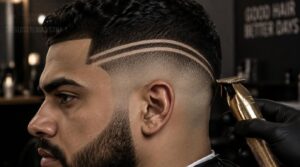
Lines are the fastest upgrade for your cut. A single line runs 1–2 mm deep along the fade, giving crisp separation. The Double Notch adds a second groove 2–4 mm apart for extra contrast.
- Simple Line: clean, subtle, suits every face shape
- Single Notch: placed above the temple arch
- Double Notch: maximizes definition on dense hair
- T-outliners deliver the sharpest line design
- Touch up every 1–2 weeks
Hard Parts and Fade Separators
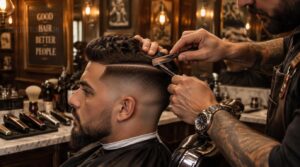
Take those lines further. A hard part carves a crisp groove through your hair. It’s a real step up. In your fade haircut, the fade separator defines the top. A low hard part stays subtle; the disconnected crop hits bold.
| Style | Placement | Statement |
|---|---|---|
| Hard Part | Temple | Sharp |
| Fade Separator | Boundary | Defined |
| Low Hard Part | Below | Subtle |
| Disconnected Crop | Top | Maximum |
Geometric and Zigzag Patterns
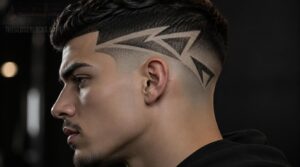
Hard parts prove you’re serious. Geometric patterns and zigzag designs push that commitment even further. These geometric hair patterns use angular offsets of 15-45 degrees to carve sharp, eye-catching contrast directly into your fade. Your barber cuts geometric shapes with T-blade trimmers and stencils for consistent symmetry. These shaved patterns are surging 27% on social media, but refresh them every 7-10 days.
Pairing these patterns with a Balbo or anchor beard sharpens the architecture even more, and this guide to bald with beard styles shows how the contrast works.
Curves, Waves, and Abstract Designs
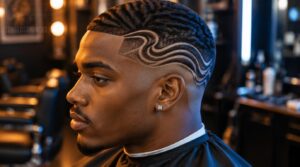
Geometry goes sharp, but curved and wavy lines go fluid. Wave crests spaced 1-2 cm apart on medium-density hair keep the motion readable and recognizable.
Your barber runs guard-on clippers with a straight-edge trimmer for precise 3D line designs. Shaved negative space frames the arcs, amplifies depth, and makes haircut line designs look fully intentional. Touch up every 1-2 weeks.
Stars, Bolts, and Statement Shapes
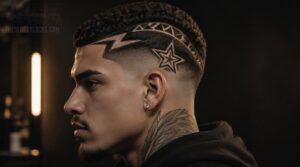
Star line haircut designs use negative space inside the fade to carve a crisp five-point silhouette. Nail your symmetry or the star design immediately looks off.
A lightning bolt line along the temple hits hard, and lightning bolt patterns get sharper with multiple clipper passes at decreasing lengths.
Statement shapes like bold arcs or triangles always belong at the crown.
Picking the right tool matters too, so a guide to the best shape-up clippers can help you find one that holds those sharp lines with ease. If you’re also working with facial hair, this mustache trimming guide with clippers walks you through blade technique and edge detailing that translates well to any precision grooming work.
Beard and Eyebrow Extensions
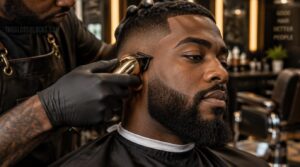
push haircut line designs beyond the scalp. A clean beardtohair connection line depends on three things:
- Short surrounding fade for contrast
- Fine edging tool with consistent pressure
- Repeated corrective strokes to tighten borders
Brow extensions trace your natural arch, not cut across it. Build these barbering techniques into your grooming routine and the lines stay sharp.
Choosing a Haircut Line Design for Your Fade, Face Shape, and Hair Texture
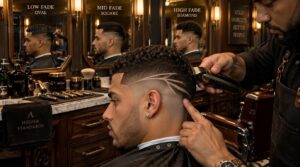
Not every design works for every head. Fade level, face shape, and hair texture each narrow your options before you even pick up a reference photo. Here’s what to keep in mind before you commit.
Fade and Hair Length
Your fade’s height changes everything. A high fade with longer top hair creates sharp contrast right where the design sits, so the line practically jumps off the scalp.
Drop to a low or mid fade and that contrast shrinks fast. The shorter the surrounding hair, the more your barber relies on blade separation rather than length to hold the line.
Face Shape and Placement
Your face is the canvas, and good line placement is the frame.
Face shape analysis drives every decision. Round faces need designs that add height, so place lines high on the hairline. Oblong faces call for horizontal lines, since you don’t want extra length. Diamond faces need strategic upper-third volume. Always confirm hairline symmetry before locking in your perimeter guidelines. Understanding your proportions is easier when you take face shape measurements beforehand to make sure your chosen line design complements your natural bone structure.
Curly, Coarse, or Fine Hair
Your hair texture changes everything about line work.
- Curly hair shrinks after cutting, so cut a curly zigzag slightly deeper than it appears when wet.
- Coarse hair holds sharp haircut line designs longest due to its thicker strand structure.
- Fine hair loses contrast faster; simpler designs stay cleaner longer.
- Always cut with the curl flow direction to preserve clean boundaries.
How Barbers Create Crisp Haircut Line Designs With Precision Tools
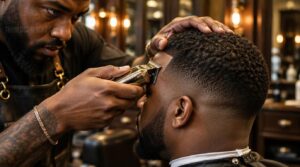
Clean lines don’t happen by accident. Every crisp edge starts with the right tools and a locked-in approach to precision hair cutting. Investing in professional precision hair clippers purpose-built for barbers gives you the blade control that turns good lines into great ones.
Your lineup trimmer does the heavy lifting for line design. Small blades give you control that bulk clippers can’t match. Work in short passes, not one long drag, keeping blade pressure consistent so edges stay sharp.
Here are five steps top barbers use:
- Comb hair into its natural lay before cutting
- Apply manual skin tension to flatten waviness
- Outline first, then fade outward from the boundary
- Use foil or edger work to clear shadow bulk near the line
- Finish with razor detailing under direct lighting to catch gaps
That’s what separates a clean cut from a crisp one.
What to Ask Your Barber Before Getting a Haircut Line Design
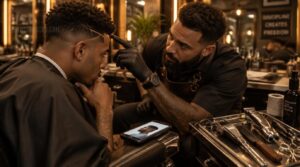
You’ve seen how clipper control and razor detailing make a line design pop. Now flip the script: your voice matters too. A great cut starts with clear communication before the clippers buzz.
Bring a reference photo. Ask your barber to mark which details are non-negotiable, like line thickness, spacing, and pattern density. That single step prevents 80% of design disappointments. A dedicated barber hairstyle lookbook gives you curated visuals in one place, making it far easier to pinpoint exactly what you want before you sit in the chair.
Then get specific. Ask whether the design is freehand or stencil-based, especially for geometric patterns with multiple angles. Request the first guideline placement so you can approve the draft before detailing begins.
Talk logistics too. Mention sensitive skin, cowlicks, and your hair texture so edges don’t look broken later. Confirm where the fade ends relative to the design’s baseline, and ask whether your next visit needs full reset or line cleanup only. Barbering skills shine brightest when you both speak the same language.
How Long Haircut Line Designs Last and How to Maintain Them Safely
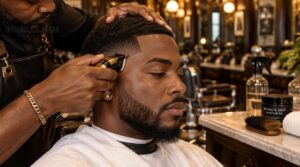
You asked the right questions, now protect the payoff. A basic line-up holds sharp for 3 to 5 days before losing its edge, and fine or straight hair shows every fraction of an inch of regrowth first.
Style longevity depends on your routine. Here’s your playbook:
- Run a soft brush along the hairline daily to train hair direction and keep the design intentional.
- Hit the forehead and temples with a light moisturizer every morning; freshly lined skin dries fast.
- Use an exfoliating cleanser and bump-reducing aftershave for razor burn prevention, especially on curly or coarse hair.
Your maintenance frequency matters more than your first visit. Book a 5-minute edge up between full cuts and extend the style a week or more. Never re-line at home. Over-trimming the same follicles pushes your hairline back permanently, and that’s hair health you can’t buy back.
Book a quick edge-up between cuts to keep your design sharp—never re-line at home, or your hairline pays the price
Frequently Asked Questions (FAQs)
What is a haircut line?
You’ve probably spotted a haircut line on the sharpest fades in the shop. It’s a thin shaved line etched directly into the scalp, usually 1-3 millimeters wide, separating different hair lengths with crisp, clean precision.
How many haircut line designs are there?
No barber or stylist works from a fixed list. Your shop likely offers over 15 distinct haircut line designs, from simple shaved lines to full geometric patterns, with custom fade styles expanding that number constantly.
What is a line-up haircut?
A line-up haircut sharpens your forehead, temples, and sideburns into crisp, straight edges. Your barber uses precision barbering tools to frame your face cleanly, making every fade, hard part, and style look sharp and intentional.
Are haircut line designs a trend?
Haircut line designs are a real trend, and you’re seeing it everywhere. Social media influence drove them mainstream around 2020, reshaping mens hairstyle trends and street style aesthetics globally. Grooming trends keep cycling them back.
What is side haircut line design?
A side haircut line design is a sharp, shaved channel etched into your temple area using precise razor detailing. Paired with a clean fade, it builds immediate contrast that makes your entire hairline design pop.
What is a star line haircut?
A star line haircut uses razor detailing to shave a crisp star shape near your temples or fade. It’s a bold statement within haircut line designs and needs a touch-up every one to two weeks.
How Can Line design Haircuts Be Made?
Every great design starts with client communication about what you want. Your barber then uses T-outliner trimmers and straight razors to cut clean, precise channels. Simpler designs stay crisp; complex patterns fade within 7-10 days.
How Long Does Line Design Last?
Like a fresh tattoo of hair, your line design stays crisp 1 to 2 weeks. Fade cuts blur fastest, around 7 days. Coarse hair boosts style longevity; regular maintenance frequency extends haircut longevity.
What Are Line Designs in Hair Called?
Last week a client asked for a "hair tattoo," and I knew exactly what he meant. They’re officially line designs, but you’ll hear hair tattoos, shaved lines, or hair patterns. Barbers say haircut lines or line work.
How much do haircut line designs cost?
Expect to pay more than you think: basic haircut line designs run $5–$20, simple lines near $7, while complex hard part patterns hit $40+. Urban professional barber services and kids’ bundles shift prices.
Conclusion
Picture that razor gliding clean through the grain, leaving a line so sharp it catches light from across the room. That’s what the right haircut line design does for you.
Pick a pattern that fits your fade and face shape, ask your barber the hard questions, and respect the maintenance schedule. Lines fade fast, but skill compounds. Book the appointment, sit in that chair, and walk out with your signature.