This site is supported by our readers. We may earn a commission, at no cost to you, if you purchase through links. This content is for general informational and educational purposes only and is not a substitute for professional medical, dermatological, or nutritional advice.

Most people grab a pair of clippers, run them over their head, and never think twice about what’s happening inside that humming shell. That’s fine—until the blades start pulling, the motor sounds wrong, or a fade comes out uneven and you don’t know why.
A hair clipper is a precision cutting system. Motor, blade geometry, and tension work together in milliseconds to shear hair cleanly rather than drag it. The difference between a smooth pass and a painful tug often comes down to a clearance gap measured in hundredths of a millimeter.
Understanding the mechanics gives you real control—over your cuts, your equipment, and how long that equipment lasts.
Table Of Contents
- Key Takeaways
- How Do Hair Clippers Work?
- Main Parts of Hair Clippers
- Types of Hair Clipper Motors
- How Clippers Control Hair Length
- Maintenance, Safety, and Troubleshooting
- Frequently Asked Questions (FAQs)
- How do hair clippers cut hair?
- How do I clean and maintain my hair clippers?
- Can hair clippers be used on any hair type?
- What does 8 4 0 mean on clippers?
- Can hair clippers be used on wet hair?
- How often should clipper blades be replaced?
- What causes clippers to overheat during use?
- Are hair clippers suitable for all hair types?
- How do you sharpen dull clipper blades?
- Can hair clippers cut wet or damp hair?
- Conclusion
Key Takeaways
- The blade gap—measured in hundredths of a millimeter—is the single most critical variable between a smooth cut and a painful hair pull.
- Motor type (magnetic, pivot, or rotary) determines not just speed but torque and heat tolerance, making it the right starting point for choosing any clipper.
- The taper lever and guard sizes work as a two-tier length control system—guards set the range, the lever micro-adjusts within it—giving you far more precision than most users realize.
- Clean blades, consistent oiling, and timely replacement aren’t optional upkeep; they’re what protect your motor from overload and your scalp from irritation.
How Do Hair Clippers Work?
Every time you flip on a pair of clippers, a precise chain of mechanical events fires off in under a second. Understanding that sequence — from motor spin to the final cut — gives you real control over your tool, not just a vague sense of how it operates. Here’s exactly how it all comes together:
Motor Creates Blade Motion
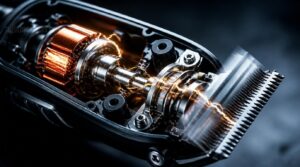
The motor drives every cut. A drive hub and shaft coupling transfer torque directly to the blade assembly, with precise spindle alignment minimizing runout.
Tight tolerances in the drive hub make a real difference in shaping results, much like the precision engineering behind top-rated shape-up clippers designed for clean, consistent lines.
- Magnetic motors reach 7,000+ RPM via electromagnetic force
- Pivot motors deliver twice the torque of magnetic designs
- Rotary motors balance blade speed with sustained power
Understanding different clipper motor types is essential for choosing the right tool for your specific cutting needs.
Vibration damping mounts isolate motor oscillation, keeping your edge quality consistent.
Moving Blade Meets Fixed Blade
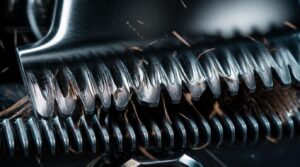
Once the motor sets everything in motion, the real cutting work happens at the blade interface. The moving blade oscillates against a fixed stationary blade, and that rapid back-and-forth is what shears hair cleanly.
Blade gap precision matters here — clearances run just 0.02 to 0.08 millimeters. Too wide, and hair slips through; too tight, and friction heat management becomes a problem fast.
| Blade Property | Specification | Effect |
|---|---|---|
| Clearance gap | 0.02–0.08 mm | Controls snag risk |
| Oscillation speed | Thousands of strokes/min | Determines cut aggressiveness |
| Thermal expansion | Slight metal growth | Shifts effective blade gap |
Teeth Shear Hair Strands
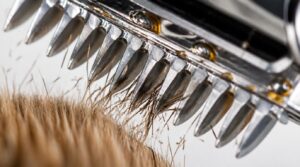
That blade interface sets up what happens next — the teeth do the actual work.
Each tooth creates a micro bite on contact, engaging only a few strands per pass. Tooth angle and serration depth determine whether hair shears cleanly or bends away. Coarse fibers resist more, while fine hair yields quickly. The geometry controls everything — get it right, and every stroke cuts with precision.
Tension Prevents Pulling
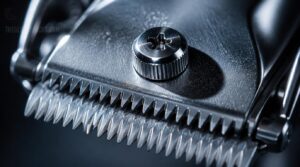
Shearing clean is only half the equation — keeping blades locked together is what stops the pull.
Blade alignment screws regulate how firmly the moving blade presses against the fixed one during blade oscillation. Get that pressure right, and you eliminate:
- Blade chatter from inconsistent contact
- Micro-gaps that snag hair instead of shearing it
- Friction spikes that drag across the scalp
Consistent cutting pressure is the difference between a smooth pass and a painful one.
Speed Affects Cutting Power
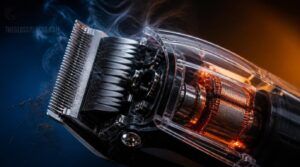
RPM isn’t just a number — it determines how cleanly each pass through hair actually performs.
| Speed Factor | Effect on Cutting |
|---|---|
| Blade Speed Thresholds | Peak efficiency before heat limits output |
| Hair Texture Variations | Coarse hair needs controlled, lower speeds |
| Thermal Power Limits | Overheating throttles motor torque |
| Precision Shearing Efficiency | High RPM lifts and severs short hairs cleanly |
| Speed-Induced Wear | Unchecked speed accelerates blade oscillation damage |
Higher blade speed means more hair engagements per second — but only up to the point where heat overwhelms the motor. Past that threshold, cutting efficiency drops.
That’s why cordless hair clippers with powerful rotary motors tend to maintain optimal blade speed longer, keeping performance consistent even through dense or coarse hair.
Main Parts of Hair Clippers
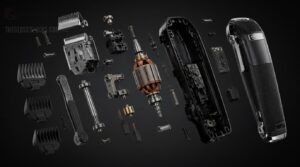
Every clipper—no matter the brand or price point—comes down to a handful of essential components working in sync. Knowing what each part does puts you in control, whether you’re troubleshooting a problem or just shopping smarter. Here’s what’s actually inside your clippers:
Motor Assembly
Everything starts with the motor assembly — the engine behind every cut.
The rotor-stator interaction converts electrical energy into rotational force, while bearings support the shaft under load.
- Stator windings generate the magnetic field
- Rotor delivers torque to the blades
- Bearings reduce friction and wear
- Thermal dissipation prevents overheating
- Lead wires handle electrical wiring safety
Motor type directly shapes blade speed.
Stationary and Moving Blades
Two blades do all the real work — one fixed, one oscillating at high speed against it. The stationary blade directs hair into the cutting path, while the moving blade shears strands clean through rapid mechanical oscillation.
Blade gap precision determines performance; too wide and hair snags, too narrow and the blades grind. Most are steel-alloy with titanium nitride coatings to resist wear.
Guards and Attachment Combs
Guards are the plastic combs that snap onto your blade and set a fixed cutting plane between 1 mm and 25 mm. Smaller numbers cut closer; larger ones leave more length.
A locking lip clicks each guard securely into place so it won’t shift mid-cut. Clean them with soap and warm water after every use.
Taper Lever
The taper lever sits beside your blade and shifts the top blade’s position to change cutting length without swapping guards.
Use it to:
- Open for longer, guardless cuts
- Close for shorter blade exposure
- Micro-adjust between guard sizes
- Smooth out fades with smooth gradations
- Clean up edges without stopping
Keep the lever track clean — debris causes sticking and uneven cuts.
Housing and Grip
Your hand stays in contact with the housing longer than any other part. Ergonomic casing design reduces hand fatigue during extended sessions — a detail that separates professional clippers from budget grooming accessories. Non-slip textures on the grip panels keep control steady even when oil or moisture is present. Weight distribution matters too; a well-balanced clipper feels lighter than it actually is.
A well-balanced clipper feels lighter than it actually is — and that illusion separates professional tools from budget ones
| Feature | Purpose | Impact |
|---|---|---|
| Ergonomic casing | Contours to hand shape | Reduces fatigue |
| Non-slip texture | Maintains grip under moisture | Improves control |
| Weight distribution | Balances motor and blade mass | Lessens strain |
| Material durability | Resists drops and daily wear | Extends tool lifespan |
Types of Hair Clipper Motors
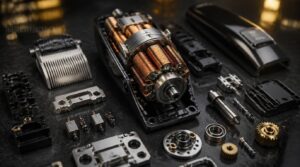
The motor is the heart of any hair clipper — it determines how fast the blades move, how much power they deliver, and how well they hold up under heavy use.
Not all motors are built the same, and choosing the wrong type for your needs can mean the difference between a clean cut and a frustrating session. Here’s a breakdown of the main motor types you’ll encounter, along with what sets each one apart.
Magnetic Motors
Magnetic motors drive blades using electromagnetic force paired with a spring — pushing teeth past 7,000 RPM through rapid oscillation. They’re lightweight and fast, though they overheat sooner than other types.
If yours starts rattling, it’s likely fallen out of resonance. A quick turn of the resonance tuning screw on the side restores smooth, quiet operation instantly.
Rotary Motors
Where magnetic motors oscillate, rotary motors spin — converting electrical energy into continuous rotation through a rotor-stator interaction that drives a shaft and gear train directly into blade motion.
Brushless rotary designs use electronic commutation, eliminating physical contacts for better efficiency and longer lifespan. They balance high blade speed with high torque, handle multiple speed settings, and work equally well in corded or cordless builds.
Pivot Motors
Rotary motors spin continuously, but pivot motors work differently — two electromagnets pull the blade carrier left and right across a low-friction pivot point, delivering twice the torque of magnetic designs. That mechanical advantage keeps cutting consistent under load.
- Peak speeds reach 9,000–18,000 RPM
- Torque ranges from 0.2 to 0.6 N·m
- Precision bearing races minimize blade bounce
- Temperature stays under 60°C during extended sessions
- Pivot assemblies endure 50,000+ oscillation cycles
They run quieter, too.
Corded Vs Cordless Power
Pivot motors handle heat and load well — but your power source shapes the entire experience.
Corded clippers deliver constant torque without voltage drop, running indefinitely through heavy sessions. Cordless clippers trade that consistency for mobility, with battery life ranging 60–180 minutes. As charge depletes, output can sag. Fast charging recovers 80% in roughly 30 minutes, though battery lifespan adds real long-term costs.
Home Vs Professional Clippers
What separates a home clipper from a professional one isn’t just price — it’s durability under pressure.
Pro clippers handle daily 8-hour sessions. Home units wear faster, run cooler, and suit occasional trimming.
Five differences that matter:
- Motor wattage — pro models run higher RPMs without pulling
- Blade longevity — ceramic or high-carbon steel lasts longer
- Tool repairability — pro parts are widely available
- Guard precision — micro-adjustments support clean fades
- Cost effectiveness — pro clipper maintenance costs less long-term
How Clippers Control Hair Length
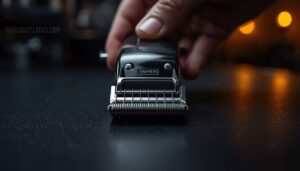
Knowing how your clippers cut is one thing — knowing how to control exactly how much they cut is where real precision begins.
Length control comes down to a handful of specific mechanisms, each giving you a different level of adjustment depending on what you’re trying to achieve. Here’s a breakdown of the key ways clippers let you dial in your cut:
Guard Sizes and Measurements
Guard sizes are your primary tool for hair length control — each clipper attachment snaps onto the blade and creates a fixed cutting plane. Most sets follow a standardized length chart ranging from 1/8 inch (3 mm) to 1 inch (25 mm).
| Guard Size | Hair Length Left |
|---|---|
| 1/8 inch | 3 mm |
| 1/4 inch | 6 mm |
| 3/8 inch | 9.5 mm |
| 1/2 inch | 13 mm |
| 1 inch | 25 mm |
Color-coded identification helps you grab the right size fast. Check brand compatibility before mixing guards — Wahl and Oster snap mechanisms differ.
Taper Lever Adjustments
The taper lever gives you micro-length control between fixed guard sizes — no swapping required. Slide it open and the top blade retracts, shortening the cut; close it and the blade advances for a longer result.
- Open position: shortest cut within that guard range
- Closed position: longest cut within that guard range
- Mid-notch settings: smooth blending micro-adjustments for fade transitions
Keep the lever pivot clean to avoid sticking.
Blade Overlap
Blade overlap — the distance the moving blade sits below the fixed blade — determines where blade teeth contact hair during each pass.
| Overlap | Effect on Cut | Risk |
|---|---|---|
| Too little | Pulling, uneven | Hair snagging |
| Moderate | Consistent length | Minimal |
| Excess | Slower blade travel | Friction buildup |
| Correct | Uniform fades | None |
| After cleaning | May drift | Misalignment |
Consistent overlap suppresses blade chatter and maximizes cutting speed.
Fade Length Gradations
A fade lives or dies by its guard sequence. Start with no guard at the base, then step through sizes 1, 2, and 3 in tight increments — each jump covering roughly 1 to 2 centimeters vertically.
Low fades hug the ear; high fades push toward the crown. Adjust the taper lever mid-pass to create extra gradations within a single guard range.
Bulk Cutting Vs Detailing
Think of bulk cutting as the surplus phase — fast passes removing mass quickly. Detailing is precision work, preserving shape with controlled, shorter strokes.
- Use wide blade oscillation for bulk removal
- Switch to fine teeth for shearing action refinement
- Reduce cutting speed during detailing passes
- Prioritize blade tension control to avoid snags
Each phase demands different clipper settings.
Maintenance, Safety, and Troubleshooting
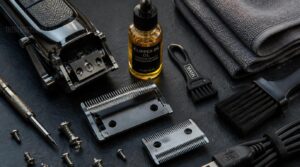
Your clippers will only perform as well as you maintain them — and that’s true whether you’re cutting hair once a week or every single day. A few consistent habits keep the blades sharp, the motor cool, and the whole tool hygienic. Here’s what you need to stay on top of.
Cleaning Hair From Blades
Hair left sitting in the teeth is a performance killer. After every session, brush out loose debris using a soft brush while the clipper runs briefly — this expels trapped strands efficiently. For stubborn buildup, disassemble the blade assembly and clear residue with a thin brush or toothpick.
Weekly deep cleaning and between-client sanitization with isopropyl alcohol prevent bacterial buildup and keep blades cutting cleanly.
Oiling to Reduce Friction
Once the blades are clean, oil is what keeps them running smoothly. Apply a few drops along the teeth, run the clipper briefly, then wipe away excess — buildup attracts debris and kills cutting efficiency.
Oil viscosity matters: thinner mineral oils penetrate quickly, while synthetic lubricants hold a stable film longer during extended sessions. Either way, reapply frequently — heat thins the film fast.
Sanitizing Clippers Properly
Oil keeps blades moving — sanitization keeps them safe. After every client, remove hair debris first so disinfectant actually contacts the metal surface underneath.
- Submerge detachable blades in EPA-registered solution for 5–10 minutes
- Wipe non-submersible housings systematically, blade edge to seam
- Use a fresh wipe per client to prevent cross contamination
- Store dry clippers in a sealed, clean case
Disinfectant contact time isn’t optional — cut it short and you’ve done nothing.
Adjusting Noisy Blades
Noise is diagnostic. A grinding sound usually means blade misalignment — set the top blade to overhang the bottom by 1–2 millimeters and verify they’re parallel across the full width.
A gap too tight creates friction; too wide and cutting suffers. The ideal clearance sits between 0.15–0.25 mm. Re-oil after any adjustment — a few drops reduces mechanical noise immediately.
Replacing Dull Blades
Dull blades don’t just cut poorly — they pull, snag, and irritate skin noticeably. Replace blades every six to twelve months, depending on use and hair texture.
Watch for these signs it’s time:
- Increased skin irritation or redness post-cut
- Uneven clipping requiring multiple passes
- Audible pulling instead of clean shearing
- Visible nicks or dull tooth edges
Fresh blades restore cutting efficiency immediately and protect your motor from compensating overload.
Frequently Asked Questions (FAQs)
How do hair clippers cut hair?
Like scissors working at machine speed, clippers shear hair by oscillating a cutting blade against a fixed one. Shearing action mechanics trap and slice strands cleanly — up to 10,000 strokes per minute.
How do I clean and maintain my hair clippers?
Brush loose hair from the blades after every use. Apply a few drops of clipper oil every 2–3 uses, then run the clipper briefly to distribute it. Wipe blades with 70% isopropyl alcohol to sanitize.
Can hair clippers be used on any hair type?
Yes — hair clippers handle most textures, but not equally. Coarse, dense hair demands high-torque motors, while fine hair needs lighter guard settings. Tightly coiled textures benefit from longer guards and blending passes.
What does 8 4 0 mean on clippers?
Those numbers — 8, 4, and 0 — are guard sizes in millimeters, controlling exactly how much hair remains after each pass. Higher numbers leave more length; lower ones cut closer to the scalp.
Can hair clippers be used on wet hair?
Wet hair and clippers are not exactly kindred spirits. Moisture-induced rust, wet hair snagging, and electrical safety risks make damp cutting a real liability. Always towel-dry thoroughly before clipping for cleaner cuts and safer sessions.
How often should clipper blades be replaced?
Blades work like tires — friction wears them down eventually. Professional barbers usually replace them every 3 to 6 months; home users can stretch that to 12 months with consistent blade maintenance and proper oiling.
What causes clippers to overheat during use?
Heat doesn’t sneak up on you — it compounds. Blade friction, motor overload from dense hair, poor airflow, and skipped oiling all stack fast, turning manageable warmth into a unit that’s too hot to use.
Are hair clippers suitable for all hair types?
Most clippers handle the majority of hair types, but the right tool depends on your texture. Thick hair demands high torque, fine hair needs precision guards, and curly hair requires blade geometry that resists snagging.
How do you sharpen dull clipper blades?
A dull edge doesn’t just cut poorly — it pulls and snags every strand. Clean with solvent first, hone at a 10–20 degree angle, deburr both blade faces, then oil before reassembly and test.
Can hair clippers cut wet or damp hair?
Yes, hair clippers can cut damp hair, but soaking wet hair clumps and grips the blades, causing uneven results. Slightly damp works best. Always dry blades after to prevent rust.
Conclusion
Think of your clippers as a precision instrument—motor, blade geometry, and tension are the three variables you now control, not guess at. Knowing how hair clippers work explains every pull, every uneven fade, and every failing motor.
That knowledge doesn’t sit on the page. It lives in how you set blade tension before a pass, and how you oil after every session. Clean tools cut clean. Master the mechanics, and every run becomes deliberate.