This site is supported by our readers. We may earn a commission, at no cost to you, if you purchase through links.
Most people can tell you their hair color in seconds, but ask them about their texture and you’ll get a confused stare. Here’s the twist: texture—not color, not length—determines whether a product will transform your hair or leave it limp and lifeless.
The diameter of each strand (measured in millimeters you can’t see) controls everything from how your hair holds a curl to why that expensive serum just sits on top doing nothing. Learning how to determine hair texture isn’t about memorizing beauty jargon.
It’s about finally understanding why your best friend’s holy-grail conditioner weighs your hair down, or why your curls fall flat by noon. Once you know whether your strands measure fine, medium, or coarse, you’ll stop guessing and start choosing products that actually work with your hair’s natural structure.
Table Of Contents
- Key Takeaways
- What is Hair Texture?
- Step-by-Step Process to Test Hair Texture
- Evaluating Hair Density and Thickness
- Determining Your Natural Curl Pattern
- Assessing Hair Elasticity and Porosity
- Choosing Products Based on Hair Texture
- Frequently Asked Questions (FAQs)
- What are the 4 types of hair texture?
- What are signs of low porosity hair?
- Can hair texture change over time naturally?
- Does hair texture differ by ethnicity or race?
- How does diet affect individual hair strand thickness?
- Can heat damage permanently alter your hair texture?
- Is hair texture inherited from mother or father?
- Does diet or nutrition affect hair texture?
- How does heat damage alter hair texture permanently?
- Are there genetic tests for predicting hair texture?
- Conclusion
Key Takeaways
- Hair texture refers to the physical width of each strand (fine under 60 micrometers, medium around thread-width, coarse above 80 micrometers), and identifying it through the thread comparison method delivers 91% accuracy in determining which products will actually work with your hair’s structure.
- You can reliably test your texture at home by comparing a single clean strand to sewing thread under natural light—thinner means fine, same width means medium, thicker signals coarse—then confirm with tactile assessment by rolling the strand between your fingers.
- Texture differs from density (follicle count per square centimeter) and curl pattern (shape the hair forms naturally), so you might have coarse texture with low density or fine texture with tight curls, requiring different product strategies for each combination.
- Once you know your texture, match products accordingly: fine hair needs lightweight volumizers to avoid collapse, medium hair tolerates flexible formulas, and coarse hair demands rich moisture like shea butter or argan oil because water has farther to travel through thick cuticles.
What is Hair Texture?
Hair texture describes the physical width of each strand on your head, and it’s one of the most practical measurements you can know about your hair texture. Understanding your texture isn’t just about labels—it’s about choosing the right products, avoiding damage, and finally getting styles that actually hold.
If you have fine hair—strands under 60 micrometers—check out these essential care tips for fine hair to keep it healthy without weighing it down.
Let’s break down what texture really means, why it matters more than you think, and how to identify which category your hair falls into.
Definition of Hair Texture
Hair texture describes the width of each strand, measured by its diameter and protein density. Your follicle structure determines how thick or thin individual hairs grow, giving you one of three texture classifications.
Here’s how texture breaks down in practical terms:
- Fine texture – strands feel nearly invisible between your fingertips, thinner than sewing thread
- Medium texture – similar width to standard thread with balanced protein structure
- Coarse texture – noticeably thick, sturdy strands you can easily feel
Understanding your hair diameter unlocks smarter product choices and more predictable styling results. To learn more about the scientific foundation of hair texture, explore the research on how genetics and protein bonds shape your natural strands.
Importance of Identifying Texture
Once you understand strand diameter, the real question becomes: why does this knowledge matter? Texture analysis isn’t vanity—it’s the difference between hair that thrives and hair that barely survives.
Knowing your texture prevents damage by guiding heat settings, product matching, and chemical service decisions. Fine strands need gentler handling; coarse hair demands richer moisture. This hair texture guide transforms guessing games into targeted hair care benefits.
Knowing your hair texture empowers you to prevent damage, select smarter products, and tailor care for fine or coarse strands
Clients who embrace texture-specific routines report fewer broken strands, smarter styling strategies, and routines that finally deliver results. Determining hair texture gives you control over your hair analysis, turning confusion into confidence.
Understanding your specific hair type and needs is key to choosing products and routines that keep your hair healthy.
Common Hair Texture Categories
Three hair texture categories form the bedrock of hair classification: fine, medium, and coarse. Fine hair products target strands measuring 0.03–0.06 mm in diameter—delicate and nearly invisible between your fingers. Medium hair styling suits the most common texture type, with balanced diameter and easier manipulation.
Coarse hair care caters to the thickest strands (0.08–0.2 mm), which feel sturdy but need deep moisture. Mastering these hair texture types transforms your entire routine.
Step-by-Step Process to Test Hair Texture
You don’t need fancy lab equipment to figure out your hair texture—just a few simple at-home tests that take less than five minutes.
The most reliable method involves comparing a single strand to sewing thread, which gives you 91% accuracy in identifying whether your hair is fine, medium, or coarse. Here’s how to run these quick assessments and decode what your hair is telling you.
The Thread Comparison Method
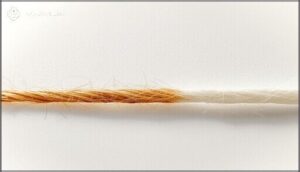
If you’ve ever wondered whether your hair is fine, medium, or coarse, the thread comparison method gives you a clear answer in under five minutes. This visual assessment delivers outstanding thread test accuracy—studies confirm 91% agreement with lab instruments—by using a single sewing thread as your baseline.
Once you know your texture, you’ll also want to factor in density—especially if you’re planning treatments like bleaching, which affects fine and coarse hair differently.
Here’s how to run your own hair strand comparison for texture classification:
- Pluck one clean, product-free strand from your crown area
- Lay it flat beside standard cotton sewing thread on white paper
- Examine both under natural daylight for the truest hair analysis
- Thinner than the thread? You have fine hair texture
- Same width? That’s medium; noticeably thicker signals coarse
This sewing thread method transforms guesswork into data. The thread measures roughly 0.15–0.20 mm, while fine hair sits around 0.05 mm and coarse exceeds 0.08 mm—giving you a reliable hair classification foundation for smarter product decisions.
Visual and Tactile Hair Assessment
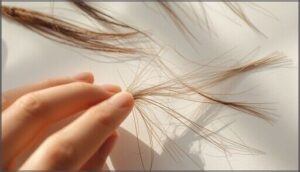
Your fingertips hold surprising texture-reading power when you know what to feel for. Pinch a single strand between thumb and finger—fine hair nearly disappears, creating almost no tactile feel, while coarse strands resist with wiry firmness that you can’t miss. Medium texture sits comfortably in between, smooth but clearly present.
Visual cues matter just as much. Hold several strands against a white background under daylight: fine hair looks almost invisible, medium matches sewing thread, and coarse casts a bold shadow. Check hair shine patterns too—fine hair scatters delicate light across the surface, while coarse reflects in larger, defined panels.
For deeper hair analysis, slide fingers from root to tip. Low surface texture glides easily (that’s low porosity), but rough, bumpy resistance signals high porosity and lifted cuticles. Combine these observations with strand thickness checks to nail your hair type and density before selecting products.
Fine, Medium, and Coarse Texture Clues
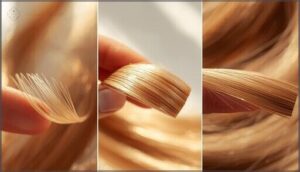
Hair Strand Analysis starts with real clues your fingers can decode. Fine Hair—under 50 microns—feels nearly invisible when rolled between your thumb and finger, often slipping away like silk.
Medium Hair sits firm but smooth, easy to detect without feeling wiry. Coarse Hair delivers sturdy resistance above 80 microns, signaling healthy Hair Follicle Health and distinct Hair Growth Patterns that demand richer moisture for ideal Scalp Condition.
Evaluating Hair Density and Thickness
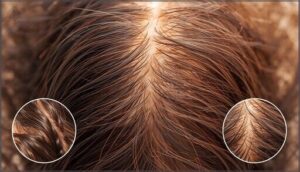
Now that you’ve nailed down your hair’s texture, it’s time to figure out density—the number of individual strands packed onto your scalp.
Density isn’t the same thing as thickness, and confusing the two can throw off your entire product strategy. Let’s walk through three quick checks that’ll show you exactly where your hair falls on the density spectrum.
Identifying Hair Density Levels
Most adults carry between 100,000 and 80,000 total hairs, yet follicle count per square centimeter tells the real story—ranging from 80 in sparse areas up to 250 in dense zones depending on your genetics. When you understand Hair Density (not strand thickness), you’ll know why some styles fall flat while others feel impossibly heavy.
Professional Hair Density Tests reveal your coverage level through targeted methods:
- Ponytail test: Measure circumference at the elastic—under 2 inches signals low Density Measurements, 4+ inches indicates high
- Strand count: Isolate one square inch; 80–100 strands means low, 150–200+ means high
- Part width: Visible Scalp Analysis shows thinning; narrow parts signal fuller Follicle Count
- Clinical trichoscopy: Dermatologists use imaging for precise Hair Thinning diagnosis and Hair Analysis
Analyzing Scalp Visibility
When you tilt your head forward under bright overhead lighting, does your part suddenly look wider than you remember? Lighting effects play tricks on your eye—harsh bathroom bulbs highlight every gap between strands, while natural daylight gives you a more honest picture of hair density.
Track changes with this quick reference:
| Check Point | What to Look For |
|---|---|
| Part width | Wider than old photos signals part widening |
| Crown view | Increased see-through areas show thinning patterns |
| Pattern shape | “Christmas tree” branching marks progressive loss |
| Product response | Volumizers no longer hide scalp = reduced coverage |
| Monthly photos | Same angle, same light = reliable tracking progress |
Fine hair texture and low hair porosity naturally show more scalp—that’s not thinning, just physics. Compare your current part to images from twelve months ago to separate real density shifts from temporary styling hiccups.
Differences Between Texture and Density
Think of texture and density as two sides of the same coin—texture classification measures individual strand diameter (fine under 0.06 mm, coarse above 0.08 mm), while density measurement tracks hair follicle count per square centimeter.
Your hair strand analysis might reveal coarse texture with low density, creating sparse volume despite thick strands, or fine texture with high follicle count, delivering surprising fullness through sheer numbers.
Determining Your Natural Curl Pattern
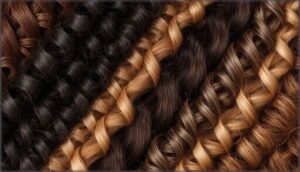
Your curl pattern is separate from texture—it’s about the shape your hair forms naturally, not the thickness of each strand.
Understanding your curl pattern helps you choose the right techniques and products that work with your hair instead of fighting it. Here’s how to identify where your hair falls on the curl spectrum.
Using The Andre Walker Hair Typing System
Celebrity stylist Andre Walker built this Hair Typing System in the 1990s to simplify Hair Classification for salons and product lines. You’ll use Curl Pattern Analysis to place your natural texture into one of four groups—straight (Type 1), wavy (Type 2), curly (Type 3), or coily (Type 4)—with A, B, C subcategories refining each.
That Texture Classification unlocks Hair Care Personalization and smarter Styling Product Selection, giving you a shared language that connects you to tutorials, communities, and formulas designed for your exact Hair Type.
Recognizing Curl Patterns (1A–4C)
Now you’ll map your strands to the full Hair Typing Systems spectrum. Type 1A grows pin-straight from root to tip, while Type 2A shows wide, loose waves that vanish without product. Type 2C forms thicker S-curves that hold even air-dried.
Type 3A delivers well-defined spirals, 3B tightens to marker-sized coils, and 3C shrinks into straw-diameter corkscrews. Type 4A coils densely in tight S-shapes, 4B bends into sharp Z-angles, and 4C shrinks seventy percent with cotton-like density.
Accurate Curl Pattern Classification drives every Frizz Management choice you’ll make.
Observing Hair Behavior When Wet
Once you’ve placed your pattern, watch your strands under running water. Wet Hair Clumping shows how well sections group together—strong clumps signal uniform Porosity and lower Frizz Patterns.
Track Shrinkage Rates by measuring where wet curls hang versus their dry height; tight coils can shrink seventy-five percent. Check Drying Speeds and run gentle Elasticity Tests to confirm Hair Hydration balance for smarter Hair Care choices.
Assessing Hair Elasticity and Porosity

Beyond texture and curl, your hair’s internal structure tells you exactly how it reacts to moisture and stress.
Elasticity shows how much your hair can stretch without breaking, while porosity reveals how easily it absorbs and holds water. These two factors explain why some routines work beautifully and others fall flat.
How to Test Hair Elasticity
Hold a clean, damp strand between your fingers and gently pull—this wet stretch method shows your hair fiber strength in seconds. Healthy hair stretches about 30 percent of its length before snapping back (that’s your elasticity sweet spot), while damaged strands break immediately during these hair stretch tests.
Breakage analysis reveals which elasticity factors—like chemical damage or moisture imbalance—are compromising your hair texture and overall hair health.
Simple Porosity Check Methods
Your hair’s absorption habits shape every product choice you make. The Float Test drops a clean strand into water—floating after a few minutes signals low porosity, quick sinking reveals high. The Slip Test runs your fingers from tip to root, feeling for bumps that indicate open cuticles. Watch Drying Time too: high porosity hair dries in two to four hours, while low porosity takes over eight.
- Spray Bottle Test: Mist clean hair and observe—beading water means resistant cuticles, instant absorption points to thirsty strands
- Product Absorption Clues: Notice how leave-in conditioners behave on your hair throughout the day
- Hair Analysis Combo: Cross-check results from multiple tests for accurate porosity assessment
Why Elasticity and Porosity Matter
Resilience separates hair that thrives from hair that snaps. Elasticity tests show whether your strands stretch and bounce back or crack under tension, while porosity levels reveal how well moisture stays locked inside. Together, they guide every protein balance decision and product choice you make.
- Hair breakage drops when you match treatments to your elasticity and porosity
- Moisture retention improves dramatically once you understand your hair’s absorption patterns
- Hair care becomes targeted rather than guesswork, protecting texture through every style
Run your hair analysis today for smarter, damage-proof routines.
Choosing Products Based on Hair Texture
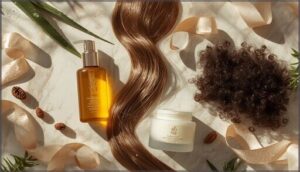
Once you know your hair’s texture, the real power move is choosing products that actually work with it instead of against it.
Fine hair needs lightweight formulas that won’t collapse your volume, while coarse hair craves rich moisture to tame that natural strength.
Here’s how to match your texture to the right products and build a routine that finally makes sense.
Matching Products to Fine, Medium, or Coarse Hair
Once you know whether you’re working with fine, medium, or coarse hair, product matching becomes straightforward. Fine hair needs lightweight volumizers—think mousses and root sprays—so you don’t flatten what little lift you have. Medium hair tolerates both airy and slightly creamier formulas, depending on your styling goal. Coarse hair demands richer conditioners with shea butter or argan oil because moisture has farther to travel through those thick cuticles.
| Texture | Best Product Types |
|---|---|
| Fine | Volumizing mousses, lightweight sprays |
| Medium | Flexible creams, balanced leave-ins |
| Coarse | Deep masks, oil-based serums |
| All types | Start small, build gradually |
Tips for Caring for Different Hair Textures
Caring for your texture category transforms daily hair maintenance from guesswork into precision. Fine strands demand lightweight hair oil benefits and volumizing texture-specific products, while coarse hair types thrive on intensive hair mask therapy weekly. Match your daily hair routine to your diameter.
- Washing cadence: Fine hair needs cleansing every 1–3 days; coarse textures flourish on weekly washes that preserve natural oils.
- Layering logic: Apply water-based hair care first, then seal moisture with styling tool tips like low-heat diffusers.
- Overnight protection: Silk pillowcases guard hard-won definition.
Adapting Your Hair Care Routine
Seasons mess with your strand performance more than you’d expect. Seasonal adjustments tied to your hair texture keep hair maintenance steady—winter deep conditioning battles brittleness, while summer UV sprays shield from humidity frizz.
Routine tweaks for exercise or hard water, smart product layering from lightest to heaviest, and targeted hair masking all enhance your hair care routine. Here’s how styling techniques shift across hair type and lifestyle:
| Season/Need | Routine Tweak | Product Swap |
|---|---|---|
| Winter dryness | Weekly deep conditioning | Heavier leave-ins |
| Summer humidity | UV protection sprays | Lighter serums |
| Frequent workouts | Co-wash between shampoos | Scalp-soothing rinses |
Frequently Asked Questions (FAQs)
What are the 4 types of hair texture?
Most guides classify hair texture into fine, medium, thick, or coarse based on strand diameter.
However, texture describes individual strand thickness—not curl pattern—so any texture can appear in straight, wavy, curly, or coily hair.
What are signs of low porosity hair?
Low porosity hair resists moisture because its tightly packed cuticle structure creates a barrier.
Watch for slow absorption during showers, product buildup on the surface, and unusually long drying times—even after blow-drying.
Can hair texture change over time naturally?
Yes—your hair texture can shift naturally over time. Hormonal changes, aging effects, environmental factors, nutritional impact, and lifestyle influences all alter hair growth cycles, density, and porosity despite your genetics setting the baseline.
Does hair texture differ by ethnicity or race?
Genetic variations play a lead role in ethnic texture. Your follicle shape, curl patterns, and strand diameter vary by ancestry—African hair shows tighter coils, Asian hair stays straighter—but racial differences overlap widely within populations.
How does diet affect individual hair strand thickness?
Your protein intake shapes how thick each strand grows—low levels starve keratin production.
Iron levels, vitamin D, omega fats, and calorie balance all steer hair density and fiber strength through direct follicle support.
Can heat damage permanently alter your hair texture?
Once the damage is done, the deed is done—heat styling above 347°F triggers permanent texture change through broken disulfide bonds, leaving curls looser and requiring thermal protection to prevent irreversible hair damage and breakage.
Is hair texture inherited from mother or father?
Your hair pulls traits from both parents—over 20 genes combine to shape your texture, weaving genetics and hair texture into every strand through inherited characteristics.
Family patterns blend across generations, never just one side.
Does diet or nutrition affect hair texture?
What you eat shapes how strong your hair feels—think of each strand as a tiny rope that frays when nutrient deficiencies strike.
Poor dietary patterns weaken hair growth, leaving new lengths brittle and rough instead of smooth.
How does heat damage alter hair texture permanently?
When you torch strands above 300°F, keratin proteins denature, bonds fracture, and the cuticle layer cracks open—so curls turn limp, texture feels coarse, and that altered structure won’t reverse until you cut it off.
Are there genetic tests for predicting hair texture?
Yes, consumer DNA analysis tools can predict general hair traits like straight versus curly by scanning variants in TCHH and EDAR genes, though genetic hair testing isn’t precise enough yet to classify exact texture categories.
Conclusion
Think of your hair like a fingerprint—completely unique, waiting to be decoded. Now that you know how to determine hair texture through thread tests, curl assessments, and porosity checks, you’re no longer flying blind through the beauty aisle.
Your strands have been sending signals all along; you’ve just learned the language. Armed with this knowledge, you’ll finally choose products that honor your hair’s natural blueprint instead of fighting against it.
- https://www.hair.com/hair-texture-chart.html
- https://savvyhairartistry.com/2024/03/23/understanding-hair-texture-density-and-porosity/
- https://www.devacurl.com/us/curl-101/hair-texture-101
- https://floraebeauty.com/blogs/news/understanding-hair-porosity
- https://www.clevercurl.com.au/how-to-determine-hair-porosity-and-what-it-means-for-your-hair/