This site is supported by our readers. We may earn a commission, at no cost to you, if you purchase through links. This content is for general informational and educational purposes only and is not a substitute for professional medical, dermatological, or nutritional advice.
Most beards grow down. The ducktail grows down, then defies gravity with a sharp point that draws the eye. This Renaissance-era style has roared back because it does something most beard styles can’t—it adds length to round faces, sharpens soft jawlines, and broadcasts confidence without saying a word.
But here’s the catch: you can’t just let your beard grow wild and expect that signature point to materialize. Growing a ducktail beard requires strategic length, precise trimming angles, and daily maintenance that separates amateurs from men who’ve mastered their facial hair. The good news? With the right technique and about 4-6 weeks of growth, you can sculpt this commanding look yourself.
Table Of Contents
- Key Takeaways
- What is a Ducktail Beard?
- Best Face Shapes for Ducktail Beards
- Preparing to Grow a Ducktail Beard
- Growing Your Ducktail Beard Step-by-Step
- Essential Tools for Shaping a Ducktail Beard
- How to Trim and Shape a Ducktail Beard
- Daily Care and Maintenance Tips
- Top Beard Grooming Kits for Ducktail Beards
- Frequently Asked Questions (FAQs)
- How to start growing a ducktail beard?
- Is ducktail beard attractive?
- What products are best for ducktail beards?
- How to get a ducktail beard?
- How long does it take to grow a ducktail beard?
- How many inches should a ducktail beard grow?
- How do you shape a ducktail beard?
- How do you grow a ducktail beard?
- Is ducktail Beard oil good for a big beard?
- How do I make my beard ducktail?
- Conclusion
Key Takeaways
- The ducktail beard requires 8-12 weeks of growth and strategic shaping to create its signature pointed chin that elongates round faces and sharpens soft jawlines through deliberate tapering from cheeks to chin.
- Daily maintenance with beard oil, weekly trimming sessions, and proper tools like precision trimmers with 0.5-20mm settings separate sharp, commanding results from scraggly amateur attempts.
- Round and square faces benefit most from the ducktail’s vertical illusion and angular contrast, while the style demands consistent exfoliation, moisturizing, and protein-rich nutrition to support healthy follicle growth.
- Shaping success hinges on creating a narrow 1-3mm chin point with clean cheek lines and necklines trimmed two finger widths above your Adam’s apple, using gradual tapering techniques instead of aggressive over-trimming.
What is a Ducktail Beard?
A ducktail beard is exactly what it sounds like—facial hair that tapers to a distinctive point at your chin, mimicking the shape of a duck’s tail. This classic style combines a full beard with strategic grooming that creates a sculpted, angular look extending downward from your jaw.
Many men pair this style with a subtle beard fade along the sides to enhance the tapered effect and create a cleaner, more polished appearance.
Before you commit to growing one, you need to understand what sets this beard apart, how it compares to similar styles, and why it might be the perfect choice for your face.
Key Characteristics of The Ducktail Style
The ducktail beard stands out through its sculpted chin profile—a sharp taper ending in a pointed tip at your chin’s center, creating an unmistakable beard silhouette. Here’s what defines this commanding beard style:
- Pointed chin that mirrors a duck’s bill, with the tip sitting slightly above your natural chin crease
- Narrowed jawline achieved through precise jawline technique and controlled tapering from cheeks to chin
- Clean cheek lines that slope downward, emphasizing facial harmony and the signature point
- Defined neckline trimmed above the Adam’s apple, preventing drift while showcasing your beard grooming precision
This facial hair style demands even hair texture and consistent density along your jaw for that smooth, intentional taper. Regular beard styling keeps the point sharp and prevents your look from rounding out into something improvised.
Ducktail Vs. Other Pointed Beards
Pointed tips come in several beard styles, each with distinct differences. While the ducktail beard features a pronounced taper along your jawline ending in a sharp V, other pointed beards emphasize the chin without that gradual side slope.
The ducktail keeps cheeks shorter to highlight the taper—your beard trimmer becomes essential for that clean silhouette. Standard pointed styles allow fuller cheeks, creating contrast rather than continuity.
A healthy beard relies on regular grooming, as highlighted in this resource about ducktail beard care essentials.
| Feature | Ducktail Beard | Standard Pointed Beard |
|---|---|---|
| Jawline Taper | Gradual V-shape from cheeks to chin | Minimal or no taper along jaw |
| Cheek Length | Trimmed shorter for definition | Often fuller for balance |
| Chin Point | Sharp, symmetrical tip extending down | Straight or slightly curved tip |
| Maintenance | Regular shaping sessions required | Less frequent trimming needed |
| Face Lengthening | Strong vertical elongation effect | Moderate chin emphasis |
Benefits of Choosing a Ducktail Beard
Beyond shape alone, this beard style delivers tangible advantages. You’ll notice a facial slimming effect as that pointed chin creates a vertical line that elongates your face. Beard confidence rises when your grooming routine yields a signature look that signals sophistication factor.
Here’s what you gain:
- Style versatility across casual and formal settings
- Sharp jawline definition that enhances your natural bone structure
- Easy coordination with different hairstyles and accessories
- Predictable beard care and maintenance with weekly trims
- A polished image that reflects disciplined facial hair styles
Regular beard grooming becomes your tool for projecting authority and intentional style—no guesswork, just consistent results.
Best Face Shapes for Ducktail Beards

Not every beard works with every face, and the ducktail is no exception. The good news? This style actually complements most face shapes when you understand how to adjust it to your features.
Let’s break down which faces benefit most from the ducktail and how to tweak the style to work with what you’ve got.
Suitability for Round Faces
Round faces need vertical illusion—and that’s exactly what you get with a ducktail beard. The pointed chin draws eyes downward, elongating your face while sharp cheek lines slice away visual width. You’re creating angles where nature gave you curves, redefining your jawline enhancement through strategic beard symmetry and cheek definition.
| Ducktail Element | Impact on Round Faces | Grooming Focus |
|---|---|---|
| Pointed Chin | Adds vertical length, counters width | Keep taper crisp and centered |
| Tapered Cheeks | Creates angular contrast | Trim high for slimming effect |
| Sharp Jawline | Defines bone structure | Maintain clean edges weekly |
| Controlled Sides | Prevents added roundness | Avoid bulk near cheekbones |
Your face shape analysis starts with understanding this: ducktail beard styles transform round face shapes by emphasizing downward flow. Regular beard grooming maintains those angles that counter soft contours, making this one of the most flattering facial hair styles for men seeking command over their appearance.
Men with thinner growth can achieve the same shaping effect by following techniques on how to style a thin beard that maximize visual density along the jawline.
Flattering Square and Oval Faces
Square and oval face shapes are ducktail territory—you’ve got the facial proportions that make this beard style shine.
Your square jaw gains vertical length through the pointed chin, softening harsh angles while maintaining jawline enhancement. Oval faces already balance cheekbone balance naturally, so the ducktail amplifies symmetry without fighting your structure.
Use your beard trimmer to preserve that natural harmony through precise beard symmetry. You can determine your unique features with a quick look at these helpful face shape identification tips.
Adjusting Ducktail Style for Your Features
Facial proportions demand custom chin point styling—your beard symmetry depends on face shape analysis that respects natural structure.
Diamond face shapes benefit from a narrower 1.5-centimeter chin point that doesn’t compete with prominent cheekbones, while jawline enhancement on any oval face shape or square face shape requires adjusting cheek fullness.
This ducktail beard style adapts through proportion, not guesswork.
Preparing to Grow a Ducktail Beard

Before you let a single whisker grow wild, you need to prep your skin like you’re building a foundation for a house. Skip this step and you’ll deal with itchiness, patchiness, and ingrown hairs that’ll make you want to shave it all off.
Let’s break down the three critical prep moves that’ll set you up for a clean, healthy ducktail.
Skin Cleansing and Exfoliation
You can’t grow a killer ducktail on irritated skin. Start with a noncomedogenic cleanser twice daily, massaging in circular motions for 20 seconds.
Exfoliate one to three times per week using chemical exfoliants like salicylic acid to clear pores and prevent ingrown hairs. Always follow with moisturizer post-exfoliation. Skip scrubbing if your skin feels raw—beard care tips start with smart skin care and personal grooming fundamentals.
Moisturizing and Conditioning Routine
Soft beard hair starts with locked-in moisture. Apply a hydrating serum followed by a lightweight moisturizer to seal water for up to 12 hours—your skin barrier needs layered hydration. Use beard oil or conditioner two to three times weekly to soften coarse hairs and reduce snagging by 40 percent.
- Morning ritual: Massage beard oil into damp hair after your shower
- Midweek boost: Deep condition with a leave-in treatment for intense softening
- Daily defense: Finish with balm to extend moisture protection up to eight hours
Supporting Healthy Beard Growth
Your beard won’t reach its full potential without the right fuel. Growth nutrition matters—eat protein-rich foods to boost keratin production, add zinc and omega-three fatty acids for follicle health, and consider a biotin supplement if you’re deficient.
Lifestyle factors like consistent sleep and exercise support hormone balance that drives beard growth. Pair quality beard care products including beard oil and beard balm with stress management to enhance beard health from the inside out.
Growing Your Ducktail Beard Step-by-Step
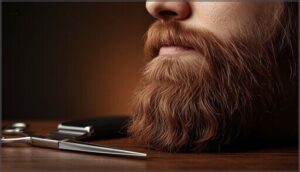
Growing a ducktail beard isn’t rocket science, but it does require patience and a solid game plan. You can’t just let your facial hair run wild and expect it to magically shape itself into that signature pointed look.
Here’s what you need to know about the growth process, from dealing with patchy spots to maxing out your beard’s natural thickness.
Ideal Growth Timeline and Length
You’ll need at least 8 to 12 weeks to build the foundation for your ducktail beard—patience is non-negotiable. Here’s what happens during each growth phase:
- Weeks 1-3: Facial hair growth establishes initial beard density across your chin and cheeks
- Weeks 4-6: Beard length hits 0.5 to 1 inch, allowing early shaping techniques
- Weeks 7-10: Your chin reaches 1.5 to 2.5 inches—the sweet spot for ducktail beard trimming
- Weeks 12+: Full beard maintenance mode begins with regular touch-ups
Managing Patchy or Uneven Areas
Patchy areas on your chin and jawline won’t sabotage your ducktail beard—they just need strategic handling. Focus on follicle care with daily beard oil and biweekly exfoliation to wake up dormant hairs.
Keep your chin length slightly longer than your cheeks to pull attention toward fullness, not gaps. Patience wins: facial hair growth fills from the center outward as weeks pass, gradually improving beard filling and overall skin health.
Tips for Maximizing Beard Thickness
Boosting hair density starts with beard nutrition—eat 1 gram of protein per kilogram of body weight daily to feed keratin production.
Massage your face twice daily to increase blood flow to follicles, and apply beard oil every morning for moisture and strength.
Growth serums with peptides can help when diet and grooming tips aren’t enough, but consistency with these thickening tips delivers real beard thickness over time.
Essential Tools for Shaping a Ducktail Beard
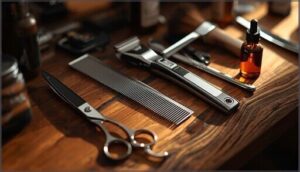
You can’t shape a ducktail beard with your bare hands and good intentions.
The right tools make the difference between a sharp, defined point and a scraggly mess that looks more confused than confident.
Here’s what you need in your grooming arsenal to actually pull this off.
Beard Trimmers and Scissors
Precision wins when you’re sculpting that signature ducktail point. Your gear determines whether you’ll nail clean lines or fight patchy disasters. Here’s what separates pro results from amateur hour:
- Beard trimmers with titanium or ceramic blade materials stay sharper longer—look for 0.5 mm to 20 mm trimmer settings and quick-charge lithium batteries for uninterrupted sessions.
- Detailing trimmers with narrow blades handle edge precision around your chin taper.
- Barber scissors (4-6 inches) let you point-cut straggly hairs that electric tools miss during beard maintenance.
Combs and Brushes
Once you’ve got your trimmer dialed in, the right beard comb and beard brush become your daily allies in beard maintenance.
Boar bristle brush types distribute natural oils for healthier beard textures, while wide-tooth comb materials like wood or bamboo minimize breakage when detangling tools hit snags.
Mixed bristle grooming techniques balance control with shine—solid mens grooming tips and tricks for shaping that pointed chin.
Beard Oils and Balms
Beard oil benefits go beyond shine—jojoba and argan base oils hydrate skin beneath your ducktail while balm ingredients like beeswax lock in moisture and add hold.
For daily beard care and products:
- Apply 3-8 drops of beard oil to damp beard after washing
- Warm balm between fingers before shaping flyaways
- Choose oil blending with cedarwood or sandalwood for skin conditioning
- Store grooming tips and tricks products away from sunlight
- Test essential oils if you’ve got sensitive skin—beard maintenance tips that prevent irritation
How to Trim and Shape a Ducktail Beard
You’ve got the growth and tools—now it’s time to turn that wild chin fuzz into a proper ducktail.
The shaping process breaks down into three key techniques that transform your beard from bushy to sharp.
Here’s how to sculpt that signature tapered point and clean up everything around it.
Creating The Signature Pointed Chin
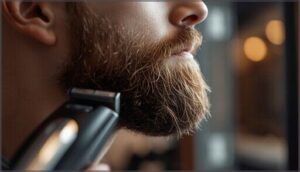
The pointed chin is your ducktail’s signature feature—so you’ll want to get it right.
Start by trimming a vertical guideline from your lip line down, then carefully taper both sides toward a narrow tip about 1 to 3 millimeters wide.
Use your trimmer’s zero guard for precision, and don’t rush it—small adjustments beat over-trimming every time.
Trimming Cheek and Necklines
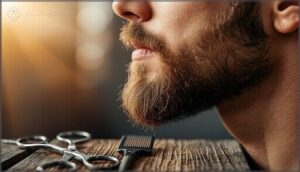
After creating the pointed chin, clean up your cheek line and neckline to frame your face properly. For cheek line definition, follow your natural arch about mid-ear level—keep both sides even for symmetrical facial framing.
Your neckline shaping sits roughly two finger widths above the Adam’s apple in a gentle curve. Use beard scissors or your trimmer for precise edge trimming without removing too much length.
Tapering and Blending Techniques
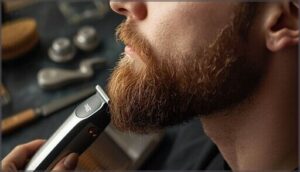
Smooth edge transitions separate amateur ducktail beard styling from professional results. Start your neckline taper with a 0.5 to 1.5 millimeter guard, creating gradual facial blending as you work toward fuller chin pointing areas.
Use your precision trimmer for micro-adjustments along curved jawline contours—this grooming technique prevents harsh step marks. Proper beard shaping requires light clipping passes for fluid beard trim transitions during maintenance.
Daily Care and Maintenance Tips

You’ve shaped your ducktail beard into the perfect point, but that’s just the beginning. Maintaining that sharp, refined look requires a daily routine that keeps your beard clean, conditioned, and properly styled.
Here’s how to lock in your hard work with consistent care that takes less than five minutes a day.
Washing and Conditioning Your Beard
You can’t skip washing if you want a sharp ducktail. Use a dedicated beard shampoo 2 to 3 times weekly with lukewarm water temperature—hot water strips natural oils and leaves your facial hair brittle.
Follow with a beard conditioner for 1 to 3 minutes, then rinse cool to seal cuticles. Exfoliate the skin beneath weekly for proper scalp care and healthier growth.
Applying Beard Oil and Balm
Oil and beard care are non-negotiable if you want proper products. Apply 3 to 6 drops of beard oil to damp facial hair after washing—jojoba and argan carrier oils deliver skin nourishment and hair hydration while mimicking natural sebum. Warm it between your fingers, work from roots to tips for full beard oil benefits, then finish with a pea-sized amount of balm for balm application that holds your ducktail point without stiffness.
Regular Brushing and Trimming Schedule
Your grooming routine demands consistency. Brush once every morning with a boar bristle tool to distribute oils and maintain that signature triangular shape—short, gentle strokes prevent frizz along the chin point.
Trim every 4 to 7 days during early hair growth, then shift to a 10 to 14 day cycle once you hit target length. Regular maintenance keeps your ducktail sharp.
Top Beard Grooming Kits for Ducktail Beards
You can’t shape a proper ducktail without the right tools in your arsenal.
The good news? You don’t need to buy everything separately or waste money on gear that doesn’t deliver.
Here are three solid grooming kits that give you everything you need to maintain that sharp, pointed chin without breaking the bank.
1. Panasonic Cordless Beard Trimmer
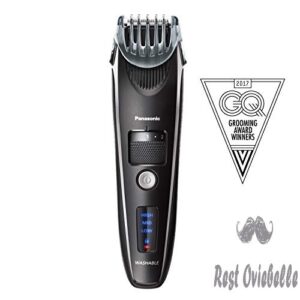
You’ll want a trimmer that tackles ducktail precision without a fight. The Panasonic ER-GB42 delivers 19 length settings from 0.5 mm to 20 mm on a single dial—no fumbling with multiple guards.
Its 45-degree angled blades cut dense whiskers cleanly in one pass, which matters when you’re shaping that signature pointed chin. The rechargeable battery runs 50 minutes per charge, and you can use it corded if needed.
The hypoallergenic blades won’t irritate your skin during detail work around your mustache and cheeks.
| Best For | Guys who want precise control over their beard shape and length without dealing with multiple attachments or complicated settings. |
|---|---|
| Brand | Panasonic |
| Weight | 0.18 Pounds |
| Primary Use | Beard trimming |
| Washable | Yes |
| Power Source | Cordless/Corded |
| Portability | Travel-friendly |
| Additional Features |
|
- 19 adjustable length settings on one dial make it simple to find your exact trim length
- Sharp stainless-steel blades deliver 9,800 cuts per minute for fast, clean results
- Fully washable design makes cleanup quick—just rinse under the tap
- Higher price compared to basic trimmers might not fit everyone’s budget
- Charger design can be awkward and doesn’t fit easily in all outlets
- Some users report the blades occasionally catch or pull on thicker beards
2. Philips Norelco Multigroom Trimmer Kit
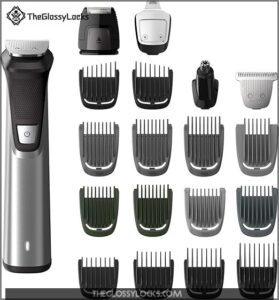
If you need versatility over portability, the Philips Norelco MG7750/49 covers your bases with 23 attachments. You’ll get dedicated guards for everything from stubble to longer lengths, plus detail trimmers for edging your neckline and cheeks.
The DualCut blades self-sharpen and last up to five years without oil, and the lithium-ion battery delivers five hours per charge. At 0.93 pounds it’s heavier than single-purpose trimmers, but the reinforced fiberglass guards won’t crack when you’re shaping that tapered point.
| Best For | People who want one grooming tool that handles everything from precise beard edging to full-body trimming without buying separate devices. |
|---|---|
| Brand | Norelco |
| Weight | 0.93 Pounds |
| Primary Use | All-in-one trimming |
| Washable | Yes |
| Power Source | Rechargeable Battery |
| Portability | Travel-friendly |
| Additional Features |
|
- 23 attachments cover every grooming scenario—beard styling, head shaving, body hair, nose/ear trimming, and detail work
- Self-sharpening DualCut blades last up to 5 years with no oiling required, saving maintenance hassle
- 5-hour battery life means you can go weeks between charges, and it works in the shower
- Storage becomes a real issue with 23 pieces—you’ll need dedicated drawer or counter space
- Heavier than single-purpose trimmers at 0.93 pounds, which some users find awkward for facial detailing
- The foil shaver attachment doesn’t deliver a close shave, so you might still need a dedicated razor
3. Viking Beard Grooming Kit
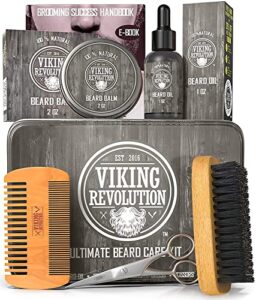
For complete at-home maintenance, the Viking Revolution kit bundles everything in one metal tin. You’ll get a boar bristle brush, double-sided pocket comb, unscented beard oil, citrus balm, and stainless steel scissors—all the basics for shaping and softening your ducktail.
The scissors draw mixed reviews on sharpness, and some tins arrive dented during shipping. But at this price point, you’re covering daily grooming without buying each tool separately. Just test the scissors on scrap hair before trimming your chin point.
| Best For | Men who want a complete, all-in-one grooming kit for daily beard maintenance without buying individual tools separately. |
|---|---|
| Brand | Viking Revolution |
| Weight | 0.1 Pounds |
| Primary Use | Beard grooming |
| Washable | No |
| Power Source | N/A |
| Portability | Travel-friendly |
| Additional Features |
|
- Includes all essential tools (brush, comb, oil, balm, and scissors) in one portable metal tin
- Boar bristle brush and balm help soften coarse hair and reduce tangles
- Budget-friendly way to get started with beard care without multiple purchases
- Scissors may lack sharpness and require testing before use on your beard
- Beard oil might irritate sensitive skin
- Tin packaging sometimes arrives dented or damaged during shipping
Frequently Asked Questions (FAQs)
How to start growing a ducktail beard?
Start with clean skin—exfoliate twice weekly and moisturize daily. Let your beard grow untouched for 4 to 6 weeks to establish proper length and density before you shape anything.
Is ducktail beard attractive?
A well-maintained ducktail signals confidence and attention to detail.
The sharp, pointed chin adds definition to your jawline, creating a polished and deliberate look that stands out in modern grooming trends.
What products are best for ducktail beards?
A lightweight beard oil keeps your ducktail soft without losing shape, while a medium-hold balm sculpts the chin point.
You’ll also need a wide-tooth comb and boar bristle brush for daily styling.
How to get a ducktail beard?
You’ll need 4 to 6 weeks of growth, then define a central chin point with a precision trimmer and taper the sides while keeping cheek fullness for that signature V-shape.
How long does it take to grow a ducktail beard?
Growing a ducktail beard is like cultivating a garden—patience pays off. Most men need 6 to 12 weeks from a clean shave to achieve a full, pointy ducktail shape.
How many inches should a ducktail beard grow?
A ducktail beard should reach 2 to 4 inches at the chin for a defined point. Round faces look sharper at 5 to 5 inches, while square faces benefit from 5 to 5 inches.
How do you shape a ducktail beard?
Start by mapping a rough V shape from your ears down to the chin, then carve out a crisp point at the bottom while keeping sides shorter to emphasize that signature taper.
How do you grow a ducktail beard?
Most men see their first ducktail shape after 2 to 6 weeks of growth. You’ll need patience, regular trimming every 1 to 2 weeks, and consistent beard oil to support healthy growth.
Is ducktail Beard oil good for a big beard?
Yes—beard oil is essential for big beards. It moisturizes thick hair, reduces itch, prevents flaking, and helps weigh down the chin point for that signature ducktail taper you’re working toward.
How do I make my beard ducktail?
You’ll need a precision trimmer and sharp scissors to taper your chin hair into a V-shaped point while keeping cheek growth shorter.
Daily brushing and beard oil help shape and maintain definition.
Conclusion
Michelangelo didn’t chisel David from marble overnight—he studied angles, planned his strikes, and trusted the process. Your ducktail beard demands the same discipline.
You’ve learned how to grow a ducktail beard from foundation to finish: the growth timeline, trimming angles, and daily upkeep that separates sharp lines from scraggly chaos. Now grab your trimmer, work in quarter-inch increments, and shape that point with purpose. Your jawline will thank you.