This site is supported by our readers. We may earn a commission, at no cost to you, if you purchase through links. This content is for general informational and educational purposes only and is not a substitute for professional medical, dermatological, or nutritional advice.
Most guys think a Viking beard is just letting your face run wild for six months. Wrong. Those ancient Norse warriors didn’t wake up looking like battle-hardened legends by accident—they knew their facial hair was a badge of honor, a symbol of strength, and honestly, a damn intimidating piece of their identity.
The modern Viking beard demands the same commitment: you’re looking at 5-6 months of disciplined growth, strategic trimming, and zero shortcuts. But here’s the payoff: once you nail the technique—from feeding your follicles the right fuel to mastering braids and beard oil rituals—you’ll have a look that channels raw masculinity and turns heads everywhere.
Growing a Viking beard isn’t about patience alone; it’s about knowing exactly what to do at each stage so you don’t end up with a scraggly mess instead of a warrior’s mane.
Table Of Contents
- Key Takeaways
- What is a Viking Beard Style?
- Is Your Face Shape Suited for a Viking Beard?
- How to Grow a Viking Beard Step-by-Step
- Essential Viking Beard Care and Maintenance
- Trimming and Shaping Your Viking Beard
- Styling and Adorning Your Viking Beard
- Frequently Asked Questions (FAQs)
- How do I get a beard like a Viking?
- Can everyone grow a Viking beard?
- How long does it take to get a Viking beard?
- What is the difference between a Viking beard and a full beard?
- Can anyone grow a Viking beard regardless of genetics?
- How long does a Viking beard take to fully mature?
- Are there any health risks associated with growing a Viking beard?
- Can a Viking beard be grown with patchy facial hair?
- Are there any social or workplace limitations to having a Viking beard?
- Can I grow a Viking beard with patchy facial hair?
- Conclusion
Key Takeaways
- Growing a proper Viking beard demands 5-6 months of disciplined growth with zero shortcuts, combining strategic trimming, proper nutrition (biotin, protein, omega-3s), and daily beard oil rituals to avoid ending up with a scraggly mess instead of a warrior’s mane.
- Oval and square face shapes naturally rock the Viking beard style, while narrower or wider faces need strategic adjustments—keeping extra volume on sides for narrow faces or going longer at the chin for wide jawlines to maintain that authentic Norse symmetry.
- Essential maintenance means washing 2-3 times weekly with sulfate-free shampoo, daily brushing with boar-bristle tools to distribute natural oils, and using beard oil on damp skin to prevent the goddamn itch and beardruff that plague most beginners.
- Authentic Viking styling goes beyond just length—braiding techniques like fishtail or three-strand patterns, adding beads at 2-3 cm intervals, and maintaining a thick mustache swept toward the corners transforms your beard from basic facial hair into a legitimate statement of rugged masculinity.
What is a Viking Beard Style?

You’ve seen them in movies and on every third guy at the craft brewery—but what the hell actually makes a Viking beard a Viking beard? It’s more than just letting your facial hair run wild and hoping for the best.
That means feeding your follicles the right vitamins and nutrients so every strand grows thick and strong from day one.
Let’s break down what sets this style apart, where it came from, and how it stacks up against other popular beard looks.
Key Characteristics of a Viking Beard
A Viking beard isn’t your average facial hair—it’s a bold, untamed statement. You’re looking at full, dense coverage from jaw to chest, with thick, coarse texture that screams rugged Scandinavian Viking warrior.
The beard style blends a prominent mustache seamlessly into heavy chin growth, creating that battle-ready appearance everyone associates with Norse legends. It’s substantial beard growth with minimal fuss—raw masculinity personified.
For more on the distinct features and recommended care, check out these Viking beard style tips.
Historical and Cultural Significance
Beyond the raw, untamed look, this beard style carries serious cultural weight. In Viking culture and history, facial hair wasn’t just grooming—it was Norse symbolism tied to warrior status and honor.
In Viking culture, facial hair wasn’t just grooming—it was Norse symbolism tied to warrior status and honor
Your Scandinavian Viking ancestors used beard rituals to mark maturity and clan identity. That Viking heritage still echoes today, giving your Norse look authentic historical context rooted in seafaring resilience and cultural identity.
Viking Beard Vs. Other Beard Styles
So how does this ancient grooming practice stack up against modern facial hair trends? The beard style evolution shows massive differences in Viking beard history versus today’s beard culture comparison:
- Fullness: Viking beards reach your neckline—most modern styles stop higher
- Accessories: Braids and beads define the look, unlike minimalist hipster cuts
- Mustache: Strong upper lip growth balances the chin, not always true elsewhere
- Shape: Broad and rugged beats today’s tapered precision
- Maintenance: Growth over daily grooming rituals
Artifacts uncovered from burial sites reveal that daily grooming routines were important to Viking men.
Is Your Face Shape Suited for a Viking Beard?

Not every face was carved for the same beard, and the Viking style is no exception. Some face shapes will make you look like you sailed straight out of Valhalla, while others might need a few tweaks to pull it off right.
Let’s break down which faces naturally rock this look and how to adjust if yours doesn’t quite fit the mold.
Best Face Shapes for Viking Beards
Let’s get real—oval faces are the goddamn champions of Viking beard styles. Your natural symmetry means you can rock a full, brutal beard without overwhelming your features.
From sleek braided beards to fierce warrior styles, check out these stylish Viking beard designs that’ll make the most of your face shape.
Square jaws benefit too, because that extra facial hair balance softens those hard angles while cranking up the rugged Viking aesthetics.
Round and diamond faces? You’ll need strategic jawline enhancement to nail the look.
Adjusting The Style to Fit Your Features
Your facial structure determines which tweaks achieve that perfect Viking beard symmetry. Here’s how to dial in your adjustments:
- Narrow faces: Keep extra volume on the sides and trim the chin shorter—you’ll widen your look without sacrificing that warrior vibe.
- Wide jawlines: Go longer at the chin and tighter on the cheeks for vertical balance and enhanced cheekbone definition.
- Patchy growth: Strategic mustache fullness masks thin spots while maintaining authentic beard styling.
How to Grow a Viking Beard Step-by-Step
Growing a Viking beard isn’t some mystical transformation that happens overnight—it’s a deliberate process that requires patience and the right approach. You’re going to need a solid game plan if you want to avoid looking like a patchy mess halfway through.
Here’s how to go from clean-shaven to battle-ready beard without screwing it up.
Starting With a Clean Slate

You can’t build a damn Viking beard on a dirty foundation. Beard preparation starts with proper facial hygiene—wash your face twice daily with a gentle cleansing routine to strip away oil and grime.
Skin exfoliation two to three times weekly clears dead cells that block beard growth. If you’ve got stubble now, do some initial trimming to even things out.
Clean skin equals strong facial hair.
Letting Your Beard Grow Out

Beard Patience is your new religion—Growing a Viking Beard takes roughly 5 to 6 months of absolute hands-off discipline. Here’s what you’re signing up for:
- First month brings uneven patches and that goddamn itch everyone complains about
- Growth crawls at about half an inch monthly—it’s slow as hell
- Cheeks fill in dead last, so don’t panic early
- Resist trimming urges for at least 8 weeks
- Moisturize daily to survive the Growing Pains phase
Diet and Lifestyle for Beard Growth

Your beard needs fuel from the inside out. Pump up your protein intake for keratin production—that’s what fills in those patchy spots. Load up on biotin benefits through eggs and nuts to boost hair growth thickness.
Omega-3s from fatty fish calm inflammation, while zinc importance can’t be overstated for testosterone metabolism.
Hydration keeps your follicles happy and your beard health on point.
Overcoming Common Growth Challenges
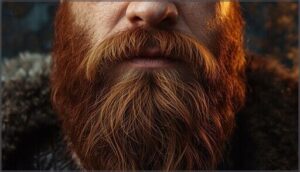
Patchy beard driving you nuts? Relax—patchiness improves in 6 to 12 weeks of steady growth. Exfoliate your jawline to wake up dormant follicles and boost density.
Beard itch and breakage? Daily beard oil keeps skin moisturized and hairs strong through growth phases. Gentle facial massage increases blood flow for follicle care.
Stick with your beard maintenance routine—persistence beats impatience every goddamn time.
Essential Viking Beard Care and Maintenance

You can’t just grow a Viking beard and walk away—this thing needs actual care to stay healthy and not look like a rat’s nest. Maintenance doesn’t mean spending an hour in the bathroom every goddamn day.
Let’s break down the essential routines that’ll keep your beard looking fierce without turning grooming into a second job.
Washing and Conditioning Techniques
You can’t build a legendary beard on neglect, goddamn man. Wash 2-3 times weekly with sulfate-free beard shampoo—lukewarm water lifts grime without stripping natural oils.
Massage cleanser into the skin beneath for 20-30 seconds, then rinse completely.
Follow with lightweight conditioner on midshaft to ends, let sit 1-3 minutes, and rinse cool to seal the cuticle and boost shine.
Daily Combing and Brushing
Once your beard’s clean, grab a boar-bristle brush or wide-tooth beard comb and work through it twice daily—root to tip, short gentle strokes.
Daily brushing spreads natural oils from your hair follicle down the shaft, prevents tangles, and trains wild hairs into submission. Comb techniques matter: detangling from the bottom up saves you breakage.
It’s beard maintenance tips 101, goddamn man.
Preventing Itch and Beardruff
That itch? It’s usually dry skin and flaky dead cells piling up under your beard. Cold air, overwashing with harsh cleansers, and coarse hair all strip moisture and trigger beardruff.
Gentle exfoliation once a week removes buildup without irritation. Wash with a sulfate-free product 2–3 times weekly, apply beard oil daily on damp skin, and hydrate with a lightweight moisturizer.
Itch relief comes from skin conditions prevention and proper beard hygiene—not scratching like a goddamn animal.
Using Oils, Balms, and Beard Products
Once your skin’s happy, lock in that moisture with the right beard products. Beard oil softens hair and hydrates skin—drop 3–6 drops into damp whiskers daily. Beard balm adds hold and tames flyaways with waxes and butters.
Match products to your skin types: sensitive guys need fragrance-free formulas, while everyone else can experiment with fragrance options. Choose lighter blends for volume, heavier ones for control.
Beard care isn’t rocket science, just consistency.
Trimming and Shaping Your Viking Beard
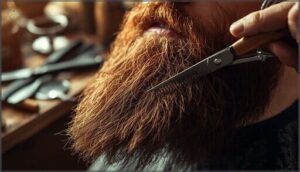
Look, you can’t just let your Viking beard run wild forever—eventually, you need to grab some tools and give it direction. The trick is knowing when to trim, where to cut, and how to keep that rugged shape without turning into a goddamn mess.
Here’s how to maintain that warrior aesthetic without looking like you’ve been lost at sea for six months.
Maintaining Length and Shape
You can’t build a legendary mane without protecting what you’ve already grown. Length retention and shape maintenance go hand-in-hand—your beard trimming strategy determines whether you look like a warrior or a walking tumbleweed. Here’s how to nail beard health while keeping Viking styling intact:
- Trim every 4 to 6 weeks using sharp shears and a guiding comb
- Remove only 1/8 to 1/4 inch per session to preserve bulk
- Check symmetry from multiple angles during beard care and grooming
- Use beard oil on ends to prevent split ends and support beard growth and maintenance
Trimming The Sides and Chin
Clippers in hand, you’re about to carve definition into that wild Viking beard. Use a beard trimmer to drop side lengths to 0.5–1.5 inches, then clean the cheek line with a curved edge—no sharp angles.
Let your chin contour stay longer for that classic taper. Do symmetry checks from every angle, and finish with a blending fade from cheek to jaw.
Managing Split Ends and Stray Hairs
Split ends? They’re the goddamn enemy of every Viking beard worth its salt.
Trim visibly damaged sections every 6 to 8 weeks with sharp scissors—point cutting creates softer ends than blunt chops.
Daily beard oil locks in moisture and prevents hair breakage, while sulfate-free shampoo and leave-in conditioner seal the cuticle. Your beard health depends on it.
Styling and Adorning Your Viking Beard
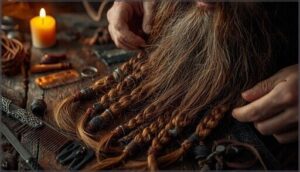
Alright, you’ve got the length and the shape—now it’s time to make that beard your own. Vikings didn’t just let their beards hang there like some goddamn caveman; they braided, adorned, and styled them to show off their personality and status.
Here’s how you can channel that same bold energy and turn your beard into a proper statement piece.
Braiding Techniques and Styles
You want that goddamn Viking warrior look? Fishtail braids are your go-to—crisscross those strands tight for killer texture. Crown styles wrap around your jawline like a battle-ready headpiece, while classic three-strand braid patterns keep things medieval-authentic. Viking knots at the ends? Chef’s kiss.
Beard weaving isn’t rocket science—just patience and steady hands transforming your braided beards into legitimate beard styling mastery.
Adding Beads, Rings, and Accessories
Bead placement turns your braided beards from “meh” to mythic—thread beads at 2-3 cm intervals along your chin strands for balanced swagger.
Choose your accessory materials wisely:
- Wood beads give you rustic lightweight vibes without dragging your jaw down
- Metal rings in brass or silver pop against dark hair like battle-worn trophies
- Stone beads (amber, jasper) add earthy textures that scream authentic Viking
- Secure everything with hidden fishing line or leather wraps—attachment methods matter when you’re headbanging
Check knot integrity every few months and remove accessories before showering. Accessory care keeps your beard styling legit, not janky.
Moustache Styling for Viking Looks
Your moustache styling makes or breaks the Viking beard—grow it thick and sweep it toward the corners without excessive droop for that battle-ready vibe.
Here’s how your upper lip game upgrades your facial hair styles:
| Technique | Method | Grooming Tips |
|---|---|---|
| Mustache Length | Keep center shorter than sides | Tapered silhouette balances chin beard styling |
| Curl Shaping | Subtle upward curl at ends | Norse warrior silhouette without cartoon vibes |
| Wax Application | Small amounts on outer thirds | Light hold prevents stiffness, goddamn man |
| Moustache Compatibility | Match thickness to jawline | Fuller chin pairs with heavier ‘stache definition |
Wax Application sculpts tips for that distinctive Viking beard swagger—comb straight across, then mold with fingertips for a controlled finish.
Customizing for Personal Expression
Your Viking beard styles become your story—personal style shows through every choice, from symbolic adornments to texture styling that mirrors your face shape.
- Coloring beards with semi-permanent dye shifts tones 1 to 3 shades for specific beard fashion
- Braid patterns reflect achievements or clan heritage in traditional beard styling
- Bead placement every 1 to 2 inches creates rhythmic visual storytelling
- Minimalist approaches balance modern beard shaping with historical nods
Frequently Asked Questions (FAQs)
How do I get a beard like a Viking?
Growing a Viking Beard starts with patience and genetic potential. Commit to at least four to six weeks of untrimmed growth, overcoming patchiness through consistent beard care and proper styling techniques.
Can everyone grow a Viking beard?
Not everyone can pull off a thick Viking beard—your genetic potential, hormonal influence, age impact, and ethnic differences all play massive roles in facial hair density and growth patterns.
How long does it take to get a Viking beard?
Like watching a glacier carve a fjord, beard growth demands patience. Most men need 3 to 4 months to achieve proper Viking length and density, though facial hair development varies wildly based on genetics and hormones.
What is the difference between a Viking beard and a full beard?
A full beard covers your face evenly with balanced density.
Viking beard styles push dramatic length and bulk—think rugged facial hair styles with braids, beads, and that raw Viking aesthetic modern interpretations love.
Can anyone grow a Viking beard regardless of genetics?
No, genetics set your baseline. Facial hair growth is polygenic—hormones like testosterone and DHT, plus follicle count, determine density.
But grooming tricks, patchiness solutions, and styling can utilize your genetic potential.
How long does a Viking beard take to fully mature?
Your Viking beard’s gonna take a goddamn eternity—well, 6 to 12 months for full maturation.
Growth factors like hormones and genetics set the pace, with monthly milestones marking your beard growth journey.
Are there any health risks associated with growing a Viking beard?
Skin irritation, product allergies, and infection risks top the list. Poor beard health and hygiene plus deficiencies in vitamins can slow growth. Keep your Viking beard clean and moisturized.
Can a Viking beard be grown with patchy facial hair?
Yes, goddamn man, you can. Focus your Patchy Beard Strategies on the Jawline Focus—let the chin and lower neck dominate.
Growth Patience pays off; visual tricks with beard care products mask thin spots beautifully.
Are there any social or workplace limitations to having a Viking beard?
Some workplaces enforce safety concerns or grooming policies that restrict long, unkempt facial hair.
Client perception in conservative industries may clash with Viking beard culture, though discrimination issues protect religious or cultural expression.
Can I grow a Viking beard with patchy facial hair?
Look, patchy growth reality doesn’t mean you’re doomed.
You absolutely can rock a Viking beard with a customized growth plan that uses strategic shaping and visual balance to work with what you’ve got.
Conclusion
Ironically, the Vikings never had access to beard oil, balms, or YouTube tutorials—yet they dominated with legendary facial hair. You’ve got every advantage they didn’t, so there’s zero excuse for a half-assed attempt.
Learning how to grow a viking beard means committing to the process: months of growth, strategic maintenance, and owning that warrior energy. Stop overthinking it. Start growing it. Your face was built for this—now prove it.