This site is supported by our readers. We may earn a commission, at no cost to you, if you purchase through links. This content is for general informational and educational purposes only and is not a substitute for professional medical, dermatological, or nutritional advice.
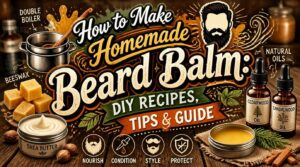
Store-bought beard balm costs $15 a tin and hides a long ingredient list you can’t pronounce. A homemade version needs four ingredients, a double boiler, and about twenty minutes. That’s the whole trade.
Learning how to make homemade beard balm puts you in control of hold, scent, and skin feel. You choose cedar and sandalwood over synthetic fragrance. You adjust the wax ratio until the balm grips exactly how your beard needs it to. You skip the fillers entirely.
Below, you’ll find the full process, three tested recipes, and the ratios that let you tweak texture like a pro.
Table Of Contents
- Key Takeaways
- What Ingredients and Tools Do You Need for Homemade Beard Balm?
- How Do You Make Homemade Beard Balm Step by Step?
- How to Adjust Beard Balm Hold, Texture, and Skin Feel
- Homemade Beard Balm Recipes, Scents, and Vegan Alternatives
- How to Apply, Store, and Check Homemade Beard Balm for Spoilage
- Frequently Asked Questions (FAQs)
- What to use if you don’t have beard balm?
- What is the best natural beard balm?
- What softens beard hair naturally?
- What are the ingredients in Amish beard balm?
- Can beard balm expire or go bad?
- How much balm should I use daily?
- What mistakes should beginners avoid when making balm?
- Can women use beard balm for hair?
- Is beard balm safe for sensitive skin?
- Can I use beard balm on my hair?
- Conclusion
Key Takeaways
- Homemade beard balm needs only four ingredients (beeswax, shea butter, a carrier oil, and essential oil), a double boiler, and about twenty minutes, giving you full control over hold, scent, and skin feel for a fraction of the $15 store-bought price.
- The process hinges on temperature control: melt wax and butters at 65–75°C (never above 85°C), add carrier and essential oils below 60°C so heat doesn’t burn off scent, and pour at 50–55°C for a smooth, bubble-free finish.
- You adjust the balm like a pro by tweaking ratios—more beeswax firms the hold, more shea or cocoa butter adds body, and cutting liquid oils fixes a greasy feel—so always test small batches and label each with its ratios and date.
- Spoilage is the real risk, not the recipe: nearly 60% of homemade balms go bad early from moisture exposure, so scoop with clean dry utensils, store in an airtight tin in a cool dark spot, and toss the batch after 6–12 months if it smells rancid, separates, or shows mold.
What Ingredients and Tools Do You Need for Homemade Beard Balm?
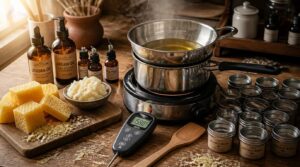
Before you start, get everything in place so nothing stalls mid-batch. The main ingredients are beeswax for hold and structure, shea butter for body and softness, a carrier oil like jojoba or argan to thin the mix, and a few drops of essential oil for scent.
If you’d rather skip the trial-and-error, our roundup of the best beard care balms breaks down which store-bought options nail this same ingredient list. It’s especially handy if you’re working with coarse gray beard hair, since our guide to the best beard balms for gray beards flags formulas that add extra moisture and conditioning.
For tools, you need a double boiler or a heat-safe container set over a pot of simmering water, a thermometer, a stirring spatula, and small screw-top tins to package the finished balm. Clean, dry containers are non-negotiable; even a trace of moisture can destabilize the texture and shorten shelf life.
Label each batch with the ingredient ratios and the date so you can track what works and repeat it.
How Do You Make Homemade Beard Balm Step by Step?
Making beard balm comes down to four steps. Each one matters, and the order matters just as much. Here’s the full step-by-step process so you can get it right on your first batch.
Measure The Ingredients
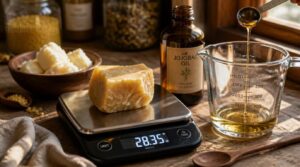
Precision matters here. Set your digital kitchen scale to grams and weigh beeswax first, then shea butter, then carrier oils. Use your measuring spoons for small amounts like jojoba oil.
Pour everything into a glass measuring cup or pouring jug so you can see total volume. Keep a stirring utensil ready.
If you’re unsure how much balm to start with, this guide to cedar-scented beard balm breaks down the right amount for every beard length.
Pre-weighing everything shortens melt time and limits oxidation.
Melt Wax and Butters
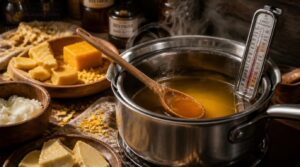
Set up your double boiler and add your beeswax and shea butter first. Heat until everything melts into a uniform mix, around 65–75°C. If you’re using cocoa butter, it goes in now too. Stir continuously so the phases stay combined. Keep the temperature under 85°C; hotter than that degrades the butters. Pull it off the heat once the mixture runs clear and smooth.
Add Carrier and Essential Oils
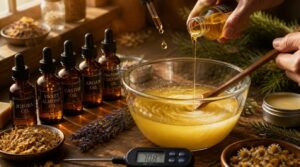
With your base off the heat, wait until it drops below 60°C. Hot wax burns off the essential oil and wastes scent.
- Jojoba for a light, fast-absorbing feel
- Sweet almond for a balanced, midweight feel
- Castor for extra tack and hold
- Argan for a smoother finish
- Fractionated coconut for a neutral, clean scent
Stir your carrier oil in first, then the essential oil, keeping total fragrance around 1–2% of your beard balm recipe. Mix for a full minute so nothing concentrates in streaks, but stop once it thickens. Over-stirring whips in air and leaves your beard balm ingredients grainy as they set.
If you’d rather tweak the ratios for a thinner finish, this beard oil with natural ingredients pairs nicely with your balm.
Pour and Cool The Balm
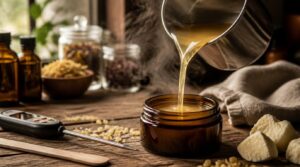
Pouring at 50–55°C keeps air bubbles out and gives you a clean, smooth surface. Let it cool undisturbed for 60–75 minutes, or refrigerate it if you’re short on time.
Check beard balm consistency after 24 hours; it should be solid and uniform with no visible oil separation. Store it at 15–25°C and inspect around 4–6 weeks for off-odors or discoloration.
How to Adjust Beard Balm Hold, Texture, and Skin Feel
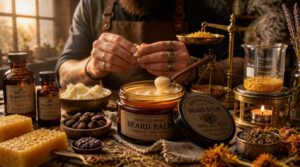
Once you know the base, beard balm hold comes down to your wax fraction. More beeswax or carnauba firms things up. Less wax keeps it pliable.
Butter ratios in balm shape body and drag. Shea and cocoa add structure. Carrier oil benefits go the other way: they soften the feel but cause sliding if overdone.
Beard balm texture issues usually trace to incomplete melting. Stir slowly and keep heat steady.
Cut liquid oils when your beard balm skin feel runs greasy. Essential oils shift how fast the film settles.
- Increase wax for firmer hold
- Add shea or cocoa for body
- Cut liquid oils to reduce grease
- Stir slowly during cooling for smooth texture
- Pick low-volatility oils for lasting skin feel
Homemade Beard Balm Recipes, Scents, and Vegan Alternatives
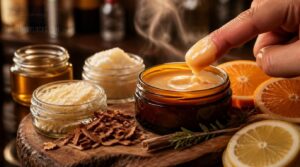
Picture warm cedar rising from a tin while cool jojoba spreads across your palm. That’s what a solid homemade beard balm delivers. Three beard balm recipes give you a real starting point:
- Cedar-Sandalwood Balm: 8g beeswax, 20g shea butter, 40g jojoba oil, 6-8 drops cedarwood, 5 drops sandalwood
- Citrus-Glow Balm (vegan): 6g carnauba wax, 20g shea butter, 40g almond oil, 8 drops sweet orange, 4 drops lemon
- Unscented Conditioning Balm: 8g beeswax, 24g cocoa butter, 40g grapeseed oil, 1g vitamin E
For vegan beard balm, swap beeswax for candelilla at a 2:1 ratio. Keep total essential oils under 2% of your batch to avoid irritation. DIY beard balm customization comes down to your ratios, so always test small batches first.
How to Apply, Store, and Check Homemade Beard Balm for Spoilage
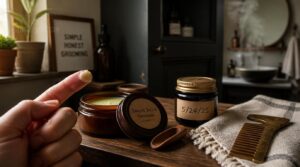
A 2023 survey found nearly 60% of homemade balms spoil early because of moisture exposure, not bad recipes. That means your technique after mixing matters as much as the recipe itself.
Moisture exposure, not bad recipes, spoils most homemade balms—so post-mixing technique matters as much as the recipe
Application is simple. Warm a pea-sized amount between your fingertips, then work it from roots to tips on damp or freshly groomed hair. Less is more; you want a light coat, not grease.
For beard balm storage and daily handling, keep these habits:
- Scoop with a clean, dry utensil every time
- Use an airtight tin and keep water out of the jar
- Store in a cool, dark cabinet, never on a steamy bathroom shelf
- Label the jar with your make date
Typical beard balm shelf life runs six to twelve months. Toss it if you notice sour or rancid smells, discoloration, fuzz, or separation that won’t remix.
Frequently Asked Questions (FAQs)
What to use if you don’t have beard balm?
No beard balm? Use petroleum jelly for occlusive moisture, a fragrance-free lotion for conditioning, or a thin beard oil layer for shine. None give wax hold, but they’ll tame dryness temporarily.
What is the best natural beard balm?
The best natural beard balm pairs beeswax or candelilla wax with shea or cocoa butter and jojoba oil. Jojoba mimics skin sebum, so it absorbs cleanly, making it ideal beard balm for sensitive skin.
What softens beard hair naturally?
What softens beard hair naturally? Fatty butters and carrier oils like shea, jojoba, and argan. They coat each strand, cut friction, and lock in moisture, so your DIY beard balm leaves hair noticeably softer.
What are the ingredients in Amish beard balm?
Amish beard balm ingredients are simple: beeswax for hold, shea butter for smoothness, a carrier oil like coconut or jojoba, plus a light essential oil scent mix. This Beard Balm Ingredients Guide covers it.
Can beard balm expire or go bad?
Yes, beard balm can expire. Expect a beard balm shelf life of six to twelve months. Watch for rancid smells, separation, or mold. Airtight beard balm storage tips: keep it cool, dark, and dry.
How much balm should I use daily?
How much balm should I use daily? Start with a pea-sized amount for short beards, more for longer ones. Rub it between palms first. If your beard looks greasy, cut back; if flyaways persist, add slightly more.
What mistakes should beginners avoid when making balm?
What mistakes should beginners avoid when making balm? Think of ratios as a recipe, not a suggestion. Overheating kills essential oils, wrong wax-to-oil balance ruins texture, and rushed stirring leaves clumps. Use airtight containers, patch-test oils, and follow these beard balm making tips.
Can women use beard balm for hair?
Can women use beard balm for hair? Absolutely. A DIY beard balm conditions strands, tames frizz, and adds light hold. Check the beard balm recipe for allergens and pick a scent you like.
Botanical oils like jojoba and argan nourish hair by mimicking natural sebum, making beard oil for hair an effective lightweight conditioner when applied to the ends.
Is beard balm safe for sensitive skin?
Is beard balm safe for sensitive skin? It can be, but don’t assume "natural" means gentle. Fragrance and essential oils trigger most reactions. Prioritize essential oil safety, do patch testing on your inner wrist for 24 hours, and choose unscented, simple formulas.
Can I use beard balm on my hair?
Can I use beard balm on my hair? Yes, but expect trade-offs. Wax and butters add hold yet leave buildup on finer scalp hair. Warm a small amount, apply lightly, and wash out thoroughly.
Conclusion
Picture a tin of balm on your shelf, still carrying the warm scent of cedar you picked yourself. That’s what learning how to make homemade beard balm gets you.
Four ingredients, twenty minutes, and full say over hold, texture, and fragrance. Tweak the wax until it grips right, store it cool and dry, and watch for any off smell. Your beard, your recipe, your rules. Make the first batch this weekend.