This site is supported by our readers. We may earn a commission, at no cost to you, if you purchase through links. This content is for general informational and educational purposes only and is not a substitute for professional medical, dermatological, or nutritional advice.
You chop off length, expecting freedom, and instead get a fuzzy triangle staring back in the mirror. Sound familiar? Short curls shrink more than long ones, and that surprises almost every client who sits in my chair for the first time.
Here’s the good news: shrinkage isn’t your enemy, technique is just missing. The right order of products, a little water, and some patience turn frizz into defined, bouncy curls that actually hold their shape.
Once you know how to style short curly hair the right way, you’ll stop fighting your texture and start working with it, curl by curl.
Table Of Contents
- Key Takeaways
- How to Style Short Curly Hair Step by Step
- Customize Styling for Your Curl Type
- Add Volume and Face-Framing Definition
- Choose a Flattering Short Curly Cut
- Refresh and Maintain Short Curly Hair
- Frequently Asked Questions (FAQs)
- How do you make short curly hair look good?
- How to style curls on short hair?
- Which hairstyle is best for short curly hair?
- How to style short curly hair after shower?
- How to protect short curly hair while sleeping?
- Best products for defining curls in short hair?
- Dealing with frizz in humid outdoor environments?
- Styling short curly hair for active sports?
- How to refresh short curls between wash days?
- How often should I wash short curly hair?
- Conclusion
Key Takeaways
- Blot your curls with a microfiber towel instead of rubbing, then apply leave-in conditioner and curl cream or mousse to damp hair before scrunching upward from ends to roots to build definition and fight frizz.
- Diffuse or air-dry on low heat until about 80% dry, then let curls finish drying on their own to protect your curl pattern and cut down on shrinkage.
- Matching your products and techniques to your specific curl type, density, and porosity makes a bigger difference than following one generic routine.
- Between washes, refresh curls with a water mist and a little leave-in, protect them overnight with a silk pillowcase or the pineapple method, and stick to regular trims to keep your shape looking sharp.
How to Style Short Curly Hair Step by Step
Short curls have a routine all their own, and getting it right makes all the difference. You don’t need fancy tools or a ton of time, just the right order of steps. Here’s exactly how to work from wet hair to defined, bouncy curls.
Starting with a good leave-in conditioner routine for curly hair sets the stage for curls that stay soft, hydrated, and full of life.
Gently Blot With Microfiber

Grab a microfiber towel (or old cotton tee) and blot, don’t rub. Rubbing causes frizz; blotting wicks water through tiny fibers instead.
Why it works:
- Microfiber absorbs several times its weight in water
- Blotting protects your curl pattern
- It cuts drying time before styling
- Less frizz means better hold later
Gentle pressure, clean sections, done.
Apply Leave-in to Damp Hair
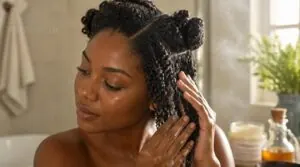
Once you’ve blotted, hair should feel moist, not dripping, that’s your sweet spot.
Section into four to six parts and smooth leave-in conditioner mid-lengths to ends using your fingers. Damp strands let ingredients absorb deeper into the cortex, boosting hydration and frizz control before you build definition with curl-defining products next.
For curly hair, choosing richer formulas with natural oils like shea butter, coconut, or argan oil can make a noticeable difference in definition and softness.
Layer Curl Cream or Mousse
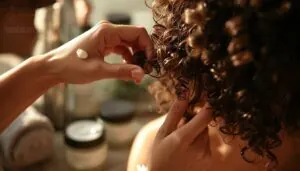
Now for the fun part. Work a curl cream through mid-lengths first for moisture and softness, then follow with a small amount of styling mousse for hold. This order boosts curl definition while balancing bounce.
Use light amounts, too much product causes buildup or a waxy cast once hair dries.
Scrunch Curls From Ends Up

With cream and mousse in place, it’s time to shape those curls. Cup sections in your hands and squeeze upward from ends to roots, holding each squeeze a few seconds. Keep going until water stops dripping, this releases excess moisture while clumping curls together. Gentle, consistent scrunching fights frizz and locks in definition before you move to drying.
Plop, Then Dry on Low

Now wind that microfiber towel around your curls and let it sit for about 5 minutes, no longer, so you don’t dry out your scalp.
Set your dryer low, around 120-140°F, and either diffuse or air-dry until 80% done.
Low heat protects your curl pattern and cuts shrinkage, so let the last bit finish on its own.
Customize Styling for Your Curl Type
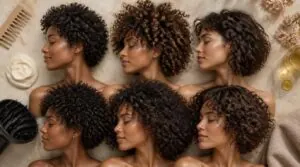
Not all curls play by the same rules, and yours has its own personality. Once you know what you’re working with, picking the right products and techniques gets so much easier. Here’s how to match your routine to your curl type.
Beyond product picks, understanding why curly hair is so universally flattering can help you embrace your natural texture with more confidence.
Identify Your Curl Pattern
Ever wonder why your curls look different every wash day? That’s normal. Check your hair wet, using a curl type chart (2A-4C) to compare. Try a strand test on a few pieces too, since patterns often vary across your head.
| Curl Type | Shape |
|---|---|
| 2 | S-wave |
| 3 | Spiral |
| 4 | Tight coil |
Choose Hold for Softer Curls
If your curls tend toward looser waves or springy spirals, skip the heavy gel. Look for a soft-hold curl cream with glycerin listed high up, paired with lighter oils like jojoba or argan. This gives you curl definition without a hard cast, so once you scrunch and dry, curls stay bouncy and touchable instead of stiff.
Add Rich Moisture for Coils
Tight coils are thirsty, so give them what they crave. Reach for a deep conditioner with shea butter and mafura oil, then seal with a few drops of jojoba while hair’s still damp.
Weekly treatments, twenty minutes minimum, keep hydration locked in. Try warming with a shower cap for deeper absorption, sealing in lasting moisture and softer, more defined coils every time you style.
Match Products to Hair Density
Not all curls need the same amount of product, and that comes down to density.
If your strands are fine or less dense, go light so curls don’t fall flat.
Medium density loves balanced hold formulas.
Thick, dense hair wants richer creams and mousse for real curl definition without stiffness or crunch.
Detangle With Fingers or Wide-Tooth Comb
Knots love to hide near your ends, so start there. Add a leave-in for slip, then finger detangle in small sections, working ends to roots.
Switch to a wide-tooth comb to catch anything you missed. This gentle combo protects curl definition on short curly hair while keeping breakage low.
Add Volume and Face-Framing Definition
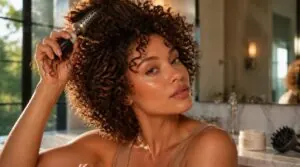
Once your curls are clean and defined, it’s time to build them up. Volume and face-framing details are what take your look from flat to full of life. Here’s how to get there, step by step.
Lift Roots With a Diffuser
Grab your diffuser and flip your head upside down, that’s where the magic starts. Cup sections in the bowl, swirl gently toward your scalp, and pause 30-60 seconds per section.
- Bouncier roots that catch every glance
- Volume that lasts through errands and dinner plans
- Curls that finally match your energy
Finish with a cool shot to lock that lift in.
Clip Roots While Hair Dries
Once your diffuser work is done, small clips can lock that lift in for good.
Watch for the 80% dry mark, then clip small crown sections upward. Plastic clips suit thicker curls, tiny metal ones work for fine strands. Skip product here, the clips alone hold volume for days until your next wash.
Scrunch Out The Product Cast
Now those clips are out, your curls feel stiff, almost crunchy. That’s the cast, and breaking it is what reveals the bounce underneath.
Breaking the crunchy cast is what finally reveals the bounce hiding underneath
- Scrunch upward gently from ends to roots
- Rake fingers through for stubborn spots
- Tilt your head side to side for even release
- Mist lightly, then finger-fluff for softness
Fine hair breaks fast. Coils take patience.
Define Curls Around Facial Features
Once your curls bounce free, look at what’s framing your face. Cheekbone curl definition adds lift, while jawline softening layers ease sharp angles.
Curls swept toward your temples soften your forehead, and shorter pieces near your chin create natural face framing. Match this to your face shape and porosity, since thirsty strands clump differently than sleek ones.
Choose Parts for Balanced Volume
Where you part your hair changes everything about volume. A middle part gives round faces balanced symmetry, while a deep side part builds extra lift and drama.
Try these placement tricks:
- Keep the part short, just an inch or two up front
- Let hair fall naturally where it separates
- Avoid parting clear back to the nape
This works with any face shape and hair density.
Choose a Flattering Short Curly Cut
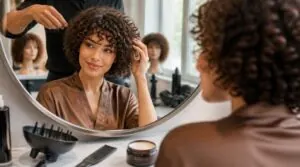
Once your routine’s down, the next step is picking a cut that actually works with your face shape. The right cut can make styling faster and your curls look even better. Here are a few flattering options to look at.
Round Faces: Crown-Height Pixies
Want extra height without extra length? A crown-height pixie is your best friend for round faces.
| Do This | Why It Works |
|---|---|
| Leave crown 3-5" long | Fights curl shrinkage |
| Taper sides shorter | Narrows silhouette |
| Dry cut curls | Prevents length loss |
| Diffuse upside down | Lifts roots for height |
Round faces love vertical lines, and this pixie cut delivers.
Square Faces: Soft-Layered Bobs
If your face shape leans strong and angular, a soft-layered bob is your secret weapon.
- Keep length past the jawline
- Add face-framing layers around cheekbones
- Skip blunt, boxy ends
Textured bob ends and gentle layered curls soften that jawline beautifully, no sharp lines needed.
Heart Faces: Wispy Curly Bangs
A wide forehead and narrow chin? Wispy curly bangs are your balance trick.
Keep them longer than brow level, side swept, with soft feathered ends for face framing bangs that skim the hairline without bulk.
Curl definition bangs come from finger coiling plus a light cream, never heavy gel.
Trim every 4-6 weeks. That’s how to style short curly hair around your best features.
Oval Faces: Versatile Cropped Styles
Lucky you: an oval shape is basically a blank canvas, and cropped curls look great on it.
Try a cropped cut with long bangs, a tapered fringe blended into the sides, or highlights that show off texture. Keep crown volume placement balanced and layers soft around your jaw. That’s how to style short curly hair when your face already does the work for you.
Tapered and Undercut Styles
Ready for something bolder? A tapered fade blends short sides into a longer curly top, keeping definition up top while cutting bulk below. An undercut goes further, shaving underneath for major height contrast.
- Great for round or square faces (adds vertical lift)
- Balances heart-shaped jawlines with volume
- Needs touch-ups every 2-3 weeks
- Pairs well with curl cream for shape
Refresh and Maintain Short Curly Hair

Getting the cut and style right is only half the job, you’ve got to keep those curls looking good day after day. That means a few easy habits between wash days and regular trims to keep your shape sharp. Here’s what your maintenance routine should include.
Refresh Curls With Water Mist
Some mornings your curls just need a little wake-up call. Fill a mister with distilled water, hold it 20-30 cm away, and mist mid-lengths and ends until slightly damp.
Scrunch and reshape upward, finger-coil stubborn spots, then diffuse on low.
That’s real curl revival, no rewash required.
Reapply Leave-in Sparingly
Once your mist has done its job, don’t reach for a full pump of leave-in again. Use sparingly, just a small amount worked from mid-lengths to ends, always avoid roots so curls don’t feel weighed down.
This keeps hold fresh and helps prevent product buildup between wash days, so your curls stay bouncy, not crunchy or flat.
Pineapple or Bonnet Curls Overnight
Nighttime matters just as much as your morning routine. Try the pineapple method: flip your head over, gather curls loosely at the crown with a silk or satin scrunchie, never a tight tie. Curls stay lifted, not crushed.
Or wear a satin bonnet for full frizz control. Both protect your texture while you sleep, so you wake up with definition intact.
Deep-Condition Curls Weekly
Protecting curls at night only goes so far if they’re thirsty underneath. Once a week, treat strands to a deep conditioner, focusing on ends where dryness lives. Comb it through with fingers, keep it off your scalp, and let heat (a shower cap works great) help it sink in for 15-30 minutes. Rinse before frizz creeps back in.
Schedule Six-to-Eight-Week Trims
Six weeks or eight? Let your hair growth rate decide.
Tight coils need trims every six weeks to dodge knots, while looser waves can stretch to twelve. Faster growers should book sooner.
Summer humidity calls for six-week check-ins; winter dryness prefers eight.
Regular trims stop split ends from traveling upward, whether you go professional or DIY curl-by-curl.
Frequently Asked Questions (FAQs)
How do you make short curly hair look good?
Short curls don’t have to mean frizzy or shapeless, promise. Scrunch curl-defining cream into damp hair, layer with a leave-in, then diffuse on low. That combo builds definition, adds volume, and keeps frizz calm.
How to style curls on short hair?
Smooth curl-defining cream onto damp hair, then scrunch gently with a microfiber towel. Diffuse on low heat, scrunching upward toward your roots, this builds volume and definition while keeping frizz under control.
Which hairstyle is best for short curly hair?
Picture layers catching light with every bounce, that’s the magic of a graduated pixie cut. It suits nearly every face shape, works with your curl pattern, and pairs beautifully with a diffuser for easy volume.
How to style short curly hair after shower?
Right after your shower, blot with a microfiber towel, smooth on leave-in, then layer curl cream. Scrunch upward from ends to roots, plop for curl definition, then air-dry or diffuse on low heat.
How to protect short curly hair while sleeping?
Think of your curls as delicate cocoons, guard them and they’ll bloom by morning. Swap cotton for a silk pillowcase, gently detangle first, then try the pineapple method or wrap with a silk scarf to prevent breakage overnight.
Best products for defining curls in short hair?
Go for lightweight defining gels, hydrating curl creams, or curl enhancing mousses on damp hair.
Leave-in detanglers boost slip, flexi hold gels lock curls without crunch, and a light scrunch brings out true, bounce-ready definition every time.
Dealing with frizz in humid outdoor environments?
Rinse with cold water to seal cuticles, then swipe on an anti-frizz sealant before heading out. That barrier locks in moisture retention and keeps your curl definition strong, even when the air outside feels like a sauna.
For color-treated curls especially, that protective step matters even more—covering red hair dye with brown already stresses the cuticle, so sealing it after every wash helps preserve both the color and your curl pattern.
Styling short curly hair for active sports?
Sleek and secure beats loose and wild on workout days. Slick a wide stretchy headband across your crown, tuck front pieces under, apply curl cream for flexible hold, then finish with sweat-resistant hairspray to lock everything in place.
How to refresh short curls between wash days?
Mist curls with water first, then work in a little diluted leave-in using finger coiling. Scrunch gently upward to reawaken clumps, add light curl cream where flat, and let air-dry for bouncy, frizz-free definition.
How often should I wash short curly hair?
Washing curly hair daily is basically a spa day your curls never asked for. Aim for 2-3 washes weekly, adjusting for activity and scalp buildup, to protect natural oils, curb frizz, and keep wash and go styles bouncy with sulfate-free cleansers.
Conclusion
The less you touch your curls, the better they behave, that’s the paradox every curly girl learns eventually.
Mastering how to style short curly hair isn’t about fighting your texture, it’s about listening to it. Blot gently, layer product, scrunch with care, and let your curls dry on their own time.
Trims keep shape, water restores bounce, and patience builds real definition. Your curls were never the problem. Your routine just needed catching up.