This site is supported by our readers. We may earn a commission, at no cost to you, if you purchase through links. This content is for general informational and educational purposes only and is not a substitute for professional medical, dermatological, or nutritional advice.
A ducktail beard makes a statement—that sharp, tapered point draws the eye and adds instant edge to your look. But here’s the catch: one careless pass with the trimmer can turn that distinctive V-shape into a patchy mess.
The difference between a crisp ducktail and a beard that looks like you trimmed it in the dark comes down to technique. You need to understand how to balance the sides, create that signature taper, and maintain symmetry without over-trimming.
The good news? Once you master the fundamentals of shaping and the right sequence of cuts, you’ll keep that pointed profile looking sharp between barber visits.
Table Of Contents
- Key Takeaways
- What is a Ducktail Beard?
- Who Should Try a Ducktail Beard?
- How to Prepare Your Beard for Trimming
- Step-by-Step Guide to Trimming a Ducktail Beard
- Achieving a Symmetrical and Balanced Look
- Maintaining Your Ducktail Beard Style
- Common Mistakes When Trimming a Ducktail Beard
- Advanced Ducktail Beard Styling Tips
- Frequently Asked Questions (FAQs)
- How to trim ducktail beard yourself?
- How often should you trim a ducktail?
- How long should a ducktail beard be?
- What is the most attractive ducktail beard style?
- How often should I wash a ducktail beard?
- Can I use regular shampoo on my ducktail beard?
- How do I manage beard patchiness with a ducktail?
- What comb type is best for detangling a ducktail?
- How long does a ducktail beard take to grow?
- Can patchy beards work with ducktail styles?
- Conclusion
Key Takeaways
- A ducktail beard requires 4-6 weeks of growth to reach 1-2 inches before you can shape that signature V-point that extends about an inch beyond your chin, and you’ll need to trim every 1-3 weeks to maintain the tapered silhouette.
- The key to avoiding a lopsided mess is working in sections—taper your cheeks gradually toward the ears, keep the chin center 1.5-2 cm longer than the sides using scissors (not clippers), and position your neckline one finger above the Adam’s apple in a curved U-shape.
- Face shape determines whether the ducktail flatters you—oval and diamond faces handle the pointed V best, while round faces gain structure and square jaws get softened, but all shapes need proper symmetry checks from three feet back and side-angle photos.
- Over-trimming the sides, creating a blunt wedge instead of a gradual taper, and neglecting the neckline are the three mistakes that wreck the style fastest, so use light passes with your trimmer and check both sides constantly in the mirror.
What is a Ducktail Beard?
A ducktail beard is a full beard style that’s shaped and trimmed to resemble a duck’s tail, with the facial hair tapering down to a pointed end at the chin. This distinctive look creates a V-shaped profile that’s wider at the top and narrows as it extends about an inch or two beyond your natural chin line.
If you’re looking to achieve this sharp, tailored look, growing a ducktail beard requires patience and precise trimming techniques to maintain its signature pointed shape.
To really understand what sets this style apart, let’s break down its key features, origins, and how it compares to other popular beard styles.
Key Features of The Ducktail Shape
The ducktail beard creates a sharp, narrow V silhouette that puts all eyes on the chin point. You’ll notice the beard shape features a crisp, elongated tip aligned with your philtrum, while the cheeks stay trimmed close for maximum contrast.
The jawline treatment guides a clean path downward, and proper neckline style completes the facial harmony—making beard trimming essential for maintaining that signature tail.
History and Popularity
That iconic point you’re shaping has roots stretching back to the Civil War era, when soldiers and civilians adopted bold chin-length styles for a sharp masculine silhouette. Hollywood barber shops revived it in the early 20th century, while the 1970s punk scene embraced longer pointed finishes. Today’s celebrity influence and social media tutorials have sparked a global resurgence in this timeless facial hair statement.
- Civil War soldiers pioneered the ducktail origins as a symbol of rugged determination
- Film stars transformed beard trends by showcasing defined jaw lines in golden age cinema
- Rock legends reclaimed the style during counterculture movements, rejecting clean-cut conformity
- Modern pop culture icons prove that historical context meets contemporary mens fashion trends
Ducktail Vs. Other Beard Styles
Where does the ducktail stand in beard diversity? Unlike a full boxed beard that adds bulk across your jaw, this style sharpens your chin into a pronounced V-shaped point.
A corporate chevron or simple goatee won’t deliver that same facial harmony—those rounded or blunt finishes skip the taper that defines true ducktail beard trimming and styling evolution.
Who Should Try a Ducktail Beard?
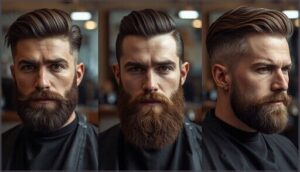
The ducktail beard isn’t a one-size-fits-all style, but it works remarkably well for a wide range of guys. Your face shape, hair texture, and personal style all play a role in whether this look will complement your features.
Let’s break down who can pull off a ducktail beard and why it might be the perfect choice for you.
Best Face Shapes for Ducktail Beards
Your face shape determines how well a ducktail beard creates facial balance and jawline enhancement. Oval and diamond shapes handle the pointed V best, while round faces gain cheekbone definition and structure.
Square jaws soften with the tapered chin, and triangular faces achieve better symmetry. Proper face shape analysis ensures your beard trimming highlights your features instead of fighting them.
For a detailed comparison of various beard styles for each face shape, consider reviewing expert guidelines.
Hair Types That Suit The Style
Your beard’s texture and density shape how cleanly you can form a ducktail beard and maintain its pointed chin profile. Straight styles hold crisp edges with minimal product, while wavy textures soften transitions without losing definition.
- Coarse beards build natural volume for a pronounced V-shape and sharper taper
- Fine haircuts need precise trimming to avoid blunt ends and retain a clean point
- Curly hair requires stronger hold wax to control frizz and keep the ducktail shape intact
Density determines fullness; thicker facial hair creates a bolder silhouette, while moderate growth still forms a clear beard shape with careful beard trimming.
Celebrity Ducktail Beard Inspiration
Hollywood influence drives beard trends, and celebrity styles offer powerful grooming tips for your ducktail beard.
Combining those carrier oils with proper training techniques helps you achieve that polished, Hollywood-ready look while keeping your ducktail beard healthy and manageable.
Brad Pitt showcases a refined taper with fuller chin and lighter cheeks, while Leonardo DiCaprio proves facial hair versatility—from compact to sculpted.
Charlie Hunnam pairs rugged edge with sharp definition, and Jamie Foxx’s bold V-shape demonstrates focused beard trimming.
These celebrity examples prove proper beard styling delivers striking results. For more on essential grooming, see the benefits of a healthy lifestyle and beard care to keep your ducktail beard looking its best.
How to Prepare Your Beard for Trimming

Before you pick up your trimmer, you need to set yourself up for success. A well-prepared beard is easier to shape and gives you cleaner, more precise results.
Let’s cover the two essentials: getting your beard to the right length and prepping it properly before you start cutting.
Growing Your Beard to The Right Length
You can’t rush a proper ducktail—patience is your first tool. Your beard needs at least 4 to 6 weeks to reach 1 to 2 inches, giving you enough length for effective beard shaping.
Growth speed varies based on genetic factors, but you can refine your timeline:
- Support your beard growth with a balanced diet rich in protein and biotin
- Maintain healthy habits like regular exercise to improve circulation
- Track your length milestones, aiming for full jawline coverage before trimming
Diet support and consistency matter more than you’d think.
Pre-Trimming Grooming Tips
Before you pick up the trimmer, set yourself up for success with proper beard cleansing using a gentle wash to remove oil and buildup. Soften your hair with a warm damp towel for 2 to 3 minutes, making each cut cleaner.
Skin exfoliation once or twice weekly prevents ingrown hairs, while light beard hydration reduces irritation during trimming prep—essential facial hair care steps you shouldn’t skip.
Step-by-Step Guide to Trimming a Ducktail Beard
Now that your beard is properly prepped, it’s time to get down to the actual trimming. The ducktail shape requires careful attention to proportion and symmetry, so you’ll want to work methodically through each section.
Here’s how to create that signature V-shaped silhouette from start to finish.
Defining The Basic Shape
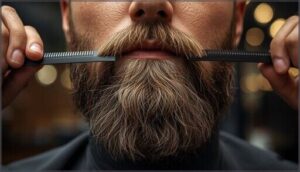
You’ll start by mapping the ducktail beard shape before you make any cuts. Comb your facial hair downward, then visualize a clean V that tapers toward your chin.
Mark the chin pointing area where fullness concentrates, keeping your sides lighter for strong shape definition. This initial outline drives every trimming technique forward, ensuring beard symmetry and precise beard styling from the first pass.
Tapering The Cheeks and Sides

Once your outline is clear, taper your cheeks to perfect the V silhouette. Proper cheekbone alignment and sideburn integration keep the beard trimming techniques balanced, while symmetry techniques prevent unevenness.
Follow these beard shaping steps:
- Start above your natural cheekbone and shorten hair toward your ear.
- Blend sideburns at mid-ear level using a precision trimming tool.
- Condition skin texture before close passes to reduce irritation.
- Compare both sides frequently, adjusting for fullness differences.
- Clean your beard trimmer blade between passes for consistent cuts.
Shaping The Chin and Pointed End

Your cheeks are tapered—now shift focus to chin point styling. The pointed end defines your ducktail beard, so precision matters. Comb your chin hair straight down, then trim the center strands 1.5 to 2 centimeters longer than the sides to form a sharp V. Check beard symmetry by comparing both angles in the mirror.
Use pointed end trimming with scissors—not clippers—for facial hair contouring that enhances jawline definition without looking blunt.
| Step | Tool | Target Length |
|---|---|---|
| Comb chin hair downward | Wide-tooth comb | Full extension |
| Trim center strands | Sharp scissors | 1.5–2 cm past sides |
| Check left/right balance | Mirror | Even taper |
Trimming The Neckline and Mustache
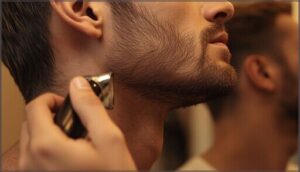
With your chin point sharp, a clean neckline completes the ducktail beard. Position it just above your Adam’s apple—about 1 inch above the collarbone—using a beard trimmer with a 0.5 mm guard for crisp edges. For mustache blend, trim hairs crossing your lip while keeping corners connected to the beard.
- Shave a curved U-shape along the neck, not a straight line
- Comb your mustache before trimming to follow natural lip contours
- Check neckline placement symmetry on both sides to avoid mistakes
Daily facial hair care keeps your ducktail sharp between full beard styling sessions.
Achieving a Symmetrical and Balanced Look
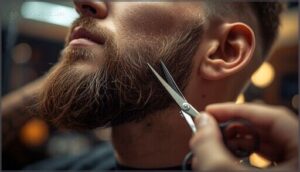
Getting your ducktail beard to look right isn’t just about the initial trim—it’s about making sure both sides match and the whole thing sits well on your face.
You’ll need to step back, check your work from different angles, and make small adjustments until everything lines up. Here’s how to fine-tune your beard for a clean finish that works with your unique features.
Using a Beard Comb and Scissors
Precision separates a sharp ducktail beard from an uneven mess. For comb selection, grab a wide-tooth carbon fiber or cellulose acetate comb to minimize breakage and static during detangling. When applying scissor techniques, choose 4 to 5 inch stainless steel barber scissors with micro-serrated edges for grip and control.
Beard sectioning simplifies your workflow—divide your ducktail beard into cheek, chin, and neck zones before you start. Hold your beard comb flat against each section, lift the hairs, and trim just above the comb teeth using small vertical snips for finishing touches. Keep trimming angles shallow and parallel to your skin to avoid blunt edges and maintain natural taper.
| Tool | Purpose |
|---|---|
| Wide-tooth comb | Detangles without snagging or breakage |
| Stainless steel scissors | Precise cuts on cheeks and chin point |
| Light beard oil | Calms flyaways after trimming |
This beard styling guide approach keeps your beard trimmer work clean and your shape balanced.
Checking for Evenness
After refining each section with your beard trimmer and scissors, step back from the mirror about three feet to catch asymmetry your up-close view misses.
Snap a straight-on photo for symmetry checks—comparing left and right beard balancing on screen reveals uneven cheek fades or a ducktail beard point drifting off facial alignment.
Turn your head slowly to spot high or low sections, then use evening methods like matching clipper passes for hair trimming control.
Adjusting for Your Face Shape
Face shape analysis drives ducktail beard trimming decisions that jawline enhancement demands. Adapt your tapering based on facial proportions.
- Round faces need a longer 1.5-inch chin point for added vertical length
- Square faces benefit from gradual cheek contouring to soften angles
- Oval faces require subtle beard symmetry adjustments to preserve natural balance
- Narrow faces call for wider chin tapers
- Heart-shaped faces pair ducktail beard style with fuller lower thirds
Maintaining Your Ducktail Beard Style
Getting the perfect ducktail shape is one thing, but keeping it sharp requires consistent effort.
Your beard won’t maintain itself—you’ll need a solid routine for trimming, cleaning, and conditioning to preserve that distinctive V-shape.
Let’s cover the essential maintenance practices that’ll keep your ducktail looking fresh and well-groomed.
Setting a Trimming Schedule
Your beard’s growth tracking determines your trimming frequency—most ducktail styles need maintenance every 1 to 3 weeks.
Schedule planning starts with measuring growth at the chin tip over two weeks; faster growers require weekly sessions to preserve the point. Use your beard trimmer when the beard is dry, applying consistent trimming techniques to maintain shape.
A solid beard maintenance routine prevents imbalances and keeps your look sharp.
Cleaning and Conditioning Tips
Regular beard hygiene begins with a sulfate-free cleanser that won’t strip your skin’s natural oils, keeping facial hair moisture intact. Wash two to three times weekly with lukewarm water, then pat dry gently.
Follow with a leave-in conditioner to restore softness and prevent that coarse feel. Apply beard oil while your beard’s still damp—this simple beard care routine maximizes absorption and keeps your ducktail looking sharp.
Recommended Beard Oils and Waxes
You’ll want carrier oil blends like jojoba or argan—they mimic natural sebum and soften coarse hairs without clogging pores.
For styling, beard wax with beeswax offers stronger hold than oil, perfect for taming that pointed chin. Choose fragrance options like cedarwood or citrus for a subtle masculine scent.
These grooming tools and beard care products keep your ducktail sharp between trims.
Common Mistakes When Trimming a Ducktail Beard
Even experienced groomers can stumble when shaping a ducktail beard for the first time. Small missteps with your trimmer or scissors can throw off the entire silhouette and leave you starting over from scratch.
Here are the most common trimming mistakes you’ll want to avoid to keep your ducktail looking sharp and symmetrical.
Over-Trimming The Sides
Taking too much off one side throws your entire ducktail beard into chaos—you’ll end up with a lop-sided silhouette and visible asymmetry that’s impossible to hide.
Use your beard trimmer with steady, even strokes on both sides, checking frequently in the mirror. A crooked outline from temple to chin signals you’ve misjudged symmetry during facial hair care, requiring frustrating rework to restore balance.
Uneven or Blunt Point
A ducktail beard demands a gentle taper at the chin, not a boxy wedge that kills your beard shape. Blunt ends wreck chin definition and make the whole style look unfinished.
- Use your beard trimmer‘s lowest guard and scissors together for precise point trimming
- Check beard symmetry by tilting your head—uneven tapering tips create a jagged edge
- Finish with small snips to perfect the taper, avoiding excessive passes that cause noticeably shorter hairs near the tip
Neglecting The Neckline
Your neckline anchors the entire ducktail beard—trim it too high and you’ll flood your jawline with bare skin, killing beard density. Set it too low and you’ll lose the clean separation that makes chin definition pop. Follow your natural jawline contour when shaping, keeping the line centered so your point doesn’t float or sag.
| Neckline Position | Visual Impact | Fix Strategy |
|---|---|---|
| Too high on neck | Exposed skin reduces beard fullness | Lower line to one finger above Adam’s apple |
| Too low placement | Blurry jawline contour, sagging point | Raise to follow natural jaw curve |
| Irregular angle | Bulky or off-center ducktail beard tip | Use beard trimmer in straight passes along jaw |
| Undefined edge | Spread-out appearance, no clean taper | Mark line with comb, trim with precision guard |
| Asymmetric sides | Lopsided facial hair balance | Check both profiles in mirror during shaping |
Advanced Ducktail Beard Styling Tips
Once you’ve mastered the basic ducktail trim, you can take your beard to the next level with a few sophisticated techniques.
These styling strategies help you customize the look to match your personal style and the occasions you’re dressing for. Whether you want to add complementary facial hair, create more dimension, or adapt your beard for different settings, the following tips will give you that extra edge.
Adding a Mustache or Goatee
You can accentuate your ducktail beard with complementary facial hair like mustache styles or goatee shapes that improve the overall beard shape. A handlebar mustache or pencil goatee adds vintage flair, while a full mustache balances the pointed chin.
Focus on beard blending by feathering edges with scissor-over-comb trimming tips, keeping the mustache separate from your beard style for clean definition and symmetrical facial hair.
Creating Layered or Textured Looks
You can add dimension to your ducktail beard through layered cutting techniques that create varied lengths for visual depth.
Use micro trimming in 1–3 millimeter increments along the jawline, adjusting beard density by thinning underlayers while keeping top sections fuller.
Directional styling with a lightweight texture product enhances movement, and point-cutting softens edges for fluid beard shape transitions during routine beard maintenance.
Styling for Formal and Casual Occasions
Layered cuts translate into adaptable styling when you adjust your ducktail beard for different settings.
For formal events, you’ll want:
- A clean taper from temple to jawline that sits neatly under dress collars
- Chin point trimmed 1 to 1.5 inches beyond your natural chin line
- Close-trimmed sideburns aligned with your natural hairline
- Light beard oil for shine without greasiness
Casual wear allows a longer chin point and fuller sides for relaxed mens grooming.
Frequently Asked Questions (FAQs)
How to trim ducktail beard yourself?
The sharpest beards demand the most patience.
Start by defining a central vertical line from your lip to chin, then taper the cheeks inward using a precision beard trimmer with adjustable guards for controlled shaping.
How often should you trim a ducktail?
You’ll want to trim your ducktail every two to three weeks to keep that sharp point crisp and the sides tapered.
Faster beard growth may bump your maintenance schedule up to weekly touch-ups.
How long should a ducktail beard be?
Your ducktail beard should extend 5 to 3 inches beyond the chin point for classic facial harmony.
Chin point length depends on beard growth rate, hair texture, and how sharp you want the beard style‘s signature taper.
What is the most attractive ducktail beard style?
Like a well-fitting suit, the classic ducktail beard flatters most—its moderate chin point and even taper create timeless balance.
Long ducktail and layered ducktail variations offer bold style inspiration for those seeking dramatic beard design and shape.
How often should I wash a ducktail beard?
You should wash your ducktail beard two to three times per week to maintain skin health and preserve natural oils, adjusting washing frequency based on your hair type, environmental factors, and product impact on beard maintenance.
Can I use regular shampoo on my ducktail beard?
You can, but it’s not ideal for beard care. Regular shampoo strips natural oils, causing hair damage and dryness.
Switch to gentle cleansing with beard hygiene products or shampoo alternatives designed for facial hair.
How do I manage beard patchiness with a ducktail?
Sparse patches vanish when you taper the sides short and guide fuller chin growth to a sharp point—this focal beard styling trick pulls eyes to the center while beard maintenance keeps patchy zones minimized.
What comb type is best for detangling a ducktail?
You’ll want a wide tooth comb for thick, curly ducktail beard hair since the spacing prevents snagging.
For finer textures, anti static combs and paddle brushes work better during detangling sessions.
How long does a ducktail beard take to grow?
Building a solid ducktail beard takes patience—most guys need four to six months from a clean shave to reach the two to four inches of beard length required for a clean, tapered chin point.
Can patchy beards work with ducktail styles?
Yes, patchy beards can work with ducktail styling tips—focus trimming techniques on emphasizing the chin point while tapering sides shorter.
This beard style redirects attention from sparse facial hair textures toward sharp beard maintenance and intentional beard growth patterns.
Conclusion
Perfect points don’t happen by accident—they’re carved through careful cuts. Now that you know how to trim a ducktail beard with precision, you can maintain that signature taper without second-guessing every stroke.
Keep your tools sharp, your hand steady, and your trimming sessions consistent. The difference between a beard that draws admiration and one that falls flat lies in the details you’ve just mastered. Own that look.