This site is supported by our readers. We may earn a commission, at no cost to you, if you purchase through links.
Hair wax has a reputation problem. Not because it’s a bad product—it’s one of the most adaptable styling tools out there—but because most people apply it the same wrong way every time. Too much, too close to the scalp, on hair that wasn’t quite dry.
The result looks less like a styled look and more like you skipped a shower. The good news: greasy hair after wax isn’t a hair type problem or a product quality problem. It’s a technique problem, and technique is fixable.
Once you understand why wax behaves the way it does, knowing how to use hair wax without looking greasy becomes second nature.
Table Of Contents
Key Takeaways
- Greasy hair from wax is almost always a technique problem — too much product, applied at the roots, on hair that wasn’t fully dry — not a hair type or product quality issue.
- Warming a pea-sized amount between your palms until it nearly disappears, then working it through mid-lengths and ends only, is the single biggest fix most people need.
- Choosing the right formula matters — matte, water-based, or clay-infused waxes prevent shine buildup, while petroleum and mineral oil formulas are the usual culprits behind that greasy, day-two look.
- When things go wrong mid-day, dry shampoo and a wide-tooth comb will save your style faster than reaching for more wax ever will.
Why Hair Wax Can Make Hair Look Greasy
Hair wax isn’t the problem — how it’s used usually is. A few specific things cause that slick, weighed-down look most people are trying to avoid. Here’s what’s actually going on.
If your hair is fine or thinning, the formula itself matters just as much as technique — lightweight styling options for wavy black hair can help you skip the heaviness entirely.
Common Causes of Greasy Appearance
Most greasy hair wax disasters come down to a few fixable habits.
Applying too much product causes product overload, while rubbing wax directly into greasy roots mixes it with your scalp’s natural oils and accelerates that slick look. An oily scalp makes this worse fast.
Add wax buildup from skipping clarifying shampoos, and product buildup turns even fresh hair into a greasy mess.
To better understand how daily hair habits contribute to greasiness, check out this overview of product buildup causes.
Differences Between Wax, Gel, and Pomade
Not all styling products behave the same, and that matters when you’re chasing a clean finish.
Hair wax gives a pliable hold with a matte or low-shine finish — ideal for textured styling techniques. Gels lock hard with a wet-look finish. Pomades land in between, offering strong hold with high shine.
Knowing these finish types, product ingredients, and hold strength helps you pick what actually fits your goals. For more details on the distinctive finish types and product hold, review expert comparisons of pomade, wax, and gel.
Impact of Hair Type and Condition
Your hair type and condition quietly run the show. Fine strands get weighed down fast, while coarse hair accommodates richer formulas without collapsing.
Scalp health, hair density, and wax absorption all shape how your hair care routine actually lands. Hair porosity matters too — a damaged cuticle layer drinks wax in unevenly, leaving patches that read as greasy hair.
Choosing The Right Hair Wax for Your Hair
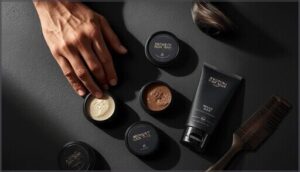
Not all waxes are built the same way, and picking the wrong one is usually where things go sideways.
The right formula depends on a few key factors that are easy to match once you know what to look for.
Once you understand how beard oil actually works, matching ingredients to your skin type and beard texture becomes a lot more intuitive.
Here’s what to keep in mind before you grab anything off the shelf.
Hold Strength and Shine Level
Two things decide whether your wax works for or against you: hold strength and shine level. Strong hold locks thick or resistant hair in place, while light hold lets fine hair move without collapsing.
Shine control is just as important — matte wax keeps hair texture looking natural, and high-shine formulas can turn even a clean style into something that looks oily fast.
Best Formulas for Fine, Thick, or Curly Hair
Your hair type is the real boss here. Fine hair needs a lightweight wax formulation — cream or water-based — that won’t drag strands flat.
Thick hair can tolerate stronger hold levels and richer wax without buckling. Curly hair porosity matters most: a soft, conditioning wax locks in moisture and defines curl pattern without that heavy, coated feeling other styling products leave behind.
Ingredients to Look for (and Avoid)
The label tells you everything — if you know what to look for. Prioritize these non-greasy ingredients and wax types:
- Beeswax or lanolin for flexible hold and a natural matte finish without heavy buildup
- Lightweight formulas with water listed first, using emulsifying agents that rinse clean
- Natural oils like castor or olive in small amounts for spread without shine bands
- Kaolin clay for matte texture that absorbs excess oil
Skip petroleum wax, mineral oil, and synthetic waxes loaded with occlusive films — they’re the usual suspects behind that greasy, limp look by day two.
Preparing Hair for Wax Application

Before wax even touches your hair, the prep work is already deciding how the final result looks.
Greasy styles usually start before the product — not during application.
Here’s what to do to set yourself up right.
Importance of Clean, Dry Hair
Think of your hair as a canvas — wax only works as well as the surface it’s applied to. Clean, dry hair gives wax something to actually grip. On greasy or damp strands, wax slides right off and pools near the roots.
Clean, dry hair acts as the perfect canvas for wax, while greasy or damp strands sabotage your style by causing product to pool at the roots
| Clean, Dry Hair | Dirty or Damp Hair |
|---|---|
| Better wax adhesion | Wax slides off strands |
| Improved hair texture | Greasy, clumped finish |
| Natural volume preserved | Roots look heavy |
| Even product distribution | Patchy, uneven coverage |
| Longer-lasting style | Breaks down faster |
Clean scalp, dry hair benefits, better results — that’s the formula.
Proper Washing and Conditioning Routine
Your wash routine sets the stage for everything. Use gentle shampoos focused on the scalp, where wax buildup and excess oil actually live.
For scalp health, rinse with warm water first, then cool water to close the cuticle. Conditioner tips: mid-lengths to ends only — never the roots. Your hair type and hair texture determine how often, but two to three times weekly works for most.
Using Heat Tools for Volume and Texture
Heat tools aren’t just for special occasions — they’re your secret weapon before wax even touches your hair. Rough drying to about 80 percent using blow dry techniques fattens the shaft and boosts natural texture, so hair wax grips better with less product.
For a textured quiff or curl enhancement, finish with a cool shot. Volume boosting and hold strength start long before styling.
How to Apply Hair Wax Without Looking Greasy
Knowing which wax to buy is only half the battle — how you apply it makes all the difference.
Most greasy hair moments come down to a few fixable habits, not the product itself. Here’s exactly what to do at each step.
Correct Wax Amount and Warming Technique

Start with a small amount — a pea-sized dab for short hair, a dime-sized amount for longer or thicker strands. Before applying hair wax, warm up the wax between your palms until it nearly vanishes. That’s a key wax melting technique that makes all the difference.
Well-emulsified product spreads evenly, improving hold enhancement strategies and preventing the heavy, greasy patches that ruin a good style.
Targeted Application—Avoiding The Scalp
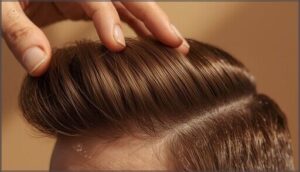
Now that the wax is warmed and ready, where you put it matters just as much as how much you use. Keep it off your scalp — full stop. Applying hair wax directly at the roots invites greasy hair and scalp irritation fast.
Focus on mid-lengths and ends instead. Hair sectioning helps here: lift small sections, apply wax from mid-shaft outward, and let scalp protection happen naturally through root minimization and smart wax distribution.
Even Distribution and Styling Tips
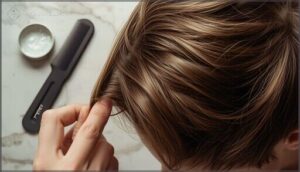
Even distribution is where good wax application becomes great styling. Once you’ve kept it off the scalp, rake your fingers through in different directions to break up any rigid lines — this is what gives hair texture its natural, lived-in feel. Product layering is your secret weapon here.
- Work section by section, back to front
- Use a wide-tooth comb to even out thick patches
- Pinch small tips to define pieces without overloading strands
- Scrunch upward for wavy hair to accentuate natural curl patterns
- Let each layer settle before adding more
Finishing Touches to Reduce Shine

Once your hair’s sitting right, the finishing touches are what keep it from crossing into greasy territory. A quick matte topcoat or finishing spray — something with silica or rice starch — kills surface shine without flattening your style.
Blotting excess wax with a tissue works faster than you’d think. For surface detail, a cool blast from your dryer sets everything dry and nongreasy.
Troubleshooting and Maintaining a Non-Greasy Look

Even with the best technique, things don’t always go perfectly — and that’s fine.
Knowing how to course-correct keeps you in control without starting over from scratch.
Here’s what to do when your hair needs a reset or a quick fix.
Fixing Over-Application or Greasy Spots
Over-applied it? Don’t panic — a quick fix beats starting over. Press a microfiber towel onto greasy sections using blotting techniques that absorb excess wax without disrupting your style.
Dry shampoo at the roots tackles leftover shine fast, giving you matte finishes without rewashing. For stubborn product buildup, redistribute with a wide-tooth comb to spread wax evenly and eliminate patchy, greasy spots instantly.
Recommended Washing Frequency and Clarifying
Most wax users do well washing every two to three days, but fine hair often needs a rinse every other day to stay fresh.
A clarifying shampoo once a week cuts through wax buildup and restores scalp health by lifting product residue that regular shampoo misses. Watch your hair porosity — if conditioner stops absorbing, that’s your cue to clarify.
Lightweight Styling Products for Touch-Ups
Reaching for more hair wax mid-day is almost always the wrong move. Instead, keep a few lightweight alternatives on hand that match your hair type and desired shine level:
- Dry shampoo or texturizing sprays absorb oil and restore volume
- Styling creams smooth flyaways without greasiness
- Pomade sticks target specific zones like hairlines
- Touch up gels reshape curls with zero slick buildup
These styling techniques keep things fresh without overload.
Frequently Asked Questions (FAQs)
How to make hair wax not look greasy?
The secret is starting small amounts, a pea-sized amount, warmed between your palms until nearly invisible.
Focus on mid-lengths and ends, never the roots, and choose a matte finish wax to stay grease-free.
Why does hair wax make my hair greasy?
Most of the time, it comes down to wax oil content, product buildup, scalp oil production, and application habits — even a small amount applied wrong turns clean hair greasy fast.
Does weather affect how hair wax performs?
Yes, weather plays a real role. Humidity Control becomes critical because moisture swells the hair shaft and weakens hold.
Temperature Effects soften wax consistency, and sweat accelerates greasiness — so Climate Adaptation and Seasonal Adjustment matter more than most people realize.
Can you mix hair wax with other products?
You can mix hair wax with other products, but product compatibility and mixing techniques matter.
Smart wax blending tips and the right product order keep your style looking clean, not weighed down.
How do you store hair wax properly?
Store hair wax at room temperature, away from heat and sunlight.
Seal the lid tight after every use.
Most formulas last six to twelve months once opened before product degradation affects hold and finish.
Is hair wax safe for color-treated hair?
Most hair wax is safe for color-treated hair. Since wax sits on the surface rather than penetrating the shaft, it won’t trigger color fade or cause damage when chosen and applied carefully.
Conclusion
Most people spend years fighting their hair wax, convinced the wax is broken or their hair is impossible—when the real fix takes thirty seconds and a pea-sized amount of product.
Now that you know how to use hair wax without looking greasy, that battle’s over. Clean hair, warmed wax, and hands that stay away from the scalp—that’s the entire formula. Apply it right, and the only thing anyone will notice is the style.
- https://holup.com/blogs/articles/hair-pomade-vs-hair-wax
- https://www.highland.style/blogs/learn/pomade-vs-hair-wax
- https://www.100percentpure.com/blogs/feed/7-surprising-causes-of-greasy-hair
- https://smoothandcharming.com/blogs/news/hair-shine-spray-makes-hair-look-greasy
- https://ethique.com/blogs/hair/why-does-my-hair-get-greasy-so-fast