This site is supported by our readers. We may earn a commission, at no cost to you, if you purchase through links. This content is for general informational and educational purposes only and is not a substitute for professional medical, dermatological, or nutritional advice.
Your hair doesn’t just need protein—it is protein. Every strand sprouting from your scalp is nearly 100% keratin, a fibrous protein structure held together by intricate amino acid chains and disulfide bonds.
When you’re not eating enough protein, your body diverts what’s available to main organs first, leaving your follicles scraping the bottom of the nutritional barrel. The result? Thinner strands, excessive shedding, and regrowth that stalls after every trim.
Understanding how protein fuels each phase of your hair growth cycle—and recognizing the warning signs when you’re running low—gives you the control to actually fix the problem instead of just throwing products at it.
Table Of Contents
- Key Takeaways
- Is Hair Made of Protein?
- How Does Protein Affect Hair Growth?
- Signs of Protein Deficiency in Hair
- How Much Protein Supports Healthy Hair?
- Best Dietary Sources of Hair Growth Protein
- Do Protein Supplements Boost Hair Growth?
- Protein-Rich Foods to Add for Hair Health
- Can Topical Protein Products Help Hair?
- When Protein Isn’t Enough for Hair Growth
- Frequently Asked Questions (FAQs)
- Does hair growth use protein?
- Can hair grow without protein?
- Will eating protein make my hair thicker?
- How long does it take for protein to grow hair?
- Does protein increase hair growth?
- Is hair a protein or not?
- Can lack of protein cause hair thinning?
- Is hair full of protein?
- When is the best time to eat protein?
- Can excess protein damage hair follicles?
- Conclusion
Key Takeaways
- Your hair is nearly 100% keratin protein, and when dietary protein runs low, your body prioritizes vital organs over follicles—resulting in thinner strands, excessive shedding, and stalled regrowth that no topical product can fix.
- Protein deficiency disrupts your hair growth cycle by shortening the anagen phase and starving follicles of the amino acids they need for keratin synthesis, which shows up as diffuse thinning, brittle strands that snap mid-shaft, and slower regrowth after trims.
- Most adults need 0.8 grams of protein per kilogram of body weight daily as a baseline, but your actual requirements shift based on activity level, stress, and metabolism—and spreading intake across meals matters more than hitting one big protein target.
- Topical protein treatments temporarily patch surface damage and reduce breakage, but only dietary protein delivers the amino acids directly to your hair bulb below the scalp where real keratin production and new growth actually happen.
Is Hair Made of Protein?
Yes—your hair is almost entirely protein. Every strand is built from keratin, a tough fibrous protein that gives hair its structure and resilience.
If you’ve lost hair to chemotherapy, boosting your protein intake can help support hair regrowth after chemo by giving your follicles the keratin building blocks they need.
Let’s break down what that actually means for your scalp and strands.
Hair Structure and Keratin
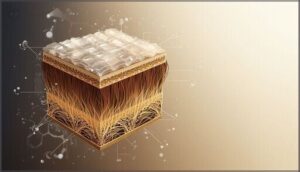
Your hair isn’t just dead tissue—it’s nearly 100% keratin, a fibrous protein that determines everything from shine to strength. This protein-rich structure gives your strands their identity:
- The cuticle layer shields inner fibers with overlapping scales
- Protein bonds (especially disulfide crosslinks) lock keratin formation into shape
- The cortex houses keratin networks that control hair texture and resilience
For a detailed look at hair structure fundamentals, understanding the cuticle, cortex, and medulla is key to caring for and strengthening your hair.
Follicle health starts here.
Role of Amino Acids in Hair
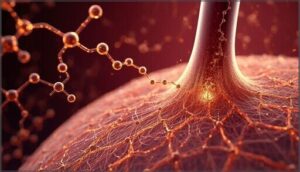
Keratin doesn’t build itself—amino acids do the heavy lifting. Your follicles actively pull amino acid synthesis from your bloodstream during growth phases, especially cysteine for hair bond strength.
These building blocks drive follicle uptake, fueling protein intake needs that support keratin production. Without adequate cysteine, methionine, and lysine, your hair growth stalls—no matter how many topical treatments you try.
A deficiency in essential amino acid intake directly impacts the hair growth cycle and structure.
How Does Protein Affect Hair Growth?
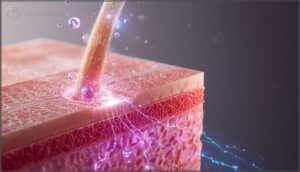
Your follicles don’t just need protein—they run on it. Without a steady supply of amino acids, the entire growth cycle starts breaking down from the inside out.
Here’s exactly how protein keeps your hair in the anagen phase longer and prevents those frustrating shedding spikes you’ve been noticing.
Protein’s Role in The Hair Growth Cycle
Your follicle cells depend on steady amino acid delivery to manufacture keratin during the anagen growth phase—when your strands actively lengthen. Adequate protein intake fuels this protein synthesis, helping you:
- Sustain a longer anagen phase for increased length
- Speed up keratin production at the root
- Delay the shift into shedding
- Supply energy for vigorous cell division
Without it, growth stalls.
Impact on Follicle Health and Strength
Protein also fortifies each fiber from the inside out—strengthening the cortex so your strands resist snapping when you comb or style. Here’s what balanced protein intake delivers to your hair follicles and scalp health:
| Impact Area | How Protein Works | Visible Result |
|---|---|---|
| Follicle Nutrition | Amino acids fuel keratin synthesis at the root | Thicker, more resilient growth |
| Hair Fiber Strength | Fills cuticle gaps after heat or chemical damage | Fewer split ends and breakage |
| Protein Synthesis | Enhances Keratin 6 and 16 production during anagen | Longer growth phase |
| Scalp Health | Improves microcirculation for nutrient delivery | Stronger anchoring of each strand |
Without steady protein intake, your follicles can’t build durable fibers—and weak hair follows.
Keratin production depends on a steady supply of amino acids, which is why understanding what nutrients are required for hair growth can help you protect against breakage and shedding.
Signs of Protein Deficiency in Hair
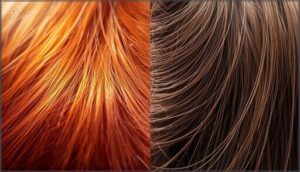
Your hair won’t send you a polite email when it’s starving for protein—but it will send signals. These warning signs often show up gradually, making them easy to miss until the damage becomes obvious.
Here’s what protein deficiency actually looks like when it’s affecting your follicles.
Hair Thinning and Shedding
Your scalp tells the story before you even notice the drain clogging. When protein intake drops, follicle health tanks—and hair thinning becomes the visible SOS signal your body’s sending.
Watch for these telltale signs of protein-related hair loss:
- Diffuse thinning across your entire scalp—not just in typical hair loss patterns
- Excessive shedding during brushing or washing—more strands than you’re used to
- Slower regrowth after trims—your anagen phase is shortening
- Noticeably thinner strands—even your ponytail feels lighter
Brittle or Weak Hair Strands
Your strands snap like dried twigs—that’s protein deficiency showing up as brittle hair and hair breakage. When keratin damage sets in from inadequate protein intake, weak strands lose their elasticity and fracture mid-shaft during normal brushing.
You’ll notice shorter hairs accumulating everywhere, visible hair fracture at the ends, and an inability to maintain length despite healthy hair growth at your scalp.
How Much Protein Supports Healthy Hair?
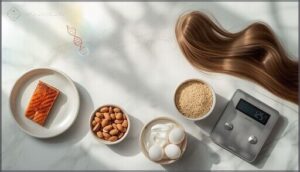
You can’t just eat “more protein” and call it a day—your follicles need a specific amount to function optimally, and that number shifts based on your body and lifestyle.
The standard recommendation gives you a baseline, but it doesn’t account for stress, activity level, or how your metabolism actually processes nutrients. Here’s how to calculate what your hair truly needs.
Recommended Daily Protein Intake
Your follicles need fuel—but how much? The Recommended Dietary Allowance sits at 0.8 grams per kilogram of body weight per day for most adults. That’s roughly 56 grams daily if you weigh 70 kilograms.
These intake guidelines establish your baseline protein targets to prevent protein deficiency, ensuring dietary protein promotes nutrient balance. Meeting this daily allowance keeps protein-rich foods stocked in your system, feeding those keratin-hungry strands.
Adjusting Protein Needs for Lifestyle
Your lifestyle dictates how much dietary protein your follicles actually get. Activity levels shift your daily intake needs—sitting at a desk all day versus training for a marathon demands different amino acid loads.
Here’s how to adjust your protein balance around lifestyle factors:
- Sedentary routine: Stick to baseline—0.8 to 1.0 g per kg keeps protein deficiency at bay
- Moderate exercise: Bump up to 1.2 to 1.6 g per kg for tissue repair
- Intense training: Push toward 1.6 to 2.2 g per kg to feed muscles and follicles
- Recovery phases: Maintain consistent protein-rich foods even on rest days
Nutrient timing matters too—spread intake across meals for steady amino acid flow.
Best Dietary Sources of Hair Growth Protein
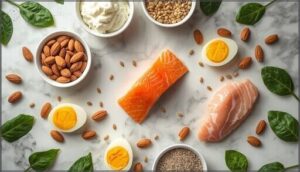
Not all protein sources are created equal in terms of feeding your follicles. Some foods pack complete amino acid profiles—meaning they contain all nine essential building blocks your body can’t produce on its own—while others fall short.
Let’s break down the best options from both animal and plant sources, and what complete actually means for your hair.
Animal-Based Protein Options
Chicken delivers a serious punch—31 grams of protein per 100 grams of cooked breast—making it one of the easiest ways to boost your dietary protein intake.
Salmon offers about 25 grams plus omega-3s that calm inflammation around follicles, while lean beef clocks in at roughly 26 grams.
Egg protein is complete with all essential amino acids your hair craves, and low-fat dairy sources round out your protein-rich foods arsenal beautifully.
Plant-Based Protein Options
You don’t need animal products to hit your protein intake goals—plant sources deliver serious nutritional firepower for plant-based diets. Vegan protein from legume benefits and soy products supplies the amino acids your follicles crave.
- Lentils pack 18 grams per cooked cup plus iron that fights follicle fatigue
- Chickpeas offer 15 grams and fiber that stabilizes your system
- Tempeh brings 21 grams per 100 grams—that’s fermented goodness with probiotics
- Edamame yields 17 grams alongside healthy fats your scalp needs
Quinoa nutrition stands out as a rare plant-based complete protein at 8 grams per cup.
Complete Vs. Incomplete Proteins
Not all protein is created equal—and that distinction matters for hair health. Complete proteins like eggs and fish deliver all nine essential amino acids your body needs for keratin production, while incomplete proteins such as rice or beans lack one or more.
Animal sources usually offer complete amino acid balance, but smart dietary planning lets you combine plant foods—think lentils with quinoa—to achieve ideal protein quality and nutrient absorption for stronger strands.
Do Protein Supplements Boost Hair Growth?
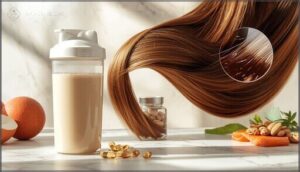
If you’re struggling to get enough protein through food alone—or your hair is visibly suffering—supplements might seem like the obvious fix. But not all protein powders and pills deliver the same results, and timing matters more than you’d think.
Let’s break down which supplements actually support follicle health and when they’re worth adding to your routine.
Whey, Collagen, and Peptide Supplements
You’ve got three heavy hitters in the supplement world—whey protein, collagen peptides, and peptide blends—each bringing distinct amino acids to your follicles’ feast.
- Whey delivers all nine essential amino acids your body can’t make on its own, feeding keratin production fast
- Collagen peptides supply glycine, proline, and hydroxyproline—the building blocks your hair shaft craves
- Peptide supplements absorb quickly because they’re already broken down into smaller chains
- Blended formulas combine whey and collagen for dual muscle and connective tissue support
- Third-party certifications like NSF separate legit products from sketchy powders
When to Consider Supplementation
Knowing the supplement types isn’t enough—you need to spot the gaps in your own plate. Consider supplementation when your dietary intake consistently falls short of daily protein targets, especially if you’re vegan, over fifty, or recovering from illness.
Deficiency signs like brittle strands and slow regrowth signal it’s time. Collagen benefits kick in when whole foods alone can’t deliver the amino acids your follicles demand.
Protein-Rich Foods to Add for Hair Health
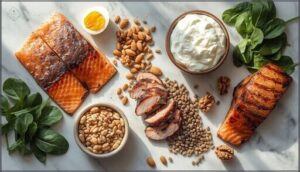
The best protein for your hair is already sitting in your kitchen—or on the menu at your favorite restaurant. You don’t need exotic superfoods or expensive meal plans to feed your follicles what they need.
Let’s break down the most accessible, follicle-friendly options and how to work them into your actual life.
Eggs, Fish, and Lean Meats
Start with eggs—two large ones give you 12 grams of protein plus sulfur-rich amino acids your follicles crave. A 3-ounce portion of salmon or cod delivers 20–25 grams along with omega-3s that calm inflammation.
Lean meats like chicken breast or pork tenderloin pack similar protein density, fueling keratin production without excess saturated fat. Pair any of these with vegetables for complete hair health support.
Legumes, Quinoa, and Dairy
If you don’t eat meat, you’re not out of luck—legumes like lentils deliver 7–9 grams of protein per cooked cup, complete with iron and folate your follicles need.
Quinoa stands alone as a plant protein containing all nine essential amino acids, while dairy alternatives fortified with calcium can bridge nutrient gaps. Pairing these creates powerful nutrient synergy that fuels healthy hair growth without dietary restrictions.
Sample Meal Ideas
Meal planning doesn’t have to feel like guesswork—you can hit 80–100 grams of protein daily with simple swaps. Here are four breakfast options and protein snacks that support hair growth and nutrition:
- Greek yogurt with almonds delivers 20–25 grams of protein to kickstart your morning
- Scrambled eggs with cheese provides 20–28 grams in one sitting
- A whey protein smoothie adds 20–30 grams per serving
- Cottage cheese (28 grams per cup) makes an easy protein-rich foods choice
These dietary changes fuel follicles with steady amino acids throughout the day.
Can Topical Protein Products Help Hair?
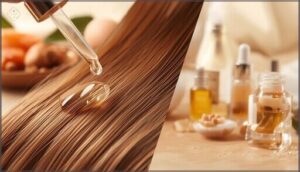
You’ve probably seen protein treatments and hair masks promising stronger, shinier strands—but do they actually deliver what eating protein does? The science here gets tricky, because topical protein works differently than the keratin your body builds from the inside out.
Let’s break down what protein-coated hair products can and can’t do for your follicles.
Protein Treatments and Hair Masks
Protein treatments—think keratin infusions, hydrolyzed silk masks, or wheat protein conditioners—work by reinforcing your hair fibers from the outside in. They temporarily patch weak spots, boost elasticity, and smooth the cuticle for less frizz and breakage.
But here’s the catch: overdo it, and you’ll end up with stiff, brittle strands. Always follow protein repair with moisture to keep hair strengthening balanced.
Topical Vs. Dietary Protein for Hair
Here’s the truth: topical protein strengthens the shaft you already have, but it can’t fuel new hair growth from the follicle.
Topical protein strengthens existing hair shafts, but only dietary protein fuels new growth from the follicle
Real keratin production happens below the scalp—where dietary protein delivers amino acids straight to the hair bulb.
Surface treatments reduce breakage; protein intake builds density.
For lasting results, prioritize dietary balance and protein absorption over serums alone.
When Protein Isn’t Enough for Hair Growth
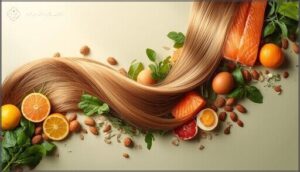
Protein is essential—but it’s not the whole story. Your follicles need a full roster of nutrients to function properly, and deficiencies in other areas can sabotage even the best protein intake.
Here’s what else your hair depends on, and when it’s time to call in professional help.
Other Nutrients Essential for Hair
Your follicles don’t run on protein alone—they need a full crew of micronutrients to thrive. Zinc facilitates protein synthesis and follicle repair, while iron delivers oxygen that prevents excess shedding.
Biotin, other vitamins, and minerals like copper and selenium work alongside amino acids to keep growth cycles humming. Omega benefits include reduced inflammation, and antioxidants protect against oxidative stress.
Nutrient deficiency in any area undermines even perfect protein intake.
When to Seek Medical Advice
If hair loss escalates beyond 100 strands daily, develops alongside fever or fatigue, or your scalp shows redness and swelling—book a dermatologist.
Medical emergencies like scalp injuries or sudden patchy shedding need immediate evaluation. Endocrine issues, nutrient deficiencies mimicking telogen effluvium, and persistent hair loss symptoms all warrant medical evaluation for hair health and wellness that protein alone can’t fix.
Frequently Asked Questions (FAQs)
Does hair growth use protein?
Yes—your follicles depend on protein synthesis to manufacture keratin during the growth phase. Without steady amino acids from dietary protein, hair growth slows, strands weaken, and keratin production stalls.
Can hair grow without protein?
No—your strands simply won’t grow without protein. Keratin production halts when amino acids aren’t available, forcing follicles into shedding mode and leaving you with thinning, brittle hair that breaks before it lengthens.
Will eating protein make my hair thicker?
Adding more protein intake won’t necessarily make your hair thicker—it promotes keratin production and amino acid balance, but dietary supplements and protein intake help only if you’re deficient or experiencing protein-related hair thinning.
How long does it take for protein to grow hair?
Your follicles need about three to six months of steady protein intake before you’ll notice stronger strands—hair growth cycles demand patience, and nutrient balance matters as much as protein dosage for visible hair regrowth.
Does protein increase hair growth?
Protein intake fuels keratin production—the key to stronger, longer hair growth.
When you supply enough amino acids, hair follicles stay active longer, supporting thicker strands and reducing shedding through improved nutrient balance.
Is hair a protein or not?
Yes—your hair is nearly pure protein synthesis. Each strand is built from keratin, assembled by amino acids in a process called protein synthesis.
That keratin structure gives your hair its strength, flexibility, and ability to grow.
Can lack of protein cause hair thinning?
Absolutely—when protein deficiency sets in, keratin synthesis slows and follicle cell impact becomes real.
Your hair growth cycle gets disrupted; the anagen phase shortens, amino acids run low, and diffuse thinning follows.
Is hair full of protein?
Think of your hair shaft as a tightly woven rope—about 80 percent of its weight comes from keratin, a fibrous protein built by amino acids like cysteine that hair follicles synthesize continuously.
When is the best time to eat protein?
Your follicles don’t care about meal frequency—but your body does.
Aim for 20 to 40 grams at breakfast, then distribute protein evenly across meals to boost synthesis and keep those amino acids flowing.
Can excess protein damage hair follicles?
Excess protein won’t burn out your hair follicles—but protein overload on strands causes stiffness and breakage.
The real follicle stress comes from imbalanced protein intake paired with poor overall nutrition, disrupting growth cycles.
Conclusion
The irony? Most people obsessing over hair growth protein are already eating enough of it—they’re just not absorbing it properly, or they’re missing the cofactors that actually build keratin.
Zinc, biotin, iron, and vitamin C don’t work in isolation. Your follicles need the full nutritional ecosystem, not just isolated macros.
If your hair’s still struggling after fixing your diet, that’s your body waving a red flag. Time to dig deeper than your plate.