This site is supported by our readers. We may earn a commission, at no cost to you, if you purchase through links.

You wake up, style your curls with all the right products, and step out feeling confident. Two hours later, you catch your reflection and barely recognize your hair. Those springy spirals you worked so hard to create have deflated into sad, shapeless waves clinging to your scalp.
If this sounds familiar, you’re dealing with limp curls—and you’re not alone. The culprit often isn’t your curl pattern itself, but a combination of moisture imbalance, product choices, and styling habits working against you.
Once you understand what’s weighing your curls down, you can make targeted adjustments that bring back the bounce and volume you’ve been missing.
Table Of Contents
- Key Takeaways
- Common Causes of Limp Curls
- How Product Choices Affect Curl Volume
- Solutions for Restoring Bounce to Limp Curls
- Essential Routine Adjustments for Healthy Curls
- Top 3 Styling Products for Limp Curls
- Frequently Asked Questions (FAQs)
- Why are my curls limp?
- Are limp curls a problem?
- How to fix limp curls?
- Why is my curly hair limp & lifeless?
- What does limp hair look like?
- What hairstyles work for Limp hair?
- Can I revive limp curls between wash days?
- Does sleeping position affect curl volume overnight?
- Will hard water filters improve my curl bounce?
- Can diet or vitamins strengthen limp curls?
- Conclusion
Key Takeaways
- Limp curls are usually caused by too much moisture, product buildup, heavy ingredients, and improper styling techniques.
- Balancing protein and moisture, using clarifying shampoos, and choosing lightweight products can restore bounce and definition.
- Regular trims, curl-specific haircuts, and adapting your routine to seasonal changes help maintain volume and healthy curl patterns.
- Root-lifting methods like diffusing upside down, root clipping, and scrunching boost volume and keep curls from falling flat.
Common Causes of Limp Curls
If your curls have been falling flat lately, you’re not alone—it’s one of the most common frustrations in the curly hair world. The good news is that limp curls aren’t a mystery.
Let’s walk through the main culprits so you can pinpoint what’s weighing your curls down.
Excessive Moisture and Over-Moisturizing
When you drench your curls with too much moisture, you risk hygral fatigue—a cycle of swelling and shrinking that saps curl integrity. Over-moisturizing through daily co-washing or marathon deep conditioning sessions throws off your hair’s moisture balance, leaving strands gummy and limp.
Without adequate protein balance, your curls can’t hold their shape, and moisture overload becomes the hidden culprit behind lifeless spirals. You may need to clarify your hair to remove buildup.
Product Buildup and Heavy Ingredients
Product buildup acts like a cast around your curls—layers of styling creams, gels, and serums form a heavy coating that flattens your natural pattern. Heavy oils and silicone effects create a barrier that won’t rinse away easily, weighing down strands.
When you skip regular hair product buildup removal, ingredient accumulation—waxes, non-water-soluble silicones, and rich butters—demands a product detox every few weeks to restore bounce. This is especially true, because curly hair is prone to dryness.
Fine Hair and Genetics
Beyond buildup, your genes actually set your curl’s baseline. Fine hair—naturally thinner hair fiber diameter—can’t hold much lift because each strand weighs less and offers less structural support.
Genetic hair disorders, age-related changes, and ethnic differences all shape hair texture and follicle miniaturization. If you’ve inherited delicate follicles, even perfect products won’t magically thicken your strands or boost hair volume the way they would on coarser textures.
Humectants, Humidity, and Environmental Factors
Your genetic blueprint sets one boundary, but the air around you creates another. Humectants—ingredients like glycerin—pull moisture from humidity into your strands, causing them to swell and sag when the dew point climbs past 60°F.
High hair porosity accelerates that absorption, while pollution and UV rays team up to crack cuticles further, flattening your curl pattern and triggering serious humidity damage.
Haircut Issues and Styling Mistakes
Why does a great haircut turn into a flat disaster? Cutting techniques matter more than you realize. Blunt, one-length cuts create bottom-heavy triangles, while wet cutting misjudges shrinkage by up to 50%.
Heat damage from flat irons weakens curl memory, and styling errors like skipping the diffuser or pulling tension styles flatten your roots.
Even thinning shears disrupt clump formation, leaving you with limp, uneven patterns instead of bounce.
How Product Choices Affect Curl Volume

The products you choose have a direct impact on whether your curls spring up or fall flat. Some ingredients add strength and definition, while others can weigh your hair down or attract too much moisture.
Let’s look at how proteins, humectants, and product residue shape your curl volume.
The Role of Proteins and Humectants
Think of your hair as a sponge that needs the right balance. Protein penetration strengthens your curl structure—keratin treatments can double tensile strength in damaged hair, giving limp curls their backbone.
Your curls need the right balance of protein and moisture—keratin treatments can double their strength and restore bounce to limp hair
Meanwhile, humectants like glycerin work differently depending on humidity effects: they boost moisture retention in balanced conditions but trigger swelling when dew points climb too high. Molecular weight matters, too—smaller proteins dive deeper into your cortex, while larger ones shield the surface.
Getting this protein and moisture balance right transforms weak curls into springy, defined spirals.
Avoiding Product Buildup and Residue
When you layer styling products day after day, polymers and oils coat your strands within a week, dragging curls flat. That’s where clarifying shampoo steps in—higher surfactant levels strip away hair product residue that ordinary cleansers miss. Use one weekly to reset your hair care routine.
In hard-water areas, chelating shampoos with EDTA dissolve mineral deposits every few washes, while gentle cleansers maintain daily freshness without adding more buildup.
Solutions for Restoring Bounce to Limp Curls
Now that you know what’s dragging your curls down, it’s time to fix it. The good news is that limp curls aren’t permanent—you can bring back bounce with the right approach.
Here’s what actually works to restore volume and definition.
Clarifying and Chelating Treatments

When buildup steals your bounce, a deep reset becomes essential. Clarifying shampoo confronts product buildup with stronger surfactants, while chelating shampoo removes hard water mineral deposits using agents like EDTA.
For most curls, clarify every four to six weeks—more often if you use heavy products or face metal buildup. Always follow with deep conditioning to restore moisture after you clarify your hair.
Adjusting Moisture and Protein Balance

Your curls need both protein and moisture—get one wrong, and they’ll collapse. Too much moisture creates limp, stretched-out spirals that won’t hold shape (hygral fatigue). Too much protein makes hair stiff and brittle.
Test curl elasticity: stretch a wet strand. If it snaps, add moisture. If it stretches endlessly without bouncing back, incorporate protein treatments and dial back moisture levels.
Volumizing and Lightweight Styling Techniques
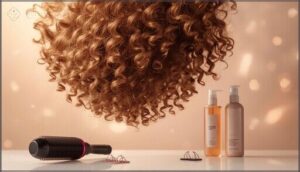
The right styling products and hair styling techniques can boost lift without adding weight. Start with gel formulas that contain fewer oils—lightweight products cut weigh-down by 50% in fine textures.
Try these volumizing hair products and methods for achieving hair volume:
- Diffusing methods with upside-down positioning and low heat reduce drying time to 10 minutes while enhancing root lift
- Root clipping at 90 degrees during drying prevents flat sections
- Scrunching curls removes excess water and doubles perceived bounce
The Importance of Regular Trims and Curl Cuts
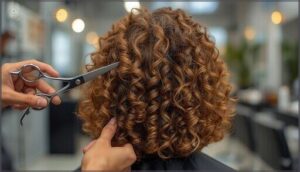
Beyond products, you need haircut precision for lasting lift. Trim your hair every 6-8 weeks to prevent split ends and restore curl definition—research shows regular curl-by-curl haircuts improve bounce by 45%.
The impact of haircuts on limp curls is dramatic: specialized curl cuts remove damaged weight, boost length retention benefits, and reset your pattern. Follow this trim frequency guide to maintain volume naturally.
Adapting Your Routine to The Season

Your scissors can only do so much—seasonal hair care demands routine flexibility. Winter dryness strips moisture, requiring richer conditioners, while summer humidity swells curls into frizz.
Spring shifts call for lighter products as temperatures rise, and fall moisture restoration prevents breakage.
Swap your hair product selection every 10–12 weeks, matching formulas to dew points for ideal hair moisture balance and bounce year-round.
Essential Routine Adjustments for Healthy Curls

Sometimes the difference between limp curls and bouncy ones comes down to how you use your products, not just which ones you choose. Small tweaks to your daily routine can reveal volume and definition you didn’t know your hair had.
Let’s walk through the key adjustments that’ll help your curls hold their shape from wash day to day three.
Proper Product Application and Amount
How much product are you actually using? Product over-application is a silent curl killer. For short hair, stick to a dime-sized amount; medium lengths need a quarter-sized portion; long curls benefit from half-dollar quantities. Tailor the amount to your hair type—fine strands require even less.
Focus application on mid-lengths to ends using techniques like scrunching or praying hands to avoid root heaviness and product buildup.
Detangling and Washing Techniques
Your washing frequency guidelines and detangling approach can make or break your curls. Wet detangling benefits curly hair textures by reducing breakage—work conditioner through with a wide-tooth comb, using a sectioning technique by dividing hair into four parts, starting at the ends. For tool selection, fingers often work best.
Wash every 2-3 days with a clarifying shampoo monthly to eliminate product buildup. Your hair care routine should match your hair texture needs perfectly.
Root Volume Boosting Methods
How do you lift flat roots without weighing down your curls? Diffusing techniques like upside-down drying increase root volume by directing airflow to your scalp, while root clipping with duckbill clips holds curls vertically during drying.
Try lightweight volumizing mousse at roots or mechanical lifting tools like bamboo picks to tease roots outward. Upside-down styling pulls hair away from your scalp, boosting body considerably over downward methods.
Preventing and Managing Environmental Damage
Beyond your four walls, pollution and UV radiation wage a silent war on your curls. Environmental damage sneaks up on you, but protective strategies make all the difference. Seasonal adaptations matter—summer humidity demands lighter formulas, while winter cold strips moisture fast.
- Shield from UV with leave-in conditioners containing peptides that reduce oxidative stress by 95%.
- Combat pollution using weekly clarifying shampoos to deep-cleanse particulates and buildup.
- Adjust seasonally by switching to humidity-proof products when dew points climb above 60°F.
Top 3 Styling Products for Limp Curls
The right styling gel can make or break your curl routine when you’re dealing with limp, lifeless spirals. You need products that offer strong hold without weighing your hair down or leaving behind sticky residue.
Here are three tried-and-true gels that deliver lasting definition and bounce.
1. Giovanni L.A. Hold Styling Gel
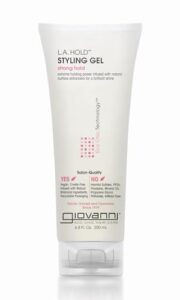
When limp curls need serious support, Giovanni L.A. Hold Styling Gel delivers the hold strength to keep your curls lifted all day. This vegan formula packs botanical ingredients like aloe vera and chamomile that work double duty—controlling frizz while boosting shine enhancement.
You’ll get that firm grip without the sticky crunch, and it washes out clean without leaving buildup behind. If you’re tired of hair styling products that weigh down your curls, this gel’s lightweight texture makes it one of the smartest hair products for reviving bounce.
Best For: People with curly or wavy hair who want strong, long-lasting hold that fights frizz and adds shine without the stiff, crunchy feel of traditional gels.
- Delivers firm hold that keeps curls defined and bouncy for 2-3 days while controlling frizz and adding natural shine
- Clean, vegan formula with botanical ingredients like aloe vera and chamomile that’s free of parabens, sulfates, and silicones
- Washes out easily without buildup and won’t leave hair sticky or weighed down
- Some users find the hold weakens after day two, leading to increased frizz without reapplication
- May feel sticky or too firm for those who prefer a softer, more flexible hold
- The scent is subtle and might not be noticeable enough for people who like fragrant hair products
2. Jessicurl Spiralicious Styling Gel No Fragrance

If you’re battling protein sensitivity or fragrance allergies, Jessicurl Spiralicious Styling Gel No Fragrance addresses limp curls without the common triggers. Its polyquaternium-69 formula provides strong hold strength—retaining about 90% of curl definition even in high humidity—while staying protein-free and silicone-free to prevent buildup.
You’ll notice tighter clumps and reduced frizz without weighing down fine curly hair. The initial cast scrunches out easily, leaving your styling products to work their magic.
This hair product suits sensitive scalps perfectly, keeping your hair styling routine clean and effective.
Best For: Curly-haired individuals with protein sensitivity, fragrance allergies, or fine hair that needs strong hold and frizz control without buildup or weighing down.
- Maintains 90% curl retention in high humidity thanks to polyquaternium-69, outperforming many traditional gels
- Protein-free and glycerin-free formula prevents stiffness and moisture issues while staying Curly Girl Method–approved
- Initial cast scrunches out easily to reveal soft, bouncy curls with lasting definition across multiple days
- May feel stiff or crunchy before scrunching, which requires an extra step in your styling routine
- Lacks moisturizing properties, so dry hair types may need to layer with hydrating products
- Performance and volume can vary depending on individual hair porosity and texture
3. Briogeo Curl Charisma Curl Defining Gel
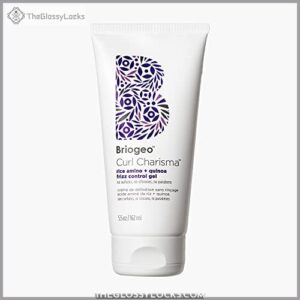
When your curls need moisture without the weight, Briogeo Curl Charisma Curl Defining Gel delivers light-to-medium hold through rice amino acids and tomato fruit ferment. This ingredient analysis reveals it’s 94% naturally derived and silicone-free—key for preventing limp curls caused by buildup.
User experiences confirm excellent curl definition on types 2A to 4C, though some report dryness on highly porous hair.
The product comparison shows it’s pricier at $20-26, but its flexible hold styling products don’t leave crunchiness. Layer it over their leave-in cream for maximum bounce on curly hair.
Best For: People with wavy to coily hair (types 2A-4C) who want lightweight curl definition and frizz control without crunchiness, especially if you prefer clean, vegan formulas.
- Flexible, non-crunchy hold that keeps curls bouncy and defined without stiffness or weighing them down
- 94% naturally derived and free of silicones, sulfates, and parabens—won’t cause buildup that makes curls limp
- Works across multiple curl types (2A-4C) with rice amino acids and tomato ferment that lock out frizz while maintaining moisture
- Some users with highly porous or dry hair report it doesn’t provide enough moisture on its own
- Pricier than many drugstore options at $20-26 per 5.5 oz bottle
- Mixed reviews on whether it works for fine hair, with some reporting dryness or the need to layer with other products
Frequently Asked Questions (FAQs)
Why are my curls limp?
Your hair’s natural spring—its curl elasticity—depends on a delicate balance. When that balance tips, you’ll notice flat, lifeless strands.
Product buildup, scalp health issues, and porosity levels all play starring roles.
Are limp curls a problem?
Yes, they affect self-esteem and curl confidence. A 2025 UK survey found only 23% felt confident dating with natural curls visible, showing how societal perceptions and beauty standards create real psychological impact.
How to fix limp curls?
Start with clarifying shampoo to remove buildup, then balance moisture with protein treatments. Layer lightweight products, adjust routines seasonally, and try root clipping. Curl training and proper product layering restore bounce effectively.
Why is my curly hair limp & lifeless?
Several culprits can rob your curls of life. Product buildup, protein deficiency, water hardness, and excess moisture top the list.
Hair porosity and scalp health also affect curl elasticity and overall bounce.
What does limp hair look like?
When you stretch a strand and let go, watch for the telltale sign: instead of springing back, it sags like a tired rubber band.
Limp curls show elongated patterns, root volume loss, and reduced bounce—shapeless, weighed-down spirals lacking definition.
What hairstyles work for Limp hair?
Layered crops and textured shags work beautifully because layers lift roots and create movement. Add bangs or face-framing pieces for fullness.
Try side parts and upstyle options—loose half-ups concentrate volume at the crown while hiding sparse ends.
Can I revive limp curls between wash days?
You can revive limp curls between washes using refresh techniques. Lightly mist water on mid-lengths, scrunch in a small amount of gel, then diffuse briefly—this reactivates product and restores bounce without full rewashing.
Does sleeping position affect curl volume overnight?
Yes—your sleep position directly impacts curl volume. Back sleeping flattens curls against the pillow, while side sleeping with protective styles like a satin bonnet or high pineapple preserves volume and reduces friction overnight.
Will hard water filters improve my curl bounce?
Filtering out the hardness can truly soften the blow mineral buildup delivers to your curls. Hard water’s calcium and magnesium deposits coat hair shafts, reducing curl elasticity by roughly 7%.
Filters paired with chelating shampoo and clarifying treatments offer complementary strategies for restoring bounce.
Can diet or vitamins strengthen limp curls?
What you eat truly matters for hair health and nutrition. Boosting dietary protein and omega-3s, and managing micronutrient deficiencies can strengthen curls.
Hair supplements and proper hydration levels also support bounce, especially if nutritional deficiencies are affecting hair protein structure.
Conclusion
Imagine your curls springing so high they nearly brush the ceiling—because limp curls don’t stand a chance once you’ve mastered the right routine. Every product, every trim, every tweak you make is like fuel for your hair’s natural energy.
Don’t settle for lifeless waves when your curls can be bold, buoyant, and full of personality. With the tools and know-how in your hands, you’re set to reclaim the bounce you’ve always wanted—no compromises, just results.
- https://www.ouidad.com/blogs/curl-talk/is-humidity-a-curls-friend-or-foe
- https://manetain.in/blogs/posts/the-blow-dry-lie-what-heat-styling-does-to-curly-hair
- https://www.lubrizol.com/company/insights/2022/11/textured-hair-consumers-reveal-what-they-want-in-products
- https://loveurcurls.com/blogs/news/product-buildup-in-hair
- https://holisticenchilada.com/common-causes-of-limp-curls-how-to-fix-them/