This site is supported by our readers. We may earn a commission, at no cost to you, if you purchase through links.
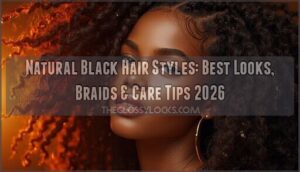
Black hair does something no other hair type does—it defies gravity, holds shape, and transforms completely depending on how you wear it.
A wash-and-go on type 4c hair looks nothing like yesterday’s twist-out, which looked nothing like last week’s box braids.
That range isn’t a challenge to manage around; it’s the whole point.
Natural black hair styles carry decades of cultural pride and personal identity in every coil and braid pattern.
Whether you’re newly natural, switching up your protective style rotation, or finally ready to try finger coils, there’s a look here that fits your hair, your life, and your mood.
Table Of Contents
- Key Takeaways
- Popular Natural Black Hairstyles
- Protective Styles for Natural Hair
- Braided and Twisted Style Ideas
- Styling Tips for Healthy Natural Hair
- Hair Care and Maintenance Essentials
- Frequently Asked Questions (FAQs)
- What are popular natural black hairstyles?
- What is type 3 black hair?
- What are some natural hairstyles for black women?
- What afro hairstyle is best for black women?
- Are black women embracing natural hairstyles?
- How do I get a natural black hairstyle?
- What are the best natural hairstyles for black women in 2024?
- What can I do with my natural black hair?
- Is natural black hair attractive?
- What kind of hairstyle makes you look younger?
- Conclusion
Key Takeaways
- Natural black hair isn’t one thing — it’s a whole range of textures, styles, and looks that you can shift depending on your mood, your schedule, and how much time you’ve got.
- Protective styles like box braids, twists, and cornrows do more than look good — they shield your strands from daily wear and give your hair real room to grow.
- The basics matter more than the fancy stuff: seal in moisture, sleep with a satin bonnet, and detangle gently from ends to roots to keep breakage low and length intact.
- Your hair’s cultural roots run deep — every coil, braid, and puff carries history, and wearing your natural texture is as much about identity and pride as it is about style.
Popular Natural Black Hairstyles
Natural hair is anything but one-size-fits-all — and that’s exactly the point. Whether your hair is freshly cut or growing past your shoulders, there’s a style that fits your mood, your texture, and your life.
From wash-and-go curls to protective twists, natural hair styling ideas for every texture prove there’s no wrong way to wear what grows from your head.
Here are some of the most popular natural hairstyles worth knowing in 2026.
Afro and TWA (Teeny Weeny Afro)
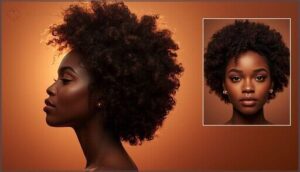
Whether you’re growing out a big chop or rocking a full classic Afro, both styles celebrate natural hair in its purest form.
The TWA — your Teeny Weeny Afro keeps it simple and bold, with tight coils under two inches that need daily moisture and a satin bonnet at night.
For Afro volume techniques, grab a pick comb and lift from the roots.
A consistent daily moisturizer routine helps keep the TWA hydrated.
Twist-Outs and Braid-Outs

From short TWAs to longer lengths, twist-outs and braid-outs work on almost every natural hair style. A twist-out gives you curl definition and volume; a braid-out gives stretch and softer waves.
Section sizing matters — smaller sections mean tighter curls.
For longevity strategies, sleep with a satin bonnet. Refresh techniques like light water misting extend wear.
Smart product pairings, like leave-in plus twisting cream, make both styles last. braid outs last three can last three to seven days, offering extended wear.
Finger Coils and Coil-Outs
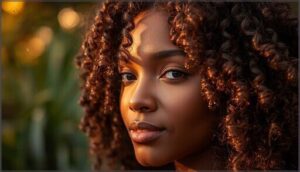
Finger coils take your natural hair to the next level — think defined ringlets that pop with bounce and shine. Start one inch from roots, wrap damp hair tightly around your finger, then seal with flaxseed gel or a curl cream for moisture retention.
- Coil definition lasts up to two weeks with proper nighttime coil care
- A satin bonnet protects your coil styling tools while you work overnight
- Morning coil refresh with a water‑based leave‑in keeps protective styling intact
Afro Puffs and Space Buns
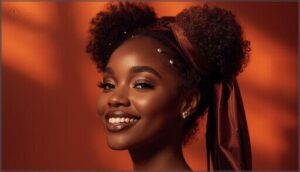
From tight ringlets to something a little more playful — afro puffs and space buns are natural hair styles that never miss. A high puff celebrates cultural symbolism rooted in Black Power-era pride.
For accessory styling, try jeweled pins or a silk scarf.
Tension management matters: use snag-free bands.
Conversion techniques let you twist each puff into space buns instantly.
Mohawk and Faux Hawk Styles
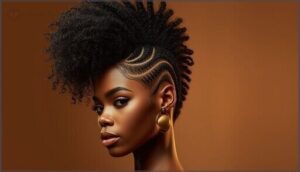
Mohawks aren’t just edgy — they’re a full-on celebration of natural hair texture.
Try faux hawk ponytails by creating small ponytails down your center and fluffing each one for afro volume. Braided side mohawks use cornrows to frame a curly frohawk beautifully.
Twist out mohawks and protective mohawk variations with bantu knots keep your hair care goals and braids-based protective styles working together.
Protective Styles for Natural Hair
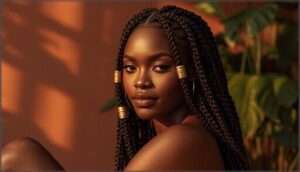
Protective styles are some of the best tools you have for keeping your natural hair healthy and growing strong. They shield your strands from daily wear while giving you a break from constant styling.
Since growth speed depends on factors like hair type and the season, understanding how long it takes for roots to grow out can help you set realistic expectations while rocking a protective style.
Pairing protective styles with a regular scalp massage using Jamaican black castor oil for hair growth can seriously boost circulation and give your follicles the support they need to thrive.
Here are some of the most popular options worth trying.
Box Braids and Knotless Braids
Box braids and knotless braids are two of the best protective styling options for Black women — and the difference matters. Box braids use a knot at the base, while knotless braids feed in extensions gradually, reducing scalp tension and edge stress.
Size variations range from micro to jumbo. Installation time varies too.
Accessory options and maintenance frequency differ, so ask your stylist what fits your lifestyle.
Senegalese and Passion Twists
Senegalese and Passion Twists are two crown jewels of protective styling. The right extension textures make all the difference — straight for Senegalese, soft curly for passion twists’ boho finish. Size options range from jumbo to small, affecting installation time and longevity.
- Wrap nightly in a satin bonnet
- Apply jojoba oil for scalp care every other day
- Limit wear to six weeks maximum
Cornrows and Feed-in Braids
Cornrow braids carry deep roots in Black Hair Culture — tracing back centuries to African Yoruba tradition.
For protective styling that lasts, feed-in braids are a significant improvement: small extensions added gradually create a smooth, knot‑free finish.
Master your Tool Essentials — rat‑tail comb, edge control, duckbill clips.
Explore Pattern Variations like zigzag or straight‑back rows.
Your Maintenance Schedule: wash every two weeks, oil your scalp twice weekly.
Bantu Knots and Flat Twists
Bantu knots and flat twists are two of the most rewarding styles you can master at home.
Knot placement and DIY geometry shape your whole look — try 6 to 8 uniform sections for balance.
Flat twists need steady twist tension close to the scalp.
Scalp hydration and smart product pairings like leave-in conditioner plus medium-hold mousse for protective styling that genuinely lasts.
Crochet Braids and Jumbo Loc Plaits
Crochet braids might be your fastest route to a full, protective look — installation time runs just 2 to 4 hours.
latch hook weaves extension textures like kinky curly or water wave through your cornrow base with low tension, keeping scalp care easy.
Jumbo loc plaits add serious volume with fewer locs.
Your maintenance routine stays simple, and style longevity reaches a solid 4 to 6 weeks.
Braided and Twisted Style Ideas
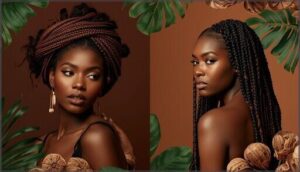
Braids and twists are where natural hair really gets to shine.
Whether you want something sleek and structured or soft and free-flowing, there’s a style that fits your mood, your schedule, and your hair goals. Here are some standout looks worth trying.
Goddess Braids
Goddess braids are one of the most striking choices in protective styling for Black women with natural hair. Thick, sculpted sections flow close to the scalp, with curly extensions woven in for that soft, bohemian finish. Your installation techniques and extension choices shape everything about the final look.
- Jumbo sections create bold, dramatic volume
- Knotless versions feel lighter and look smooth
- Halo patterns frame your face like a crown
- Side-swept designs add unexpected asymmetry
- Feed-in braids build natural-looking thickness gradually
Keep your scalp care consistent — oil every few days, sleep in a satin bonnet, and your style can last six to eight weeks easily.
Two-Strand and Rope Twists
Where goddess braids go bold and structured, two-strand twists keep things soft and free.
Divide your hair using clean sectioning techniques, then overlap two parts clockwise — that’s your classic TwoStrand Twists.
Rope Twists go tighter, twisting each strand counter-clockwise first.
The texture differences are real.
Use a quarter-size of twist butter per section, sleep in your bonnet, and your Protective Styling can last two to three weeks.
Side-Swept and Updo Braids
Side-Swept Braids take your look from everyday to elevated fast.
Start at one temple, use Edge Control Techniques along your hairline for clean baby hairs, then let the braid fall over your shoulder.
Updo Styling works the same way — anchor your Braids at the crown, tuck the ends, add Hair Jewelry Pairings like gold cuffs.
Satin Maintenance Benefits keep both styles fresh longer.
Mind Tension Management near your edges always.
Halo Braid and Crown Braid
Both the Halo Braid and Crown Braid sit like royalty on natural hair.
The halo wraps tightly along your hairline; the Crown Braid rests higher for bold drama.
Use Pre‑Stretch Methods first, then Edge Control Techniques to smooth your baby hairs.
Bobby Pin Securing keeps everything smooth.
Add Hair Jewelry Accents for events, and always finish with Nighttime Satin Care — these Protective Styling Braids deserve it, Black Women.
Braided Ponytails and Buns
Braided ponytails and buns are two of the most adaptable Black hair styles you can pull off.
Try High Ponytail Variations using box braids — gather them at the crown for an elongated, neck-flattering look. Low Ponytail Styling works beautifully with cornrow bases and Extension Integration for extra swing.
Wrap ends into Ponytail Bun Techniques, secure with bobby pins, and add Accessory Accents to finish.
Styling Tips for Healthy Natural Hair
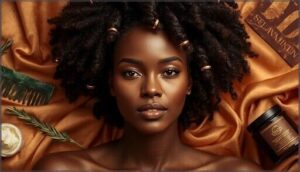
Good hair days don’t happen by accident — they’re built on consistent, simple habits.
natural hair thrives when you treat it with intention, from how you moisturize to how you sleep.
what actually has an impact.
Moisturizing and Sealing Techniques
moisture as your hair’s best friend — and sealing is how you keep it close.
The LOC Method (Liquid, Oil, Cream) works beautifully for high-porosity 4C hair, while the LCO Method suits finer strands better.
Smart sealing oil selection — castor, jojoba, or argan — locks everything in.
Finish with shea butter benefits doing the heavy lifting, and your leave-in moisturizers laying the foundation.
Nighttime Protection (Bonnets & Pillowcases)
Sleeping on a cotton pillowcase is basically undoing everything your moisture routine worked for. Satin bonnets reduce friction by up to 43 percent compared to cotton, keeping cuticles flat and locking in natural oils overnight — that’s real moisture retention working while you rest.
Satin bonnets reduce friction by 43 percent overnight, protecting what your moisture routine worked all day to build
Size matters too: large bonnets fit voluminous afros or braids, while extra-large holds locs securely.
Hand wash weekly and air dry flat.
Choosing The Right Styling Products
The right styling products are everything — and porosity matching is where you start. Low porosity hair loves lightweight aloe vera; high porosity needs shea butter to seal moisture in.
- Hold Level Selection: Light mousse for twist-outs, firm gel for sleek puffs
- Ingredient Safety: Skip sulfates, mineral oil, and petroleum
- Seasonal Adjustments: Heavier butters in winter, water-based products in summer
Gentle Detangling Methods
Detangling doesn’t have to mean breakage. Start with wet detangling benefits in mind — damp hair with conditioner creates slip, making every pass smoother.
Use the ends-to-roots technique, working from tips upward. Finger detangling first separates curls gently, then a wide tooth comb glides through sections with ease.
| Method | Best For | Key Tip |
|---|---|---|
| Finger Detangling | Fine, fragile strands | Use oil on dry hair |
| Wide Tooth Comb | Coily textures | Apply after conditioner |
| Sectioning Quadrants | Thick 4C hair | Twist each section after |
Avoiding Heat Damage
Heat is one of the biggest threats to natural hair health. Before you reach for any tool, apply a heat protectant like Olaplex No.9 or Mizani Heat Screen Spray — both guard up to 450°F.
Pre‑heat conditioning with a deep conditioner restores elasticity first. For low‑temp styling, keep flat irons at 350–400°F.
Better yet, try heatless curling with flexi rods or Bantu knots. Your strands will thank you.
Hair Care and Maintenance Essentials

Great styles start with great care — it’s really that simple.
How you treat your hair between wash days and styling sessions makes all the difference in the long run.
Here are the essentials that’ll keep your natural hair thriving.
Regular Trimming and Shape Maintenance
Most natural hair thrives with a trim every 8 to 12 weeks. That’s your sweet spot for split end detection before damage travels up the strand.
Short styles like TWA need shape tools and a cleanup every 6 to 8 weeks. Try the dusting technique — snip just a quarter inch — for DIY trimming that promotes hair growth and damage prevention without sacrificing length.
Washing and Conditioning Routines
Once your trims are done, washing becomes your next line of defense for hair health. Start with pre‑poo oils — coconut or olive — before shampooing to protect strands from dryness. Then reach for sulfate‑free shampoos to cleanse without stripping moisture.
- Deep‑conditioning frequency: weekly for most textures
- Cool‑water rinse to seal cuticles after conditioning
- Leave‑in sealing with the LOC method on damp hair
- Wash and go works beautifully when hair is properly moisturized
Scalp Health and Cleansing
Your scalp is the foundation of everything.
A clarifying shampoo every two to four weeks lifts product buildup and sweat without disrupting your hair health.
Try a bentonite clay mask monthly to pull out hard water minerals.
A tea tree treatment soothes irritation fast.
Finish with a gentle oil massage to boost circulation and keep your hair care and maintenance routine on track.
Hydration and Protein Treatments
Your moisture‑protein balance is what keeps curls strong without going stiff.
A weekly treatment schedule of moisturizing deep conditioners, plus protein once a month, works for most.
Try the stretch test indicators — pull a shed strand gently. Snapping fast means protein time; stretching too far signals moisture first.
Watch for protein overload signs like dryness and brittleness.
Build a porosity‑based regimen that actually fits your hair.
Extending The Life of Styles
Getting more out of every style starts with small, consistent habits.
Try the pineapple method at night — a loose high ponytail limits pillow contact and preserves your curl pattern beautifully. Pair it with satin bonnet use for real damage prevention.
A midweek refresh with light leave-in keeps things vibrant.
Retwisting roots and regular scalp cleansing round out your hair maintenance routine.
Frequently Asked Questions (FAQs)
What are popular natural black hairstyles?
Natural hair is like a garden — it grows in every direction, wild and wonderful.
From sculpted curls to a layered afro, your options include braids, twists, protective styling, microbraids, braided crowns, and high top fade looks.
What is type 3 black hair?
Type 3 curly hair features S-shaped spirals ranging from loose 3A coils to tight 3C corkscrews.
Shrinkage management, moisture retention, and porosity levels all shape how you style and care for your natural hair texture.
What are some natural hairstyles for black women?
Black women have endless options: twist-outs, afro puffs, Mini Bantu Knots, Flat Twist Updos, and a Silk Press Finish.
Protective Styling like Braids keeps hair thriving.
Head Wrap Art and Moisturizing Curl Cream complete any look.
What afro hairstyle is best for black women?
The best afro for you depends on your texture and lifestyle.
A round afro celebrates bold volume, while a tapered cut needs minimal upkeep.
Short on time? Try an afro puff — it’s simple and stunning.
Are black women embracing natural hairstyles?
Like a wave that only keeps growing, yes — and the numbers prove it. Nearly 61% of Black women wear natural hair all the time, and that confidence isn’t slowing down.
How do I get a natural black hairstyle?
Start with clean, moisturized hair and pick a style that fits your texture.
Product selection matters — a good leave-in conditioner and curl cream go a long way toward DIY curl definition that actually lasts.
What are the best natural hairstyles for black women in 2024?
Fluffy afros, coil-out techniques, and protective styling like braids dominated as top picks.
Natural hair thrives with moisture sealing and nighttime hair care — simple habits that keep black women’s hairstyles looking their best.
What can I do with my natural black hair?
Honestly, the options are endless. From bold braids and protective styling to DIY treatments and seasonal styling switches, your natural hair is a canvas. Explore, experiment, and make it yours.
Is natural black hair attractive?
Yes, absolutely. Natural black hair is deeply beautiful.
Celebrity influence, social media perception, and shifting cultural beauty standards have helped millions of Black women embrace their texture as a powerful form of natural beauty and self-esteem.
What kind of hairstyle makes you look younger?
Soft fringe and layered curls instantly lift your look.
A voluminous puff or high ponytail adds youthful bounce.
Side-swept bangs frame your face beautifully, making hair and beauty feel simple and fresh.
If you’re torn between styles, weighing micro bangs versus curtain bangs upkeep can help you pick the low-maintenance option that best fits your routine.
Conclusion
There’s a theory that natural hair limits your options. Spend one week cycling through a wash-and-go, a twist-out, and fresh cornrows, and that theory falls apart completely.
Natural black hair styles don’t restrict you—they expand what’s possible.
Every coil holds memory, every braid carries meaning, and every style you choose is yours to own. Learn your hair, feed it well, and it’ll keep showing up for you in ways you haven’t even tried yet.
- https://hellobeautiful.com/playlist/natural-hairstyles-for-black-women/
- https://www.hair.com/wash-and-go.html
- https://www.curlsqueen.com/blog/hairstyles/best-protective-hairstyles-recommended-to-black-women-with-natural-hair.html
- https://naturallclub.com/blogs/the-naturall-club-blog/twist-outs-v-braid-outs
- https://therighthairstyles.com/30-best-black-braided-hairst/