This site is supported by our readers. We may earn a commission, at no cost to you, if you purchase through links. This content is for general informational and educational purposes only and is not a substitute for professional medical, dermatological, or nutritional advice.
The quiff haircut survived seven decades of style shifts because it does something few cuts can: it adds height where it counts and keeps everything else tight. Elvis built his reputation on one. Your barber can build yours in twenty minutes.
What makes the quiff work is simple math. Longer hair up front, two to four inches, paired with faded or tapered sides creates structure without effort. You get lift that reads as confidence, whether you finger-shape it messy for the weekend or comb it sharp for Monday.
Here’s how to pick your version, style it, and keep it sharp.
Table Of Contents
- Key Takeaways
- What is a Quiff Haircut? Key Features and Pompadour Differences
- Popular Quiff Haircut Variations: Classic, Textured, Fade, and Undercut
- How to Choose The Right Quiff Haircut
- How to Style a Quiff Haircut
- Maintaining Your Quiff Haircut: Daily Care and Regular Trims
- Frequently Asked Questions (FAQs)
- What to tell a barber for a quiff?
- Why is it called a quiff?
- What is the difference between a quiff and a faux hawk?
- What does a modern quiff look like?
- What is a men’s quiff haircut?
- What is a classic quiff hairstyle?
- Which face shape is suitable for a quiff haircut?
- What do I tell my barber for a quiff?
- How long should your hair be for a quiff?
- Is a quiff hairstyle attractive?
- Conclusion
Key Takeaways
- A quiff works because of contrast, so ask your barber for 2 to 4 inches on top with faded or tapered sides, and bring a reference photo to back it up.
- Pick your version by matching it to your face shape and hair type, like going higher and asymmetric for a round face or adding mousse to fine hair.
- You’ll get lasting lift by blow-drying the roots upward with a round brush, then finishing with clay or another product that fits your hair and the finish you want.
- Keep it sharp by re-shaping it each morning, clearing out product buildup weekly, and booking a trim every 3 to 6 weeks (every 2 to 3 weeks with a tight fade).
What is a Quiff Haircut? Key Features and Pompadour Differences

You’ve got questions, and we’ve got answers. Below, we’ll break down what a quiff haircut actually is, the key features that define it, and how it stacks up against its flashier cousin, the pompadour. Ready to take control of your look? Let’s get into it.
And if a thinning hairline is part of the equation, this guide to the best hairstyles for a receding hairline covers styles like the textured quiff that work with what you’ve got. A sharp quiff pairs best with well-groomed facial hair, so a solid guide to mustache trimming techniques keeps the whole look on point.
What Is a Quiff?
Quiffs put you in charge of your look. The quiff haircut features a lifted front section swept upward and back, while the sides stay shorter or flatter.
Rock-and-roll icons like Elvis Presley made it famous in the 1950s, and the Modern Quiff still carries that confident edge. Think of it as your daily dose of rebellion, styled in minutes.
Elvis made the quiff famous in the 1950s, and today’s modern quiff still carries that confident, rebellious edge you can style in minutes
Key Quiff Features
A quiff haircut lives and dies by contrast. You need longer hair on top, usually 2 to 4 inches, paired with short, faded or tapered sides.
That height at the front comes from blow-drying upward and setting it with a texture clay for all-day hold.
Want a Textured Quiff? Ask your barber for layers and point-cutting, then let airflow do the heavy lifting.
Using a round brush while blow drying directs airflow upwards and back to build the pronounced lift at the front.
Quiff vs. Pompadour
Once you’ve got the lift down, the Quiff vs Pompadour question comes up fast. A Pompadour rolls back in one smooth, continuous sweep over the top. A Classic Quiff keeps its height at the front, while a Modern Quiff stays looser and more textured.
Picking the right one is easier when you see them side by side, so this temple taper fade guide breaks down each style with photos.
Your Quiff Styling comes down to one thing: should the front stand up or roll back?
Popular Quiff Haircut Variations: Classic, Textured, Fade, and Undercut
Once you know the basics, it’s time to pick your lane. The quiff comes in several versions, and each one hands you a different kind of control.
- Classic Quiff: Keep 3-5 inches on top with short, neat sides. Taper it gradually to skip the helmet look.
- Textured Quiff: Add sea salt spray or texture clay for a messy, lived-in finish. It loves thick or wavy hair.
- Fade Quiff: Pair a skin or taper fade with volume up top. Pomade or matte paste keeps it moving.
Want maximum contrast? The Undercut pairs 4+ inches on top with buzzed sides, held tall by strong wax. Every fade and Undercut demands steady Quiff Maintenance, so book trims every few weeks.
How to Choose The Right Quiff Haircut
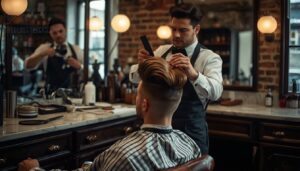
A great quiff starts with a cut that fits you, not just a photo you like. Your face shape, hair type, and the way you talk to your barber all decide how sharp it looks. Here are the three things to get right before you sit in the chair.
Matching Your Quiff to Face Shape
Your face shape decides how much height you can own. Face Shape Compatibility makes the difference.
An Oval Face Shape suits nearly any version, especially textured ones. A Round Face Shape needs lift, so go high and asymmetric. A Square Face Shape loves a textured mid fade. A Heart Shaped Face balances best with a mid-length quiff and low taper.
Adapting Quiffs to Your Hair Type
You don’t need a new look, just a smarter quiff. Hair type adaptability starts with your hair texture:
- Fine: Shorter top, add mousse.
- Thick: Fade sides, light pomade.
- Wavy: Sea salt spray, finger-style.
- Curly: Longer top, use diffuser.
- Straight: Sharp shape, blow-dry upward.
Also weigh hair length specification, hair health and face shape compatibility before cutting.
Barber Instructions and Reference Photos
Picture the mirror: your phone glows, the barber leans in, and one reference photo says everything.
How to Ask Your Barber for a Quiff Haircut? Name the top length and fade, then show it.
| Detail | Say | Show |
|---|---|---|
| Top | Medium | Photo |
| Fade | Mid | Sides |
Great barber communication gives you control. This quiff guide continues with how to style a quiff haircut.
How to Style a Quiff Haircut

A great quiff takes about ten minutes and three simple steps. You’ll pick the right product, blow-dry for lift, and shape the finished look with your fingers or a comb. Run through each step below and you’ll walk out the door with a quiff that looks easy and holds all day.
Choosing Products for Hold and Texture
Your product decides how much control you have over your quiff.
Go with Texture Clay for strong matte hold, and warm it between your palms first. If your Hair Texture is fine, try Styling Cream for lighter lift. Match Hold and Texture to your finish, and schedule Product Buildup Removal weekly so your quiff stays fresh, flexible and fully yours.
A light hold styling cream gives fine hair volume without weighing the quiff down.
Blow-Drying for Lift and Volume
Want a voluminous top that holds all day? BlowDry it right.
- Towel-dry until damp, not dripping.
- Apply heat protectant first.
- Dry roots against your style’s direction.
- Lift the front with a round brush.
- Finish with a cool-air pass.
That’s how you build real hair lift and lasting hair volume. Keep the nozzle moving and aim it straight at the roots.
For extra lift that lasts even longer, dust a little volumizing hair powder at the roots after drying.
Finger-Shaping or Combing Your Quiff
Your quiff, your rules. Want easy texture? Go with finger-shaping after your blow-dry. Push hair up with fingertips, pinch the front, and scrunch in product for tousled volume. Craving sharper control? Grab a comb first, then finish with fingers.
| Finger-Shaping | Combing |
|---|---|
| Soft, relaxed texture | Clean, polished finish |
| Casual, messy volume | Defined side-part quiff |
| Best for waves | Best for sharp lines |
Try both. Own your look.
Maintaining Your Quiff Haircut: Daily Care and Regular Trims

Styling your quiff is only half the win. The other half is keeping it sharp, and that starts with a solid hair care routine.
Your daily reset takes two minutes. Sleep flattens the front, so dampen it, work in a touch of product, and re-shape with your fingers. If wax or clay builds up, hit it with a clarifying shampoo once a week. Skip daily full washes if your scalp runs dry, and condition the lengths only, never the roots.
Regular trims keep the whole look alive. Book every 3–6 weeks, or every 2–3 weeks if you’re rocking a tight fade. Tell your barber how much top length you want to keep, and your quiff stays in fighting shape.
Frequently Asked Questions (FAQs)
What to tell a barber for a quiff?
Walking into the chair armed? Here’s your blueprint. Tell the barber your top length at the front, crown length, sides fade height, and blended or disconnected. Mention messy or polished, plus daily styling time. Bring a reference photo showing front and side.
Why is it called a quiff?
Like a crest on a wave, the name’s origin is murky.
Some link this Retro Hairstyle to French "coiffe" or Dutch "kuif." Still, the Quiff Haircut, or Quiff Cut, ruled Haircut Trends after James Dean.
What is the difference between a quiff and a faux hawk?
Mix these up and your barber will wince. A Quiff Haircut lifts volume at the front and sweeps it back. A faux hawk pulls hair from the sides into a center ridge. Choose your peak.
What does a modern quiff look like?
Picture a High Fade Quiff: skin-short sides, four inches up top. That’s the Modern Quiff Haircut.
Go Textured Quiff Haircut for matte lift, Messy Quiff Haircut for edge, or a Side Part Quiff for polish.
What is a men’s quiff haircut?
Nobody ignores a great quiff. A Quiff Haircut sweeps longer top hair upward and back over shorter sides, adding Hair Volume.
Go Classic Quiff Haircut, Textured Quiff, or Modern Quiff Haircut, and own the room.
What is a classic quiff hairstyle?
The Classic Quiff Haircut pairs tapered sides with 3 to 4 inches on top, swept up and back. Start with Volumizing Shampoo, then style Textured Hair with clay. You’ll own a Classic Quiff in minutes.
Which face shape is suitable for a quiff haircut?
Oval, square and round faces all rock a quiff. A HeartShaped Face loves extra volume on top, while oblong faces should keep height modest.
Straight Hair, Wavy Hair, Curly Hair or Thick Hair all work.
What do I tell my barber for a quiff?
What to tell my barber for a quiff: request a low taper haircut or fade haircut, disconnected sides, 2–3 inches, point-cut texture, and loose hair parting. Bring a photo to choose the right quiff haircut.
How long should your hair be for a quiff?
Hair Length Requirements for Quiff Styling: 2 inches for a Short Quiff, 3 to 5 for a Medium Length Quiff, 6+ for a Long Quiff Haircut. How to Choose the Right Quiff Haircut starts here too.
Is a quiff hairstyle attractive?
Looking easy takes work, and that’s the joke. It’s attractive: women swipe right, and Hair Confidence shows. Choose a Textured Quiff, skip Quiff vs Pompadour, and buy the Best Hair Products for a Quiff Haircut.
Conclusion
Picture the mirror on a Monday morning: a wave of hair rising off your forehead, sides clean and sharp, nothing out of place unless you want it to be.
That’s the quiff haircut at its best. You decide the height, the texture, the finish. Tell your barber what you want, dry it for lift, shape it with the right product, and book your trim before it loses its edge.
Your hair, your rules. Walk tall.