This site is supported by our readers. We may earn a commission, at no cost to you, if you purchase through links. This content is for general informational and educational purposes only and is not a substitute for professional medical, dermatological, or nutritional advice.
You know that moment when your hair feels soaked on the outside, yet the middle of your twist-out is still dry as a cracker? That’s what happens when you moisturize everything at once. The water and product sit on top while the dense layers underneath stay thirsty.
Sectioning hair for moisturizing fixes that. Smaller portions give you direct access to every strand, so conditioner reaches from root to tip, detangled pieces stay detangled, and you stop fighting knots at the nape. Once you see how much easier wash day gets, you won’t skip this step again. Here’s exactly how to do it.
Table Of Contents
Key Takeaways
- When you moisturize your whole head at once, product piles up on the outer layers while the nape and behind-the-ear strands stay dry, so working in smaller sections is what gets moisture to every strand.
- Start with wet hair and plenty of conditioner or detangling spray, then loosen knots with your fingers from ends to roots before using a wide-tooth comb, and stop to add more water or product if anything resists.
- Pick your section count by density, not length: four for fine hair, six for medium, and eight for thick hair, keeping each section roughly equal and clipped about half an inch from your scalp so it doesn’t pull.
- Moisturize and seal one section at a time, working a water-based leave-in from root to tip and then locking it in right away with a small, rice-sized amount of oil or butter before twisting that section away.
Why Section Hair Before Moisturizing

Why do so many of us slather product on our whole head and still wake up to dry ends? Because moisture piles up on the outer layers, the top and front, while the nape and the spots behind your ears get whatever’s left over.
Dry ends happen because moisture gathers where hair is easiest to reach, leaving the nape and behind-the-ear strands with almost nothing
Sectioning off your hair fixes that. Smaller portions let you actually see and reach each strand, so you know it’s coated instead of just hoping. Dense hair hides uncoated pieces everywhere, and smaller sections give you real access to the shaft. Dividing wet hair this way also exposes interior layers for product access, which are the dry zones thick hair often keeps hidden after conditioning.
It protects your hair. Working in sections keeps detangled strands from re-knotting with unworked ones, so you won’t yank on bundles of coils. Less tension means less breakage, and every section ends up slippery and hydrated.
A good leave-in conditioner for hair hydration adds the slip that keeps each section soft, pliable, and easy to detangle.
Prep Hair With Water and Gentle Detangling

Before you part a single section, get your hair wet. Water softens the cuticle, so strands bend instead of snapping, and it lets them glide past each other instead of snagging. Wet hair is also where moisture sticks best, so this step sets up everything that follows.
Next, add a generous layer of conditioner or detangling spray. You want real slip here. If a section starts to dry out, mist it with water and add more product.
Start with your fingers to find and loosen knots, working from your ends to roots. Then follow with a wide-tooth comb, or a flexible-bristle brush while your hair is soaking wet.
If something resists, stop. Reapply water or product instead of forcing it through.
Choose Four, Six, or Eight Sections
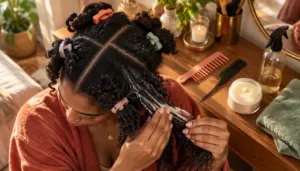
Once your hair is wet and detangled, you’re ready to decide how many parts to work in. The answer depends on density, more than length. The quadrant method, which splits your head into four parts, is the baseline for fine or low-density hair.
Thick hair needs more room to breathe. Here’s how I’d think about it:
- Four sections: fine or low-density hair, with a fifth at the crown if the top layer mats up.
- Six sections: medium density, or hair you twist up for moisturizing and sealing.
- Eight sections: high-density or thick hair that feels bulky in your hands.
- Keep sections roughly equal so each one absorbs product at the same pace.
- If a section feels unmanageable, make it smaller.
How to Section and Secure Your Hair
Once your hair is damp and detangled, it’s time to part it into manageable pieces. Below, I’ll walk you through the three steps that take you from a full head of hair to neat, moisture-ready sections. Each one builds on the last, so you’ll stay in control the whole way through.
Sectioning your hair this way also makes it easier to apply moisture to dry, brittle hair evenly, so every strand gets the hydration it needs.
Create Four Basic Quadrants
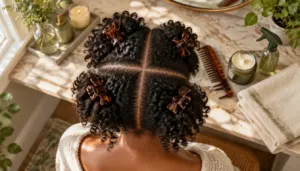
Find your center, part your crown, and the quadrant method clicks.
Run your comb from forehead to nape, then ear to ear over the crown. Clip each quarter, teeth up.
| Quadrant | Location | Tip |
|---|---|---|
| Front left | Hairline to ear | Clip first |
| Front right | Hairline to ear | Mirror left |
| Back quadrants | Crown to nape | Keep even |
Keep every quarter roughly the same.
Split Dense Areas Into Smaller Sections
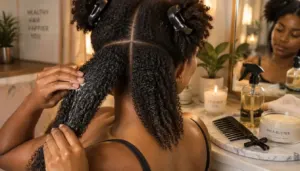
Divide and conquer when your hair feels thick and dense. Part each quadrant into smaller, manageable parts so moisture reaches the inner strands.
- Use a vertical part down the middle of each quadrant.
- Keep both halves the same size.
- Take extra care in knot-prone spots like the nape.
- Split again if your fingers can’t saturate it fully root to tip.
Secure Sections Without Pulling
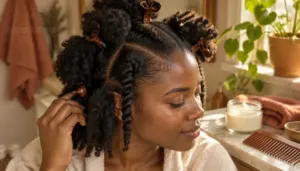
Clip each section about half an inch from your scalp, so the clip anchors the hair without pressing on sensitive skin. Pick serrated clips with rounded edges, since texture grips without crushing. If you can feel the clip while you work, loosen it.
For tender hairlines or crown, use a loose two-strand twist instead, and never twist tightly before clipping.
Moisturize and Seal One Section at a Time

Think about it: you’ve spritzed your hair, moisturized the whole left side, and by the time you reach the right, the left already feels dry again. That’s why working in sections matters so much.
Release one section from its clip. Smooth your water-based leave-in through it from roots to ends, massaging it in with your fingers, and focus on the mid-lengths and ends. Then go straight to sealing, because water evaporates fast.
Use a rice-sized amount of sealant, a pea-sized dab if your hair is long or thick. Fine hair loves jojoba or argan, while coily strands can handle butter. Twist the finished section away, then move on.
Go light. Moisturized hair needs much less, and your natural hair care routine improves.
4 Hair Sectioning and Moisturizing Essentials
You don’t need a bathroom full of products to section your hair well. These four tools cover the basics of sectioning and moisturizing without making your routine more complicated. Here’s what I’d keep within arm’s reach on wash day.
1. Revlon Black Extra Long Hair Elastics
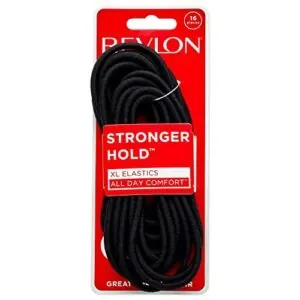
Ever tried sectioning thick hair with a skinny band? It slides right off. These elastics are built differently, with a thick elastic band that grips full, long, or 4B-4C hair without loosening halfway through your routine.
I like that there’s no crimper, so nothing snags or tugs as you slip them on and off. You get 16 in the pack, plenty for eight sections plus spares.
One caveat: they’re too bulky for short or fine hair. Over months, seams can fray, and a rare defective one may snap.
| Best For | People with thick, full, long, or coily (4B–4C) hair who need a strong, no-snag elastic for ponytails, braids, buns, and workouts. |
|---|---|
| Dimensions | 0.38 x 2.25 x 6 inches |
| Weight | 1.45 ounces |
| Model Number | B01F8SRBXC |
| Hair Type | Full, thick, or long hair |
| Key Benefit | Strong, secure hold |
| Main Drawback | Wears down over time |
| Additional Features |
|
- Thick elastic band holds full, long, or thick hair securely without slipping
- No-crimper design prevents hair pulling and damage during wear and removal
- Pack of 16 gives plenty for sectioning hair, with spares left over
- Too thick for short or fine hair
- Elastic may wear down or come undone at the seams after months of use
- Some units may be defective, with cut crimps that snap
2. Curl Keeper Tweek Curl Cream
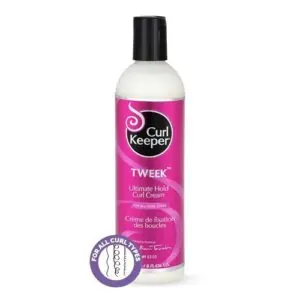
Ever notice how a sectioned head of hair turns into a puzzle the second you reach for a heavy cream? This one keeps things lighter. It’s a water-based, silicone-free formula that wakes back up with moisture, so a quick spritz brings it back to life.
The pH-balanced ingredients, including proteins, add softness and shine, and it’s made for every curl type, so flyaways and static stay in check.
Go easy, though. The hold runs stronger than some people like, and the scent can be intense, so start small on each section.
| Best For | People with fine or fresh-styled curls who want to refresh day 2–4 hair and add lift at the roots, and who don’t mind starting with a small amount to control the hold. |
|---|---|
| Dimensions | 3 x 3 x 5 inches |
| Weight | 8 ounces (227 g) |
| Model Number | 2262 |
| Hair Type | All curl types |
| Key Benefit | Restores curl definition |
| Main Drawback | Overpowering scent |
| Additional Features |
|
- Water-based, silicone-free formula that reactivates with moisture, so a quick spritz revives your curls.
- Restyles day 2–4 hair to restore definition, reduce frizz, and add volume and lift at the roots.
- Made for all curl types, with pH-balanced ingredients and proteins for softness and shine, and helps prevent flyaways and static.
- The scent can be overpowering and has caused headaches for some users.
- The hold is stronger than some people prefer, so it takes careful application.
- The texture can feel sticky to some users.
3. Tangle Teezer Curly Hair Detangler Brush
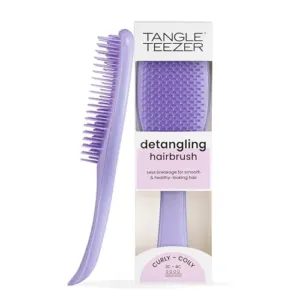
Ever fought a knot halfway through moisturizing and watched your neat sections fall apart? This brush helps prevent that.
Its two-tier design is patent-protected. Longer, firmer teeth work through tangles, while shorter teeth smooth everything out. The firm-flex bristles are made for 3C to 4C curls and coils, though they also work on looser 2A to 3B textures.
Use it on wet or dry hair, in or out of the shower. Work conditioner or curl cream through each section, and detangling time can drop by half.
One caution: the plastic handle gets slippery when wet.
| Best For | People with tight curls and coils (3C to 4C) who want to detangle and spread conditioner evenly during wash day, though it also works on looser 2A to 3B textures. |
|---|---|
| Dimensions | 1.57 x 2.56 x 8.66 inches |
| Weight | 2.82 ounces |
| Model Number | TWD-NC-LIL-010121 |
| Hair Type | 3C to 4C curls and coils |
| Key Benefit | Even product distribution |
| Main Drawback | Slippery handle when wet |
| Additional Features |
|
- Patent-protected two-tier design uses longer, firmer teeth for tangles and shorter teeth for smoothing.
- Works on wet or dry hair, in or out of the shower, and spreads conditioners, masks, leave-ins, and curl creams evenly.
- Can cut detangling time in half while helping keep curl definition.
- The plastic handle has no textured grip, so it gets slippery and hard to hold when wet.
- The bristles can feel harsh on sensitive or straight-haired scalps.
- Results on breakage are mixed, and some users report hair damage despite easier detangling.
4. Goody Large Hair Claw Clips
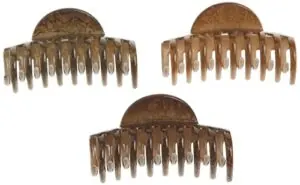
Once your brush has done its job, you need something to keep those sections put while you work on the next one. That’s where these clips earn their spot.
You get a three-clip assortment in brown shades, built with strong hinges so hair doesn’t slip out. They’re lightweight, so your sections won’t feel heavy while you work.
They’re best for fine or thin hair, and they’re not for thick hair. Some people also find them small for large volume, so size up if you’re dense.
| Best For | People with fine or thin hair who want a lightweight, secure clip for half-up styles and updos, or for holding sections out of the way while styling. |
|---|---|
| Dimensions | 6.5 x 3 x 0.6 inches |
| Weight | 0.8 ounces |
| Model Number | AGO-042 |
| Hair Type | Fine and thin hair |
| Key Benefit | Secure updo hold |
| Main Drawback | Unsuitable for thick hair |
| Additional Features |
|
- Strong hinges help keep hair from slipping out
- Lightweight, so it doesn’t weigh down your hairstyle
- Comes as a three-clip set in brown shades, with a secure hold for fine and thin hair
- Not suitable for long or very thick hair
- The plastic comb tines and finish may wear off with extended use
- Some customers find the clips smaller than expected for large volume
Frequently Asked Questions (FAQs)
How often should I moisturize sectioned hair?
I could moisturize my hair a thousand times a day and it’d still beg for more, but it doesn’t need that. Most curls do best with a full routine every three to seven days, while daily misting takes care of the rest.
Can I section dry hair if needed?
Sure, you can section dry hair, though it’s a bit like untangling headphones in the dark. Use only your fingers, work loosely, and mist each piece with water as you go, so dry hair doesn’t snap.
Should you section differently for overnight moisture treatments?
Wondering if bedtime calls for a different game plan? Yes, slightly. Stick with your usual section count, but twist each one after sealing so strands stay put overnight. Then cover with a satin bonnet.
Can sectioning work on chemically treated hair?
Yes, and it’s one of the smartest moves for chemically treated hair. Relaxed or bleached strands drink up water fast but lose it just as quickly, so working in sections gets moisture to every strand, not just the surface.
Should I section hair differently for protective styles?
Funny how the style meant to protect your hair is the one that punishes sloppy parting. Yes, section differently: let the style set your size, then moisturize each section and seal the moisture before installing.
How long does sectioning take for beginners?
Most beginners spend about 15 to 20 minutes on the whole post-shower routine, sectioning included. Your first few tries will run longer while you learn where your parts go, but that time shrinks with practice.
Conclusion
Ever tried frosting a cake by dumping the whole tub on top? That’s what moisturizing unsectioned hair feels like. Sectioning hair for moisturizing turns a messy, rushed routine into something calm and controlled, because every strand finally gets its turn.
Grab your clips, part your quadrants, and work one small section at a time. Your hair will feel much softer, your knots will shrink, and wash day will finally stop owning your entire Sunday afternoon.