
This site is supported by our readers. We may earn a commission, at no cost to you, if you purchase through links. This content is for general informational and educational purposes only and is not a substitute for professional medical, dermatological, or nutritional advice.

Wet shaving raises your risk of fragrance allergy nearly threefold compared to dry shaving. Razor microtrauma gives scent chemicals a direct path into your skin.
That makes the ingredient list more than fine print. The right fats build a dense, cushioning lather, while the wrong alkali ratio or a stray allergen leaves you with early collapse, dryness, or a rash. Most labels hide these details behind words like "natural" and "clean," which carry no strict FDA meaning.
Knowing what ingredients to look for in shaving soap puts you back in control. Here’s what to check, plus six soaps and creams worth your money.
Table Of Contents
- Key Takeaways
- Look for Lather-Building Fats and Fatty Acids
- Check Alkalis for Shaving Soap Texture
- Choose Moisturizing Ingredients for Better Razor Glide
- Assess Fragrances and Potential Skin Irritants
- Read Shaving Soap Labels Beyond Marketing Claims
- Compare 6 Shaving Soaps and Creams’ Ingredients
- Frequently Asked Questions (FAQs)
- Conclusion
Key Takeaways
- Start with the fat list, because stearic acid and a balanced mix of saturated and unsaturated fats (like tallow, shea, or kokum) build the dense, cushioning lather you want, while coconut oil above roughly 30% can dry your skin.
- Check the alkali clues too, since sodium hydroxide gives a firm puck, potassium hydroxide suits creams, and a cured pH above 10.5 or a superfat past 8% points to irritation, early lather collapse, or a soft puck.
- Wet shaving nearly triples your fragrance allergy risk, so if your skin is sensitive, choose unscented soap, watch for allergens like linalool and sandalwood oil, and patch test on your jaw for 48 hours.
- Ignore front-label claims like "natural," "clean," and "hypoallergenic," which carry no real guarantee, and read the first three ingredients for the fat base, the glycerin position for moisture, and the tail of the list for likely irritants.
Look for Lather-Building Fats and Fatty Acids
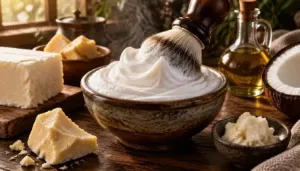
Start your label check with the fat or oil list, because it sets your lather quality. Stearic acid is the backbone of most shaving soaps. Whether it comes from tallow, palm, kokum or cocoa butter, it builds dense foam that lays flat and cushions the blade.
Pairing that stearic acid base with glycerin and plant fats like shea butter is what makes a soap feel slick, so this guide to what makes a good shaving soap shows how to judge the rest.
Next, look at the fatty acid profile. Saturated chains give foam its body, while unsaturated ones keep it pliable so it doesn’t collapse mid-shave. Tallow balances this well, and plant butters like shea and kokum come close. Tallow’s high oleic acid content also mirrors human sebum, so tallow-based soaps condition skin rather than stripping it.
Watch the coconut. Lauric acid rich oils lather fast, but they can dry your skin above roughly 30% of the fat base. Castor oil offsets that by adding creamy, stable bubbles. Aim for balance, not one hero.
Check Alkalis for Shaving Soap Texture
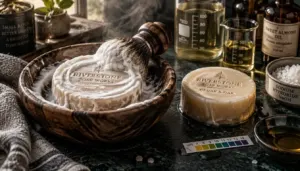
Fats set your lather, but the alkali decides how that lather behaves and how the bar holds up.
Look for sodium hydroxide, potassium hydroxide, or both. Sodium gives a firm, slow-dissolving bar with a slick lather, which suits pucks. Potassium dissolves quickly and feels softer, so it dominates creams. Many makers mix them, often 40% NaOH to 60% KOH, for hardness plus easy loading on the brush.
A cured pH of 9 to 10 is normal. Above 10.5, expect irritation and lather that collapses early, a sign of leftover lye or incomplete saponification.
Superfat matters too. Around 5% is standard. Past 8%, lather thins and the puck turns soft. Labels rarely list ratios, so treat these as clues, not guarantees.
Choose Moisturizing Ingredients for Better Razor Glide

Alkali builds the bar. Moisturizers decide how it feels on your face.
Glycerin comes first. It pulls water into the lather and adds slickness, and stearic acid formulas often need extra. Vegetable glycerin is the better pick. Check the label for these:
- Vegetable glycerin for slip and skin hydration
- Shea butter for a creamy, protective barrier
- Cetyl alcohol for a smooth, jojoba-like finish
- Kaolin or bentonite clay to keep lather on skin
- Goat or donkey milk proteins for added cushion
Coconut oil gives fast, fluffy lather and strong slickness, but it can dry your skin at high concentrations. Higher fat content usually means better razor glide. Ingredient order helps, but treat it as a clue, not proof. Water balance matters.
Assess Fragrances and Potential Skin Irritants

Moisturizers soften the shave, but fragrance can undo that comfort. Razor microtrauma lets scent chemicals reach deeper skin, and wet shavers carry nearly triple the fragrance allergy risk of dry shavers.
Know what each label name means:
| Label name | Why it matters |
|---|---|
| Linalool, citronellol, geraniol | EU-listed allergens, named individually |
| Sandalwood oil | Santalols can trigger delayed reactions |
| MCI and MI | Preservative allergens, separate from scent |
If you have sensitive skin or fragrance sensitivity, choose unscented soap. Artificial fragrances aren’t the only culprit, though. Natural sandalwood can cause allergic contact dermatitis too, and on deeper skin tones the dark marks can linger.
Patch test a soap on your jaw for 48 hours. Stop if you notice redness, itching, or lasting skin irritation.
Read Shaving Soap Labels Beyond Marketing Claims
How can you tell what’s actually in the tub? Start with the first three ingredients, since they reveal the fat base. Sodium Tallowate or Sodium Cocoate means true soap. Sodium Lauroyl Isethionate first? That’s a synthetic detergent bar, not soap.
Next, find the glycerin. Sitting third or fourth, it was probably added back. Not a flaw, just useful to know, and it hints at the moisturizing properties the maker intended.
Ignore the front panel. The FDA doesn’t define "natural," and "organic" needs USDA certification. "Clean" and "hypoallergenic" promise nothing about ingredient safety.
Marketing buzzwords like natural, clean, and hypoallergenic are empty promises, so trust the ingredient list instead of the label’s front
Read the tail of the list. Surfactants, preservatives, and fragrance sit there, and they’re the likeliest triggers of skin irritation. Labels can’t reveal everything, but they beat marketing.
Compare 6 Shaving Soaps and Creams’ Ingredients
Now you can put those label-reading skills to work on six real products. Each pick below gets a look at its key ingredients, so you can see which fats, alkalis, and additives it relies on. Use that to match a soap or cream to your skin and your brush.
1. Proraso Eucalyptus Menthol Shaving Soap
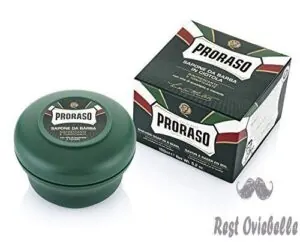
Want a shave that wakes you up? This soap delivers a cool, tingly menthol sensation from the first pass, thanks to eucalyptus oil and menthol.
It builds a thick lather that suits all beard types and gives your razor plenty of glide. Skin feels refreshed and moisturized afterward. Menthol can bother reactive skin, though, so patch test first.
You’ll need to build the lather by hand, unlike canned foam.
Weight: 5.2 oz (147 g). About 30 shaves. Price: EUR 9.12.
| Best For | Men who enjoy a traditional wet shave and want a cool, tingly menthol feel with a thick lather that works on any beard type. |
|---|---|
| Net Weight | 5.2 oz |
| Dimensions | 2.5 x 2.5 x 2.5 in |
| Model Number | 8004395001149 |
| Lather Quality | Thick lather |
| Scent | Eucalyptus and menthol |
| Shaving Method | Manual lather |
| Additional Features |
|
- Builds a thick lather that suits all beard types and gives the razor plenty of glide.
- Leaves skin feeling refreshed and moisturized, with a cool menthol tingle from eucalyptus oil and menthol.
- Lasts about thirty shaves per container at EUR 9.12.
- Requires making the lather by hand, unlike canned foam.
- Menthol can bother reactive skin, so a patch test is a good idea first.
- The tingly menthol sensation may not appeal to those who prefer a milder shave.
2. Gentleman Jon Sandalwood Shaving Soap Puck
Say you’re halfway through a shave and your razor starts to drag. Often that’s a lather that’s thinned out too fast, not a blade problem.
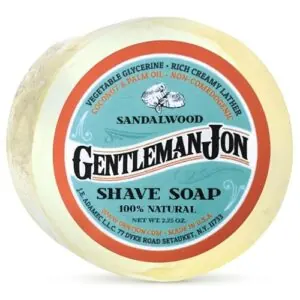
This sandalwood puck is built to help with that. It whips up a thick, creamy lather that cushions the razor and leaves a protective barrier on your skin. Whiskers soften, so you get a close, smooth pass with less irritation.
At 2.25 ounces, it’s compact. Brush or towel lathering only. No ingredient list was provided, so check the label if you’re sensitive.
| Best For | Wet shavers who use a brush or towel and want a sandalwood-scented soap that makes a thick, cushioning lather and helps cut down on razor irritation. |
|---|---|
| Net Weight | 2.25 oz |
| Dimensions | 2.24 x 2.2 x 0.79 in |
| Model Number | 638888628148 |
| Lather Quality | Thick, creamy lather |
| Scent | Sandalwood |
| Shaving Method | Wet shave, brush or towel |
| Additional Features |
|
- Makes a thick, creamy lather that cushions the razor
- Leaves a protective barrier on the skin and softens whiskers for a close, smooth shave
- Compact at 2.25 ounces, with hydrating, nourishing benefits that leave skin soft after use
- No ingredient list or allergy information is provided, so sensitive users should check the label
- Works only with manual wet shaving, using a brush or towel to build the lather
- No warranty or return policy details are included
3. Viking Revolution Shaving Soap Variety Pack
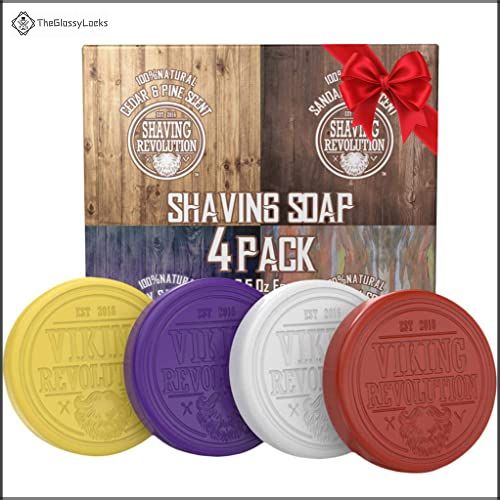
Say you’re a beginner who wants to try a puck without committing to one scent. This pack fits that. You get four 2.5 oz (70.9 g) pucks in Sandalwood, Cedar & Pine, Clary Sage, and Bay Rum.
It’s built for a brush and bowl, and it works with double-edged razors. The brand says it makes a rich, thick lather that stays moist and lasts over a year, though how long each puck lasts depends on how often you shave.
Buy a brush separately. Pucks come without one.
| Best For | Beginner wet shavers who want to try four different scents without committing to a single soap puck. |
|---|---|
| Net Weight | 4 x 2.5 oz |
| Dimensions | 5.24 x 5.16 x 0.87 in |
| Model Number | VRSS4PK |
| Lather Quality | Rich, thick lather |
| Scent | Sandalwood, Cedar & Pine, Clary Sage, Bay Rum |
| Shaving Method | Wet shave, brush and bowl |
| Additional Features |
|
- Includes four 2.5 oz (70.9 g) pucks in Sandalwood, Cedar & Pine, Clary Sage, and Bay Rum
- Makes a rich, thick lather that works well with double-edged razors
- Offers a budget-friendly way to get into manual wet shaving
- Requires buying a shaving brush and bowl separately
- Scents are marketed specifically for men
- How long each puck lasts depends on how often you shave
4. THEMANCODE Four Pack Shaving Soap
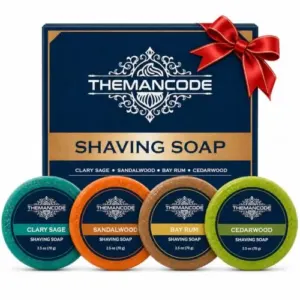
Want variety without buying four separate soaps? This pack gives you that.
You get four 2.5 oz pucks, 10 ounces total, in Clary Sage, Sandalwood, Bay Rum, and Cedarwood. Each is formulated with glycerin, which helps soften coarse hair and cushion the lather. Expect a creamy build and less razor drag. Works for daily shaves, beard line cleanup, or pre-work routines.
One caveat: it’s made for wet shaving. You’ll need water and a brush or cloth. Razor compatibility isn’t specified.
| Best For | Men who enjoy a traditional wet shaving routine and want to try four different scents without buying separate soaps. |
|---|---|
| Net Weight | 4 x 2.5 oz (10 oz) |
| Dimensions | 5.79 x 5.75 x 0.75 in |
| Model Number | N/A |
| Lather Quality | Rich, creamy lather |
| Scent | Clary Sage, Sandalwood, Bay Rum, Cedarwood |
| Shaving Method | Wet shave, brush or cloth |
| Additional Features |
|
- Includes four 2.5 oz pucks (10 oz total) in Clary Sage, Sandalwood, Bay Rum, and Cedarwood.
- Glycerin formula helps soften coarse facial hair and build a creamy, cushioning lather.
- Helps the razor glide with less tugging and drag, and works well as a gift.
- Made only for wet shaving, so you need water and a brush or cloth.
- Razor compatibility is not specified.
- Comes as a fixed set of four scents, so you can’t choose just one.
5. Taylor Sandalwood Shaving Cream Bowl
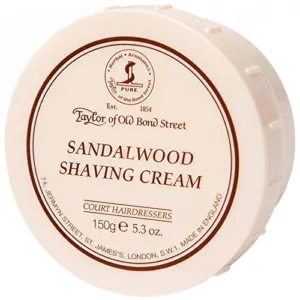
Sandalwood doesn’t have to mean a fussy routine. This 5.3-ounce (150 g) cup, model AD1564, comes in a resealable bowl and works best with a brush, so plan on loading it for a thick, silky lather. Coconut fatty acid and glycerin do the heavy lifting: foam and glide.
Check the scent, though. The delicate sandalwood fragrance includes linalool and coumarin, common allergens. Patch test first if your skin reacts easily. Reviewers say a cup lasts several months. Good value overall.
| Best For | Wet shavers who already use a brush and want a thick, silky lather with a delicate sandalwood scent. |
|---|---|
| Net Weight | 5.3 oz |
| Dimensions | 8 x 8 x 6 units |
| Model Number | AD1564 |
| Lather Quality | Thick, silky lather |
| Scent | Delicate sandalwood |
| Shaving Method | Wet shave, brush |
| Additional Features |
|
- Produces a thick, silky lather for close, smooth shaves
- Comes in a resealable bowl and lasts several months per cup
- Made with coconut fatty acid and glycerin for good foam and glide
- Requires a shaving brush for best performance
- Contains common allergens such as linalool and coumarin
- Sandalwood fragrance may not suit people who prefer unscented products
6. Proraso Sandalwood Shea Shaving Soap
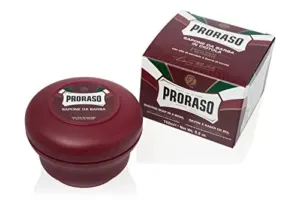
Prefer sandalwood paired with a richer base? This 5.2-ounce soap, model 400116, pairs sandalwood oil with shea butter, so you get conditioning along with the scent.
Wet your brush, work it over the soap, and build the lather in a bowl or on your face. It forms a thick, protective layer that softens coarse beards and helps your razor glide, which means fewer nicks and less razor burn.
Remember: it needs a brush and a damp face. No brush, no lather.
| Best For | Men with coarse or thick beards who already use a shaving brush and want a rich, sandalwood-scented lather that conditions the skin. |
|---|---|
| Net Weight | 5.2 oz |
| Dimensions | 3.54 x 3.54 x 1.97 in |
| Model Number | 400116 |
| Lather Quality | Thick protective lather |
| Scent | Sandalwood |
| Shaving Method | Wet shave, brush on damp face |
| Additional Features |
|
- Contains sandalwood oil and shea butter for a conditioning scent and feel
- Forms a thick, protective lather that softens coarse beards
- Improves razor glide, which helps reduce nicks and razor burn
- Requires a shaving brush to build lather
- Must be applied to a damp face
- Works only for wet shaving
Frequently Asked Questions (FAQs)
How do you get the thickest lather from shaving soap bar?
Start with a tallow-based soap, then load your brush firmly for a full 30 to 60 seconds. Use a damp, not soaking, brush, and add water in small drops while you build. Cured bars lather densest.
Does hard water affect shaving soap lather?
Yes, it does. Calcium and magnesium bind to soap, forming scum before foam can build. You’ll see thin, grainy lather that collapses fast. Load the puck longer, and test with distilled water.
What type of brush works best with shaving soap?
You can spend forty dollars on a badger brush and still fight your puck. Boar bristles work best for hard soaps, since their stiffness breaks down dense surfaces. Synthetics are the safer all-rounder. They need no break-in.
How should shaving soap be stored between uses?
Let your shaving soap dry completely after each shave. Keep it in an open, ventilated spot away from heat, sunlight, and steamy showers. Damp, sealed storage softens the surface and shortens its life.
Can shaving soap be used for head shaving?
Yes, and it often works better than canned foam. Load your brush for 30 to 40 seconds, since a scalp needs far more lather than a face. Aim for dense, water-rich lather that cushions the blade.
How do I make my own shave soap?
Say you want a 100-gram puck. Melt stearic acid, shea butter, coconut oil and a little castor oil, then add lye water at about 90°F. Cook it, mold it, and aim for a 5% superfat.
Conclusion
Why trust a label’s mood words when the real answer sits in the ingredient list? Knowing what ingredients to look for in shaving soap turns a guessing game into a quick check. Scan for stearic and palmitic fats, a balanced alkali, and a glycerin or shea buffer. Then flag fragrance, especially if you wet shave daily.
Patch test anything new. Your skin answers quickly, and a good soap earns its place in your daily routine.